
| ||||||||||||||||||||
| ||||||||||||||||||||


It has been noted elsewhere that critics and scholars writing on Altman faced the particular challenge that his body of work, more than most, resists interpretation and being narrowed down to a single formula or a single set of meanings. It was marked by a consistently open approach to risk taking.
When the dust settled on the turmoil of the late 60s-early 70s something called the New Hollywood began to emerge. The studio moguls and the Fordist production line division of labour had gone and multinational corporations were taking over the business, authority in the main being shared between what Coppola referred to as “people who had no right to be running the studios” which survived only in name. By right Coppola believed it was the creators of the art, the auteur directors, who should be in control and he was already working on a strategy to realise this.
Success at the box office 1972-5 (see the entry on Coppola in this series) looked as though what David Cook terms the “Auteurs Manqué and Maudit” might prevail. Mediating aesthetically and culturally between the generations were Penn, Kubrick, Peckinpah and Altman who, all except Kubrick, received their basic training in television. The other auteur strand was the “film school” generation of Coppola, Lucas, Scorsese, Spielberg, and De Palma who as a group were “attempting to parlay the creative freedom of the late sixties and early 1970s into auteurist careers.” While attempting to do this collectively, the two groups produced a number of remarkable path-breaking films, some crucially meeting unprecedented box office success.
They also shared with the French ‘nouvelle vague’ directors a sense that this was “their time in history” and the belief that only talent and will was needed for success (Cook 98)
In between was what Cook refers to as the Easy Rider “youth cult” bubble given body by the rapidly expanding 16-30 audience demographic, encouraging the employment of relatively untested directors such as Mike Nichols, Peter Bogdanovich, William Friedkin, Bob Rafelson, Hal Ashby, and Alan Pakula. It was an environment in which originals like John Cassavetes and Terrence Malick also had an opportunity to prosper (ibid 99).
 |
| Lily Tomlin, Keith Carradine, Nashville |
In surveying the seventies, Richard Corliss in ‘Film Comment’ (16/1 1980) noted that “if a Zeitgeist director is a person who expresses the best and the most of his time, then Altman is the director of the Seventies as surely as Jean-Luc Godard was the director of the Sixties. Whereas Godard gives lectures, Altman throws parties. Most of his movies don’t need to be solved, but to be experienced. His radicalism is sneaky; he’s a social critic, not a political dogmatist (though sometimes, as in Nashville and A Wedding, he is a social dogmatist)…. He makes his viewers discover what’s important by themselves - gives them hats, horns, and a sense of participation. He treats his actors in the same way, making them co-conspirators in the creative process… The one similarity between them,” Corliss concludes, “is that they both worked their butts off (Godard sixteen films in the Sixties, Altman fourteen in the Seventies.”
Kubrick in his ‘one-offs’, took control of the (modernist) artist’s prerogative to activate ambiguity leaving ‘excessive’ scope for the viewer/reader’s imagination.
 |
| A Wedding |
This he did by extended contemplation requiring multiple retakes notoriously as much as 40-50 times in order to ‘decide what he wanted,’ Rosenbaum suggests (see Part 6 (4) on Kubrick). Kubrick and Altman both developed the use of the zoom lens during the 1970s. Cook comments that Altman’s use was “essentially non-demonstrative, sometime even subliminal, approximating the mental processes of the viewer…refocussing on significant details in a seemingly arbitrary field…ideally suited to his sense of American social reality as both ambiguous and random” (363). In comparison Kubrick’s resort to the zoom was ‘more restrained and magisterial’ but no less decisive in terms of aesthetic design. His DP on Barry Lyndon, John Allcott, told Michel Ciment that Kubrick “used the zoom integrally throughout and not simply to speed-up production…Each time, it became an image in itself, and not , as is usually the case, [for] moving from one point to the other.”
*************************
Previous entries in this series can be found if you click the following links
Notes on canons, methods, national cinemas and more
Part Two - Defining Art Cinema
Part Three - From Classicism to Modernism
Part Four - Authorship and Narrative
Part Six (1) - The Sixties, the United States and Orson Welles
Part Six (2) - Hitchcock, Romero and Art Horror
Part Six (3) - New York Film-makers - Elia Kazan & Shirley Clarke
Part Six (4) - New York Film-makers - Stanley Kubrick Creator of Forms
Part Six (5) ‘New Hollywood’ (1) - Arthur Penn, Warren Beatty, Pauline Kael and BONNIE AND CLYDE
Part Six (6) Francis Ford Coppola: Standing at the crossroads of art and industry
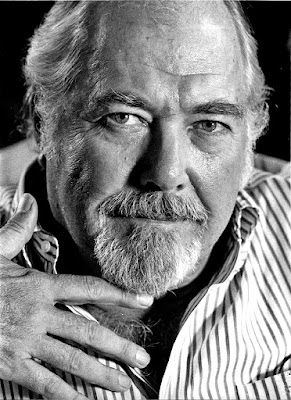 |
| Robert Altman (1983) |
*********************************************
The legend has you as “Hollywood maverick Robert Altman” or “Hollywood outsider Robert Altman”. Given how widely revered you are by people inside the industry, do you see yourself that way?
I don’t… No, not really. I go on from one project to another. I’m never sitting there and waiting and stopping and thinking about these things. I’m working on two projects right now that are going to go – both of ’em – in the next six months. And I don’t think about anything else. When Prairie came out in America – and we did real well with that – I think it grossed somewhere over $20 million. And I was just thrilled by that. Other pictures I’ve made… I’ve just read something about Prèt-à-Porter that said it was one of the worst pictures ever made. That makes me feel bad, but what makes me feel good is that I did those pictures.
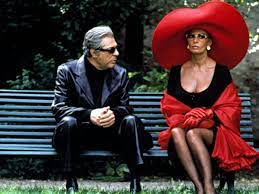 |
| Marcello Mastroianni, Sophia Loren, Prèt-à-Porter |
I read an interview recently where you said that you’re “scared shitless” about bad reviews. I guess I understand that, but isn’t it also true that reviews will tell you more about who’s writing them?
I’m not “scared shitless” about bad reviews. I hate ’em. I get my share of them but it doesn’t really change anything.
You’ve done a lot of work as a producer on films directed by other people, especially Alan Rudolph. What’s been the nature of your involvement, say, on Rudolph’s films?
None. I might go visit the set once. But I won’t have any artistic input into it. I don’t talk to him about it. It’s his picture and all I want to do is enable him to do it.
You said that you’re working on two projects at the moment. I understand that one of them is Hands on a Hard Body. Are you able to say anything about that at this stage?
Well, I’m hoping to be shooting this very soon.
Have you put a cast together yet?
Well, it’s a big cast. A lot of people. I don’t want to say who they are at the moment. They’re gonna have to be available at the time I’m making the picture. So somebody will say, ‘Yeah, I want to be in it.’ And then they’re not available because I can’t be flexible.
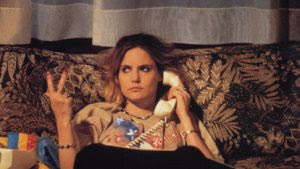 |
| Jennifer Jason Leigh, Short Cuts |
Geraldine Pieroni, editor on Short Cuts, says on the feature on the DVD release (Luck, Trust & Ketchup), that you have “a dark view of the world”? Is that how you see it?
I don’t think so. I don’t know what my view of the world is, but I don’t think it’s dark. If you ask me, it’s probably her view. She committed suicide a year ago.
Oh, I’m sorry to hear that. I didn’t know.
Do you see any difference then, between the Hollywood you depict in The Player, and by implication maybe in films such as Nashville, and the world of politics which you present in the ‘Tanner’ series?
Well, aren’t they all the same? Isn’t it all our struggles, our positioning? Where do I sit in the room?
I guess, but it seems much more public and exposed when it’s Hollywood and when it’s politics.
That’s because so many people write about it. It’s so public, with publicists calling up and giving stories to the press all the time.
Do you ever feel when you’re making a film that it’s your version of “payback time”?
[Chuckles] I don’t know what you mean by that.
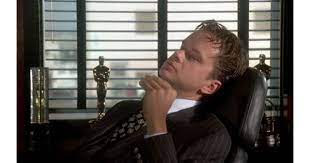 |
| Tim Robbins, The Player |
Well, it has been said, for example, that The Player was your way of laying Hollywood bare, of actually exposing the process.
That was such a soft-gloved treatment of Hollywood that it verges on the supernatural. It was really, really kid-gloved. They were treated very well, the community.
As a community perhaps, but there are individual characters in The Player who are shown to be corrupt and totally compromised.
Oh, you bet. And there’s more of them at that level of business… Anyway, it’s rampant. People play and pay for that publicity. “I don’t care what you say about me, just spell my name right.” It’s all so silly.
In Short Cuts, Marian (Julianne Moore) talks about her art and about “seeing and the responsibility that comes with it”. Separating the line from the character’s pretensions for a moment, what do you see as the responsibility that comes with “seeing”?
That comes with what?
That comes with “seeing”.
The responsibility that comes with seeing?
Yes.
With sight?
Yes, with the seeing that’s part of the understanding and insight of being an artist and the responsibility that arguably comes attached to that.
I don’t know. Is that something that her character says?
It is.
Well, it’s probably something that she created, that character. And that character was pretty silly.
I’m just looking at that in relation to your work and what you see as your responsibilities as an artist.
Well, my responsibilities are to myself and to whatever it is that I do. I’m showing the films as my view, my truth about something, whether I use a degree of exaggeration… So it’s to myself. Ultimately other people decide. If nobody likes it, I’ll become extinct, quickly. But if a few people like it… and pay attention to it…
As you’ve probably gathered, I could talk forever about which of your films are most important to me, and which bits of those films. But I have to ask which of them are now most important to you?
Well, Tom, do you have any children?
Yes.
Which one is most important to you?
I can answer that ’cause I’ve only got one.
Oh, well. You can, but I can’t because I’ve got about 40. And they’re really all important to me for different reasons. None of the reasons has anything to do with their success or failure, the perception of that. But they all have their own fingerprints… The bad ones did such silly things that they became good, although there are a lot of silly things that didn’t work. But basically who cares? If everything is praised as a hit, the artist is in serious trouble. And I try to stay out of trouble.
Will you forgive me if I don’t believe you?
[Laughs] Yeah, I’ll forgive you for that.
What do you do to get away from it all?
I spend all my time trying to get in it all. I don’t want to get away from it.
Do you read a lot?
Not so much any more.
Well, what about your musical tastes?
My musical tastes are very eclectic.
Are you a fan of country music?
I like country music.
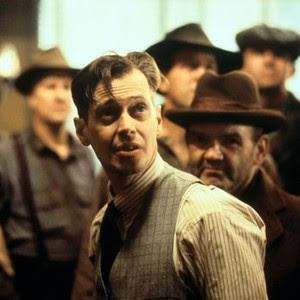 |
| Steve Buscemi, Kansas City |
And your liking for jazz seems to be very clear from films like Kansas City. I presume your upbringing in Kansas imbedded that in you?
My upbringing in Missouri? We have great local pride in being from Missouri. During the Civil War, Missouri sold supplies to both sides… [chuckling]
It’s interesting that you said you’re a fan of country music, because I get a sense from both Nashville and A Prairie Home Companion that you’re more ambivalent about it than that.
I don’t know. How do you mean “ambivalent”?
My taste for it? Is that what you mean?
… the tacky emotional side of country music. For example the song that Meryl Streep and Lily Tomlin sing about their mother is both affecting and awfully sentimental. The worst kind of country music, I would have thought.
That’s a statement in itself. I would say that this is one of my top country songs. I mean, it’s like in Nashville: “For the Sake of the Children” and some of those songs are outrageous.
Yes.
And they’re supposed to be. I mean, they are what they are. I’m not trying to say that this is great music, although in some cases it is.
A song that I personally responded to in Nashville is “I’m Easy”, the Keith Carradine one, which comes immediately to mind whenever I think of Nashville. Which he wrote himself…
He did. In fact, he wrote it for another picture. But they didn’t use it… a picture about a train [n.b. this was probably Robert Aldrich’s Emperor of the North Pole, made a couple of years before Nashville, TR].
I understand there was to be a sequel to Short Cuts?
Oh, there’s always… There was to be a sequel to Nashville. Those things are always thought of, but they’re always bad ideas.
When a thing is done it should have its own time and it shouldn’t be…
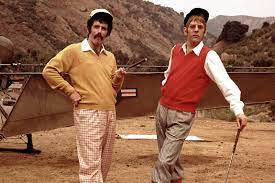 |
| Elliott Gould Donald Sutherland, M*A*S*H* |
I ask you with some trepidation, but how did you feel about the television series of M*A*S*H* then?
I despised it. The fact of making it a series! And the enemy was the Asian family guy and everybody else were the good guys! And what they said, the platitudes they delivered in their American war speeches! When we made M*A*S*H*, there was a point to it. I was more upset then than I am now.
Not much.
Well, Anderson of course. He’s in the middle of doing a film right now. I don’t talk to him when he’s shooting, but it sounds to me like it’s pretty good.
Well, I’m a big Alan Rudolph fan. I guess he’s not a young filmmaker.
No, but he, like you, qualifies as a contemporary filmmaker because he’s still working. Although he hasn’t made films for a while.
No, he hasn’t. He’s had a hard time because the kind of films he makes aren’t the kind of films they buy now.
Have you seen or do you know of the film Jindabyne?
No, I don’t.
It’s an Australian adaptation of the Raymond Carver story, ‘So Much Water So Close To Home’.
Oh, I remember we had to give them the rights for that. What did they call it?
It’s called Jindabyne, which is the name of a township near a snowfield resort.
Have you seen the film?
Yes, I have.
Is it good?
I think it’s very good and I think it does what seems to me to be there in the Carver story, that is tell us more between the lines than with the lines.
Well, that’s good to hear.
It stars Gabriel Byrne and Laura Linney.
I’ll see it.
I’m sure it’ll finish up in New York at some point.
One more question. Do you plan to continue working in the theatre whenever you have the opportunity?
Sure, whenever it occurs to me. I love it.
When you are working in the theatre, do you take the same kind of approach with actors and collaborations and free movement that you do in your films?
Well, it’s a little more… The frame is a little tighter in the theatre and opera. The opera I love.
Yes. I understand you did an opera version of The Wedding.
Yeah, it was terrific.
It’ll show up in the next three or four years in one of these… There’s a lot of people in it, which is what makes it difficult.
Well I’d certainly love to see it and I’m very much looking forward to your future projects.
Well… if you get to see them.
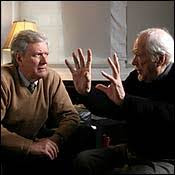 |
| Michael Murphy being directed by Robert Altman Tanner 88 |
Well, it’s just a way of presenting what you’ve done. There’s nothing wrong with television other than its content. I don’t care whether it’s on television, or underwater, or on a screen. How you transmit it to people doesn’t really matter.
Are you able to work with the same kind of freedom when you’re making something like Tanner as you clearly do with your films?
Oh, absolutely. I had a great collaborator in Garry Trudeau. He was doing the writing and we worked as partners on that. And he was great to work with. We had a wonderful time doing that. But when I’m making a film I don’t have a partner.
But you actually like that kind of collaboration with a writer?
Oh, sure. Absolutely. Somebody has to be the one who turns the switch on and turns it off.
To go back to how you actually came to be a film director: who were your inspirations when you were going to the movies as a young man?
Fellini, the Europeans, Bergman. You know, the usual group were the films that I saw and that attracted me. I wasn’t high on American films.
Looking back, at what point did you first feel like there was some correlation between you and the role that put you in the director’s chair? When did you actually feel that this was your life’s profession?
The first time I did it. I liked it.
Can you recall what led you to the parts of the style that makes your films so distinctive: the ensemble casts, the crisscrossing narratives, the overlapping dialogue, the restless, zooming camera?
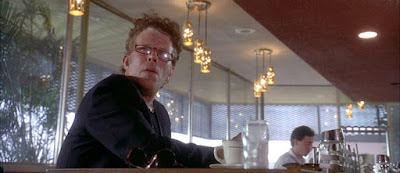 |
| Tom Waits, Short Cuts |
Well, it grew. One thing came out of another. That’s just what I was doing. I was always attracted to the multiple story thing. M*A*S*H* was a series of events, and certainly Short Cuts was. With Nashville we were really just showing off the arena rather than any individual story in it. And I just had fun doing that. I liked that kind of storytelling.
What of the overlapping dialogue, the decision to have characters talking over each other?
But I didn’t invent that. If you look at the films that Howard Hawks made in the ’30s, they were all just that way. The reason they didn’t have that generally is that most of that stuff comes from the theatre and in theatre you don’t have people talking at the same time because the audience couldn’t hear ’em.
How do the writers feel about whatever dialogue is there not being buried so much as being difficult to get at?
I don’t know. I don’t have any idea.I guess they’d need to speak for themselves.
What is it about the zoom that you like so much?
Well, it just lets me change my focus. It’s just a device to help the audience into the scene.
As I watch the films one of the things that strikes me is that it simultaneously gets you close, yet forces you to remain at a distance?
Well, OK. That’s valid.
I’m wondering here about your relationship to the characters in the arena that you’re presenting, the degree to which you empathise with them.
Well that depends on which character it is.
 |
| Warren Beatty, Julie Christie, McCabe and Mrs Miller |
Well, let’s go back to the ’70s and look at McCabe.
I certainly empathise with McCabe. I cry for McCabe.
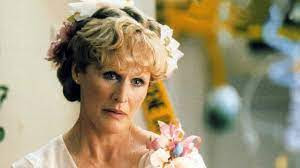
What about one that I can’t find any sympathy for and that’s the Glenn Close character in Cookie’s Fortune?
Oh, I had a lot of… Well, you’re right. She was quite a ditz, wasn’t she? But that was just that character.
Yes, but you created that character.
No, Anne Rapp created that character. She wrote that character and then Glenn Close created that character. I just… It was brought to me. It walked in on to the set and that was it. We just played the thing out. She did that. That’s her soul in there.
 |
| Glenn Close, Cookie's Fortune |
To go back for a moment to the question of your visual style: one of the things that struck me watching Prairie the other day is that you never have a still shot. Why?
Well, I don’t think that’s quite true, but if I don’t it’s because I have no reason to. Maybe I have a reason… Something happens in a certain space and the camera records that. How it records it, in close-ups or long shots or moving shots: that’s brush strokes. And there’s no right way or wrong way. There’s just a way. It’s one’s way and I do what I do because it amuses me. I like it. I like presenting the material my way.
To what extent are the visual compositions of your films blocked out before you start shooting?
About one per cent. It’s usually the space and the action that determine what the shot is.
And you decide that as you shoot it?
Yes, almost always. Sometimes we’re going one way and then we decide it’s more interesting to go another way.
It doesn’t matter who your cinematographers are, and you’ve worked with many, your films all look like Robert Altman films. What kinds of qualities do the cinematographers need to exhibit for you to want to work with them? Is there anything in particular about their previous work that makes you want to work with them?
Oh certainly, in all cases.
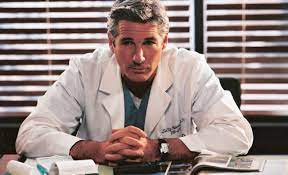
Say with Ed Lachman, who shot A Prairie Home Companion?
 |
| Richard Gere, Dr T and the Women |
Well, Ed also shot the last part of Dr. T and The Women. He shot all the stuff up in the desert. I was just so impressed. My son, who’s a camera operator, had worked with him and recommended him. Ed was just terrific.
What kinds of discussions do you have with cinematographers beforehand?
Ah, not much. We kind of ramble a little bit about how it should look and it shouldn’t look. It just sort of… happens. There’s not a lot of discussion.
Do they ever argue with you about how to go about shooting a particular sequence?
Yes. It’s happened.
And this is part of the collaboration aspect that you like so much?
Yeah. But I always win those arguments.
You have a wicked sense of humour, Mr. Altman.
[Chuckles] It’s easy to be wicked, I think.
What are your rules for collaboration with writers? Or is it different every time?
It’s like all things: it’s different every time, but it’s always the same.
The freedom you give your actors to improvise, to make their own contributions has become legendary. Years ago someone described a Robert Altman set (I think he was talking about Brewster McLoud) as an “improvisational encounter group”. Is that fair?
[Laughs] All’s fair. It’s an exaggeration, of course. But if that’s the way it impresses somebody then that’s fine with me because that’s what I’m trying to transmit.
In such a working environment, though, do you ever worry about losing control?
Well, I’d worry if I had control. You know, I have to follow what’s happening, that animal that’s in front of me. I have to… He grows on his own, grows his own teeth, and he’s prowling around there and I have to film him, not make him fit my lens.
So you’re happy with that.
Sure. That’s what I do. I don’t say that’s what everybody should do.
In the light of that, it’s interesting that your filmsare often about characters who think they’re in control but who are, sometimes without ever knowing it, up against forces they never fully comprehend.
Welcome to life.
 |
| Sterling Hayden, Elliott Gould, The Long Goodbye |
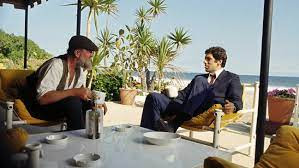
This side of it… there’s a sense in which your characters always experience a problem of seeing. I’m thinking of someone like McCabe, or Dr. T, or Elliot Gould’s Philip Marlowe, who have this vision of themselves but who understand very little. This seems to me to be the central theme in your career. Do you see it that way?
Well, I think that more people are alike than not. To some degree, we all are much more than we think we are. And, you know… we try to posture ourselves and fit ourselves into something grander. But we’re not that at all. And that’s what most of these characters, who lead us through whatever the madness is, are showing us.
Have you ever given or did you ever want to give credit to Alan Smithee?
No.
Is this because of the control you’re able to exercise, having final cut and so on?
Well, yeah. I think. I don’t know what other people do really. I do what I do and just assume that everybody does basically the same kind of thing.
************
Editor's Note: This is the second of a three part interview recorded by Tom Ryan with Robert Altman The first part can be found if you click here. Previous posts in this series can be found if you click on the names Hanif Kureishi & Roger Michell Ken Loach Pt 1 Ken Loach Pt2 Colin Firth (Part One) Colin Firth (Part Two) Lawrence Kasdan (Part One), Lawrence Kasdan (Part Two) Costa-Gavras Jonathan Demme (Part One) Jonathan Demme (Part Two) Click on the names to read the earlier pieces.

