Monday, 20 April 2026

The Current Cinema - another new Australian movie that might fall through the cracks - ALPHABET LANE (James Litchfield. Australia, 2025)

Anna (Tilda Cobham-Hervey), Alphabet Lane 

I'm warning you. Pay attention. Remember the first line of Alphabet Lane. Think about the last. It takes less than  an hour and a half to get from one to the other.

Dont think about the title. Unless I missed it, there's not even a road sign to indicate what it means. 

Alphabet Lane is set in the Monaro. High up. A young couple have left the big smoke for a quieter life, which proves to be a duller life. She's a doctor who works nights at the local hospital. He works on the Snowy Hydro. They start telling stories to each other to brighten up their humdrum existence. They invent things about their neighbours, indeed invent neighbours.

But you'll be asking questions. Why do the couple park their cars a hundred metres apart ...Why didn't Michelle just get in her car and drive away...and why dont they put stamps on the letters. Such mysteries... 

You might, if you wanted to be critical, ponder just what a master like Claude Chabrol might have made of this material. The Chabrol of the 60s and 70s, of La Femme Infidele and Juste Avant La Nuit might have produced a much more beefier movie, something with some serious consequences for role playing and games, something with some eros and more danger to make the stakes higher. But Chabrol had made maybe twenty movies before then and on more than a few was just marking time or perfecting his craft as they say. Nobody in Australia ever gets to have those options unless doing tv soaps counts.

Two starting points. Alphabet Lane and Le Beau Serge. Does James Litchfield have a career stretching out before him making interior melodramas and mysteries about the wayward middle classes. If his career trajectory is like everyone else in Australia we'll likely at best get a second look in about three or four or five years. Not at all satisfactory for someone who just might offer something a lot more thoughtful and subtle than the squalid horror derivatives that seem to be the lot of our commercial film-making.


Sunday, 12 April 2026

Streaming on Netflix - Rod Bishop recommends - DETECTIVE HOLE aka Jo Nesbø’s Detective Hole (Jo Nesbø, Norway, 2026)


Any Norwegian serial killer, police-procedural that uses the German philosopher Martin Heidegger as a running joke, has got to be worth a look.

Tobias Santelmann plays Detective Harry Hole (pronounced Hurl-ah) as a self-loathing, destructive introvert, almost completely lacking in social skills and occasionally suicidal. An alcoholic with a taste for prescription meds, he’s brilliant with forensics and highly skilled at serial killer profiling. It’s the booze that keeps getting him into trouble, causing an on-and-off relationship with his current partner Rakel (Pia Tjelta). It also means he’s constantly in danger of suspension from the police force.

He gradually bonds with Rakel’s 14-year-old son Oleg (Maxime Baune Bochud) and scores big time with the teen by introducing him to the Ramones. Despite the threats of suspension, Harry’s serial killer expertise means the Oslo cops can’t do without him.

Tobias Santelmann as Jo Nesbø’s troubled cop in Detective Hole

His adversary is Tom Waaler (Joel Kinnerman), a seriously corrupt, narcissistic police colleague with a sociopathic idea of social justice. Tom also blames Harry for being drunk and killing Tom’s friend (possibly his lover) in a police car chase. Forced to work together, Tom and Harry have nothing but contempt and suspicion for each other. All this - and more - is revealed in the first episode. Another eight follow. 

Adapted for television by Jo Nesbø from his fifth Detective Hole novel (The Devil’s Star), Nick Cave and Warren Ellis add a brooding original score to the copious collection of songs. The ‘needle drops’ include Iggy Pop, Ramones, Los Lobos, Sex Pistols, Warren Zevon, Donovan, The Doors, Slayer, PJ Harvey, Leonard Cohen, The Falls, Muddy Waters, Elvis Costello, Otis Brown, Tammy Wynette and others.

Jo Nesbø 

At times graphically violent, this crime thriller is set in an often gritty and grimy Oslo. Although many of the tropes are familiar, the psychological character studies are interestingly heightened, and Nesbø has loaded the series with enough Nordic pickled herring plot twists to keep most viewers guessing and absorbed. 

Thursday, 9 April 2026

On Criterion 4K UHD and 2K Blu-ray - David Hare discovers "A perfect rescue of a perfect movie" - TROUBLE IN PARADISE (Ernst Lubitsch, USA, 1932)

 Criterion's new 4K disc of Trouble in Paradise is a giant step up from the screening of a "new" restoration from Universal which I saw back in 2017 at Bologna. It was good, certainly better than the older UK and US Blu-ray discs. But it had quite a few work-in-progress problems. All the opticals - and they are very many - tanked the grain and density. The new print (I recall it was screened on 35) had tramline emulsion scratches through 80% of the picture, and there were sundry other problems. But it was good enough to bring the very youthful house that day to its feet in what must have been for them the first discovery of a total, seamless masterpiece, a perfect movie, and for me, a joyous reunion after first seeing it in a lovely 16mm print at the Trinity Church Wall Street Sunday cine club Screening Nites way WAY back in December 1971.


When Criterion announced this I wondered how much further they might go with restoration. In the interim Universal did a superb 4K restoration of Leisen's 1939
Midnight (another perfect Paramount 30s film) which played to a knocked out full house at Sydney Cinema Reborn back in 2023. That superb 4K was curated from a previously wrongly identified dupe nitrate safety fine grain and other elements which had been lying around mislabelled as safety 35 copies at the Library of Congress until Universal dug it out and discovered to their surprise near-pristine material.
Unfortunately Criterion released a Blu-ray of Midnight only back last year which was hugely underwhelming displaying massive grain reduction to near zero grain, lowered black shadow detail, softer edges and overall a really shitty encode. I had hoped Criterion would release Midnight as a 4K but given such a mediocre master like this what was the point. Maybe someday another label will risk the budget and coax a reliable 4K master for disc encoding out of Universal.
The story for Trouble in Paradise is the total reverse of Midnight. Universal appears to have gone full hog on this and Criterion has stepped up to what looks like a perfect 4K encode with a flawless 4K disc AND Bluray/2K disc. Everything sings. It's unbelievable, especially for a pre-1935 slower-speed-neg-film and faster lenses era.
The softness now is totally supported without a hiccup through the grain which while always visible is a part of the images' "lifeblood." One of the biggest surprises is not a whisper of density bumps in the opticals all of which flow seamlessly. Grayscale is total, whites and deep black perfect, silver and reflective jewellery and glass shimmer with nitrate sparkle.
A perfect rescue of a perfect movie. Essential to life.

Monday, 6 April 2026

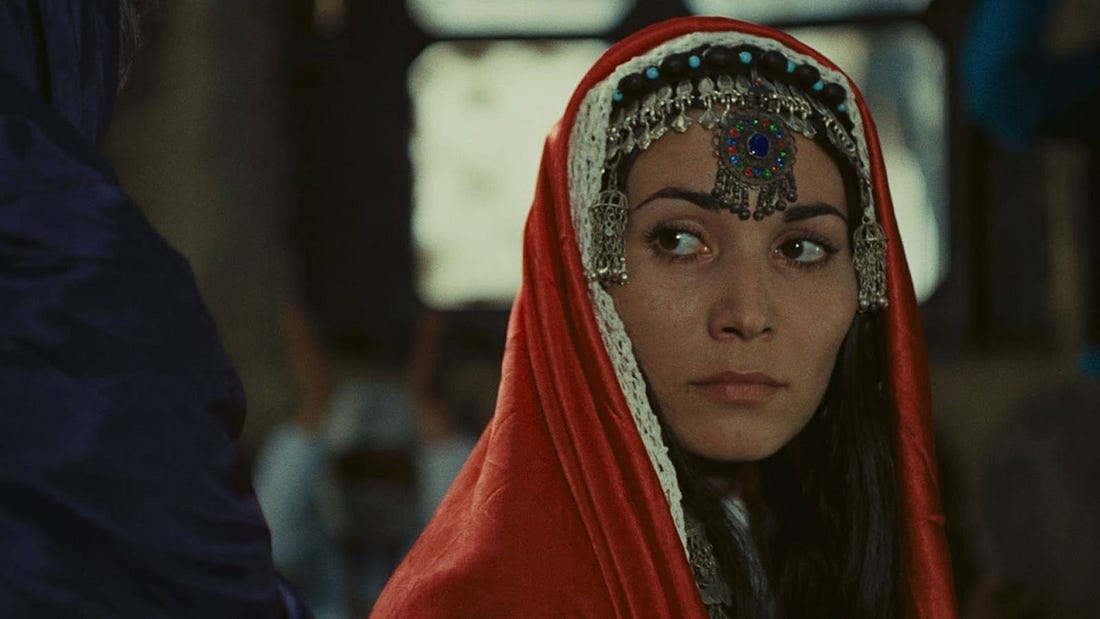
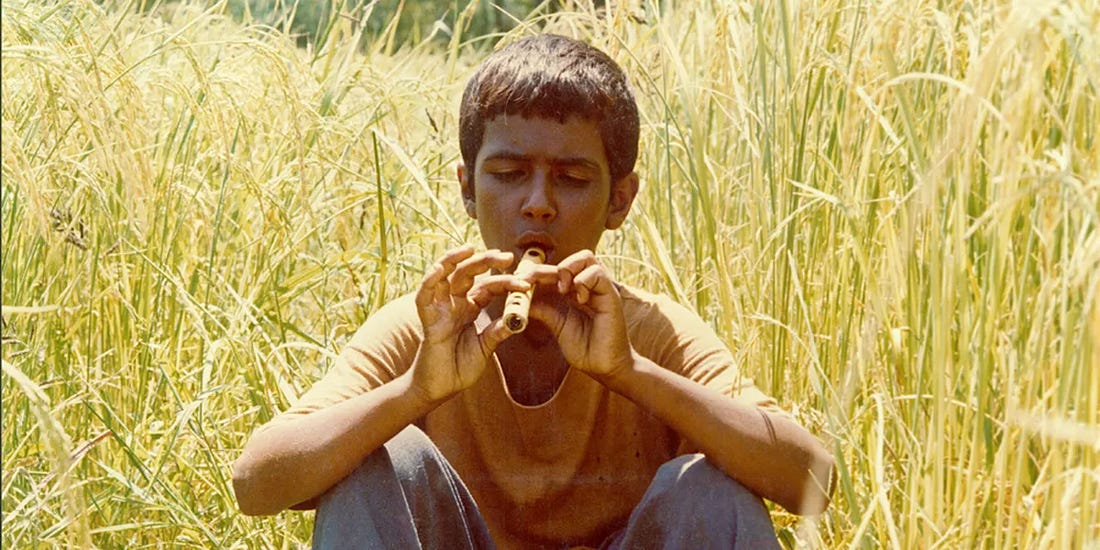
CINEMA REBORN and PERSIAN FILM FESTIVAL AUSTRALIA Present Tributes to Bahram Beyzaie Iranian Filmmaker (1938-2025)


Thursday, 2 April 2026

On Blu-ray - David Hare finally comes round to appreciating TEA AND SYMPATHY (Vincente Minnelli, USA, 1956)

Below are four screen shots from the sublime "Shadowy glade" climax of Minnelli's 1956 adaptation of the Robert Anderson play, Tea and Sympathy. It's both this sequence and the extraordinary colour photography by John Alton, one of several pictures he shot for Vincente Minnelli during the fifties, that finally won me over, especially in this new 4K scan and Blu-ray from Warner Archive.


In fact it's taken me literally sixty years to finally come around to any sort of appreciation for the movie, so long has it has been a subject of disdain for me, perhaps thanks to skewed perspective.
Alton's single light source setups and Minnelli's Scope staging emphasize shadow, background and peripheral enclosure as much as they do the players. In this sequence it finally dawned on me that the subject of the movie is not only, as I always persisted in thinking, John Kerr's character Tom's "closeting and/or guilt resulting from the social constrictions of 50's America. In fact the substantially larger and ultimately more tragic core of the drama is Deborah Kerr's superb Laura, clad throughout the picture in shades of burnt orange, ginger and rustic warmth, a futile beacon of affirmative life against the grey and white suburban drudgery and conformity of 50s bourgeois America. Indeed the colour play in these Minnelli melodramas is easily the equal of Sirk's at Universal, although Sirk often extends the colour play to sets, decor and staging with coloured lights much as post expressionist painting.
If there's a real cry for acknowledgment and passion from a stranded soul buried in the daily inertia of suburban college town 50's America, it's not only John Kerr's Tom, with his affection for the classics and the piano and the light touch of his loafers. But also from the figure of Laura, left unsatisfied at the end. This penultimate sequence really delivers what must have been profoundly personal material for Minnelli himself, given his own bi- (or more majorly gay) sexuality and the trajectory of his professional life before and after Garland.
The new Warner Archive derived from a 4K scan and regrade is predictably a thing of staggering Eastman (via proprietorial "Metrocolor") beauty.

Wednesday, 1 April 2026

CINEMA REBORN – CLASSIC ASIAN FILM-MAKING - PEKING OPERA BLUES (Tsui Hark, Hong Kong, 1986) + THE WIFE OF SEISAKU (Yasuzo Masumura

 Two of the most renowned names in Asian filmmaking will be represented in Cinema Reborn’s 2026 programme.

Peking Opera Blues – IFC Center

PEKING OPERA BLUES (Tsui Hark, Hong Kong, 1986)

‘As a director and producer, [Tsui] Hark has emerged as the most influential figure of the [1980s], a virtuoso of high-speed narration and optical panache … at his best, as in the period comedy Peking Opera Blues, his interlocking machinery of cues and responses induces a euphoria in which one is happy to mistake the screen’s leaps and convolutions for a semblance of reality.’Geoffrey O’Brien, The New York Review of Books

Set in 1913, after the fall of China’s last imperial dynasty, Tsui Hark’s vibrant action-comedy follows three young women – a cross-dressing spy (Brigittte Lin), a musician and courtesan (Cherie Chung), and an aspiring actor (Sally Yeh) – who become entangled in a political conflict. Forming an alliance with a guerrilla fighter (Mark Cheng) and a disillusioned soldier (Cheung Kwok Keung), the group enacts a plan to protect the democracy of the fledgling Chinese Republic.

Showcasing Tsui at the exhilarating height of his powers, Peking Opera Blues is an enigmatic, richly layered and wildly entertaining opus that director Quentin Tarantino has declared ‘one of the greatest films ever made.’

Introduced by Dylan Cheung at Ritz Cinemas and Cecilia Tsan at Lido Cinemas.

Screens once only in each city. For links to each theatre’s

bookings and session times and to read superb programme notes by Rachel Ho Click here.

Yasuzo Masumura – Windows on Worlds

THE WIFE OF SEISAKU (Yasuzō Masumura, Japan, 1965) 

...And from Japan comes a film by the largely unknown director Yasuzo Masumura, a film which in critic Tony Rayns program notes advises us that, with the recent discovery of Masumura’s work and the restoration of his work being undertaken by his distributor Kadokawa The Wife of Seisaku (Seisaku no Tsuma) will soon be known as a 1960s’ classic.”

Set against the backdrop of the Russo-Japanese War and expressing a strong critique of militarism, Yasuzō Masumura’s piercing melodrama is a major work from a long-overlooked director. Wakao, who collaborated with Masumura on twenty films, is a particularly commanding presence, bringing a fierce intensity to the tightly controlled narrative.

Introduced by Jane Mills at Ritz Cinemas and Grant Watson at Lido Cinemas.

Co-presented by The Japan Foundation, Sydney.

Screens once only in each city. For links to each theatre’s bookings and session times and to read superb programme notes by eminent British critic and scholar of East Asian cinema, Tony Rayns Click here.


CHARITABLE DONATIONS

Since our inception supporters have continued to ensure that the annual season is able to present the very latest and very best international and Australian film restorations.

Tax deductible charitable donations have enabled us to keep our admission charges to regular Ritz and Lido prices (with the lowest student concessions of any similar film-related event). We have once again set up a page via the Australian Cultural Fund to receive donations of any size, large or small. You can find it IF YOU CLICK ON THIS LINK

More news soon…