Before I came across the brilliant 112-page monograph (cover above) written by Christian Keathley and Robert B. Ray for the BFI Classics series (1), I thought I knew Alan J. Pakula’s All the President’s Men pretty well. I first saw it at a preview at Melbourne’s Capitol cinema in 1976. And I still remember commenting to a friend on the stairs outside after the screening that, while I’d loved watching it, it didn’t seem to be doing much more than providing an efficiently made retelling of the Watergate story already available in Bob Woodward and Carl Bernstein’s book of the same name. Boy, was I wrong.
After a second viewing, I reviewed it a little more thoughtfully for Cinema Papers later in the same year (2), pairing it with Fassbinder’s Mother Kuster’s Trip to Heaven on the grounds that both films took “as their ostensible subject the function of the press in contemporary Western society”. I argued that, rather than being the simple retelling I’d initially identified or an uncomplicated celebration of the importance of investigative journalism, as most reviews had been proposing, it was actually taking a probing look at the potential cost of that kind of work on those who do it.
Woodward and Bernstein’s achievements were one thing; what was required to accomplish them were another. The reporters, I wrote, are presented as “detached from the human implications of their investigation and, indeed, seem incapable of relating to each other, or to anyone, on other than a professional level”. Ends and means.
 |
| Carl Bernstein, Bob Woodward |
It’s a view I still hold and one that Pakula, in his own way endorsed when I was lucky enough to interview him during his visit to Australia to promote Sophie’s Choice in the early 1980s (3). “It was a heroic story because what Woodward and Bernstein did, what they accomplished, turned out to be heroic,” he said. “The reality, though, was that these were not good guys against bad guys. The film is about how journalism functions. They were good journalists who were responsible about what they did in terms of trying to get their facts right because, if they didn’t, they’d be in trouble. But they were not knights in shining white armour who were out to do good. They were journalists obsessed with a certain job, obsessed with achieving success in a certain job. And therefore I tried not to glorify them.”A fascinating aside (for me, at least). The release last year of Maria Schrader’s excellent She Said draws attention, by way of a comparison, to a hitherto overlooked aspect of All the President’s Men. That it’s very much about the way that men often behave in work situations.
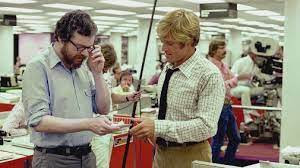 |
| Alan J Pakula, Robert Redford |
Like Pakula’s film, Schrader’s is based on an actual case, that of the investigation by two New York Times journalists, Jodi Kantor and Megan Twohey, into the crimes of Harvey Weinstein. Like All the President’s Men, it’s based on a book by the two journalists and follows their attempts to get people to speak to them about the case.
Viewed alongside All the President’s Men, She Said draws attention to the striking differences between how men might go about their assignment and how women might tackle theirs. The contrast couldn’t be clearer. Pakula’s men collaborate, and compete, with each other as professionals, doing what they have to do to get the job done without worrying too much about the moral implications of how they’re going about their task and the consequences for those who respond to their questions. Schrader’s women are just as skilled in how they do their jobs, but they mull over them, concerned about the women they talk to and the risks they’re taking, occasionally fumbling the ball in what they do and regretting it, even sometimes (in a very funny scene) worrying about the clothes they’re wearing. And whereas Pakula’s men are loners, only really at home when they’re at work, Schrader’s women have personal lives and are constantly torn between the obligations that they entail and their professional responsibilities .
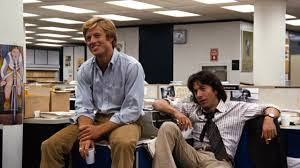 |
| Robert Redford, Dustin Hoffman, All the President's Men |
This is all by way of introduction to Keathley and Ray’s monograph about the film, which was published earlier this year through Bloomsbury Press in the UK. Keathley is a Professor of Film and Media Culture at Middlebury College in the US and the author of several books, among them Cinephilia and History, or The Wind in the Trees (2005); Ray is a Professor of English at the University of Florida and the author of A Certain Tendency of the Hollywood Cinema, 1930 – 1980 (1985), one of the finest books ever written about American cinema, as well as several others.
Not only do the pair make a great writing team – their prose is fluid, clear and concise – but they’ve produced the best analysis of the workings of a single film that I’ve come across since I encountered George M. Wilson’s study of Fritz Lang’s You Only Live Once (1937) in Sight and Sound during the 1970s (3).
Theirs is an exemplary analysis of the workings of Pakula’s film, a truly insightful study of the way it has been put together and of the sense that its formal details make. I don’t think that it invalidates the kind of thematic analysis that I’d originally pursued, and that had fuelled my use of the film for teaching purposes over the years, but it expands on it in ways that my approach hadn’t considered.
With the help of British literary critic Christopher Ricks, they begin by identifying what critics, investigative journalists and detectives have in common. Ricks’ comment that “criticism is the art of noticing things that the rest of us may well not have noticed for themselves” and that “it must neither state nor neglect the obvious” points to their modus operandi. Keathley and Ray take what we all can see – All the President’s Men progressing frame-by-frame on screen – and systematically make us aware of what we might not have noticed.
 |
| Original Film Poster |
Their underlying thesis is that Pakula’s film has been meticulously constructed to solve a problem: how to tell a detective story in which everybody knows the ending before it begins. With a final screenplay which he drafted with Robert Redford and the contributions of the officially credited writer, William Goldman, as well as the work of cinematographer Gordon Willis and editor Robert L. Wolfe, Pakula came up with a spectacular solution, one which rewrites the established rules of how conventional narrative film should be put together.
I should insert here that, while Keathley and Ray make no such grand claims for Pakula’s strategy (which was apparently conceived in collaboration with Redford), that conclusion is invited by their commentary. The plan was to try to make viewers watch the investigation unfolding without any sense of the way the pieces might fit together. That is, they might readily identify where it all began and how it all finished up, but everything in-between was to become obscure, uncertain, uncomfortable. Watching the film was to be hard work, albeit the kind of hard work that is simultaneously pleasurable. In Keathley and Ray’s words, “ATPM’s filmmakers choose to keep viewers off-balance, unsettled, confused – exactly the feelings Woodward and Bernstein had experienced.”
In their reading of it, All the President’s Men achieves this in a number of ways. “(R)elevant story information that would create a clearer continuity is regularly withheld from us,” they write, “and what we have instead is (by continuity standards) confusing and even contradictory.” As a result, the film “is marked by gaps, fissures, inconsistencies”, which the book details at length.
 |
| Carey Mulligan, Zoe Kazan, She Said |
And conventional continuities are undermined in other ways too, both spatially and temporally. Throughout the film, sequences are shot and cut together in such a way as to disorient viewers, to deny them any comfortable grasp of where the characters are in relation to each other. Drawing on Wilson, they explore the ways in which the film’s “visual organisation presents not just the script’s dramatic action, but also the film’s primary thematic concern – here, the complications of perception in a world whose previously clear moral landscape has turned disturbingly opaque”.
There’s much else about the film that this pocket-size volume provides: frame-by-frame studies of individual scenes; informed reflections on the casting and the performances of both the leads and the supporting actors; insights into the film’s organising strategies around paired oppositions; close scrutiny of Willis’s use of the split diopter lens in the film’s closing sequence; and more.
Drawing creatively on the work of a range of other thinkers about storytelling, both on the page and on screen – Roland Barthes, Pascal Bonitzer, Stanley Cavell, Douglas Pye, Victor Perkins, Ludwig Wittgenstein – Keathley and Ray also provide colour frames from the film to support their analysis.
Don’t be misled by its size. Theirs is an important book. I can’t recommend it highly enough.
******************************
(1) Christian Keathley & Robert B. Ray, All the President’s Men, BFI Film Classics series, Bloomsbury, UK, 2023
(2) Cinema Papers, September-October, 1976, pp. 171 - 172
(3) The full interview will be included in Alan J. Pakula: Interviews, a forthcoming book I’ve edited, to be published by the University Press of Mississippi in 2024.
(4) George Wilson, “You Only Live Once: The Doubled Feature”, Sight and Sound, Autumn 1977, pp. 221 – 226; subsequently altered and expanded substantially for inclusion in his book, Narration in Light: Studies in Cinematic Point of View, The John Hopkins University Press, 1986, pp. 16 - 38
All the President’s Men is currently streaming through Binge; She Said is available through Binge and Netflix. Keathley and Ray’s book can be found on the shelves of the better Australian bookshops (I bought it at The Avenue in Albert Park), on-line, or perhaps at your local library.


