Showing posts with label Colin Firth. Show all posts

Thursday, 30 March 2023

The Current Cinema - Barrie Pattison recommends EMPIRE OF LIGHT (Sam Mendes, UK, 2022)

Olivia Colman

I rate Sam Mendes’ new 
Empire of Light  as his most substantial work. He has gone on record as not wanting to have a recognisable style but this one is a perfect match for American Beauty, his most individual film and, if you look at his body of work, despite the variety of subjects and settings, you can see that the ones that show the most personality do have a unity. They are all about people who are unable to find sustained happiness in their so thoroughly established environments.  

Hey, that’s British films of the post war period - the school masters of the Mr. Perrin and Mr. Trail, The Guinea Pig and The Browning Version  trilogy, the sports fans of Maurice Elvey’s The Great Game or It’s a Dog’s Life, his worst films, the fun fair visitors in the free Cinema Films, or the wannabe lovers of Brief Encounter, which has a movie going sub-plot. These are the sub-strata of the British miserabilist tradition and they were the entertainment which was still circulating when Mendes grew up in sixties Reading.


Maybe that’s why Empire of Light’s notion of the movies has more in common with The Purple Rose of Cairo than it does with the current cycle of films that are celebrating cinema.

The setting, again a dominant element, is The Dreamland Multiplex in dimly established British South Coast Margate, repurposed as The Empire - Cinema, ballroom, restaurant and snacks. Manager Colin Firth dreams of restoring its former machine-made glory, retaining the red velvet curtains though two of its four auditoria are closed and pigeons roost in their empty shells. His hopes center on hosting the South Coast Premier of Chariots of Fire in the presence of the Mayor and Laurence Olivier.

That’s two Mr. Darcys in our picture already, though Firth authoritatively spades under his Jane Austin background, having dowdy deputy manager Olivia Colman  pleasure him in the office between sessions. She’s still a bit fragile after a spell in an institution and the rest of the artificial staff family aren’t coping all that well. Projectionist Toby Jones (below) has replaced his failed marriage with the magic of shutters and the phi-phenomenon, in his projection box papered with clippings of his favorite stars - the nearest the film comes to the current BabylonMeet the Fabelmans enthusiast cycle. The ushers compete in describing the grossest item they’ve found clearing out the seats. One of the most deft touches is the way ticket box girl Hannah Onslow looks like being a major character but is moved from center by Colman going full blast. 


Curiously, the isolated scene where Olivia calms the mean customer, who wants to take his chips and coffee into the show, is one of the film’s most resonant.

Into this environment they introduce ticket tearer Micheal Ward, who is black in the period where the streets are full of agro skin heads on about taking their jobs - “that stuff in Brixton.” Uneasily Ward and Colman become an item, restoring an injured pigeon with an improvised sock bandage, watching seaside fireworks from the roof and taking a red bus ride to the beach.

Dramatic incidents disrupt this unstable equilibrium - Colman’s losing it, the Gala Night and the street filling with thundering mods and rocker vandals in riot, to be hustled off by previously inactive bobbies. Enter Ward’s intimidating career-nurse mother Tanya Moodie.

Mendes has provided a heavy load to shift here and he deserves credit for coming close to resolving all the plot elements effectively, more than criticism for a too cheery outcome. Olivia has Toby show her first film - the carefully chosen Being There.

Performance and technical work are remarkable. Adding this one to his other films, with Mendes and the Cohens, makes cameraman Roger Deakins one of the notables in his field. Design and music complement the idea content. Empire of Light is one of the not so frequent films that makes its point by atmosphere more than narrative. The participants have chosen to push their skills to the limits and that’s something extraordinary in itself. It’s the kind of daring that endangered film making needs. Are this, Babylon and the rest, ominously going to be like the final burst of creativity in silent films - Metropolis, Asphalt,  Sunrise, Wings, Lonesome?

Micheal Ward, Olivia Colman


Thursday, 2 December 2021

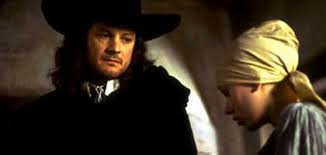
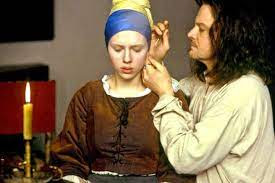
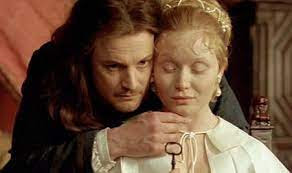
"....That kind of acting is easy..." Part Two of Tom Ryan's interview with Colin Firth conducted for the release of THE GIRL WITH THE PEARL EARRING (Peter Webber, USA, 2004)


Do you want to work in Hollywood, or have you deliberately been keeping your distance?

I’m not quite sure. I always assumed that they kept me at a distance. And that if they invited me I’d probably, you know, be tempted. But there’s a bit more interest from that department now. I would only go to work on interesting stuff. I have no interest in relocating myself in order to try to pursue a career from a different space. I like living in London. It’s my home, it’s where my friends are, and I stay purely for that reason. There’s so much I’d have to leave behind to go somewhere else. I don’t want to live in Hollywood only for that reason.


Colin Firth, Scarlett Johansson,
The Girl with the Pearl Earring


What kind of preparation did you do for The Girl with a Pearl Earring? What kind of research?


That was easy in that it was fun. You know sometimes you play a character where the research isn’t. If I was playing a child murderer, I don’t know if I’d enjoy the research very much. With Girl with a Pearl Earring, I actually got to get my hands in paints and go to art galleries in Holland and, you know, just get inside the life of an artist who is absolutely fantastic. 


I could have been playing an artist I hated – and I would have had to find something I liked about him – but I actually already had a love of Vermeer. So I couldn’t really learn to paint to any useful purpose, but I could learn to hold the brush right and I could learn to mix the paint, and I just got familiar with the stuff and I found it all hugely enjoyable.


It wasn’t kind of like Ed Harris doing Jackson Pollock? It was more detached?


Well, yes. I mean, basically, what fascinated me about Vermeer wasn’t how he applied his brush. It was more how he must have seen things, because he saw so differently. You know, there are no layout lines on any of his figures: there’s no drawings underneath. If you look at Girl with a Pearl Earring, you can’t even see the outline of her nose and yet you know where it is. 


He had this extraordinary softness in his view of everything. Some of the characters are literally out of focus in some of his paintings. They’re in soft focus, which is partly why people think he used the camera because the human eye wasn’t seeing anything that way. It just didn’t. No other artist was doing that at that time. And I was just fascinated with how he saw. 


There’s a kind of intensity and gentleness to everything and so that fascinated me as an actor. I didn’t know if there was a way to express that, and in some ways it made everything frustratingly elusive. But that interested me more than the brush technique. Which is fine, because I had more to do with that as an actor than the brush technique. 

You know, you see me with a brush in my hand every so often, but a master painter and a bad painter are probably gonna look very similar holding a brush. So that wasn’t the important thing for me. It’s what he sees when he looks at her, or when he looks in the corner of a room, or when he looks at the light coming in through the window. It was that really.

Colin Firth, Essie Davis, The Girl with the Pearl Earring
 

Was there any one thing that gave you the key to the character? Like the wig?


No.


No?


No. And that was the thing. I think there were all sorts of things that helped. I mean the paintings themselves were the things I was chasing a lot of the time, but I never found a single foothold. And maybe it was not appropriate to find a single foothold. There’s something very elusive about the paintings and there’s something quite elusive about the story and about the man, I think. 


And maybe it was just as well that it stayed elusive. 


I just remember there came a point when I was deeply immersed in it all but had never found a single hook which helped solve any mysteries. And there came a point where the camera was rolling and someone said “Action” and I just had to get on and act, ready or not. And so, interestingly enough, it always felt like he was slipping away from me, but it just meant the chase was always on and it kept it very alive.


When you were planning the part, was the idea of Vermeer-as-brooding-theatre part of it? He makes a very theatrical entrance, pushing a curtain back, like an actor moving on to a stage…


No. I’ll let you into a secret. That was stolen from another scene. That was not my first appearance in the original script, or in what we shot. That was thought up when the film was rearranged in the editing. So it was actually part of a scene which we don’t have any more where she comes back from the apothecary with my paints and secretly hands them over to me at night. And that’s me returning from the pub, or something. So it was cleverly paced. And, again, that’s how films get made: you do it one way and someone has a rethink in the cutting-room. But, as you point out, it works very well exactly like that.


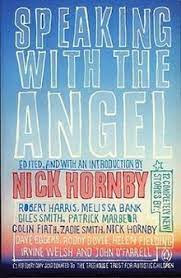
You’ve also been published as a writer with the short story, ‘The Department of Nothing’ (1). Is this another aspect of you that you want to develop?


I could say “yes”. But it’s always slightly out of reach because I never get down to it. I stay quite busy and the trouble is that the acting is the path of least resistance right now and it’s keeping me amused and stimulated, and it puts food on the table. So I think that the disciplines of writing are such that I’d have to forego this wonderful collaborative process of making films, that’s so fruitful in so many ways. I’d have to push all that aside and isolate myself for a while and calculate this other business and I haven’t reached the point where I’m prepared to do that. But I keep the idea alive. I’d either have to force myself to do it or wait until I fall on hard times.


Which is not likely to be in the near future.


Well, I don’t know. It could be in the very near future. Who knows? [Laughter]


Well, you could always play cricket for England, I suppose.


You haven’t seen my cricket. They wouldn’t even let me play cricket for my school.


Oh really. Still, I’m referring to the current England Test team… 


Oh, I see, “English cricket”. Maybe English cricket I could play. I see what you mean. 


I’m sorry.


Bloody Australians. No, I’m sorry, go on. [Laughter]


Of the work that you’ve done, what are you proudest of and what do you most regret?


Oh, no. I cannot possibly answer that. I probably could if you gave me some time, but I panic when someone says, ‘What’s your favourite song of all time?’ I’ve made mental lists for years over that and then when someone asks me everything goes out of my head.


Colin Firth, Tumbledown

What about something like Tumbledown?


Yes, I was proud of that. But I mean, I’m proud of it because it’s a kind of showcase. But I have to say that kind of acting is easy and I think that’s what people who are not actors find very difficult to understand. But, you know, a lot of histrionics, lot of passion, lot of anger, lot o’ tears. And the portraying of disability is very eye-catching stuff, but it’s not difficult to execute. Actors love it. 


Most actors who can act at all can do all of that stuff and they usually pick up a gong at the end of the day. It’s the subtleties that are really, really difficult, and are much less rewarding in terms of being appreciated. So, yes, I’m proud of it, but not because I think it was any great achievement of mine. I think it’s a fascinating, intelligent, uncompromising film. But there’s lots of other stuff I’ve done where the challenges have been greater.


(1) in Speaking with the Angel, an anthology of short stories edited by Nick Hornby, Penguin, 2000 (Firth in good company here: other included stories have been written by Hornby, Zadie Smith, Helen Fielding, Dave Eggers, Roddy Doyle, Irvine Welsh, Robert Harris and others)


***
Editor's Note: This is a second part of an interview with the actor Colin Firth. It was recorded by Melbourne film critic Tom Ryan as the basis of a feature article for The Age when the film was first released. The first part can be found  HERE Previous posts in this series have been devoted to conversations with Lawrence Kasdan (Part One)Lawrence Kasdan (Part Two) Costa-Gavras Jonathan Demme (Part One)  Jonathan Demme (Part Two) Click on the names to read the earlier pieces


Thursday, 11 November 2021

"... None of them are me as I see myself...." - Tom Ryan talks to Colin Firth - An interview recorded at the time of the release of THE GIRL WITH THE PEARL EARRING (Peter Weber, UK, 2003)


Long before Colin Firth (b. 1960) attracted international attention as a result of playing Fitzwilliam Darcy in the Andrew Davies/Simon Langton six-part TV adaptation of Pride and Prejudice (1995), his career was well under way. He’d worked extensively in the theatre in the UK and was well known on account of his roles on the big screen there as well as on the smaller one. 

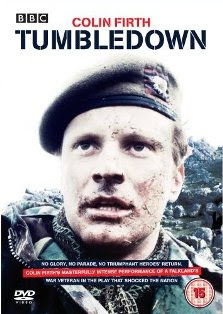
Tumbledown DVD cover

Particularly notable was Richard Eyre’s controversial telemovie, Tumbledown (1988), made for the BBC and based on a real-life story about the struggles faced by Lt. Richard Lawrence of the Scots Guards before and after he served in the Falklands. He’d also impressively played the title role in Milos Forman’s Valmont (1989), based on Choderlos de Laclos’s Les liaisons dangereuses, and his two films with director Pat O’Connor – A Month in the Country (1987) and Circle of Friends (1995) – were also praiseworthy.


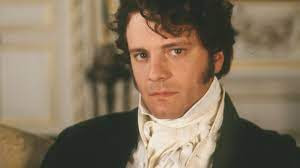
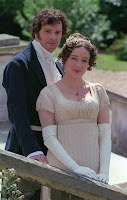
But then came Pride and Prejudice (above), after which he became more widely sought after. While that led him into some roles that he might have been better advised to avoid – a view he has readily shared – it also provided the foundations for a substantial career. 


His screen persona has allowed him plenty of room to move. He’s been found regularly playing put-upon English chaps, as in films such as The English Patient (1996), Shakespeare in Love (1998), Love, Actually and Hope Springs (both 2003), Easy Virtue (2008), The King’s Speech (2010) – where he redeploys the stammer he’d used to such good effect in A Month in the Country, except that this time it helped him win an Oscar – and The Railway Man (2013). He’s also been a strong romantic lead in The Girl with a Pearl Earring (2003) and the Bridget Jones films (2001, 2004 and 2016), where he plays another Mr. Darcy. 


He’s played dashing Dads in What a Girl Wants (2003) and Nanny McPhee (2005). And for the Mamma Mia! films (2008 and 2018), he’s even dared to sing. Arguably, though, two of his most distinctive performances were playing grief-stricken men in Michael Winterbottom’s Genova (2008) and US fashion designer Tom Ford’s directorial debut, A Single Man (2009), the latter earning him an Oscar nomination. And a third, Supernova (2020), partners him with Stanley Tucci as a gay man dealing with his partner’s slide into dementia.
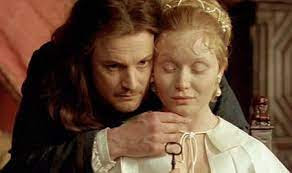
 

Firth, Essie Davis, The Girl with the Pearl Earring

When I spoke to him by phone in April, 2004, he was in Rome where he’d gone to promote the release of The Girl with the Pearl Earring. Reluctantly doing what actors are expected to do these days, he was playing the marketing game. While he’d prefer never to “do press”, as he puts it, he found himself doing just that. 


Before we spoke, I’d been negotiating with the PR person assigned to look after him about how long the interview was to be. She’d understood it was to be 10 minutes; I’d believed it was going to be 30.

 ********************

TR: Hello.


Colin Firth: Hello. Apparently we’ve got 17 minutes. [Laughter. Unbeknown to me he’d been listening]


What’s the weather like in Rome today?


It’s pissing with rain. Like a Norfolk winter rather than an Italian one though. Dark and gloomy.


Apart from the weather and a publicist with a watch, what’s it like there?


[Laughter] Actually she’s not by me as we speak. I’m sitting in a barren room that looks like an interrogation room in a Belgrade police station. I’ve got some books on a shelf on the wall. If I look out the window, however, I’m looking at a beautiful terra cotta-tiled roof with a million TV aerials and a dome, of the mini-St. Peter’s variety. And beyond that I can see an ancient Roman palace and to my right there’s a statue of St. Peter. I’m high up, so I’m overlooking the rooftops.


When you were making The Girl with the Pearl Earring, did you get an inkling at any stage about whether or not it was going to be any good? 


I always get lots of inklings, but their accuracy rate is not brilliant. So the honest answer is no, not an accurate inkling. Over the years, I’ve finished a day’s shooting thinking, ‘You know what. I have an inkling that we’re doing Something here. There’s something good happening.’


What are the signs?


It’s purely instinctive and intangible. You sometimes just feel that you’ve done good work, or something gels and you’ve developed this trust for the process and the director. And then another day it all seems to jar and nothing comes together. I usually withhold judgment now because I’ve been wrong so many times and it depends on so many variables and so many people. 


I always think that it’s a miracle that a film ever gets made, given that there are so many different elements it depends on. The pre-production’s gotta be right, the script’s gotta be well-judged, and it’s gotta be well-interpreted by people doing more jobs than I could list. And then it’s gotta survive post-production and editing. It’s gotta have the right music choices, it’s gotta have the right pace, and then it’s gotta be marketed right. And if it gets through all of those, then you’ve got a success. 


So that’s why it’s hard to have an instinct. You can have an instinct that you may be doing your own work well, but you’re in the hands of so many others. And on the other hand, you could be doing your own work pretty badly – that’s happened to me many times – but you’re saved by others.
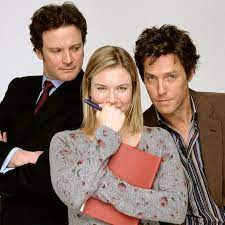
 

Firth, Renee Zellweger, Hugh Grant, the leads of
Bridget Jones Diary

I’d like to chase you more on that, but let’s move on. Is Helen Fielding’s account of her interview with you in the second Bridget Jones book an accurate rendering of your exchange?


Yes, it is, although it was contrived a little. You know, Helen is not Bridget and I’m not really Colin Firth, or at least not the one in the book. That’s someone I became for the interview. I thought it would be funnier if I took on the persona of a slightly different, rather serious actor who has no real patience for this woman.


And that’s not you at all?


Not really. [Laughs] I’m as silly as she is really. When we met… She really did come to Rome. I mean, she uses the reality as a kind of frame for the interview. But we had lunch as Colin and Helen, you know, and walked around Rome. And she describes a bit of that, but when we sat down to do the interview and she switched the tape recorder on, we both slipped into character.
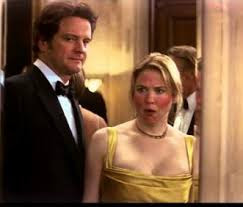

Firth, Renee Zellweger, Bridget Jones Diary (2001)


It’s very funny.


And then we edited afterwards. She was generous enough to include me in that process. She would fax me a draft and I would say, “Maybe cut this or add that or change the answer here or there”. So we continued the contrivance for the next week or two. But it’s basically very much as it was given that we’re both inside our roles.


If you’re playing Mark Darcy in the screen adaptation of the book, who’s playing Colin Firth?


We don’t have that scene.


Oh no.


Actually, I shouldn’t have said that. It’s a trade secret. I’m in this rather paradoxical position of being told not to reveal too much about the film. But we’ve been performing in front of the world’s paparazzi and there’ve been press leakages for the last four months, so I think my silence is futile. [Laughter]


But if it hadn’t been left out, who would you have liked to play you?


Um. I can’t think of anybody glamorous enough really. [Laughter] I think I would have demanded the most impossibly glamorous human being that could be found. Nobody older than Orlando Bloom…


[Laughter] That was my teenage daughter’s suggestion over dinner this evening.


[Laughter] Very good. Well there you are. It would have to be Orlando Bloom or Justin Timberlake, somebody like that.


Well my wife came up with Hugh Jackman.


No, uncomfortably close. His woollen britches. I wouldn’t want him anywhere near me. 


Have you ever played any characters that resemble you as you see yourself, or as you’d like to be?


No, actually. The second part of that question is a little more complex. But none of them are me as I see myself. 


Right.


They probably all are representative of me to some extent. I think they have to be for any actor playing any role. For it to be convincing, it’s got to come from somewhere that’s you. Um, the question is about realigning the relevant parts of yourself for the role. As I’d like to be? Not really. I wouldn’t mind Mr Darcy’s castle, you know. There are details that you take a fancy to. 


But you always find a hook on a character that you have to like about him. I mean, you can be playing the most despicable human being and if you pronounce them despicable then you’re gonna be so judgmental of the character that you won’t be able to make it real. In order to flesh something out, your job is to justify the character. So you always have to end up liking whoever it is. 
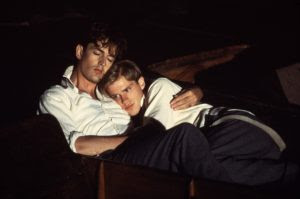
 

Rupert Everett, Firth, Another Country (1984)

I’ve actually played unappealing characters and I’ve so convinced myself of the characters’ position that I get defensive if anyone says they’re unappealing. So I think you become very subjective. I think almost all actors would do that.


Well, for you then is acting becoming the character or playing the character?


Well, it’s a bit of both. When you say “becoming the character”, you don’t want to get psychotic about it. 


Method “becoming”.


Yes. I had a Method training. And either becoming the character or letting the character become you, you know, it’s….. I do believe in getting to the heart of it and feeling that if you are that character and suspending disbelief…. It’s almost an infantile position, something that children do effortlessly. They can put themselves in a fantasy world. But they’re not psychotic, you know. The child can believe he’s a fireman or an astronaut. But Mum calls him for dinner, and he snaps out of it. Or not. But he’s got an eye on the real world. 

I think there’s a danger that actors lose that. They talk about Bela Lugosi having insisted on being buried in his Dracula gear, ’cause he’s kind of lost the plot. I think if the actor’s unstable enough, it could get a little weird.
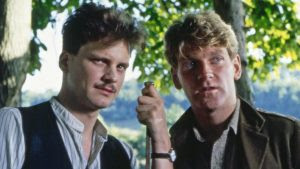

Firth, Kenneth Branagh, A Month in the Country  (1987)


So there’s no danger of you going to your grave as Mr Darcy?


Well, I think others would probably quite happily see me go to my grave as Mr. Darcy. [Laughter] But I’d be quite happy never to see a pair of britches and a frilly shirt again. But, no… You do suspend disbelief but then you keep a sensible third eye open. You’ve got to have a critical view of what you’re doing as well.


I’ve read, and what you say indicates it, that you’ve found it difficult to escape the legacy of Fitzwilliam Darcy? Do you really want to? I mean, the words “meal ticket” come to mind?


Not really. No. I was kidding before really. You know, it’s not my problem escaping it. It’s other people and their perception of me. If it doesn’t bother them, it doesn’t bother me. The tag hasn’t hurt me in any way. It’s kept me known, it’s kept people interested. It’s something for people to write about, and it is mostly what they do write. And I don’t really care. 

After a long day of press, the repetition of the question gets a little dull. But it’s no worse than that and I don’t spend a lot of time doing press. So, you know, I don’t have to deal with it at home, I don’t deal with it much in the street, and I’ve managed to keep the roles varied enough to keep me interested. So it hasn’t hurt much really. I think it’s probably kept me employed.


***************************

Editor's Note: This is a first part of an interview with the actor Colin Firth. It was recorded by Melbourne film critic Tom Ryan as the basis of a feature article for The Age. Previous posts in this series have been devoted to conversations with Lawrence Kasdan (Part One)Lawrence Kasdan (Part Two) Costa-Gavras Jonathan Demme (Part One)  Jonathan Demme (Part Two) Click on the names to read the earlier pieces