Showing posts with label British Cinema. Show all posts

Sunday, 1 June 2025

On Criterion Collection Blu-ray - Rod Bishop welcomes the 4K restoration of WITHNAIL AND I (Bruce Robinson, 1987, UK)


They're selling hippie wigs in Woolworths, man. The greatest decade in the history of mankind is over.

There’s not much of a plot, just a couple of-out-of-work actors in London in 1969 who decide to take a holiday in Cumbria. There are no plot twists, no romance, and no action sequences either. 

But it does have a cracking screenplay from Bruce Robinson and superb, unforgettable performances from Richard E. Grant, Paul McGann, Richard Griffiths and Ralph Brown.

On the first day of shooting, Robinson stood on a chair and said ‘Hello, I’m Bruce Robinson, I’m directing this movie and I don’t know what the hell I’m doing so any help you can give me is gratefully received.’ 

He has also said film crews are, in fact, conspiratorial endeavours. 

I don't advise a haircut, man. All hairdressers are in the employment of the government. Hair are your aerials. They pick up signals from the cosmos and transmit them directly into the brain. This is the reason bald-headed men are uptight.

In The Loser Chronicles, Charles Epstein’s “compendium of world-class failures, misfits, fools…”, he writes:

“I have been futilely trying to get people to watch this movie since its release in 1987. That’s 36 years of stony indifference.  My friends and the people I tend to associate with generally respect my recommendations: books, movies, TV shows, YouTube videos, articles, restaurants…[but]…apart from my friend Paul (we’ve been quoting lines at each other for three-plus decades, and never fail to laugh ourselves into a respiratory condition even though we’ve long beaten them into the ground), not a single person I’ve recommended it to has, to my knowledge, watched it.  If any of you losers - yeah, I said it - are reading this, now’s your chance, it’s the last time I’ll mention it.

Here was a man with 3/4 of an inch of brain who'd taken a dislike to me. What had I done to offend him? I don't consciously offend big men like this. And this one has a definite imbalance of hormone in him. Get any more masculine than him and you'd have to live up a tree.

I called him a ponce. And now I'm calling you one. Ponce!

Jason Hill, a brewer in Cumbria, says “In my opinion, Withnail and I is the best film in the world, but unfortunately you can’t set a record for that…” So, eleven years ago, he made an audacious attempt to set a world record at an open-air screening of the cult classic. The Westmorland Gazette reported: “Eden Brewery, based near Penrith, will attempt to set a new record for the number of people simultaneously saying a film quotation. The brewery will attempt to get the audience to shout out the line ‘I demand to have some booze’ in unison… 

Withnail fans have descended on Sleddale Hall - the location used for Uncle Monty’s cottage Crow Crag in the film – annually since 2012. Jason Hill said he was relishing the chance to get one of his favourite films into the record books. 

Paul McGann, Richard E Grant

Speed, is like a dozen transatlantic flights without ever getting off the plane... Time change. You lose, you gain... Makes no difference so long as you keep taking the pills. But sooner or later you got to get out, because it's crashing. And all at once those frozen hours, melt through the nervous system, and seep out the pores.

Unlike the otherwise exemplary A Complete Unknown, this film is far more honest about the drugs consumed in the late 1960s. Apart from the alcohol and weed, there’s speed, anti-depressants, and in desperation, lighter fluid and anti-freeze. There’s even an invented pill called Phenodihydrochloride Benzelex. “Street name The Embalmer”.

Richard E. Grant

The joint I'm about to roll requires a craftsman. It can utilise up to 12 skins. It is called a Camberwell Carrot…

Who says it’s a Camberwell carrot?

I do. I invented it and it looks like a carrot.

 I think we've been in here too long. I feel unusual.

We are indeed, drifting into the arena of the unwell...

Wikipedia: “There is a drinking game associated with the film.  The game consists of keeping up, drink for drink, with each alcoholic substance consumed by Withnail over the course of the film. All told, Withnail is shown drinking roughly 912 glasses of red wine, one-half imperial pint (280 ml) of cider, one shot of lighter fluid (vinegar or overproof rum are common substitutes), 212 measures of gin, six glasses of sherry, thirteen drams of Scotch whisky and a 12 pint of ale.” 

Paul McGann

We went on holiday by mistake.

Actor Paul McGann, in his first film, has plenty of reminiscences. He used to have strangers suddenly whisper or yell lines from the film at him in the streets of various cities around the world. He still laughs that someone once chalked on the pavement outside his house - apropos of that drunken Irishman - the word "'ponce' with an arrow pointing at his house. “I kind of like that."

McGann has also observed: “You see these TV documentaries about the sixties and the way it ends. You get Janis Joplin dying, you get Jimi Hendrix dying, Jim Morrison is dead…It’s all over in that particular few months. And you know that 12 months later you’re gonna get the Carpenters…”

Flowers are essentially tarts. Prostitutes for the bees. There is, you'll agree, a certain 'je ne sais quoi' oh so very special about a firm, young carrot. 

And this 4K restoration? 

Who knew the red blob on Monty’s lapel was actually a beautifully rendered brooch of a radish?

Richard E Grant, Richard Griffiths 
.....and the red blob on Monty's lapel


Wednesday, 4 December 2024

On 4K HD - David Hare swoons over PARIS TEXAS (Wim Wenders, 1984) and adds a thought about THE THIRD MAN (Carol Reed, 1949)


Direct from Paree aujourd’hui.

Wenders Paris Texas in a new 4K 2024 restoration. I have the earlier 2022 Criterion and honestly wondered how much better this could get.


It is amazing. The clarity’s more film-like than ever. Depth and grain are like velvet. You get the feeling from watching this 4K that Robby MÅ©ller was really falling in love with the super clean light of the Texas locations. The 2014 version which was the basis for previous discs managed all of that, but the new 4K with HDR/DV seems to capture the real “bloom” of Eastman Kodak stock (perhaps the “Vision” line.) There is a feeling of textural refinement that seems to cocoon each image, regardless of the striking slices of colour that constantly play with the eyes. 


If you are thinking about making a move to 4K this might be a decider, along with next month’s 4K remaster of The Searchers.


I bought the Carlotta release because they usually get all their encodes from David McKenzie. This release is only enabled for English French and German territories and comes with the expected language and audio options, including a totally gorgeous 5.1 mix which knocks the Ry Cooder score outta the room. 


Madman is releasing a version of this next month in Australia, but for reasons I cannot comprehend only in DVD and Blu-ray formats. But that’s their nightmare I guess. 


Oh, the Canal disc of the Carol Reed
The Third Man picture thats another McKenzie encoding and is, if it could be possible, even more refined and texturally cinematic than the Canal/Criterion Blu-ray of two years ago. 


Worthy distractions from the circus that is now becoming the slow death of the American Empire.

Wednesday, 31 January 2024

The Current Cinema and Premiering at the Mardi Gras Film Festival - Rod Bishop highly recommends ALL OF US STRANGERS (Andrew Haigh, UK, 2023)


Paul Mescal, Andrew Scott, All of Us Strangers

Andrew Haigh’s latest – and his best – reaches our screens drowning in a welter of glowing, admiring reviews. Beguiling to begin with, it slow-burns its way to an incandescent conclusion. 

For those who regard themselves as supporting gay relationships, and bask in a warm inner glow while voting for same sex marriage, yet still struggle to understand the hostility some gays have to their portrayal in the cinema, Haigh’s two overtly queer films Weekend and All of Us Strangers make good antidotes.


The fiercer of the two, Weekend rages at the normalcy of heterosexual culture and its pervasive, unconscious way of marginalizing those with different sexual orientations. All of Us Strangers is far quieter, more subtle – it includes, for instance, painful, almost whispered agonies over families who claim acceptance of their gay son but at Christmas, still hurtfully centre all their attentions on his heterosexual siblings and their children. Leaving him, if not outside, then effectively always stranded on the periphery. 


Andrew Haigh

Adam (Andrew Scott) is traumatized by bullying at high school and, at the age of twelve, by the deaths of his parents in a car accident. He lives, virtually alone, in a huge block of new apartments in London, writing screenplays for film and television. He tentatively starts a relationship with the only other resident, Harry (Paul Mescal) - also gay and also intensely lonely.

Adam takes a train to visit his old family home and finds his parents alive, but still at the ages of their deaths, and therefore much younger than he is. It’s a brilliant magical realist device for unravelling the complexities of their relationships. Mum (Claire Foy), for instance, has only just heard about the gay plague, and is clearly disturbed by her son’s now declared gay status. His father (Jamie Bell) is more accepting, but still unable to reconcile his aloof, remote, emotionless fathering and the lasting impact it’s had on his son.  

Shot on 35mm, Haigh’s hypnotic and, at times, hallucinatory direction, is complemented by flawless performances from the cast. The mundane locations are transformed by the metaphysics and the wrenching emotions and Haigh effortlessly casts a spell over his heart-breaking story.

Frankie Goes To Hollywood, the 80s transgressive band from Liverpool, makes a welcome revival, particularly The Power of Love (“I’ll protect you from the hooded claw, Keep the vampires from your door…The power of love, A force from above, Cleaning my soul, Flame on, burn desire, Love with tongues of fire, Purge the soul, Make love your goal.”)

*********************

All of us Strangers has its premiere in Sydney at the forthcoming Mardi Gras Film Festival. For information regarding session times and bookings CLICK HERE

Sunday, 15 October 2023

On 4K Ultra HD - David Hare is not taken with THE WICKER MAN (Robin Hardy, UK, 1973)

 For reasons that now completely escape me I stupidly bought the new StudioCanal UHD disc of that much touted Brit “cult film' The Wicker Man.


Maybe it’s my current nausea at horrible world events but I have not had a more vacant viewing of something so bad it actually confounded any understanding of why in God’s name (as it were) it was ever made.
For starters the director, Robin Hardy, is a figure whose movie career never took off. After watching this I know why. Lifeless, pointless arranging of poorly lit and ineptly staged shots with not one sequence displaying any dynamic or visual meaning. Direction of actors that through sheer incompetence reduces stalwarts like Edward Woodward and Britt Ekland to distilled parodies of themselves through multiple layers of strained infantile narcissism. 

If you think Woodward’s screwed up face, so tight to express his clenched sphincter so it looks like he hasn’t been able to shit for a month, is great acting, this is your picture.
Even the far too infrequent tits and ass moments are derisorily short. Boobies shake until they’re suddenly overwhelmed by the hideous tat decor that looks like it came out of the crummy antique shop David Hemmings stops to visit in Blow Up.  

But if the general hetero campery of a bunch of faux Gauls/Druids singing and dancing in costume party drag lights your joint, this is probably for you.

Friday, 8 September 2023

The Current Cinema - Happy Families - SCRAPPER (Charlotte Regan, UK, 2022), SHAYDA (Noora Niasari, Australia, 2023)

Shayda (Zar Amir Ebrahimi) and Mona (Selina Zahednia)
Shayda

You suspect from the start, maybe you even know from the start, that things will eventually work out OK. Some semblance of peace, tranquillity or acceptance will ensue. These are just movies and film-makers don’t want to send their audience home unhappy or believing the world is an utterly grim place where the bad guys always win. 

In Charlotte Regan’s Scrapper, the ragged and rough girl whose only outfit is a West Ham soccer shirt has been missing a father since birth. Then he hops over the back fence and takes control. Up to then she’s been OK living on her own, pretending to the authorities she has a carer and stealing bikes for a living. 


In  Shayda a little Iranian girl is being cared for in a women’s shelter by a mother on the run from a violent husband, and by a fiercely determined house mother who knows all the tricks that errant fathers get up to try and regain ownership of their children.


There you have it two stories made by first time directors that start from simple beginnings and build until they grip and don’t let go.


Jason (Harris Dickinson), Georgie (Lola Campbell), Scrapper

In order, Charlotte Regan’s Scrapper had me a bit nostalgic from the beginning. If you were brought up in the fifties and your mother much preferred genteel English comics like The Beano, The Dandy and Film Fun to the likes of The Phantom and Superman,  you might remember Scrapper from the day. He was part of the Ash Can Alley Gang which was a regular in The Beano. Their sworn enemies were the Gasworks Gang. I didn’t get that all from memory. A quick Google search uncovered the info and also the more amazing info that The Beano only ceased publication a decade or so ago.


Scrapper was the go to guy when there was a fist fight to be won by the Ash Can Alley Gang. Regan doesn’t give any clue, beyond the film’s title, now a generic term, that she’s a Beano fan. Her approach is much more MTV with shape-changing screens and flashbacks direct to camera that tell the backstory of teenage lovers, accidental pregnancy, irresponsible fathers, sentimental re-bonding. (Maybe that's what PR leaflet was referring to in bold type when it mentioned the film is full of "aesthetic energy".) There is a classic story arc made good by its telling, the authentic detail and the ability of otherwise inarticulate people to bounce one line zingers around the room. Totally captivating.


Shayda  is a much more serious movie. Noora Niasari’s debut is autobiographical in the extreme – a memory trace of early life in a women’s shelter escaping violent men and incorporating lots of documentary detail about the court process, possible abduction techniques, access arrangements. It is particularly good in establishing the general unsettling sense of continuous dread that such women and children experience. It is also very good in portraying the way men/a man can turn from apparently sweet-natured and kind to instantly violent and threatening. There is no flashy disco-like cutting, no attempts at alleviating humour. The subject itself is a constant story today, unlike Scrapper's story of a kid who can look after herself quite well and has more street smarts at nine or so than most of us ever have. (And yes I know Hirokazu Koreeda did a movie on the theme as well..).


These are both terrific movies and I urge you to see them. Shayda  in particular adds to what seems a rather good year for  independently spirited Australian films – Limbo, The Survival of Kindness, Petrol, Sweet As  and The New Boy spring to mind. (Three of those by established male film-makers and the other three by smart young and very talented women directors…just saying.)

Thursday, 30 March 2023

The Current Cinema - Barrie Pattison recommends EMPIRE OF LIGHT (Sam Mendes, UK, 2022)

Olivia Colman

I rate Sam Mendes’ new 
Empire of Light  as his most substantial work. He has gone on record as not wanting to have a recognisable style but this one is a perfect match for American Beauty, his most individual film and, if you look at his body of work, despite the variety of subjects and settings, you can see that the ones that show the most personality do have a unity. They are all about people who are unable to find sustained happiness in their so thoroughly established environments.  

Hey, that’s British films of the post war period - the school masters of the Mr. Perrin and Mr. Trail, The Guinea Pig and The Browning Version  trilogy, the sports fans of Maurice Elvey’s The Great Game or It’s a Dog’s Life, his worst films, the fun fair visitors in the free Cinema Films, or the wannabe lovers of Brief Encounter, which has a movie going sub-plot. These are the sub-strata of the British miserabilist tradition and they were the entertainment which was still circulating when Mendes grew up in sixties Reading.


Maybe that’s why Empire of Light’s notion of the movies has more in common with The Purple Rose of Cairo than it does with the current cycle of films that are celebrating cinema.

The setting, again a dominant element, is The Dreamland Multiplex in dimly established British South Coast Margate, repurposed as The Empire - Cinema, ballroom, restaurant and snacks. Manager Colin Firth dreams of restoring its former machine-made glory, retaining the red velvet curtains though two of its four auditoria are closed and pigeons roost in their empty shells. His hopes center on hosting the South Coast Premier of Chariots of Fire in the presence of the Mayor and Laurence Olivier.

That’s two Mr. Darcys in our picture already, though Firth authoritatively spades under his Jane Austin background, having dowdy deputy manager Olivia Colman  pleasure him in the office between sessions. She’s still a bit fragile after a spell in an institution and the rest of the artificial staff family aren’t coping all that well. Projectionist Toby Jones (below) has replaced his failed marriage with the magic of shutters and the phi-phenomenon, in his projection box papered with clippings of his favorite stars - the nearest the film comes to the current BabylonMeet the Fabelmans enthusiast cycle. The ushers compete in describing the grossest item they’ve found clearing out the seats. One of the most deft touches is the way ticket box girl Hannah Onslow looks like being a major character but is moved from center by Colman going full blast. 


Curiously, the isolated scene where Olivia calms the mean customer, who wants to take his chips and coffee into the show, is one of the film’s most resonant.

Into this environment they introduce ticket tearer Micheal Ward, who is black in the period where the streets are full of agro skin heads on about taking their jobs - “that stuff in Brixton.” Uneasily Ward and Colman become an item, restoring an injured pigeon with an improvised sock bandage, watching seaside fireworks from the roof and taking a red bus ride to the beach.

Dramatic incidents disrupt this unstable equilibrium - Colman’s losing it, the Gala Night and the street filling with thundering mods and rocker vandals in riot, to be hustled off by previously inactive bobbies. Enter Ward’s intimidating career-nurse mother Tanya Moodie.

Mendes has provided a heavy load to shift here and he deserves credit for coming close to resolving all the plot elements effectively, more than criticism for a too cheery outcome. Olivia has Toby show her first film - the carefully chosen Being There.

Performance and technical work are remarkable. Adding this one to his other films, with Mendes and the Cohens, makes cameraman Roger Deakins one of the notables in his field. Design and music complement the idea content. Empire of Light is one of the not so frequent films that makes its point by atmosphere more than narrative. The participants have chosen to push their skills to the limits and that’s something extraordinary in itself. It’s the kind of daring that endangered film making needs. Are this, Babylon and the rest, ominously going to be like the final burst of creativity in silent films - Metropolis, Asphalt,  Sunrise, Wings, Lonesome?

Micheal Ward, Olivia Colman


Monday, 20 March 2023

The Current Cinema - Some thoughts on LIVING (Oliver Hermanus, UK, 2022) and a backward glance at IKIRU (Kurosawa Akira, Japan, 1952)

Bill Nighy, Living

I think I’ve only been provoked to write this by the Sight & Sound review I mention below.
 

As I said on Facebook LIVING....an odd movie if ever there were…  and I went on to say  it made me dig out a copy of Kurosawa's film Ikiru  from 1952 which as I recall from my youth was in a MUFS season in the 60s. Then, I found its near two and half hours hard going... but that was back then... and that was the only time I’ve ever seen it until last night.


In between the two viewings of the old and the new, the Sight & Sound review of the new version came to hand and in big type there is “This is a dangerously audacious undertaking, but Oliver Hermanus and Kazuo Ishiguro have brought it off” according to Philip Kemp. He goes on “Ishiguro’s script closely follows the shape and tone” and concludes “Living offers a rare example of the remake of a masterpiece that can stand with the original.” So much there but I’m not sure I’d ever class a remake of anything as “dangerously audacious”. Maybe a remake of Satantango...


I’m still not all in the group who think the original is a masterpiece. Still not sure that a dull, risk averse, as they say today but whatever, very ordered and dull life that suddenly explodes into commitment and action is totally convincing but that’s the story. All 2 hours and 23 minutes of it.


Shimura Takashi, Ikiru

Kurosawa’s film is set in the then present, and thus in the medical environment of the day. A cancer diagnosis likely meant an inevitable if slow death. “A long illness” the obits used to say. The new version thus decides to take us back to 50s London with all its social repression and paper-filled offices echoing Kurosawa’s original. The new one also decides to be upbeat by introducing a side story romance. The new one is all about getting the colours right, the drabness in the art design of office and home. You can feel superior because things are so much better today.  So we compare and contrast a film about the day and a film which dips, maybe even wallows, in nostalgia.


And as I also said I'm not at all sure that Bill Nighy's one note raspy whisper is that effective beyond the mannerism. It’s a good trope when he plays people who can convey a mountain of information with an ironic gesture, a raised eyebrow. Like he did in the Johnny Worricker trilogy of spy stories written by David Hare. (That’s the other David Hare from the northern hemisphere). As I also also  said I  found Adrian Rawlins (there's a name to conjure with, a Melbourne reference unless you’ve seen Philip Noyce’s Castor and Pollux) to be a much more authentic grump and someone who  got deep into his misanthropic part. 


That's all...

Friday, 20 January 2023

Sixty Years of International Art Cinema - Bruce Hodsdon continues his series - 6(8) Great Britain - Joseph Losey, Lindsay Anderson, Karel Reisz, Richard Lester, Peter Watkins, Barney Platts-Mills

Joseph Losey

Great Britain                                                                                                                                                

Joseph Losey (67) b.09   Lindsay Anderson (70) b.23   Karel Reisz (82) b.26   Richard Lester b.32   Peter Watkins b.35   Barney Platts-Mills b.44

*******************************************
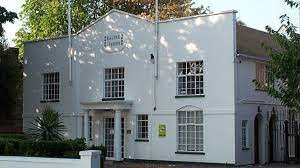
Ealing Studios

English ‘kitchen sink’ realism and after, Ken Loach, Barney Platts-Mills,
 Losey in exile, Peter Watkins 

Through the post-war years with a few exceptions, pragmatic commercialism ruled in the conformist environments at Elstree, Pinewood and Ealing studios - notable exceptions include films directed by Robert Hamer and Alexander Mackendrick at Ealing in the late 40s early 50s. There were a small number of films recognised as seriously dramatising social problems such as It Always Rains on Sunday (1947)a drama set in London’s working class East End, Yield to the Night (1956) taking an anti-capital punishment stance, and Victim (1961), a thriller portraying the dilemmas confronting homosexuals in a sympathetic light. Social problem films almost by default, made through the first half of the 60s by small independent producers, were less hostile to youth-oriented culture and tended to be dismissed as exploitation. Two of the most interesting such films made on the fringes were The Boys (1962) and The Leather Boys (63), both directed by a young Canadian Sidney Furie, the latter praised by critics for its treatment of homosexuality, is seen by Robert Murphy “as an unexpected addition to the kitchen sink cycle” (127-).
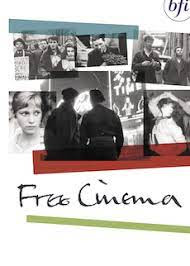
BFI DVD Free Cinema collection

In the late 1950s there was a breakthrough of new talent in the novel and theatre. The emergence of working class writers, part of a wave of dissent in cultural and political life, was foreshadowed by the BFI's promotion of the 'Free Cinema’ in six programs of short films at the National Film Theatre in 1956-9, free cinema referring to “belief shared by the documentarists that cinema should be freed from commercial constraints and look back for inspiration to Grierson’s documentary movement of the 1930s” (Street 79). Included were contributions of films focusing, generally sympathetically, on aspects of community life by Lindsay Anderson, Tony Richardson and Karel Reisz mixed with new wave shorts from Poland, France and the US all imbued with “a critical spirit of auteurism and in a tradition of  a benevolent middle-class humanism,” as Anderson delivered in a written manifesto. Reisz and cine-photographer Walter Lassally wrote articles calling for a freeing up of the British cinema from its overall tepidly humanist stagnation. There was considerable media interest created but the industry was unmoved.
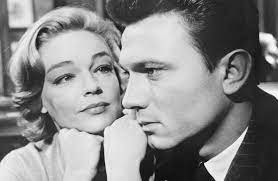
Simone Signoret, Laurence Harvey, Room at the Top

The harbinger of a new British cinema came unexpectedly from the artistic and entrepreneurial flair and financial acumen of the producer partnership of two brothers in the industry, John and James Woolf. John Braine’s novel ‘Room at the Top’ published in 1957 was a best seller combining realism of setting with the theme of the alienation of a working class ‘hero’ with an upper class education.  In John Osborne’s play Look Back in Anger Jimmy Porter’s bitterness stems from his university education which cuts him off from his working class origins. Braine’s working class hero, Joe Lampton, is public school educated but is driven by envy, not class bitterness, at the cost of his integrity and honesty. Braine identifies with his hero but maintains a certain critical distance. 

Room at the Top was directed by Jack Clayton in 1959More than the book the film was shot “with a frankness and sensuality unusual enough for the British cinema at the time” for it to be saddled by the censor with an ‘X’ certificate (Murphy 15). However, it was generally welcomed in the media not in sensational terms but as the first truly adult British film dealing seriously with contemporary social issues of class and sexual conflict. It became the fourth most popular film of 1959 after Carry On Nurse, I’m All Right Jack and Inn of the Sixth Happiness.
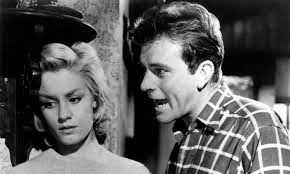
Mary Ure, Richard Burton, Look Back in Anger

A small independent  production company, Woodfall Films, newly formed by Tony Richardson and Harry Saltzman, benefiting from the success of Room at the Top, took the opportunity without front office interference, to film Look Back in Anger (1959) on studio sets, and Osborne’s The Entertainer (1961) filmed partly in northern locations, the former breaking new ground with Jimmy Porter played in the film with required acerbic excess by Richard Burton, cruelly and constantly subjecting his wife (Mary Ure) to humiliation. John Hill in his book Sex, Class and Realism argues that the real subject of Look Back in Anger  “was neither social injustice nor hypocrisy but the debasement and degradation of women” (quoted Murphy ibid 29). In The Entertainer  Laurence Olivier plays the down-at-the-heel music hall entertainer Archie Rice. “Osborne draws parallels between the state of Britain, on its last legs as an imperial power after the Suez debacle, and that of the music hall, declining into decrepitude of girly shows and TV spin-offs.” (ibid 17)

Laurence Olivier, The Entertainer

Sarah Street characterises the 60s as “an exciting period for British cinema. In 1963 five feature films sought to realistically portray working class life for the first time on British screens with lead roles for actors from working class backgrounds such as Albert Finney, Tom Courtenay and Rita Tushingham set and filmed entirely in monochrome in northern England or Midland locations. Richardson directed adaptations of a 'new wave’ play, A Taste of Honey (1961), by Shelagh Delaney filmed on location, the ‘poetic realism’ probing female subjectivity with conservative closure and devoid of the expressive anger, the social criticism less identifiable than in other Kitchen Sink films registering positively as a ‘youth cycle’ film with audiences of the time. 

Alan Sillitoe was the author of the novel Saturday Night and Sunday Morning (1960) from which Karel Reisz's first feature was adapted. It is generally acknowledged as the best realised and most successful of the ‘new wave’ cycle. Finney’s portrayal of rebel anti-hero, Pam Cook suggests, is at times engaged with society yet also alienated from it. His virility is closely linked to his desire for change in his existence. This also identifies Saturday Night  and A Taste of Honey, with the then popular ‘youth movie’ cycle, a major reason for them being the stand-out successes of the ‘kitchen sink’ films (269). 
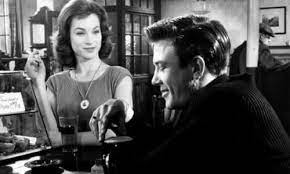
Shirley Anne Field, Albert Finney,
Saturday Night and Sunday Morning

In Morgan, a Suitable Case for Treatment (1966) directed by Reisz from a screenplay by David Mercer who was in turn influenced by the writings of R.D.Laing that gained currency in sixties counter culture. Laing argued that madness is a rational response to intolerable pressures put upon non-conforming individuals. David Warner as Morgan represented a new form of 60s hero with his surreal dreams of returning to the jungle as a gorilla. As Pam Cook points out, Morgan’s impotence is in sharp contrast to Arthur Seaton’s virility in Saturday Night “though they are both depicted as victims of their society” (ibid).  

Sillitoe was also the author of Loneliness of a Long Distance Runner (1962) which Robert Murphy identifies as marking a critical turning away from realism, “as the first of the ‘swinging sixties films” though ironically only in style (the deployment by Lassally and Richardson of a free-wheeling camera and montage with insistent music score) not in content (23). Tom Courtenay as Colin Smith, more than Albert Finney as Arthur Seaton in Saturday Night, pursues a rational form of rebellion.  

Alan Bates, June Ritchie,
A Kind of Loving

A Kind of Loving 
(1962) the most realistic of the cycle with least concession to the melodramatic elements of the Kitchen Sink films, was directed by John Schlesinger from the novel by northern writer Stan Barstow in a lower middle class setting. Compared to Finney and Courtenay the young couple (Alan Bates and June Ritchie) are “almost painfully ordinary.” The metaphoric transition away from the kitchen sink rebellion, in the second of the Schlesinger directed films when Tom Courtenay’s role as Billy Liar (1963) is contrasted with Courtney’s as a ‘borstal nihilist’ in Loneliness. 

Lindsay Anderson (1923-94) directed his first feature, This Sporting Life (1963), from David Storey's novel. Although Anderson's film was not without critical respect for what was being attempted, the public and most mainstream critics, did not buy Anderson's unyielding adaptation of the novel as tragedy rather than social commentary. The ill-defined, ultimately doomed relationship of the boorish de facto 'working class hero' Frank Machin (Richard Harris) with the widow Mrs Hammond (Rachel Roberts) is gloomily unsympathetic and the film bombed and with it the demise of the initial 'wave' of working class realism.
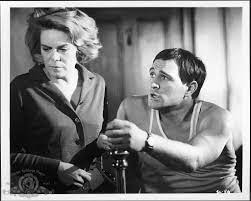
Rachel Roberts, Richard Harris
This Sporting Life

“Anderson’s interests in surrealism and in broadly Brechtian ideas taken from British theatre can be seen in all his films and could be said to differentiate them from ‘mainstream’ British social realism. Those interests are most clearly identified in If…(1968) taking the public school as a metaphor for Britain in critiquing a world ordered by elitism, hierarchy, discipline and tradition, and O Lucky Man (1973), portraying a journey through an England corrupt at every level, albeit in a sometimes confused and contradictory way” (Pam Cook 266-7). 

John Hill in Sex Class and Realism (quoted Street 82) has argued that the New Wave films of 1956-63 by no means reveal a progressive image of society in that period. New themes were introduced but presented with a traditional and conservative bias.  Although there was much more location shooting most films were made in traditional classical narrative form, exceptions although isolated and far from radical, being those in films directed by Anderson and Reisz and the visual stylisations of Tony Richardson and Walter Lassally in The Loneliness of a Long Distance Runner.

The tension in art cinema between notions of authorship, realism and modernism previously lacking any kind of meaningful framework for identification in the mainstream of British cinema, came briefly to the surface as outlined above. This coalesced with new developments of a social aesthetic in literature and theatre in the shifting portrayal of class in the cinema primarily in the films directed by Anderson and Reisz. After the end of British social realism as a coherent movement in the cinema in 1963 there were Losey’s three film collaboration with Pinter in art film mode (see below).  
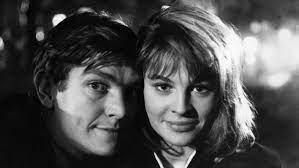
Tom Courtenay, Julie Christie
Billy Liar

The British cinema, in the words of Alexander Walker, “took the train south to swinging London.”  In Billy Liar scripted by Keith Waterhouse from his novel and Waterhouse and Willis Hall’s adaption of the play, Billy (Tom Courtenay) dreams of going to London to become a scriptwriter. Immersed in his fantasy life Billy doesn't make it but his girlfriend (Julie Christie) does. She metaphorically walks into the role of Darling (1965) as the ‘good-time girl on the make’.  Schlesinger leaves the understated observant style of his first two features behind for modernist stylistics in filming an Oscar winning script by novelist turned screenwriter Frederic Raphael.  Rita Tushingham, as the heroine in Richard Lester's Woodfall-produced comedy, The Knack... and How to Get it (1965), also ends up in London with cheerfully amoral results.

The first of Richard Lester's two films with the Beatles, A Hard Day's Night (1964) symbolically brought the British rock scene from Liverpool to London. Nowell-Smith comments that except for the two Beatles films and Antonioni's Blow-up (1966) “there was little sense among the British or in British-made films of the middle or late 60s that a cultural revolution was going on in Britain.” The only hint of revolutionary politics is in Lindsay Anderson's If…(1966) that takes place only in fantasy in the confines of a boarding school.
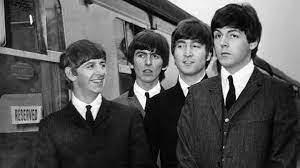
The Beatles, A Hard Day's Night

More potentially prescient was the re-emergence of realism in the mid-60s in the work of committed left wing filmmaker Ken Loach working in collaboration with Tony Garnett, initially in television. Cathy Come Home is a fictional exposé of the link between the housing industry and homelessness viewed by an historically unprecedented television audience in 1966 inspiring a parliamentary enquiry. It established Loach’s reputation for steadfast commitment to socialist beliefs strengthened by a realist aesthetic in engaging with social issues in an increasingly unsympathetic political environment. Early cinema features produced by his own company with Garnett, Poor Cow (1967) and Kes (1972) through persuasively naturalistic acting and also, in the former untypically involving a certain distancing in combining cinéma-vérité techniques with dramatic reconstruction which was subsequently disowned by Loach. There was also the adoption of some other nouvelle vague practices such as division into episodes and direct address to the camera in the portrayal of the life of a young woman through a mix of “backstreet romanticism and neo realist populism rarely seen in British films” (Murphy 152).
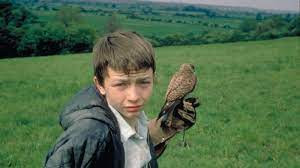
David Bradley, Kes

Loach takes the location filming much further than the ‘kitchen sink’ filmmakers and combines individual performance, rarely using name actors, with ensembles (including non-professionals) in unforced working class settings and an insistence that English be spoken in local dialect. In contrast to the affecting but unsentimental simplicity of Kes centred on the rapport formed between a socially deprived Yorkshire boy and a kestrel, the naturalism in Family Life (1971) becomes especially polarising.  Loach’s form of fictional documentary on the causes of schizophrenia, schematically scripted by David Mercer based on R,D. Laing’s unorthodox theories, leaves little scope for reflection.

Barney Platts-Mills (1944-2021) began in the industry as an editor in film and then television. He moved to directing short documentaries for Maya Films which he had set up with two friends. The film he most valued was  Everybody’s An Actor  which set out to be an account of theatre director Joan Littlewood’s notable work on improvisational drama with local teenagers.  After having initial problems the small crew won their confidence. The idea of making a feature length film finally settled on a story with some of the participants in Everybody’s an Actor who kept on asking ‘when they were going to make a real film?’  
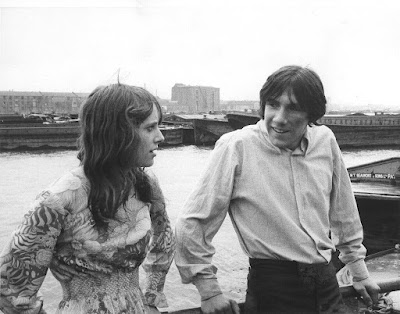
Anne Gooding, Del Walker, Bronco Bullfrog
 
The cast were all delighted to be given a script of Bronco Bullfrog (1970) which few of them then read. Del is an apprentice welder who engages in petty theft to relieve the boredom. He takes up with 15 year-old Irene to her parents’ disapproval. During their fitful courtship they join up with Bronco Bullfrog who has just escaped from Borstal. They are part of a social group who foreshadow the 70s punk movement. The film was improvised, scene by scene, with the director indicating lines of action or the dialogue and recalling actual or acted incidents to provide a basis for working. They achieve an entirely consistent acting style using their own gaucheness and inarticulateness as an expression of those of the characters. Platts-Mills’s casualness about story and structure becomes a positive and attractive quality. Despite the characters lack of direction in their lives the film develops “an inner impulse” amidst moments of high comedy.” Sustained dialogue occupies minimal screen time. “The strength of the film is that its high quality of observation is human not anthropological” (Robinson). 

In Platts-Mills’s second feature, Private Road (1971), London’s East End is replaced by middle class suburbia in Surrey and Bohemian London. While there is a similar structure to Bronco Bullfrog of an alternating escape and frustration pattern for the young couple: a struggling ‘classless’ young writer introduces a depressive young woman to the drop-out world. The ‘escape’ sequences are free of dialogue and backed by music.  The professional actors resourcefully maintain the spontaneity of Bronco Bullfrog in conveying a sense of real characters against a real background which was actual in the earlier film. Ironically as it turned out, confirming his continuing development, Platts-Mills’ is more formally confident while retaining his seeming preference for understatement in his second feature, developing what one critic has called “an odd mixture of romanticism and scepticism about society’s future” (Tom Milne in ‘Time Out’)

Bruce Robinson, Susan Penhaligon, Private Road

In these films writer- director Platts-Mills was critically acknowledged as ‘an authentic original’ (Penelope Houston), ‘a talent fulfilled’ (Lindsay Anderson), his films ‘send your heart leaping’ (Alexander Walker). Bronco Bullfrog, made in 6 weeks for £18,000, was widely acclaimed as ‘one of the freshest films of post-war British cinema’. Platt-Mills’s observant eye locates and captures semi-spontaneous behaviour through relaxed improvisation best described as a form of naturalism. Details of behaviour set in tough and difficult environments balance competing emotions with resilient good humour.  It is this unspoiled spontaneity, often seen in child actors, that is so frequently appreciated on the screen.  

Platts-Mills’s two films share company with films like that of the lead actor in Private Road, later writer-director, Bruce Robinson’s Withnail and I (GB 1986), Jacques Rozier’s Adieu Philippine (France 1961, q.v.) and Sean Baker’s The Florida Project (US 2017). The ineptitude and arrogance then too often on display in the mainstream British film industry, producer-director Bryan Forbes being a particular culprit here (see David Robinson, Sight & Sound v9/3 70 pp132-3). Inadequate distribution support made it too difficult financially for Platts-Mills to make films. He continued to share his insights in developing the talents of young people. He made two low budget features with non-professional casts in the early 2010s, one with a mythological theme was filmed in Gaelic.

The BFI released Bronco Bullfrog and Private Road on DVD in 2010.

Joseph Losey (1909-84) arrived in London in 1953 in a self-admitted state of absolute panic without family or money, in exile from the McCarthyist blacklist in Hollywood which forced him to leave a successful career as a film and theatre director. He established contacts with fellow blacklisted self-exiles and sought work necessarily anonymously, for rock bottom pay on low budget productions. His dedication and powers of persuasion enabled Losey to begin the demanding process of rebuilding a career. He developed long term relationships with Dirk Bogarde, Alexander Knox, designer Richard MacDonald, editor Richard Mills, writer Harold Pinter, et al. By 1957 he had assembled an all-star cast from the British acting establishment, including Michael Redgrave, Ann Todd, and Leo McKern for his breakthrough film as credited director, Time Without Pity, based on a play by Emlyn Williams. Losey described it “as a big turning point in my life because through the French it reached many other people […] Basically it gave me confidence that I could do something again.” 
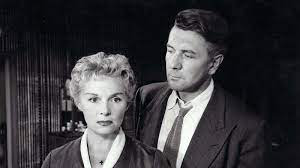
Anne Todd, Michael Redgrave, Time Without Pity

The genre adaptations that followed, most notably Blind Date (1959), The Criminal (1960) and The Damned (1961), inventively directed as they were, did not notably advance Losey’s status in the industry or with the critical establishment in Britain. Producer difficulties in the releasing of his personal Franco-Italian financed Eve (1962) was followed by Losey's decisive movement into the new art cinema in his collaboration with writer Harold Pinter and the cinematography of Douglas Slocombe in The Servant (1963) which dissects the upper middle-class with a degree of astute observation confused by finally settling for a seemingly reactionary plea for the certainties of boundaries imposed by class. The Losey-Pinter collaboration continued in a soon to be the widely praised masterpiece, Accident (1967), and the disappointingly conventional The Go Between (1971). This “enabled him to foreground themes,” Nowell-Smith suggests,” which in his genre films [in America] in the 1950s [before being blacklisted] were already present but less overtly displayed because subordinated to the demands of action and plot.” (134)                                                                          

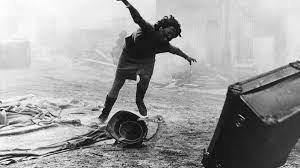
Peter Watkins as an amateur filmmaker in his mid-twenties in 1961 reconstructed the 1956 Hungarian uprising in Forgotten Faces filmed in the back streets of Canterbury. For the BBC, in Culloden (1964), he recreated the last battle to be fought on English soil, between the Jacobites and the English in 1746. The reconstruction takes the form of on-the spot tv reportage. In The War Game (1966) the effects of a nuclear attack on Britain are evoked with such affect that it was permanently deemed by the BBC to be too disturbing to be shown on television. In what he called called a 'block structure” Watkins juxtaposed the strategies for dealing with a nuclear attack with a re-creation of such an attack using simulated newsreel images and then reversing them so that the present becomes ‘fantasy’ and the supposed future ‘actuality’. His approach to docudrama in Punishment Park (1971) was filmed in the American desert pushing docudrama to its limits in which political dissenters are subjected to a staged three day survival ordeal.  In its blending of realism with expressionistic techniques and complex sound-image relationships evoking the paranoia of the Nixon years of anti-Vietnam protest, Punishment Park is a powerful advance on his first cinema feature. Privilege (1967), an attempted savage satire of the British rock scene's manipulation by the Establishment to keep the masses quiet in politically difficult times, a repressive government being portrayed as in league with the church.

The War Game

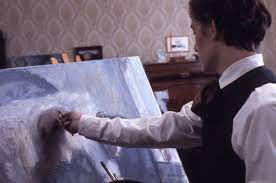
Watkins moved away from such simulation in his own work, itself a demonstration of the power of  media manipulation.  In Edvard Munch (1974) which he made clear in interviews is a deeply personal portrayal of the life and work of the pioneer expressionist painter made for Norwegian television. In his subsequent work in the media, Watkins collaboratively deployed an open, non-manipulative, if still emotionally expressive approach to narrative. In a multilevelled structure he provides a balance between the actuality of Munch’s statements, providing insight into the nature of his artistic creation in an historical context. The improvisations of non-professional actors expressing their own feelings and concerns directly, links the viewer to problems in contemporary society. 

Edvard Munch

Watkins returned to production in the 80s after devoting his energies solely in the intervening years to analysis and stinging criticism of what he sees as the dangerous centralisation and homogenisation of the mass audiovisual media - the resultant formal straitjacket he terms the monoform. This second phase was devoted to applying his analysis by collaboratively working with non-professional groups on av productions in a uniquely decentralised way.   See the entry on Watkins in Wikipedia.  Also  “Peter Watkins and the Politics of Expression”  by Gordon Thomas at  https://brightlightsfilm.com/peter-watkins-and-the-politics-of-expression-on-edvard-munch-1974-and-the-freethinker-1994/#.Y8D-xS8Rp0s                               


*******************************

Geoffrey Nowell-Smith, “Britain: From Kitchen Sink to Swinging London” Ch.10 Making Waves                                                           

Geoff Gardner “Joseph Losey: I'm a stranger here. I have no friends” essay in the Brisbane International Film Festival catalogue 2002                                                                                                                                       

Joseph A. Gomez, “Peter Watkins” International Dictionary Vol.2 Directors pp.575-6                                                                                   

Robert Murphy,  Sixties British Cinema  BFI 1992                                                                                                                                     

Geoff Brown,  “Paradise Found and Lost: The Course of British Realism” in The British Cinema Book Ed.Robert Murphy BFI 1992

Pam Cook, “Auteur Theory and British Cinema” in The Cinema Book 2nd ed. BFI 1999  pp265-82               

Sarah Street,  British National Cinema 1997

David Robinson, “Around Angel Lane”  Sight anSound  Summer 1970 pp132-3 

Penelope Houston,  “Private Road”  ibid  Autumn 1971

Luke Aspell, Great Directors: Lindsay Anderson Senses of Cinema December 2017                                                                                   

Peter Tonguette, Great Directors: Richard Lester Senses of Cinema May 2003                                                                                          

Dan Callahan, Great Directors: Joseph Losey Senses of Cinema March 2003

************************************

Previous entries in this series can be found if you click the following links


Sixty Years of International Art Cinema: 1960-2020 - Tables and Directors Lists to Accompany Bruce Hodsdon's Series


Notes on canons, methods, national cinemas and more


Part One - Introduction

Part Two - Defining Art Cinema

Part Three - From Classicism to Modernism

Part Four - Authorship and Narrative

Part Five - International Film Guide Directors of the Year, The Sight and Sound World Poll, Art-Horror

Part Six (1) - The Sixties, the United States and Orson Welles

Part Six (2) - Hitchcock, Romero and Art Horror

Part Six (3) - New York Film-makers - Elia Kazan & Shirley Clarke  

Part Six (4) - New York Film-makers - Stanley Kubrick Creator of Forms

Part Six (5) ‘New Hollywood’ (1) - Arthur Penn, Warren Beatty, Pauline Kael and BONNIE AND CLYDE

Part Six (6) Francis Ford Coppola: Standing at the crossroads of art and industry

Part 6(7) Altman