Showing posts with label COVID. Show all posts

Thursday, 3 February 2022

Defending Cinephilia 2021 (3) - Peter Hourigan on a year where Cinephilia Catches Covid

Quo Vadis, Aida, (Jasmila Žbanić)

Cinephilia [is quite different]… to DVD collecting. …You can watch 300 movies a year (all in a theater on 35mm, of course) and you will never own anything except, perhaps, an ungainly pile of torn ticket stubs.  Cinephilia is instead about collecting experiences, or maybe just the memories of those experiences. [i]

           It’s weeks now since the Editor asked me for a contribution to a look back at Cinephilia in 2021. Somehow, I just couldn’t get started. Had anything been worthy of elevation to the realm of Cinephilia? The essay from which my opening quote is taken has helped me – and it’s not necessarily a cheery picture. If Cinephilia is experiences, had there been standout experiences from this second year of Covid?

            I’ve certainly seen lots of films during 2021. There have been some wonderful ones. They’ve come from many countries, many eras. There are films that I’d thought I’d never get to see, or to see again. The latter have included some beautiful restorations letting the film look more glorious than it has for ages. There was Quo Vadis Aida and Never Gonna Snow Again from Poland  and Upper Case Print from Romania.  Georgia gave us What Do We See When We Look at the Sky?  Helene came from Finland. And from here at home, The Dry  and Higher Ground.

           But Covid was starting to stamp these films.  Among the workers listed in the end credits of many new films, the role of Covid Co-Ordinator started to appear with more frequency. 


The Dry (Robert Connolly)

           Despite the great films,  it’s hard to look back at this second year of Covid with excitement or enthusiasm. The first Covid year didn’t   seem as depressing, although the growing realisation of how our cinematic world was changing was often overwhelming. Festivals were cancelled.  Travel was off the agenda. Meeting up over a cup of coffee became almost overwhelmingly exciting or it didn’t happen.

           In 2020, streaming was one of the elements that came to our rescue. We saw organisations around the world using it so creatively.  We could not go to Bologna and Cinema Ritrovato – but we could stream a lot of it at home and so feel part of it. Moreover, we could participate in more festivals around the world that we’d never been able to visit because of time or distance. 

         But this innovation didn’t seem as exciting in 2021 as it had the previous year. First time around we were grateful for being able to share some of the experiences of these different Festivals.  Second time around, we felt more aware of what we were missing. Not all the Festivals returned online in 2022.

          With those that did return, although appreciative of their offerings, we were also aware that often they were the second tier  Both Melbourne and Sydney film festivals had good online offerings – but even better offerings had been lined up for the real-life cinema screenings. Some of those films may make their way here and even get cinema showings. But you felt more the loss of what we didn’t get. 

           Surfeit and exhaustion have been defining elements. The commercial streamers have offered us more wonderful films and series than we could hope to watch in a year. And that’s part of the problem.  With so many options, why worry if you miss one title? So what if some of your friends loved it? And when you’re trying to choose what to watch one evening, and you can’t decide – perhaps it’s easier to pick up a book instead. 


             This has been exacerbated by the entry of new commercial streamers. I’ve got no interest in many of the offerings they’ve made available. But then you realise that one streamer has ONE film or series you’re interested in. So, a new sense of frustration is added.  For example, Disney+ has a library that holds very little attraction for me but they did have the fascinating series Dopesick.Thank goodness I had a friend who was able to help me see that. Perhaps a new aspect of cinephilia will be working out access to one title on a streamer that you don’t have. 

            MUBI has probably been my favourite streamer over the year.  But even here my jaded Cinephilia sometimes kicks in. At first it seemed exciting to have a new film every day.  But then what looked like an interesting unknown film from Brazil or Mexico turns out to less than engrossing.  Interesting, yes, but not really as special as you’d hoped – and you’ve prioritised it over that DVD you’ve been meaning to watch for eighteen months or more. So, a new sense of frustration rather than exhilaration. Now, I find I’m often glad when it’s something I’ve already seen, which shouldn’t be a cinephiliac emotion!

            But that sense of hope that an unknown film will turn out to intensely satisfying is a cinehpilian emotion, and MUBI does deliver that from time to time. I had this with a film from Congo, Downstream to Kinshasa (Dieudo Hamadi).  This documentary took me where I’ve not been, and introduced me to some wonderful, damaged people.  (It’s still on MUBI, in the library, and I recommend it.) 


Procession

               And there were some other experiences on other streamers that lingered. Robert Greene’s Procession (Netflix) (Click here for my earlier blog post on it ) explored one aspect of the Catholic Church’s relationship with paedophilia. So did Dignity  on SBS OnDemand. This drama was built around a German postwar settlement in Chile where allegations of gunrunning for Pinochet and paedophilia emerged.  Then Netflix chimed in with A Sinister Cult: Colonia Dignidad.These two “Dignity” series were a fascinating double. 

               By year’s end we were going back to the cinema.  I’ve even got a new cinema complex just down the road, that screens a lot of the films I want to see. It’s got great seats – like flying Business Class, and the screens in each cinema are a decent size. But the experience is still not quite the same.  Social distancing in the cinemas isn’t an anxiety - the films I want to see are not usually heavily attended when I want to go.  I have even had several exclusive screenings (e.g.Power of the Dog) and others with only three or four others. 


Power of the Dog (Jane Campion)

               In a postscript to the article I quoted from at the head of this piece, Dibbern writes:

I’ve been going back to the movies for a few months now, but it’s been pretty underwhelming: sitting in eerily empty and quiet theaters surrounded by eerily masked patrons has often felt as if I’ve woken up from a bad dream and found myself in a dystopian hospital ward….. It feels as if the forced time away from movie theaters created a permanent fissure in my memory.

               I know what he means. I’m aware that where I would have once headed off to a screening of something or other, I’ll often think twice and three times about it It’s not that it’s often more comfortable and convenient to just switch on something to watch at home. I’m finding that I also have a different feeling to going out.

                And yet one of the big things missing has that communal experience. The conversations on the stairs out of the cinema. Or over a coffee. Even just being aware of so many others reacting to the same film you’re watching.  

                This has been something so sadly missed from visits to out-of-town Festivals – for me, ranging from going up to Sydney for the first Cinema Reborn, or to Bologna for Cinema Ritrovato. Often the important element was not so much any particular film, but the atmosphere. The old friends. The new friends. The conversations. The meals. The atmosphere. That sense of an experience. 

                 Cinephilia has taken a battering in 2021.  May it recuperate in 2022.


[i][i]On Not Seeing Movies by Doug Dibbern, in Notebook 0 (For the Cinema to Come) publ. MUBI 2021

Tuesday, 21 December 2021

Streaming on Paramount + - Rod Bishop dives deep into SOUTH PARK: POST COVID – THE RETURN OF COVID (Trey Parker, USA, 2021)


Everything that follows is spoiler, including the excess of subplots and the confusing time-travel
 

PART 1 POST COVID

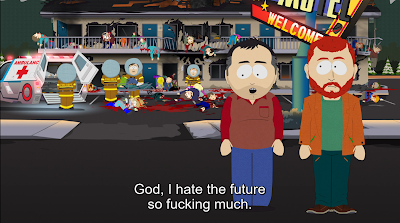
It’s been 38 years since Covid started and the South Park boys are now middle aged. 

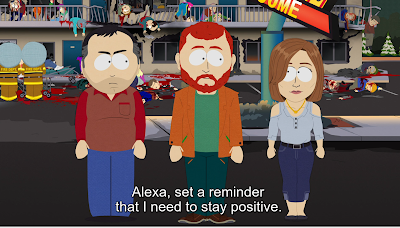
Stan is an online whiskey consultant and co-habits with his Amazon Alexa, a hologram assistant with a serious relationship attitude. Stan can always turn her off and on.

Kyle, now a guidance counselor at South Park Elementary, has summoned Stan and the rest of the gang back to South Park. Kenny grew up to become a famous wealthy physicist, but he really has died this time.


Jimmy has become a late-night talk show host - “the king of woke comedy” - and his material is so lame, there are no jokes, no punchlines, just forced canned laughter from his woke audience. Jimmy, too, heads for South Park cancelling his scheduled guest, the “First Lady Tom Kardashian”.

And Cartman? He’s converted to Judaism, with his trademark beanie turned into a yarmulke. Insisting on being called a rabbi, he arrives with his Jewish kids and smooching over his Jewish wife.

At Kenny’s wake, we see Token Black (now a cop) and Clyde who is refusing to get vaccinated, thereby causing the military to quarantine the town.

Clyde: I can’t get vaccinated because I’m allergic to shellfish

Wendy: Clyde, there’s no shellfish in the COVID vaccine

Clyde: I know, but I read sometimes in the lab where the vaccine is made, if somebody ate shellfish, then it can get cross-contaminated and leave left-over residual shellfish-ness

Jimmy: So, you’re saying you won’t get the COVID vaccine out of shellfish-ness?

Clyde: Yes, that is correct. Just a general sense of shellfish-ness


Kenny has supposedly died of the Covid Delta+ Rewards variant, but the boys decide he was really killed trying to investigate the origins of the virus and they set out to expose the truth.

Stan confronts his dad, Randy (formally South Park’s No 1 marijuana dealer) at the Shady Acres Retirement Community, now tricked up to look like a set from Bladerunner.

Randy: When the pandemic started you were only a kid. You don’t remember the pain we all went through…we as Americans went through so much. First, that incompetent jack-hole was elected President. Then the pandemic came and then the race wars. And then just when it seemed like we’d turned a corner,Space Jam 2came out and we all just kind of gave up.

Randy then admits to having started the virus when he had sex with a pangolin in China, but his new conspiracy theory blames China for setting up the pangolin sex in order to steal the USA of its “tegridy” - Randy’s own propriety dope crop.

The gang retrieve a USB stick from Kenny’s corpse – it’s up his bum – and watch a video of Kenny attempting time-travel to stop the pandemic. 

In a cliffhanger ending, we are introduced to Kenny’s assistant Victor Chouse at the South Park Mental Asylum Plus. But we see it’s a mispronunciation: Victor Chouse is really Victor Chaos…it’s Butters!


PART 2: THE RETURN OF COVID

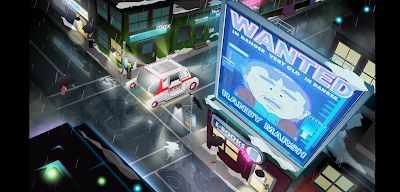
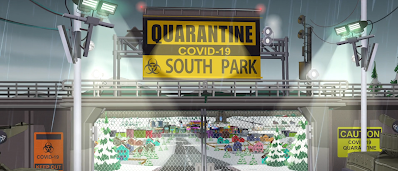
A new Covid variant, called the Kenny McCormikron, has all of South Park quarantined behind wire fences. 

It’s a rain-soaked Bladerunner set and “nobody is allowed in or out for the next 20 to 30 years”.


Randy March has escaped from the Shady Acres Retirement community, clutching his last Tegrity Farms marijuana plant. After beating up some Shady Acres workers who have tracked Randy down, Token Black (flashing his badge) takes Randy to Kenny’s lab. There, with Kyle, Stan, Wendy and Jimmy, they find Kenny’s computer can’t be opened without a voice command from Kenny’s partner Victor Chouse, now in the South Park Mental Asylum Plus. 

To make matters worse, how can they find the aluminum foil they will need for time travel? All supplies are stuck on cargo ships off the Long Beach coast.

At the Asylum, they find Victor Chouse is really Butters, who has been calling himself Victor Chaos ever since his parents accidently grounded him 16 years ago. Butters is also a full-on NFT (non-fungible tokens) snake-oil salesman and is financially ruining his victims with unique digital art tokens that operate on cryptocurrency platforms.


In the lab, Randy is growing marijuana plants, believing this will save the world. The others, however, plan to time-travel Kyle and Stan back to China to stop Randy having sex with the pangolin, thereby stopping Covid before it started.


Randy: I’m sorry, but focusing on who started the pandemic is racist…you people need to stop trying to change the past. COVID happened. Space Jam 2 happened.

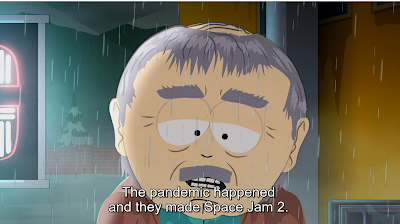
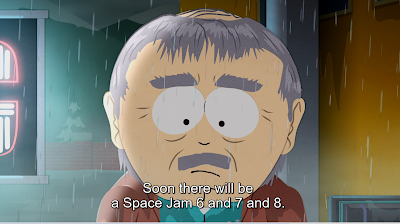
Later, Randy is sitting in a Bladerunner rain:

Randy: The pandemic happened and they made Space Jam 2…soon there will be a Space Jam 6 and 7 and 8…Like tears…in rain.


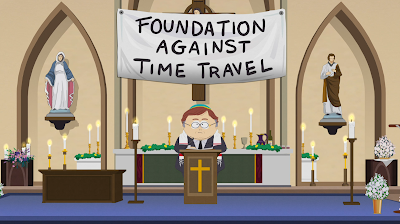
Rabbi Eric Cartman, with his wife Yentl and their three children Moisha, Hackelm and Menorah, use the South Park Church for his Foundation Against Time Travel (FATT) designed to prevent Kyle and Stan from stopping Covid and thereby depriving Cartman of his new, idyllic Jewish life and family.


Cartman starts his Foundation, recruiting Butters and the unvaccinated Craig (“the vaccines grow titties on your head”). Having stolen the time travel equipment and set it up in the Church, Cartman reveals his plan to send Clyde back in time to kill Kyle before he grows into an adult and then time-travels back to stop Covid.

Partially wrapped in aluminum foil, Clyde, Stan, Kyle and Cartman all time-travel to the past where Clyde tries to shoot the young Kyle, but instead is shot by a reformed Cartman who sets about restoring his friendship with his friends before they travel back to their adult lives.

Randy, meanwhile, has grown a new marijuana crop and gives it away for free. It’s so good, everyone starts forgiving everyone for the way they treated everyone during the 38-year pandemic. 

This even includes the rioters who attacked the Capitol Building who now stand holding signs OUR BAD, WE WENT A LITTLE BONKERS, OOPS, WE ARE Q AND WE ARE SORRY TOO

Rioter: We were like, ok, let’s storm the Capitol! And that was just a bad idea, you know, we were just going a little bonkers there. We shouldn’t have stormed the Capitol.


The listening crowd cheer and hold up signs WE ALL MAKE MISTAKES, NOBODY’S PERFECT, CAN WE START OVER?

The basketballer LeBron James is on a film set: I’m sorry, I’ve thought about it and I just can’t do Space Jam 2. I just can’t support Chinese censorship. 

Producer: Oh, yeah? Well, if you’re not gonna make Space Jam 2, then I’m not gonna make Space Jam 2! And nobody’s gonna make Space Jam 2!

The film crew cheer and throw scripts into the air.

And Cartman? Last seen drunk and homeless on the street, screaming: Fuck you guys!...Fuck you, Kyle! Fuck you, Stan! Fuck you, Butters…

Friday, 12 November 2021

Sydney Film Festival - Rod Bishop recommends THE YEAR OF THE EVERLASTING STORM (Jafar Panahi, Anthony Chen, Malik Vitthal, Laura Poitras, Dominga Sotomayor, David Lowrey, Apichatpong Weerasethakul, USA, 2021)


The better Covid-19 films to have come our way include scriptwriter Jack Thorne’s care-home drama Help (with Jodie Comer and Stephen Graham) and the two documentaries: In the Same Breath(Nanfu Wang) and Totally Under Control (Alex Gibney, Ophelia Harutyunyun and Suzanne Hillinger).

The Year of the Everlasting Storm is an art-house contribution and its seven short films make for an enthralling couple of hours.

The opener is set in Tehran, in the apartment belonging to Jafar Panahi, the Iranian film director who was placed under house arrest in 2010. It opens with his huge pet iguana, Iggy, lusting after some pigeon eggs beyond the lizard’s reach on an outside balcony. When the intercom rings, Panahi and his wife Tahereh think it’s probably someone from the Covid Unit, but it’s his 90-year-old mother in full PPE, strolling in and spraying everything in sight with an antiseptic wipe (like a real-life South Park skit).

The family use mobile phone video to connect with their daughter in Paris while Iggy prowls the corridors, sometimes retreating into his safe haven under a cupboard and then finally watching - while being stroked and sung to by Panahi’s mother - as a hatchling emerges from one of the eggs. There’s a lightness of touch to Panahi’s short despite the constant elliptical references to disease and death. Beautifully and lovingly made. 

A further three shorts from Wuhan, Santiago and California are also family-based and share similar reactions to lockdown isolation. Like Panahi’s film, they all show different ways of transcending the horrors of pandemic life. 

In her short, Laura Poitras, who made the Edward Snowden doco Citizenfour, uses an international group of activist journalists who are terrified by the Pegasus software being used on mobile phones to surveil private citizens. Many of them have been targets themselves and give examples of its use (including the killing of Jamal Khashoggi). Chillingly, they warn of the marketing of Pegasus software for Covid contact tracing.

The David Lowery and Apichatpong Weerasethakul contributions don’t directly reference Covid at all. Lowery weaves a tale of exhumation, the body of a New Orleans boy who seems to have died of a past pandemic disease, or maybe during Hurricane Katrina. His body was buried in Texas and is reclaimed at night by an unknown woman. 

Weerasethakul has us looking at white sheets teeming with insects that have been attracted to a bed by a host of overhanging florescent lights. A gecko clings to the underside of one light, the heat causing it to constantly move its legs, rather than give up access to all these delicious insects. 

The Thai auteur, always enigmatic, cinematic and speculatively interpretive, lets us gaze into an apparently chaotic test-tube of the natural world where the behaviour of even the smallest of insects is beyond the control or understanding of humans.

One screening remains of this film at the SFF on Sunday 14 November at 8.30 pm, Event Cinemas George Street.

TO BOOK TICKETS CLICK HERE 


Wednesday, 9 December 2020

Defending Cinephila 2020 (3) - Trump, Melville, Thornton...more


The Trump Taxonomy

It is a bit creepy to think that it took a pandemic to dislodge Trump from the Whitehouse – a quarter of a million dead, intensive care overrun, more to come - and still 75 million people voted for him. Back in December 2016 Rod Bishop took to analyzing movies according to their Trumpian voter taxonomy. 


“Is there a single character in Hell or High Water who would have voted for Clinton? Or a single character in Master of None who would have voted for Trump? How about the cast of Maggie’s Plan? Surely all for Hillary. Show Me A Hero? Most likely anyone but Trump. Making of a Murderer– all Trump?


“If they were forcibly led to a polling station, the black football students in Last Chance U are likely to all be Democrat. But what about the teaching staff and that white boy who could throw the football like a homing torpedo? No doubt about the entire cast of Preacher. all Trumpers, through and through.


“The border guards in the doco Cartel Land are no brainers. As are the white supremacists in the doco Welcome to Leith. Ironically, even the good townsfolk who tackled the bad guys in depressed rural Leith would most likely have voted for The Donald as well.


“The Night Of? Hard to see any of that crowd voting for Trump, but things break down with Mr. Robot(series two). Loaded up with fsocietyanarchism, can you imagine any of them in a voting booth, let alone discussing party politics? Bad for the image.”


Film Alert 101 as prescience. By 2020 we could contemplate whether the sassy women in Lorene Scafaria’s Hustlers, notwithstanding their race and colour, Trumpistas? Maybe they didn’t vote at all, having far more on their mind. Certainly the entire onscreen cast of The Loudest Whisper, notwithstanding the indignities inflicted on them by Roger Ailes and others, were likely Trump fans to the end. The workers in Steven Bognar & Julia Reichert’s doco American Factory would have got the Trump message loud and clear. The community in Phillip Noyce’s Above Suspicion would follow the Donald to the ends of the Earth…and so it goes. Hopefully the nightmare is over…


The Pandemic

Cinema going as we know it may be either over, for good, or we may be merely in the sort of shock phase once induced by the arrival of VHS (and Betamax). Such a shock can be recovered from but streaming services seem to be way beyond home video as a threat. What was never stated back in the pre-DVD days was the absolutely crap quality of VHS – full frame, murky pictures that served as a reminder that going to the movies was qualitatively better. No more. Massive screens and 1080 and HD pictures are now as good or better than what you see in a cinema and the shock of discovery that the pandemic caused may well last beyond our lifetimes.


Jean-Pierre Melville

Not on Netflix or Stan or Binge or anything, at least down here. StudioCanal’s back catalogue of six of the master’s best, of the 13 features he made, screened at the Randwick Ritz. You can buy them in a box set in the UK but the big screens (including two shows in the 700 seat Cinema 1) showed them off to perfection. Not that the selection pleased all. “Where is Le Samourai? asked Bruce Beresford’s 13 year old grandson. 


Warwick Thornton

In yet another otherwise generally dismal year for Australian cinema, notwithstanding the ever-increasing expenditure of hundreds of millions of taxpayer dollars, with near twelve hours of television Warwick Thornton set the gold standard. The Beach screened on SBS and later on the BBC, and series two of Mystery Road, screened on the ABC and also on the BBC. Mystery Road won the AACTA for best TV drama and was nominated in a lot of other categories. The Beach wasn’t nominated for anything, though Selling Houses Australia was in the “Best Lifestyle Program” section.


Things which took me by pleasant surprise

Adam (Maryam Touzani)

The Assignment (Walter Hill)

The Assistant (Kitty Green)

Bait (Mark Jenkins)

Blow the Man Down (Danielle Krudy & Bridget Savage-Cole)

Chess in the Wind (Mohammad Reza Aslani)

Corpus Cristi (Jan Komasa)

Just Imagine (David Butler)

The Mad Fox (Tomu Uchida)

Max and the Junkmen (Claude Sautet)

Suzaki Paradisu (Yuzo Kawashima)

Trapped (Vikramaditya Motwani)

White, White Day (Hylnur Palmason)


Donne e Soldati

Festivals Online

Not my idea of fun. Paying regular cinema prices to watch something on a computer isn’t my bag but I did succumb to Il Cinema Ritrovato’s offering (paid for as part of a subscription that never got to be used). I was grateful to see Melville: The Last Samourai, Donne e Soldati, I Cento Cavalieri, Ladies Should Listen, Liebling der Gotter, Let us Live, Chess in the Wind, Monangambee, Aime Cesaire: Le Masque des Mots  and Att Doda ett Barn/To Kill a Child. Lockdowns or no I’m not up for much of this.

Tuesday, 8 December 2020

Defending Cinephilia (2) - From Paris John Baxter tells tales of plague, lockdown and Christmas cheer... and remembers Dusan Makavejev


Dusan Makavajev

DUSAN MAKAVAJEV R.I.P.

            Dusan Makavajev’s death in January 2019 went largely unremarked. Not surprising, as many years had passed since Sweet Movie, W.R. Mysteries of the Organism, Montenegro and The Coca Cola Kid induced waves of amusement or protest (more oftenboth.)  His last screen credit was in 1996 for Danske piger viser alt , aka Danish Girls Show Everything. Belying its title, this is a discreet film à sketches from various hands, sociologically illuminating but with little or no sex; a surprise, given Dusan’s lifelong ambition to épater les bourgeois. 

            For a while we were neighbours in Paris. His apartment was in the same building as our local supermarket -Anna Karina was another regular –  and we’d bump into one another as he inched down the aisles, hunched over a chariot filled mostly with beer.  He was in no hurry to leave, since the market was warm, and the trolley as supportive as any Zimmer frame.

            Inspired by the ambiance, he described a trip he and his wife made back to Serbia for the fall of the Milosevic regime.  The hysteria had mellowed into confusion, marked by frequent marches, which the Makavajevs dutifully watched from their apartment window. Since the electricity worked only intermittently, Dusan decided to join one, mainly to keep warm. He had no idea what issue it was supporting. Curious, he worked his way to the head of the parade, where two men carried a large cloth banner.  It said, simply, Sauerkraut.  

            Dusan marching for sauerkraut makes more sense than him supporting a political or social issue, about most of which he was indifferent. His appetites for food and sex, on the other hand, were voracious. On deplaning in Sydney to make The Coca Cola Kid,his first demand was to visit a Reichian therapist. He was duly delivered to an innocuous bungalow somewhere along the northern beaches and didn’t emerge for four or five hours, when, refreshed by his spell in the orgone box, he directed his minder to the nearest MacDonalds.  After six Big Macs, he pronounced himself match-fit  

            We met a few times during the making of The Coca Cola Kid; meetingsilluminated by tales of cinematic duplicity and Yugoslavian chicanery. About our country, he was ambivalent. So much potential, so little achievement.  “Australia is Switzerland,” he decreed, “but it wants to be Texas.” 

                                                         *

Keira Knightley, Colette

MAKING MISCHIEF WITH KEIRA.

            I have what the French call a beguin for Keira Knightley. It dates back to her radiant appearance in Love Actually but my impression that the screen lights up when she appears was reinforced by Pride and Prejudice and that Chanel commercial in which she roars  through Paris on a white motorcycle.  Hoping to exorcise this ensorcellement my daughter took me to see A Dangerous Method but watching Miss K. being spanked by Michael Fassbender just fanned the flames.  

            Wash Westmoreland’s Colette dates from 2018but escaped me until this year, since when I’ve watched it repeatedly.

            The quality of mischief is rare in modern cinema; in cinema of any period, come to that. Clara Bow had it, and Irene Dunne – remember her in History Is Made At Night, teasing Charles Boyer about the tell-all telegram from his girlfriend? “Do you think it will ever replace baseball?”  

         Today’s actresses can guffaw, sneer or smirk, but few have a giggle in them. 

            Knightley’s Colette is mischievous passim.  She sets the tone as a teenager, demurely greeting Willy (Dominic West), her father’s old companion-in-arms, when he visits their home, then sneaking off for a quick shag in the hayloft.  Where any run-of-the mill actress would glower as Willy accepts the plaudits of the crowd for the book she’s written, Knightley’s mocking smile is as full of contentment as of malice.  Most cross-dressing actresses  put on drag like a uniform, where, for her, the starched white shirt and black tie, like Marlene Dietrich’s smoking, is the signal of an inner transformation, and the garments just the outer manifestation. Her sideways grin invites us into the deception. Look how we fool them!  More mischief, please.

                                                                        *

Gold Class, Event Cinemas, Sydney

A SNACK WITH A FLICK.

            As cinemas remained dark during the Covid 19 lockdowns, optimistic forecasts suggested that a night at the movies might be given new vitality if wine, beer and even food were served at one’s seat. 

            Responses were decidedly salt-and-vinegar. That popcorn and Coke are how movie-houses make their money is common knowledge, but on those with bars attached, where you can drink and snack at your seat, the jury is still out. (Do they still exist in Australia? I await an encyclopedic account of their popularity, probably with photographic evidence, if not menus and greasy napkins for proof.) 

            In England, they were touted for a while as the wave of the future. Cup-holders sprouted on the seats in most West End cinemas, and in such civilized venues as the Everyman in Hampstead, small tables were fitted, with a loop to accommodate a bottle.

            Serving tea on trays during theatrical matinees had ceased before I arrived in London but in Tokyo the practice flourished. Without the reviving contents of a bentobox, how could one make it through three hours of kabuki? However, as far as I know, the practice never took root in continental Europe – which is a little surprising, since the first public screening of a movie, by the Lumiérès, was in a cafe.  

            Drinking with a movie did survive, for a while at least, in provincial venues where, since there was no actual cinema, films were screened in the beer garden behind a bar. You sat on stackable chairs watching the image projected on a white painted wall, the sound-track compromised by poor amplification and the conversation from inside. Periodically, and apparently at random, the film stopped for visits to the loo, and replenishments of Stella Artois. 

            We survived smoking in cinemas so perhaps we could become accustomed to food and drink. I’d ask only that noise be kept to a minimum. There are few distractions more galling than the rustle of bonbons being unwrapped and fingers rummaging in tubs of popcorn. An old friend found them intolerable. At the first crackle, he was on his feet, bawling at the offender “What are you doing? Building a nest?”  

                                                                        *


GOD REST YE MERRY.

            Some time every Christmas, I find a pretext to watch the episode In Excelsis Deo from Season 1 of The West Wing.  

            I saw it first in Byron Bay. as a guest of the Writers Festival.  Insomniac with jetlag, I fell into the series, which was new to me. Once the sun came up, I rented the whole first year and binge-watched it over two or three days.   In Excelsis Deo was the sixth episode, and a Christmas show, but though I was seeing it with curtains drawn against the glare of the Australian sun,  its setting in a wintry Washington DC felt more real than what waited outside. I hardly knew Australia any more but had lived for some time in Virginia, not far from DC.  Everything conspired to validate Proust’s insight that places and things exist only insofar as we remember them, “and houses, trees and avenues are as fugitive, alas, as the years.”

            The issues of In Excelsis Deo rang particularly true. A family member whom I hadn’t seen since infancy lived near Byron Bay, and a meeting had been arranged with her and various siblings. It was not an encounter to which I was looking forward. 

            Presidential speech-writer Toby Ziegler (Richard Schiff), the White House’s resident conscience, is called by the police to explain why a homeless man who died of exposure has his card in his pocket. The explanation is innocent, but Toby notices that the man, as a Marine, was entitled to be buried in Arlington. Responding to impulses that he never explains, but which need no explanation, he arranges a military funeral, even though it means forging the president’s signature.  The sole festive element occurs at the conclusion, which cuts between a White House carol service and the burial at Arlington.  The loneliness and dignity of one ritual neutralises the other’s sentimentality. Everyone at the funeral looks believably strained. I liked the nervous start of the mourners at the gunfire of the salute.  

            My family meeting, though not exactly pleasurable, went better than expected. Maybe the film helped.  I was amused to read later that a fight erupted between Sorkin and co-writer Rick Cleveland over credits for the episode (which won an Emmy for Outstanding Writing for a Drama Series.) Someone didn’t get the memo about tidings of comfort and joy.

                                                            *          


“I’M MAD AS HELL...”  

                        Shortly after the pandemic started to spread, reports from China, disseminated by social media, described anonymous voices in the night shouting from the roofs of apartment buildings. Many people thought they said "Keep up the fight!"  

                        As communities across the world imposed quarantines and curfews, a custom grew up of people confined to inner city apartments coming to their windows or balconies each evening and applauding. In Italy, some sang operatic arias and popular songs, chanted football mantras, played instruments and waved flags. In Britain, Spain, Turkey and India, they did so at 7pm, but in Spain and France, in recognition of a preference to eat late, the applause took place at 8. 

                        In Paris, quarantine began at noon on March 17, 2020. It would last for 55 days.  Shops, offices, schools, restaurants, cinemas and museums closed. Only food shops remained open. Initially we were allowed out for one hour a day. We had to wear a mask and carry a document indicating where we lived and at what time we left home. Transgressors were fined, even jailed.  Paris became a ghost town – except for those moments each night when, as a few distant church bells ceased pealing, windows opened or people came out onto their balconies, and applauded.  

                        My wife and I, as well as our daughter and anyone else who happened to be in the apartment, automatically stepped out onto the terrace and joined in. We waved and smiled to neighbors across the narrow canyon of rue de l’Odéon – a bonding in adversity that soon became as important as the volume of applause.  

                        Naturally we thought of Network, the 1976 film written by Paddy Chayefsky. It imagined a similar outpouring of solidarity and discontent when, egged on by a television news-reader in the grip of paranoid schizophrenic delusions (Peter Finch, in a performance that earned a posthumous Oscar),  people all over the United States opened their windows and shouted “I’m mad as hell and I’m not going to take it anymore!”  But who were we applauding? This was as vague as what the protestors of Network  were “not going to take.” Certainly the medical services deserved our appreciation. But essentially, our “hopes and prayers”, to use the ruling cliché, were not only with them. We were also, like those fictional crowds in 1976, encouraging ourselves.   

Saturday, 5 December 2020

Defending Cinephilia in the year of the Plague - Rod Bishop leads off the annual survey of 5 Cinephilic things from 2020


SOUTH PARK: THE PANDEMIC EDITION (Trey Parker, Matt Stone, Brian Graden, USA, 2020)


What follows is all Spoiler.


South Park’s marijuana dealer Randy Marsh has packaged his product into a “Pandemic Special”, including a complimentary Pandemic bong. 


Business is booming until he sees a news broadcast blaming Covid on a Wuhan bat. He is devastated. In flashback, we see Randy and Mickey Mouse on a business trip to Wuhan where they take turns having sex with a bat. 


A panicked Randy immediately calls Mickey, who is now running Disney:


“What do you want Marsh?”

“Do you remember when we fucked that bat in Wuhan?”

“I fucked a lot of bats.”

“Well, I only fucked one. I remember I got really sick. This was all back in October.”

“Jesus Christ! You fucker! You started all this!”

“You told me to fuck the bat.”

“Didn’t you quarantine yourself after you got home?”

“Nobody knew anything about Covid when I fucked the bat...if my wife finds out I started the pandemic, she’s gonna be a total bitch about it!” 


Eric Cartman, that wonderfully misanthropic, overweight, foul-mouthed South Park kid is delighted by the Covid restrictions. His first appearance in this 45-minute special is a song-and-dance routine, chortling over the glories of social distancing.


He doesn’t have to meet and talk to his friends and he finds a way to effectively sabotage his Zoom school attendance.  Best of all is the 6-foot pole he uses like a lance to enforce his distance from others. It’s particularly effective on his mother.


To Cartman’s utter dismay, South Park Elementary is to reopen with an all-new teaching staff: the armed cops who have lost their jobs during the recent defunding of the police force.


The pupils are socially distanced behind individual screens but this doesn’t stop Cartman starting a fight with Kyle and in the chaos, the cops shoot a black student called Token.


The news media are announcing a pangolin from Wuhan as the new suspect in Covid transmission to humans. Randy Marsh and Mickey Mouse are horrified, they also had sex with a pangolin in China.


The pangolin is brought to the States for scientific research, but Randy steals it. Mickey threatens to kill Randy and turn his DNA over to the scientists who think the “foreign” DNA that is “up, inside” the pangolin might lead to a Covid cure. 


Inspired by this news, Randy starts mixing his semen with his marijuana and forces Jimbo, a hospitalized Covid patient, to smoke it. Next day, Jimbo has miraculously recovered, so Randy sets about ejaculating into all of his marijuana stash and selling it at Covid-like drive-throughs. 


Jimbo, however, has now grown a moustache identical to Randy’s and the hospital has filled up with patients, both male and female, who have all grown Randy moustaches.


Dr Anthony Fauci tells people to wear masks over their moustaches and the news media advise everyone to self-isolate at home and consume more of Randy’s marijuana Pandemic Special.


Back at the school, the cops are locking the students inside for a two-week quarantine and are claiming Token, the black student they shot, was Covid-infected:


STAN: “Um, we were there and Token was actually taken to the hospital because you guys shot him.”


COP: “Yes, due to Covid. If it weren’t for Covid, all the previous teachers would have still been here, we wouldn’t have been in the class, and nobody would have got shot. Therefore, the young man is in the hospital due to Covid. It was Covid-related.”


STAN: “That doesn’t make any sense.”


Over at The White House, the President is refusing to do anything about fighting the virus because Mexicans and other minorities have higher death rates than whites.


The students stage a mass breakout from quarantine and in the finale the police are about to shoot them all when the President appears with a flamethrower and incinerates both the chief scientist and the pangolin.


IN MY BLOOD IT RUNS (Maya Newell, Australia, 2019)

Dujuan Hoosan is having a hard-time at school in Alice Springs. 

A bright and articulate 10-year-old Arrernte boy, Dujuan is reportedly rude to his teachers. He is certainly exquisitely bored, except during Arrernte-language classes. He runs away every day, putting himself in danger of foster care or youth detention and risking his family’s welfare payments.

Maya Newell’s ‘observational documentary’ contains two hard-to-believe scenes from Alice Springs school-life. 

The first is a teacher reading from The Australia Bookby Eve Pownall (first published in 1952): 

“Listen carefully, this one isn’t a story or non-fiction, it’s information, it’s fact, it’s about the history of our country”. 

Captain Cook’s landing at Botany Bay and his voyage up the east coast is lauded and his planting of the English flag on an island at Cape York is celebrated as claiming “for the English country the whole of this new land”.

The kids are then told to use textas to mark important landmarks like Botany Bay, convicts and Arthur Phillip.

Later, Dujuan muses to himself: “The history that we’re told at home is in language and it’s about Aborigines. But the ones back at school, that was for white people.”

The second incident comes from another white teacher reading aloud from a book about the Dreamtime:

“There was a Dreaming of fire and the colour of fire burned brightly in the mind of the Great Spirit.”

She turns to the kids: “So they’re actually saying there is a Spirit. I’m not exactly sure how they do it, there’s a Spirit somewhere and in that Spirit, they have the Spirit of fire…”

One boy interrupts: “Spirit is real, ay.”

The teacher ignores the interjection and continues: “For a long time the battle of the wind, the fire and the rain raged in the Dream and the Great Spirit liked the Dream, so the Dreaming continued.”

She turns to the kids again: “Can you understand that? I’m glad you can, because I find it a bit confusing about the Spirit and the Dreaming…We’ve just got to believe it.”

Breathtaking in its ignorance and its patronage particularly as the class has many ten-year-old Indigenous children.

Newell immediately cuts to a sequence with Dujuan and the other children as they draw and talk among themselves without any white teachers around:

“What’s your Dreaming?”

“Lizard.”

“Perentie?”

“Yep”

“What’s your Dreaming?”

“Snake.”

“White cockatoo?”

“Crocodile?”


All Dujuan wants is his Indigenous identity, his land, his community, his family and his history. He just wants himself. But he’s stuck between the white colonialism so grossly on display in his school-life and the possibility of his truancy alternative – colonial-era incarceration and welfare punishment for his family.

There is a third astonishing sequence in this predominately restrained and understated documentary. It’s almost thrown away – an ABC news item read over a wide-shot of Alice Springs at dusk:

“The Northern Territory’s Police Commissioner has revealed plans to send a unit of camouflaged, specialized police with military-grade weapons to control Alice Springs at night. And it’s part of the Australian government’s national counter-terrorism task force.

The announcement comes a week to the day since a Royal Commission delivered its report on youth detention and child protection systems in the Northern Territory”.

Although not included in this documentary, Dujuan, at 12-years-old, addressed the Human Rights Council at the United Nations in 2019. He is thought to be the youngest person to ever do so. Excerpts:

“[In My Blood It Runs] was filmed when I was 10 years old. It shows what it feels like to be an Aboriginal kid in Australia and how we are treated every day…I want Australia to tell the truth that Aboriginal people were the first people who had the land…

…the film shows me working to learn Arrernte and about being Angangkere…which means I am a traditional healer. It is my job to look after my family with my healing powers…

…I feel strong when I am learning my culture from my Elders and my land…This is who I am and they don’t see me at School…I think schools should be run by Aboriginal people. Let our families choose what is best for us. Let us speak our languages in school…

…The film shows Aboriginal kids tortured in juvenile detention. I know a lot of kids who have been locked up. Police is cruel to kids like me. They treat us like they treat their enemies…

…I was lucky because of my family. They know I am smart. They love me. They found a way to keep me safe. I am alright now, but a lot of kids aren’t so lucky…

…my film is for all Aboriginal kids. It’s about our dreams, our hopes and our rights. I hope you think of me when you are telling the Australian government how to treat us better.”


THE PAINTED BIRD (Václav Marhoul, Czech Republic/Slovakia/Ukraine, 2019)

 
Xan Brooks, published in The Guardian on 3 September 2019:

“One day they’ll make a film about the first public screening of The Painted Bird, inside the Sala Darsena at the 2019 Venice Film Festival. It will feature the man who fell full-length on the steps in his effort to escape and the well-dressed woman who became so frantic to get out that she hit a stranger in the next seat. The centrepiece will be the moment 12 viewers broke for the doors only to discover the exit had been locked…After it’s over, the auditorium is hardly half full. Those who remain have decided to ride the rollercoaster right through…”

The cause of all this mayhem is a film about an orphaned and homeless Jewish boy who wanders through non-specific Nazi-occupied Slavic countries during World War Two. He experiences, and bears witness to, considerable depravities including beatings, torture, eye-gouging, child sex, executions, sexual assault, bestiality, rape (one with a bottle) and the burning of an entire village and the murder of many inhabitants. 

It’s three hours of hell inside a thinly veiled Holocaust metaphor.

Years ago, I periodically attended international film school congresses. Strange things would often happen and the antics of the Slavic delegates were particularly endearing.

They would carefully choose their time and place. During a session on, say, “Digital Transformations in Film Schools” one might stand up during the question time, but never ask a question. Instead, he would deliver an uninterrupted, improvised 20-minute oration on the mystical and poetic properties of black-and-white celluloid film stock. 

Cinematographers, he would tell us, are the greatest artistic contributors to the cinema and their palates are being destroyed by the move to digital filmmaking. Everyone remained patient until, exhausted, he sat down. “They do this” whispered the Brazilian delegate next to me.

The Slavic enthusiasm for cinematography is on fine display in The Painted Bird. Vladimir Smutný has used black and white 35mm Kodak stock and his work is transcendently beautiful, providing a most remarkable visual counterpoint to the devastation he photographs. It’s like peering into a crystalline landscape to view atrocities through the painterly clarity of Vermeer or the pristine detail of a medieval illuminated manuscript.

I have previously written of the group-think mania that can take over press rooms at major film festivals. Reading the reviews of The Painted Bird’s screening at Venice a year ago, you’d be forgiven for thinking Marhoul had exceeded the excesses of Gaspar Noé or Lars Von Trier or even the Pasolini of Salò, or the 120 Days of Sodom.

What we see in The Painted Bird isn’t more graphic than scenes from the three films it most closely resembles. The eye-gouging isn’t more horrifying than the melted crucifix being poured into the mouth of the bishop’s assistant in Andrei Rublev. The sex scenes involving the boy aren’t any more confronting than the sex scenes with the drummer boy in The Tin Drum. And the slaughter of a village by Russian Cossacks isn’t any more bloodthirsty than a similar Nazi slaughter of Belarusian villagers in Come and See.

In this film Marhoul’s vice-like direction and clarity of purpose is at least the equal of Tarkovsky, Schlöndorff and Klimov. 

The director hit back at the press after the Venice Festival. Referring to the 14 million who died in the Slavic regions during the reigns of Hitler and Stalin, Marhoul said: “compared with reality, the film is toned down”.

He disputes the press beat-ups:

“At the first screening, it was 1,500 and a maximum of 70 walked out. That means 1,430 people stayed. And the next day, from 1,200 people, maybe five left.”

The Painted Bird failed to pick up a single award at Venice despite speculation it might walk off with the Golden Lion. Of the eventual winner, Joker, Marhoul commented:

“The violence in Joker is much more visible, much more brutal, but Joker didn’t get the same reputation…Joker is a comic book character, but The Painted Bird is truthful. So, audiences are scared, but they’re not scared about my movie. Maybe they’re scared about themselves – because I’m showing them something in their own minds, in their own hearts, they would like to hide from. Maybe this is the problem.”


AN OFFICER AND A SPY (Roman Polanski, France/Italy, 2019)

Another controversial film at the 2019 Venice Film Festival, this one from Roman Polanski, won second prize - the Silver Lion. Under a storm of new and old allegations of sexual assault against the director, An Officer and a Spy(J’accuse) also won three Césars in France, (Best Director, Best Adaptation, Best Costume Design). It’s been released in more than a dozen countries, but none of them are English-speaking. 

Is cancel culture a predominately Anglo-Saxon thing?

Writing in Cineaste (Vol. XLV, no.3), Robert Koehler suggests the history of art is full of moral monsters who “create great, enduring works.” He asks:

“Can we reject wholesale Ezra Pound’s poetry based on his fascist politics?...Do Chaplin’s scandals with underage girls disqualify him as one of the supreme artists of the cinema and possibly the giant of the silent era? Does Miles Davis’s documented history as a wife-beater cancel his greatness as the key artist in modern jazz history?...Can Eisenstein’s and Vertov’s early Soviet masterpieces be viewed as defenses of an incipient totalitarian state? Leni Reifenstahl’s of Nazism? They can. And they can also be makers of great cinema.”


Doco Series:

Cheer (Greg Whiteley, USA);Country Music (Ken Burns, USA); Agents of Chaos( Alex Gibney, USA)


Films


1917 (Sam Mendes, UK/USA/India/Spain/Canada/China); Honey Boy (Alma Har’el, USA); First Cow (Kelly Reichardt, USA); I’m No Longer Here (Fernando Frias, Mexico/USA); Les Misérables (Ladj Ly, France); Matthias & Maxime (Xavier Dolan, Canada/France); The Assistant (Kitty Green, USA); The Song of Names (Francois Girard, Canada/Hungary/UK/Germany)


The Beach

Docos


The Cave (Feras Fayyad, Denmark/Germany/France/UK/USA/Qatar/Syria); A Secret Love (Chris Bolan, USA); American Utopia (Spike Lee, USA); Fireball: Visitors from Darker Worlds (Werner Herzog, USA); For Sama (Waad Al-Kateab, Edward Watts, UK/Syria/USA);Honeyland (Ljubomir Stefanov, Tamara Kotevska, Republic of North Macedonia); The Beach (Warwick Thornton, Australia); Totally Under Control (Alex Gibney, USA); What Are You Gonna Do When The World’s On Fire (Roberto Minervini, Italy/France/USA); Zappa (Alex Winter, USA)


 Babylon Berlin

Drama Series


Babylon Berlin 3 (Germany); I May Destroy You (UK); The Bureau 5 (France); The Good Lord Bird (USA); The Queen’s Gambit (USA); Unorthodox (USA); The Salisbury Poisonings (UK); Watchmen (USA)


CONTRIBUTIONS WELCOME: Send lists, comments, dot points or any thoughts to filmalert101@gmail.com All contributions published.