Showing posts with label Animation. Show all posts

Wednesday, 5 March 2025

The Current Cinema - Barrie Pattison unearths NE ZHA 2 (Yu Yang, China, 2025)


Yu Yang
’s new  Ne Zha 2 -  the0 Nezha Mo tong nao hai follow up - is, they are telling us, the most successful animated film of all time. I have to wonder about this as the one of the eight-a-day sessions I attended drew only a single figure attendance by lights down, despite all the sold seats indicated on the plan. There was also female giggling issuing from a stall in the blokes’ loo before the session, which I felt it better not to investigate.

The film might be more approachable if you see part one but what we end up with is a brain frying succession of wide screen set piece displays with a few anime characters wandering through them. The plot finally settles into a Kirikou rip off.

It  has the rebellious kid Ne Zha (Yanting Lü) who is half of the Chaos Pearl with Ao Bing (Mo Han), a more sedate character. After some gross-out bodily fluids comedy, suited to his tot aspect, we get down to what passes for a plot with the immortals battling monsters as represented by the Dragon King rulers of the Four Seas, setting their sea creatures against  the Chan Sect’s  bearded baby Wuliang from the Yu Zu Palace on a cloud, with the valiant human defenders of the Chentang Pass as victims of The Dragon Rulers of the Four Seas. The master pan is to convert opponents into immortality pearls in the mighty heavenly cauldron. Devices like the sky splitting severed hand are employed by faltering frozen parents and a chubby stone matron who ends up as rocks imprisoned in a metal cage, while hostile Badger Armies and  (impressive) underwater dragons, which are normally found only in the Eastern region, get into the combat. Will our hero be able to withstand the ice thorns which have immobilised him as the true author of the celestial  infamy is revealed?

Admirers of King Hu (Touch of Zen’s immortals on wavering bamboo stalks) and Li Han-hsiang (Love Etern’s derisive white outfit idlers) will recognise their influence. The panoramas of grotesque monsters from Asian traditional art and kiddie literature are impressive but constant barrages of them tend to have a numbing effect. The film just keeps on going long after the big screen impact of its great design and laboratory work has been absorbed. We end with a joke anachronistic routine  embedded in the end titles  Toon freaks and curious tinies are likely to enjoy it.

Thursday, 3 October 2024

The Current Cinema - Barrie Pattison recommends the unique film-making of Adam Elliott - MEMOIR OF A SNAIL (Australia, 2024)


Adam Elliot (above) can count himself as one of the rare successes of current Australian filmmaking. He looks with gratitude to the county's subsidised system. Getting
 Harvey Crumpet's Oscar didn't do any harm either. Stepping back from the big bucks of U.S. filmmaking has been added to his painstaking 3D stop motion methods. His animators can average ten seconds a day. One model maker spent near a week gumming in the wire whiskers of the bearded puppet character. This all means Elliot's work comes out widely enough spaced for us to forget about him in between them. It's been five years since his Mary and Max.

Elliot's new film Memoir of a Snail moves away from that one's international model – no U.S. setting, no Hollywood actors. This one embeds itself in the Australia ugly – a protagonist with a cleft palette ridiculed by schoolmates until her protective pyromaniac brother sorts them out. "Childhood is like being drunk: everyone remembers what you did, except you." Separated after the death of their wannabe fire eater parents, young Grace Pudle (Grace Poole?) is raised by a swinger couple, who retire to a Scandinavian nudist colony, while brother Gilbert passes into the care of a rural Christian order, who treat him with gum-on magnets as part of electric shock aversion therapy - till he burns down their church.

Meanwhile, in the awfulness of suburban Canberra, Grace (below), surrounded by her clutter of snail memorabilia, falls for the lure of a pipe cleaner mustache lothario neighbor who offers to leaf blow her lawn. Rendered impotent by his career repairing microwave ovens, he proves to see her as an outlet for his fat fetish. We get an extra helping of cartoon nudity including another of Elliot's bum crack jokes.


With its muted colours and littered art direction, where contributors were encouraged to make their output more ugly, we can't help wondering whether a film which is so intent on rubbing our noses in it ("masturbation is the thief of time") is going to find a place in a market that treasures Frozen 2.

Memoirs of a Snail  is determinedly Australian, littering its frames with references that even locals may have forgotten. Bulging red frankfurters in tomato sauce, Clag glue & Chico Rolls get a curtain call in Melanie Etchells' end credit roll. Dumpy Grace, echoing Elliot's mother's hoarder habits ("I'd never want to offend anyone"), rounds off a line of Australian grotesques that runs through The Sentimental Bloke, Dad & Dave, Alvin Purple, Kenny – and Fred Negro. Where are those resourceful comics of other film industries - Chaplin & Buster, Bob Hope & Adam Sandler? Hoges is all alone here.

Voice casting presented a challenge. Jackie Weaver as a wrinkly chum and Eric Bana doing a legal lion with a thorn in its paw were more than equal to their tasks and brought some international recognition but the local celebrity female stars were a dodgy match with Grace until Elliot was able to get back to casting his Melbourne neighbours after Sara Snook, an early choice, achieved status with the Succession series. Avoiding a funny voice for the lead doing a monologue commentary to an autographed garden pest, is another one of the risky choices. So far everyone seems to accept it.


The endearing Adam Elliot is an authentic one off. ("I always start my film with a sense of anger") Watching how he fares in a film climate that doesn't have a good record with unique personalities will be more than instructive. 

It's just a pity they had to prop up his personal appearances handing out those soggy snail buns. 

Tuesday, 21 December 2021

Streaming on Paramount + - Rod Bishop dives deep into SOUTH PARK: POST COVID – THE RETURN OF COVID (Trey Parker, USA, 2021)


Everything that follows is spoiler, including the excess of subplots and the confusing time-travel
 

PART 1 POST COVID

It’s been 38 years since Covid started and the South Park boys are now middle aged. 

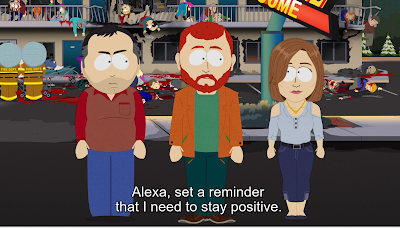
Stan is an online whiskey consultant and co-habits with his Amazon Alexa, a hologram assistant with a serious relationship attitude. Stan can always turn her off and on.

Kyle, now a guidance counselor at South Park Elementary, has summoned Stan and the rest of the gang back to South Park. Kenny grew up to become a famous wealthy physicist, but he really has died this time.


Jimmy has become a late-night talk show host - “the king of woke comedy” - and his material is so lame, there are no jokes, no punchlines, just forced canned laughter from his woke audience. Jimmy, too, heads for South Park cancelling his scheduled guest, the “First Lady Tom Kardashian”.

And Cartman? He’s converted to Judaism, with his trademark beanie turned into a yarmulke. Insisting on being called a rabbi, he arrives with his Jewish kids and smooching over his Jewish wife.

At Kenny’s wake, we see Token Black (now a cop) and Clyde who is refusing to get vaccinated, thereby causing the military to quarantine the town.

Clyde: I can’t get vaccinated because I’m allergic to shellfish

Wendy: Clyde, there’s no shellfish in the COVID vaccine

Clyde: I know, but I read sometimes in the lab where the vaccine is made, if somebody ate shellfish, then it can get cross-contaminated and leave left-over residual shellfish-ness

Jimmy: So, you’re saying you won’t get the COVID vaccine out of shellfish-ness?

Clyde: Yes, that is correct. Just a general sense of shellfish-ness


Kenny has supposedly died of the Covid Delta+ Rewards variant, but the boys decide he was really killed trying to investigate the origins of the virus and they set out to expose the truth.

Stan confronts his dad, Randy (formally South Park’s No 1 marijuana dealer) at the Shady Acres Retirement Community, now tricked up to look like a set from Bladerunner.

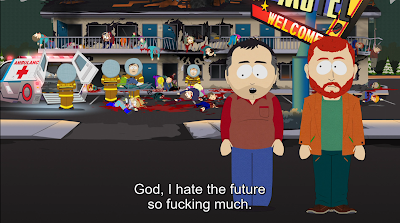
Randy: When the pandemic started you were only a kid. You don’t remember the pain we all went through…we as Americans went through so much. First, that incompetent jack-hole was elected President. Then the pandemic came and then the race wars. And then just when it seemed like we’d turned a corner,Space Jam 2came out and we all just kind of gave up.

Randy then admits to having started the virus when he had sex with a pangolin in China, but his new conspiracy theory blames China for setting up the pangolin sex in order to steal the USA of its “tegridy” - Randy’s own propriety dope crop.

The gang retrieve a USB stick from Kenny’s corpse – it’s up his bum – and watch a video of Kenny attempting time-travel to stop the pandemic. 

In a cliffhanger ending, we are introduced to Kenny’s assistant Victor Chouse at the South Park Mental Asylum Plus. But we see it’s a mispronunciation: Victor Chouse is really Victor Chaos…it’s Butters!


PART 2: THE RETURN OF COVID

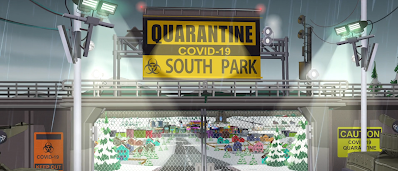
A new Covid variant, called the Kenny McCormikron, has all of South Park quarantined behind wire fences. 

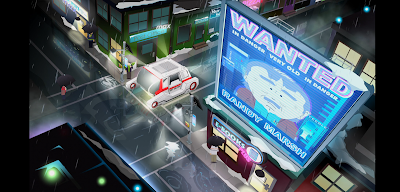
It’s a rain-soaked Bladerunner set and “nobody is allowed in or out for the next 20 to 30 years”.


Randy March has escaped from the Shady Acres Retirement community, clutching his last Tegrity Farms marijuana plant. After beating up some Shady Acres workers who have tracked Randy down, Token Black (flashing his badge) takes Randy to Kenny’s lab. There, with Kyle, Stan, Wendy and Jimmy, they find Kenny’s computer can’t be opened without a voice command from Kenny’s partner Victor Chouse, now in the South Park Mental Asylum Plus. 

To make matters worse, how can they find the aluminum foil they will need for time travel? All supplies are stuck on cargo ships off the Long Beach coast.

At the Asylum, they find Victor Chouse is really Butters, who has been calling himself Victor Chaos ever since his parents accidently grounded him 16 years ago. Butters is also a full-on NFT (non-fungible tokens) snake-oil salesman and is financially ruining his victims with unique digital art tokens that operate on cryptocurrency platforms.


In the lab, Randy is growing marijuana plants, believing this will save the world. The others, however, plan to time-travel Kyle and Stan back to China to stop Randy having sex with the pangolin, thereby stopping Covid before it started.


Randy: I’m sorry, but focusing on who started the pandemic is racist…you people need to stop trying to change the past. COVID happened. Space Jam 2 happened.

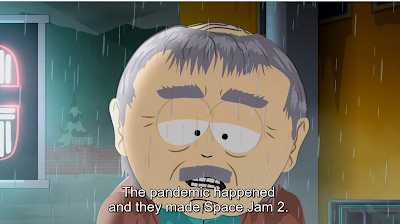
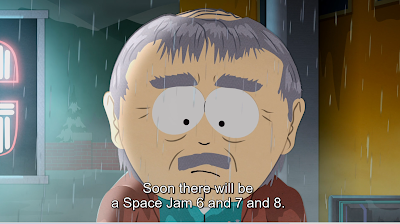
Later, Randy is sitting in a Bladerunner rain:

Randy: The pandemic happened and they made Space Jam 2…soon there will be a Space Jam 6 and and 8…Like tears…in rain.


Rabbi Eric Cartman, with his wife Yentl and their three children Moisha, Hackelm and Menorah, use the South Park Church for his Foundation Against Time Travel (FATT) designed to prevent Kyle and Stan from stopping Covid and thereby depriving Cartman of his new, idyllic Jewish life and family.


Cartman starts his Foundation, recruiting Butters and the unvaccinated Craig (“the vaccines grow titties on your head”). Having stolen the time travel equipment and set it up in the Church, Cartman reveals his plan to send Clyde back in time to kill Kyle before he grows into an adult and then time-travels back to stop Covid.

Partially wrapped in aluminum foil, Clyde, Stan, Kyle and Cartman all time-travel to the past where Clyde tries to shoot the young Kyle, but instead is shot by a reformed Cartman who sets about restoring his friendship with his friends before they travel back to their adult lives.

Randy, meanwhile, has grown a new marijuana crop and gives it away for free. It’s so good, everyone starts forgiving everyone for the way they treated everyone during the 38-year pandemic. 

This even includes the rioters who attacked the Capitol Building who now stand holding signs OUR BAD, WE WENT A LITTLE BONKERS, OOPS, WE ARE Q AND WE ARE SORRY TOO

Rioter: We were like, ok, let’s storm the Capitol! And that was just a bad idea, you know, we were just going a little bonkers there. We shouldn’t have stormed the Capitol.


The listening crowd cheer and hold up signs WE ALL MAKE MISTAKES, NOBODY’S PERFECT, CAN WE START OVER?

The basketballer LeBron James is on a film set: I’m sorry, I’ve thought about it and I just can’t do Space Jam 2. I just can’t support Chinese censorship

Producer: Oh, yeah? Well, if you’re not gonna make Space Jam 2, then I’m not gonna make Space Jam 2! And nobody’s gonna make Space Jam 2!

The film crew cheer and throw scripts into the air.

And Cartman? Last seen drunk and homeless on the street, screaming: Fuck you guys!...Fuck you, Kyle! Fuck you, Stan! Fuck you, Butters…

Tuesday, 16 March 2021

On Vimeo - Janice Tong recommends WITTGENSTEIN PLAYS CHESS WITH DUCHAMP OR HOW NOT TO DO PHILOSOPHY (Amit Dutta, India, 2020)


Directed by Amit Dutta, animation and sound by Ayswarya Sankaranarayanan Dutta,17 mins animated short,

Based on an essay of the same name but slightly extended, Wittgenstein Plays Chess with Duchamp or How Not to Do Philosophy: Wittgenstein on Mistakes of Surface and Depth by Steven B Gerrard, the Professor of Philosophy at Williams College

 *********************

As its title suggests, this alluring animated short film directed by Amit Dutta takes you into an imaginative intellectual journey that is at once beautiful to look at - the animation of Ayswarya is a palimpsestic tease to the eye and her narration crosses the boundaries of philosophy, art, literature, chess and mathematics; and is also conceptually stimulating.

The husband and wife pair balances each other out, Dutta has talked about his own drive and earlier creative surge that was at once unpredictable and free; since their collaboration started, Ayswarya has brought a close reading of texts and research to his work - and you can really see her influence and the melding of their works over the last 3 films they made together: Chitrashala, Drawn from Dreamsand Wittgenstein.

I was lucky enough to catch quite a number of Dutta’s films #mubi at the end of last year; although I would have to say that this auteur is not well-known outside cinephile circles.

So different is this film to his earlier work, Sonchidi (The Golden Bird)which I particularly liked, a kind of philosophical pilgrimage with sci-fi overtones (let’s face it, most pilgrimages have a strong notion of the extraterrestrial to them) that was beautifully shot with a Titian colour palette in parts. The meditative landscapes are reminiscent of Albert Serra’s work, but so very different from Serra’s own film Birdsong, which also had a pilgrimage at its heart. 


It is very interesting to hear Dutta speak about his cinema - he is totally uninterested in the collective viewing experience; for him, cinema is about that very intense and intimate relationship of the individual - so the experience of Dutta’s cinema is through your device, your laptop or hand-held device - it is a very direct form, almost encroaching of your personal space and intellect. Dutta has said that he wouldn’t entertain the idea of having a theatrical release of his films because he feels that theatres are not controlled environments - as a viewer you can easily be distracted by others; he likens the viewing of his films to that of reading a book, and it is just not the done thing, to attend collective reading sessions. As such, his cinema is more intimate

Dutta is a important figure to watch in avant-garde cinema (if there’s such a thing anymore); where the beauty of ideas is fused with the beauty of the cinematic. 

For those of you interested in the essay, you will find it at Toutfait.com, a Marcel Duchamp studies online journal.


Let’s be reminded of the Tractatus:

1 The world is everything that is the case.

1.1 The world is the totality of facts, not of things. 

1.11 The world is determined by the facts, and by these being all the facts. 

1.12 For the totality of facts determines both what is the case, and also all that is not the case. 

1.13 The facts in logical space are the world. 

1.2 The world divides into facts. 

1.21 Any one can either be the case or not be the case, and everything else remain the same.


Currently all of Dutta’s films (except Wittgenstein) are available to watch on #vimeo through Mantra PublicationsSonchidiand The Seventh Walkare available on #mubi in the library section if you’re in Australia. If you want to watch Wittgenstein Plays Chess with Duchamp, you’ll have to go to this #vimeo page. 

Wednesday, 12 August 2020

Melbourne International Film Festival - Barrie Pattison reports on MIFF's animated short films - "Lots of female anatomy ... and no funny talking animals"

The animated programs are frequently the high point in film festivals, so finding Melbourne was streaming their’s free was a suitable come on. They didn’t disappoint.

Interestingly the best films were the most traditional. Kalp Sanghvi & Upamanyu Bhattacharyya’s Wade  (India, 2019) was a conventionally drawn narrative film but the makers knew how to deploy their technique with maximum effect.       

 Rising ocean levels have filled  Kolkata (Calcutta in the old money) with sea water carrying rubbish and scavenging crows. The Taj Mahal is an island and graffiti proclaims “Save Kolkata from climate change refugees.” One group of these is towing a plastic bottle raft with a blind girl on it when they are confronted by a pack of  savage Bengal Tigers.  The girl has a knife and one of the tigers gives birth ...

 The directors, with a background in title sequences, have made the golden tigers wading in the kaki water an image that is both alarming and beautiful giving the film more tension and shock value than anything eleven minutes long deserves.

 Also batting above team average was Konstantin Bronzit’s Russian On ne mozhet zhit bez kosmosa / He Can't Live Without Cosmos  (Russia, 2019) companion piece to his Oscar nominated We Can’t Live Without Cosmos   again using traditional drawn animation but with a style closer to children’s picture book ilustration than multiplex toons. We follow a child born aparently in a space suit, taken by his attentive mother to live in an isolated house on a hill it shares with a swing. An attempt at violin training doesn’t wotk out and sledding with neighbour kids brings on the flu. The hint of a back story with an astronaut dad and cuts to the space station assembly along with the scarf wrap all come together in narrative that’s stronger than we usually get with these.

The film is clever and quite haunting.

 The rest were less conventional and less involving, by and large the work of people for whom ideology rated higher than audience.

 Camila Kater’s Carne/Flesh (Brazil/Spain, 2019) jammed five segments in different styles of animation (water colour, claymation, mutilated celluloid etc.) into twelve minutes. Lots of female anatomy - a feature of this selection. 

 Park Jee-youn’s South Korean Ghosts  is a black and white wash affair. A man and a woman appear from a vagina which doubles as an eye lid and make out on a bed surounded by water while tiny synchronised swimmers advance, mixed in with with a fish & a crow which eats one of the swimmers. The female examines the hole in the head of her swim goggles wearing partner and then goes dark. What if anything it imagines it is telling us remains obscure but the imagery is sufficiently unfamiliar to hold attention at nine minutes.

Also monochrome is Elodie Dermange’s Swiss  Inès  with the central pregnant woman character harassed by a phone call from her mother and a bug that hits her light bulb and which she traps under a tumbler, triggering her dream of a squad of pram pushing mums. She lets the bug go and re-assures her lover (?) when he arrives. Simple black and white wash again.

 Sverre Fredriksen’s  Human Nature puppets populate a dairy with inflatable women with huge mameries. An infant is frightened by knocking over a bin, with rats in suits laughing at their smart phone pic. of the incident, a man throwing up plastic as he comes out of the sea resembles the ones swimming in the tank in the restaurant where fish eat (think Monte Python) - and more, an ugly and occasionally disturbing eco comment short.

The Australian entry George Metaxas`Mother Bunker shows the piston face robot with the bric a brac dressing room getting itself up as a drag queen to perform a number using severed human heads for a robot audience, before one ventures out into the ruins of human civilisation weapon at the ready. Like most of these it’s polished and not a little disconcerting.

Niki Lindroth von Bahr’s Något att minnas/Something to Remember  (above) from Sweden is more surrealism  - “Six moments” in the future, human clothed bird mother & child stand and sing to empty cages , more bird men in a bedding show room, a mole and a snail record, a catapiller and a mouse are at an Edward Hopper night time petrol station and humanoid insects, with one already fallen, join in. Superior craft skills. To ask what it means would be impudent. 

Kapaemahu a Hawaiian cartoon from Hinaleimoana Wong-Kalu, Dean Hamer and Joe Wilson is a handsome ethno animation short drawn in the style of Islander art. Legend tells that ages ago four imposing hermaphodite spirits came from Tahiti to Hawaii. Treasured for their miracle cures they dragged four huge stones to Waikiki beach. With the arrival of U.S. missionaries the story was forgotten and the stones became the site of a bowling alley but after 700 years new research has revived the story. Smoothly executed & narrated in an ancient Hawaiian dialect, this is one of the event’s most approachable pieces.

Britain’s Stephen Irwin has had considerable success on the Festival Circuit. His Wood Child and Hidden Forest Mother  has a largely inexplicable plot where a grossly macho hunter is shooting all the forest creatures till he pots an elf which sends a rainbow to burn down his house and give him breasts for the critters to suckle at. Koala bears prominent. It’s grim and deliberately crude.

 Lots of female anatomy in this selection and no funny talking animals. From here there’s no way of telling whether that’s the taste of the programmer or it’s what they are drawing this year. Someone some place along the line has put a lot of effort into getting this diversity. The range of imagery and short running times makes the program an interesting enough watch but I was sitting there missing the Tournées d’animation which I used to enjoy so much. Bring back cinéastes, Ozamu Tezuka and Phil Mulloy! 

As far as the presentation goes, there’s no doubt that this intensely visual material loses without the big screen and an audience but taking the films one by one does offer a chance for reflection, even a quick spot of research which gives them individuality that’s hard to achieve in the deluge of theatrical screenings.