Showing posts with label Stan. Show all posts

Monday, 21 October 2024

Streaming on Stan - Dylan River and Tanith Glynn-Maloney ace it with THOU SHALT NOT STEAL (8 eps, Australia, 2024)

Miranda Otto, Sherry-Lee Watson, Will McDonald, Noah Taylor

It's only wild surmise of course but I reckon if Dylan River and Tanith Glynn-Maloney were to go on Mastermind their specialty subject would have to be The Films of Joel & Ethan Coen. They have learned the lessons well, probably following them up with intensive scrutiny of the TV series spinoffs of Fargo.

Not to be sneezed at in a time when too many of our film-makers, often working in pairs, cant get beyond repeating (a neutral term intended) the tropes of mostly hack horror movies or the more violent moments of Quentin Tarantino. 

In Thou Shalt Not Steal a  runaway from 'juvie", as a naive local cop calls it, Robyn (Sherry-Lee Watson) steals a taxi and heads for her dad's home after busting him out of hospital. Dad is dying and wants to give her father, whom Robyn doesn't even know is alive, a Cup. In pursuit are the authorities and the taxi driver. ...at least for starters. They start off somewhere in the Northern Territory before the action shifts to Coober Pedy and then to Adelaide. 

By about episode four it dawns on you  that there has still been absolutely no explanation as to the source of the bag of money got into the boot of the taxi ...and there never will be unless you assume that prostitutes can earn such amounts in the outback and keep it in travelling bags in the boot of their car. We know it's causing Miranda Otto's taxi driver a lot of grief and to do some rather revolting things in cahoots with Robert (Noah Taylor, seedily brilliant) who's a fake preacher who otherwise spends his life sly grogging to remote blackfella communities.... and jacking off in his caravan. 

Director River and his co-creator Glynn-Maloney are very good at doing some slight time shifts and some brilliant changes of perspective, a Coen brothers trope. Thus the various introductions of Robert's son Gidge (Will McDonald) almost always grab you with a start - the 'suicide attempt', the discovery in the back seat, the pissing scene around the tree and the appearance trussed up in the car boot are just ripper bits of comedy, superbly timed and staged to maximum effect.  If you want an example (small spoiler alert) it occurs with the scene with shotgun in  the back seat. 

The series rips through its eight eps at just 27 minutes or less each. 

It's the best thing done in these parts all year and I was somewhat amazed that Stan backed it until the credits reveal that Amanda Duthie is now running this part of Stan's business. Another impressive notch in her career as a commissioner and producer.

Sunday, 31 December 2023

Streaming on Stan - A High Recommendation for THE LONG SHADOW (Writer: George Kay, Director: Lewis Arnold)

Dennis Hoban (Toby Jones), Jim Hobson (Lee
Ingleby), The Long Shadow

There is a story, possibly apocryphal, back in the 60s I hasten to say, of a teacher at a college that taught newly-arrived migrants the basics of English. The teacher, so it is reported, used to practise his students on the sentence: “In Australia if a policeman is on the ground, we kick him.” It may have had traction in anarchist and libertarian circles, small as they were.
 

The phrase came back during the course of watching The Long Shadow  a six part Brit ITV series devoted to a dramatic reconstruction of the times and the deeds of the infamous Yorkshire Ripper, a man who terrorised Lancashire and Yorkshire from 1975 to 1980 and over that time murdered at least 13 women, most of them prostitutes working street beats. 


While Stan’s publicity tells us the series is ‘the true story of one of the most notorious and shocking serial killer cases in the world, the five-year manhunt for Peter Sutcliffe, dubbed the Yorkshire Ripper, focusing on the lives of his victims and the loved ones they left behind’ I can say with absolute certainty that the PR description is to use a word frequently employed by the coppers on the case “Bollocks”. This show is the metaphorical equivalent of kicking a policeman who is on the ground.


It’s about the coppers in all their inglory. It peels away layers of Brit police incompetence, sexism, racism, prejudice, petty harassment and dogged refusal to acknowledge the blindingly obvious. “You have failed’ becomes a catchcry from the most senior levels of the force as they berate the various detectives that over time are put in charge of the investigation. Their replacements however all seem even more dim and misguided than those that went before. One, Dennis Hoban played by the awesome Toby Jones, the first cop in charge of things states how appalled he is that, after being taken off the case and kicked upstairs to a desk job, his replacement is Detective Hobson (Lee Ingleby) whom Hoban clearly thinks is incompetent. Hobson proves to be so.


George Oldfield (David Morrissey)
The Long Shadow

Hobson is eventually replaced by George Oldfield (David Morrissey) who spends years getting absolutely nowhere. The fact that in episode two an identikit drawing of Sutcliffe has been dismissed as irrelevant and tossed in a drawer where it remains until (SPOILER ALERT) various women constables manning the help line phones piece the pictures together. 


On the way through, as the true horror of what Sutcliffe got up to slowly emerges we get a picture of petty police harassment at ground level, dogmatism at middle levels, and flailing blame shifting at upper levels. This is not swinging London. It’s the other Britain of the 70s – grim, grey, mean – on full display. 


The Long Shadow is written by George Kay who if he were writing for film would likely be being celebrated with mid-career retrospectives. His output ranges through Killing Eve, Lupin, The Hour, the quite extraordinary Litvinenko and much more. Here he delivers another devilishly good piece of TV, something to make you suspicious of coppers all over again.

Monday, 4 December 2023

Streaming on Stan - Rod Bishop sees an opportunity missed with SCRUBLANDS (Dir: Greg McLean, From a novel by Chris Hammer, Australia, 2023)


Reviewing Scrublands in The Guardian, Luke Buckmaster gives it a 4 out of 5-star rating and crowns it “a rock-solid addition to the Australian rural noir genre”.

While the setting is obviously rural, this four-part series on Stan is hardly noir. 

Most of the recognizable noir elements – cynical, pessimistic protagonists; stark lighting (sometimes with chiaroscuro effect); femme fatales who destabilize the central male character’s dramatic arc; flashbacks; voice-overs; fatalism; existentialism; and hard-boiled characters - are all missing from Scrublands.

And there’s no such thing as a “noir genre”, anyway. Film noir was a film movement, not a genre, and there’s a big difference. 

Noir is generally accepted as starting about the time of The Maltese Falcon (1940) and ending about the time of A Touch of Evil (1958). Like other film movements – such as Italian Neo-Realism and the French New Wave - they come and go, while genres such as rom-coms, Westerns and comedies and have been around since the birth of cinema. 

Film noir had its roots in the film movement of German Expressionism; the American crime films of the 1930s; the disillusioned veterans from World War II; French existentialism; and the growing new fears of the Cold War. Noir made after 1958 – if the films contained recognizable noir elements - are often referred to as neo-noir, but almost always are diluted pale imitations. Melville’s Le Samouraï is a stand-out exception.

A crime series adapted from a novel by Chris Hammer, the opening hook of Scrublands is a seemingly benign priest shooting and killing five of his flock after mass. He doesn’t then “turn the gun on himself” as reported in Luke Buckmaster’s review, but he turns the gun on the local cop forcing the cop to execute the priest and commit a ‘suicide by police’. 

Luke Arnold as Martin Scarsden, Scrublands

The protagonist is the very likable, well-meaning Sydney Morning Herald investigative journalist Martin Scarsden (Luke Arnold). He is taking a break from hard investigations to write a weekend “puff piece” on how, one year later, the small, rural township of Riversend is coping with the priest’s murderous outrage. He falls for the owner of the only bookshop in town and she’s also the only resident initially willing to talk with him.

Through her, Martin realizes there is more to the priest and the killings than anyone, including the SMH, previously thought. Through the first two episodes, this line of inquiry builds up an admirable and tense dramatic arc, but once the characters and their roles are bedded down, all that’s left is exposition - for the two more episodes. The tension disappears and the various implausibilities start to grate.

Opportunity missed. 


Monday, 8 August 2022

Streaming on Stan and SBS On Demand - Janice Tong (re)discovers THE ASSASSIN (Hou Hsiao-hsien, Taiwan, 2015) + THE EXCEPTION (Jesper W Nielsen, Denmark, 2020)

"...beauty and aesthetics of the highest order...",
The Assassin

I have been a little remiss in writing about films in 2022, the year of supposed harmony (it’s turned out to be chaos really). Watching the world burn and drown simultaneously, I found that I’ve not had the heart for it. 


But art, music, literature, poetry and of course, cinema, have a profound role to play in shaping thought; inspiring beauty; giving the soul nourishment. At times it seemed that these traces, our humanness, had been abandoned in the face of an unfolding horror-field. It becomes impossible to switch on the TV, at the prescribed hour at 6:30pm. Just in time for tea. We have no stomach for it, our dinner, that is.


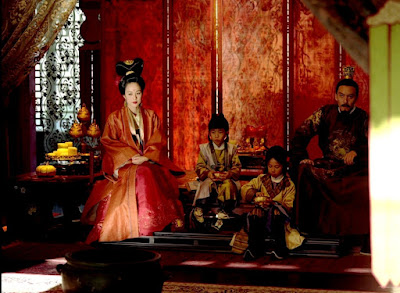
Let us travel back to an age of the mythic, where wuxia is a way of life. Hou Hsiao-Hsien’s oblique take on a classic seventh century fiction, Pei Xing’s Nie Yinniang is a slow burn; at once cinematically enigmatic and aesthetically stylised. There is little action in this wuxia pian. Whilst I haven’t read the text, the elliptical narrative would indicate that this was a loose and artistic retelling, rather than a faithful book-to-screen adaptation. Anyone who knows Hou’s cinema, would be familiar with his masterpiece A City of Sadness(1989), a meditative filmic elegy to the city of Taiwan and The Flowers of Shanghai (1998), my personal favourite – a languid film much like Bertrand Bonello’s House of Tolerance (2011). Hou’s focus is the flower houses of Shanghai in the 1880s versus Bonello’s nineteenth century Parisian take on the same subject.


In The Assassin, one can feel the same meditative languidness as Flowers; Mark Ping Lee’s cinematography is choreographic, lilting – like that of a sultry, brooding dance for one. The camera hides between billowing fabrics, between foliages, between the seen and the unseen; it sways like it’s yielding to the gentle breaths of Zephyrous. Set in the eighth century during the last years of the Tang Dynasty, which is at the summit of this dynasty’s art and culture; one should expect no less than beauty and aesthetics of the highest order in this film. 


Shu Qi plays Nie Yinniang, The Assassin


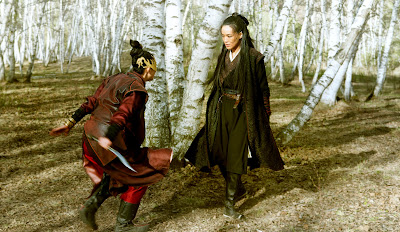
The wonderful Shu Qi plays the eponymous assassin Nie Yinniang, taken away to be trained when she was only 10 years old. She is the daughter of a general, who, years later, is sent on assassination assignments by her mentor, Jiaxin, a nun (in Chinese terms, she is actually a ‘holy person’ and not strictly in the sense of a ‘nun’ as Western culture understands) living in seclusion in the mountains (where the scenery is pristine and glorious to behold). In one of these assignments, Nie was to kill a corrupt general, but she weakened at the last moment and was unable to carry out her duty.  The target was holding his infant son. Nie returns to Jiaxin, but she has broken the assassin’s code and as punishment she is sent to Weibo in northern China to take the life of her cousin Tian Ji'an, to whom she was once betrothed – their union was meant as a seal for peace between two regions.


The film premiered at Cannes to critical acclaim (its legend written by none other than Manohla Dargis who described the screening to have been in ‘rapturous silence’ and ended with ‘thunderous applause’ – it won Hou the Best Director award. But many critics found the narrative to be intoxicating but frustratingly confounding in its narrative. To me, they seem to be saying that there is the most ravishing foreplay, but without the action that gets you off. I would like to return to the idea of dance – and ask whose eyes is this dance for? The answer is simply, it is for us, the audience, and as such, we are complicit in creating the film’s mysterious heart. 

"...ravishing foreplay, but without the action..."
The Assassin


This is not a story of connections, predestined or serendipitous, nor is it a story of contemplative lovers, like the last pairing between Chang Chen (here as the cousin Tian Ji'an) and Shu Qi – they were mesmeric in Three Times (2005). This film is also not a reinvention of the genre like Wong Kai-wai’s masterful and equally poetical Ashes of Time (1994). Hou films beauty, the costumes, the scenery and its compassionate heart is a must for those wanting a quiet moment’s solace, if only to enter into a dream during these tumultuous times.


The Exception was shown at the  Scandi Film Festival a couple of years ago, but I missed its theatrical screening at the time, so I was glad to have found it on Stan the other night. Do not confuse this small but incredibly thoughtful and tightly woven film with The Exception (2016) with Lily James and Christopher Plummer. No, The Exception I’m referring to is with Lene Maria Christensen, you would know her from Susanne Bier’s Brothers (2004) and Pernille Fischer Christensen’s En Famille (2010), Magnus Krepper (most recently seen in When the Dust Settles) and Danica Curcic (most recently seen in The Chestnut Man). If none of these names are familiar, the film also stars Sidse Babett Knudsen who is a household name these days, especially after the success of Borgen (the new series is on Netflix incidentally), not to mention 1864 (my favourite TV series, ever) and films like the blockbuster Tom Hanks vehicle Inferno or Peter Strickland’s The Duke of Burgundy. There’s also a small part for Johanne Louise Schmidt who plays the PM in the latest season of Borgen.


Anne-Lise (Sidse Babette Knudsen) - isolated by the others

Seen simply, Nielsen’s The Exception is a story about bullying, when a collective gangs up on another, for no apparent reason but just ‘because’ they can. Knudsen’s Anne-Lise is at the centre of the group’s insidious attacks; small jibes, the accumulation of uncomfortable moments, deliberate neglect, and a simmering and hurtful undercurrent of disdain. I’m sure we’ve all felt this at one time or another, by not-so-nice colleagues or ‘pretend friends’. 


Bullying is insidious- the collective from left Amanda Collin (Marlene),
Knudsen (Anne-Lise), Danica Curcic (Iben)
and Lene Maria Christensen (Camilla)


This thriller slowly unravels and Nielsen cleverly uses Iben’s (Curcic) piece on The Psychology of Evil to set up ideas (or perhaps to provide a more profound view of these behaviours) as he slowly unpicks the backstory of this ensemble. Seen in layers, their everyday lives are too complex for each other to grasp even a reasonable understanding of it. What lies under the surface, literally surfaces; but Nielsen makes a good point that it is impossible to grasp another’s pain when you are not in their skins.


The psychology of evil is not so much in question here, it exists, pure and simple; but it is its ubiquitousness and its rhizomatic behaviour that is brought to bear – the thin red line that separates survival and bloodlust, what mitigates one act from another. Wherefore our bloodline, our vessel to salvation?


The Assassin is currently showing on SBS on Demand and The Exception is currently showing on Stan.

Saturday, 1 January 2022

Streaming on Stan - 🎥 Janice Tong welcomes FIRE WILL COME/O QUE ARDE (Oliver Laxe, Galicia, 2019)

"much like early Herzog...mesmerising and stoic...", Fire Will Come

It isn’t often that you come across a cinema that is both reverential and worldly. Here, in Oliver Laxe’s Fire Will Come each sequence is brimming with the languid and yet sobering impressions  of human endeavour, whether it’s like that of Benjamin’s description of Klee’s Angelus Novus or an unaided meditation of nature; know that there is something at work. 


We follow the lived days of a man just out of prison, Amador (Amador Arias exudes a strong cinematic presence in this film) returns to his hometown, the small mountain-side village of Galicia in the northwest region of Spain, to stay with his elderly mother. He needs time to get back on his feet. He makes himself useful by fixing things around the house, and tending to the three emaciated cows (and a lone calf) by herding them farther afield for fresh grass. He is quiet, likeable and you can tell that he’s benefiting from the outdoor physical work. His mind is at rest. 


His mother, Benedicta (played by the equally wonderful Benedicta Sánchez) is a quiet observer of his labours. Benedicta must be pushing 90 and yet she is steady on her feet and her wiry frame and demeanour is like that of a mountain goat’s. The pair seem to be in exile in their own homeland. 


Arias and Sánchez are both non-actors. Their naturalistic presence imbues the film with much depth, plays to the lyricism of the story and juxtaposes a world that is ready to move on and get ahead of the times (old houses are being repaired for tourists - which conjures up the rather sad tagline of “if you build it, they will come”). Their rhythm  is more in tune with the land, a gentle destruction; the entropic power of a dripping of a tap. Interesting to note that Sánchez won the Goya Award for the Best New Actress in 2020, making her the oldest actress to be awarded in this category. She also received the  Castelao Medal in 2019 for her distinguished contribution to Galician arts.


I was so pleased to learn that this film won the Jury Prize at the 2019 Un Certain Regard at Cannes and also won best film, the Golden Astor,at the 34th Mar del Plata International Film Festival. It’s an accomplished film that draws you in even though not much is happening on the surface; or, another way of putting it, all the effort that has been put in makes it look entirely effortless. The film is captured on Kodak Super16mm film by the Spanish cinematographer Mauro Herce, who had worked on Laxe’s previous film Mimosas (2016). 


Strong cinematic presence from both Amador Arias, left, and Benedicta Sánchez


The Galician language is beautiful and melodic (apparently it’s very close to Portuguese), and cultivates a quiet ambience of the two lone figures. The language pairs well with the use of music in the film. I’m always in awe of the purity in Andreas Scholl’s countertenor voice; his rendition (with the Australian Brandenburg Orchestra) of Vivaldi’s Cum Dederit soars above the detritus and ruinous times; here in the mountains is where art or philosophy and the everyday can and must meet. 


In another scene, Elena, a vet who Amador has taken a fancy to, shares a moment in the car with him. Leonard Cohen’s Suzanne is playing and when asked whether he likes the music, Amador answers that he likes the song, but doesn’t know what he’s saying. Elena replies, “you don’t have to understand the lyrics to get the music”. And she is right, the fateful yearning this song delivers gets you in straight away, it hums of a longing that is unfulfilled, or perhaps, unfulfillable. And you don’t need to know the history behind the song about Cohen’s relationship the dancer Suzanne Verdal, one that never amounted to any physical intimacy to that point (Cohen says that he never had the opportunity or the inclination) to know its prophetic nature for Amador and Elena. 


But for me, it is the opening sequence of this film that made its mark. At once haunting and mesmeric, you realise that can’t turn away in the face of horror, when your mind finally catches up to what you’re seeing. Even in full understanding of what’s happening, you still remain glued to its strange beauty.


Laxe’s cinematic language is that of poetic stoicism, much like early Herzog but without the heartless wilderness or the evocation of folklore. Indeed, much is understood without the need of words or analysis; you simply need to be present.

Thursday, 12 November 2020

Streaming on Stan - Rod Bishop recommends THE GOOD LORD BIRD (show creator Ethan Hawke, USA, 2020)


The Americans have a couple of descriptions that aptly describe John Brown, a man some believe started the Civil War – “God-bothering” and “batshit crazy”.

At least that’s the way Ethan Hawke - the show creator of The Good Lord Bird - plays the abolitionist Brown. So driven and unhinged is he, most of the African Americans he is trying to save from slavery won’t have anything to do with him.

As he quotes and misquotes the Bible and froths at the mouth while preaching righteousness and insurrection, he leads a small group of followers on murderous raids across Kansas, pulling slave owners from their homes and executing them.

He commands respect for his cause, but money-raising and recruiting drives to the north have more abolitionists avoiding him like the plague.

By the time he reaches Harper’s Crossing and overtakes the greatest armory in the country, he still thinks the “bees” are being “hived” so that thousands of slaves will join him to create revolution.

He’s not exactly left on a raft floating down the Amazon with a bunch of monkeys, as was Don Lope de Aguirre in Herzog’s Aguirre, Wrath of God, but his derangement and religious psychosis have many similarities.

And like Klaus Kinski, Ethan Hawke has created a role that allows him to break the borders around his character and deliver an unconstrained version of Brown. It’s a performance that will sit in his curriculum vitae the way Kinski’s aberrant wrath-of-god is remembered.

Joshua Caleb Johnson, Ethan Hawke

Yet, he isn’t the main character. That is left to Henry Shackleford (a wonderful performance by Joshua Caleb Johnson), who is known throughout the series as “Onion”. He’s a shoe-shining orphan that Brown has adopted and having mistakenly decided he is a girl, Brown puts Onion in a dress.

Onion happily accepts this disguise, figuring a black girl is better off than a black boy in slavery times. And every black that Onion meets knows he’s a boy almost straight away, but keeps this secret from the whites who are stupid enough to accept his feminine gender.

Most of The Good Lord Bird is played as farce. It doesn’t have the wicked, laugh-out-loud race relations humour of last year’s Dolemite Is My Name - slavery and the coming Civil War preclude that - but the consistent absurdity helps to underscore this lacerating vision of America’s systemic racism.