 |
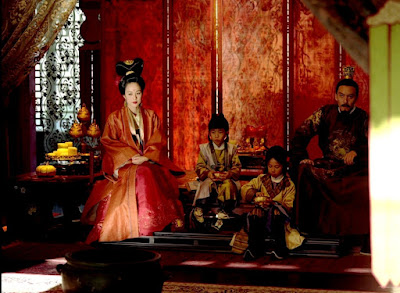
"...beauty and aesthetics of the highest order...",
The Assassin |
I have been a little remiss in writing about films in 2022, the year of supposed harmony (it’s turned out to be chaos really). Watching the world burn and drown simultaneously, I found that I’ve not had the heart for it.
But art, music, literature, poetry and of course, cinema, have a profound role to play in shaping thought; inspiring beauty; giving the soul nourishment. At times it seemed that these traces, our humanness, had been abandoned in the face of an unfolding horror-field. It becomes impossible to switch on the TV, at the prescribed hour at 6:30pm. Just in time for tea. We have no stomach for it, our dinner, that is.
Let us travel back to an age of the mythic, where wuxia is a way of life. Hou Hsiao-Hsien’s oblique take on a classic seventh century fiction, Pei Xing’s Nie Yinniang is a slow burn; at once cinematically enigmatic and aesthetically stylised. There is little action in this wuxia pian. Whilst I haven’t read the text, the elliptical narrative would indicate that this was a loose and artistic retelling, rather than a faithful book-to-screen adaptation. Anyone who knows Hou’s cinema, would be familiar with his masterpiece A City of Sadness(1989), a meditative filmic elegy to the city of Taiwan and The Flowers of Shanghai (1998), my personal favourite – a languid film much like Bertrand Bonello’s House of Tolerance (2011). Hou’s focus is the flower houses of Shanghai in the 1880s versus Bonello’s nineteenth century Parisian take on the same subject.
In The Assassin, one can feel the same meditative languidness as Flowers; Mark Ping Lee’s cinematography is choreographic, lilting – like that of a sultry, brooding dance for one. The camera hides between billowing fabrics, between foliages, between the seen and the unseen; it sways like it’s yielding to the gentle breaths of Zephyrous. Set in the eighth century during the last years of the Tang Dynasty, which is at the summit of this dynasty’s art and culture; one should expect no less than beauty and aesthetics of the highest order in this film.
 |
| Shu Qi plays Nie Yinniang, The Assassin |
The wonderful Shu Qi plays the eponymous assassin Nie Yinniang, taken away to be trained when she was only 10 years old. She is the daughter of a general, who, years later, is sent on assassination assignments by her mentor, Jiaxin, a nun (in Chinese terms, she is actually a ‘holy person’ and not strictly in the sense of a ‘nun’ as Western culture understands) living in seclusion in the mountains (where the scenery is pristine and glorious to behold). In one of these assignments, Nie was to kill a corrupt general, but she weakened at the last moment and was unable to carry out her duty. The target was holding his infant son. Nie returns to Jiaxin, but she has broken the assassin’s code and as punishment she is sent to Weibo in northern China to take the life of her cousin Tian Ji'an, to whom she was once betrothed – their union was meant as a seal for peace between two regions.
The film premiered at Cannes to critical acclaim (its legend written by none other than Manohla Dargis who described the screening to have been in ‘rapturous silence’ and ended with ‘thunderous applause’ – it won Hou the Best Director award. But many critics found the narrative to be intoxicating but frustratingly confounding in its narrative. To me, they seem to be saying that there is the most ravishing foreplay, but without the action that gets you off. I would like to return to the idea of dance – and ask whose eyes is this dance for? The answer is simply, it is for us, the audience, and as such, we are complicit in creating the film’s mysterious heart.
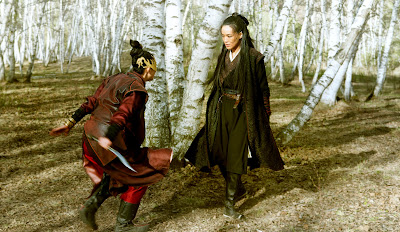 |
"...ravishing foreplay, but without the action..."
The Assassin |
This is not a story of connections, predestined or serendipitous, nor is it a story of contemplative lovers, like the last pairing between Chang Chen (here as the cousin Tian Ji'an) and Shu Qi – they were mesmeric in Three Times (2005). This film is also not a reinvention of the genre like Wong Kai-wai’s masterful and equally poetical Ashes of Time (1994). Hou films beauty, the costumes, the scenery and its compassionate heart is a must for those wanting a quiet moment’s solace, if only to enter into a dream during these tumultuous times.
The Exception was shown at the Scandi Film Festival a couple of years ago, but I missed its theatrical screening at the time, so I was glad to have found it on Stan the other night. Do not confuse this small but incredibly thoughtful and tightly woven film with The Exception (2016) with Lily James and Christopher Plummer. No, The Exception I’m referring to is with Lene Maria Christensen, you would know her from Susanne Bier’s Brothers (2004) and Pernille Fischer Christensen’s En Famille (2010), Magnus Krepper (most recently seen in When the Dust Settles) and Danica Curcic (most recently seen in The Chestnut Man). If none of these names are familiar, the film also stars Sidse Babett Knudsen who is a household name these days, especially after the success of Borgen (the new series is on Netflix incidentally), not to mention 1864 (my favourite TV series, ever) and films like the blockbuster Tom Hanks vehicle Inferno or Peter Strickland’s The Duke of Burgundy. There’s also a small part for Johanne Louise Schmidt who plays the PM in the latest season of Borgen.
%20-%20isolated%20by%20the%20others.jpeg) |
| Anne-Lise (Sidse Babette Knudsen) - isolated by the others |
Seen simply, Nielsen’s The Exception is a story about bullying, when a collective gangs up on another, for no apparent reason but just ‘because’ they can. Knudsen’s Anne-Lise is at the centre of the group’s insidious attacks; small jibes, the accumulation of uncomfortable moments, deliberate neglect, and a simmering and hurtful undercurrent of disdain. I’m sure we’ve all felt this at one time or another, by not-so-nice colleagues or ‘pretend friends’.
,%20Knudsen%20(Anne-Lise),%20Curcic%20(Iben)%20and%20Lene%20Maria%20Christensen%20(Camilla).jpeg) |
Bullying is insidious- the collective from left Amanda Collin (Marlene),
Knudsen (Anne-Lise), Danica Curcic (Iben)
and Lene Maria Christensen (Camilla) |
This thriller slowly unravels and Nielsen cleverly uses Iben’s (Curcic) piece on The Psychology of Evil to set up ideas (or perhaps to provide a more profound view of these behaviours) as he slowly unpicks the backstory of this ensemble. Seen in layers, their everyday lives are too complex for each other to grasp even a reasonable understanding of it. What lies under the surface, literally surfaces; but Nielsen makes a good point that it is impossible to grasp another’s pain when you are not in their skins.
The psychology of evil is not so much in question here, it exists, pure and simple; but it is its ubiquitousness and its rhizomatic behaviour that is brought to bear – the thin red line that separates survival and bloodlust, what mitigates one act from another. Wherefore our bloodline, our vessel to salvation?
The Assassin is currently showing on SBS on Demand and The Exception is currently showing on Stan.


%20-%20isolated%20by%20the%20others.jpeg)
,%20Knudsen%20(Anne-Lise),%20Curcic%20(Iben)%20and%20Lene%20Maria%20Christensen%20(Camilla).jpeg)