Showing posts with label British Television. Show all posts

Tuesday, 7 October 2025

On DVD - Rod Bishop reminds us of the greatness of DAYS OF HOPE (Ken Loach, Jim Allen, Tony Garnett, UK, 1975)

Paul Copley (centre) Days of Hope

There’s been no sign of any 50
th anniversary celebrations for Days of Hope, a television series Phillip Adams once blessed as the greatest he’d ever seen.

Perhaps it’s not surprising. Even in the politically charged 1970s, Ken Loach’s groundbreaking, unapologetically partisan history of the British working-class, from 1916 in the First World War to the General Strike of 1926, was always highly contentious.

After all, who wants to see members of the British Army tying a conscientious objector to a stake during the First World War and leaving him in No Man’s Land as target practice for enemy fire?

Or watch Winston Churchill as a ferocious strikebreaker; or listen to screenwriter Jim Allen compare Churchill to a vulture and Lenin to an eagle? 

Or endure dialogue like: “The only war worth fighting is the class war.”

Days of Hope recently came to mind when the actor Paul Copley made some brief appearances as a farmer in Downtown Abbey. He was also a farmer, 50 years ago, in Ken Loach’s seven-hour BBC series but that irony would be lost on most viewers today.

For politics, Downton viewers had to make do with Tom Branson (Allen Leech), the IRA socialist-sympathizing chauffeur, who conveniently became an upper-class lap-boy for the aristocracy.

Paul Copley (Downton Abbey)

In Downton, the fiery farmer turned Communist agitator from Days of Hope is now a harmless, benign tenant-farmer for the rural upper-class; while the gormless IRA supporter is now married and converted into the Downton aristocracy. The irony would not be lost on Loach, Allen or producer Tony Garnett.

Paul Copley played Ben Matthews as the central character in all four, feature-length episodes of the BBC series. 

Coming from a Yorkshire farming family, Ben Matthews enlists as a British soldier in 1916 and is stationed in Ireland to deal with the IRA. Disillusioned, he deserts and joins the Durham miners to help in their struggle over oppressive working conditions. He is jailed, then radicalized and by the time of his release joins the Communist Party. Ben and his sister Sarah (Pamela Brighton) devote their lives to confronting the government’s strike-breaking tactics, particularly through the final episode detailing the 2026 General Strike. 

Nikolas Simmonds (Days of Hope)

Ben’s story is counterpointed by Sarah’s brother Philip Hargraves (
Nikolas Simmonds). Philip becomes is a conscientious objector in 1916, but is forced into the army and sentenced to death on the front line in France. Saved by a reprieve, he joins the Labour Party and becomes a Member of Parliament in the first Labour Government. Starting out as a social democrat and defender of the working-class and trade unions during the strikes that threaten to bring down the government, Philip’s careerism prompts him into a right-wing revisionist course.

A great deal of the anger over Days of Hope was levelled at the first episode for its lacerating take on the army, government and police, prompting producer Tony Garnett to declare:

"Our own anger is reserved for the phoney objectivity, the tone of balance and fairness affected by so many programmes. We deal in fiction and tell the truth as we see it. So many self-styled "factual" programmes are full of unacknowledged bias. I suggest that you really are in danger from them and not us."

It is arguably Jim Allen’s greatest writing, and as impressive as anything Loach directed during the next 50 years. But Days of Hope has languished on BBC shelves for decades, becoming difficult if not impossible to see.  


It was never released on VHS and only made it to DVD in the collection of nine Loach works Ken Loach at the BBC in 2011, more than 30 years after its first television release The visual quality of the various episodes varies significantly and the DVDs are obviously made from an old 16mm print with scratches, dirt, blotches and reel change clue markers.

There’s been no restoration, no Blu-ray, no 4K and it doesn’t appear available on any legitimate streaming platforms in the major territories, nor on YouTube.

Ken Loach at the BBC is the only way to currently access the series.


Tuesday, 18 June 2024

Streaming on 7+ (with ads) - Rod Bishop recommends MR BATES VS THE POST OFFICE (James Strong, Gwyneth Hughes, UK 2024)

Toby Jones as Alan Bates


When it comes to Government fraud and extortion of its citizens, the British “Post Office Scandal” makes an interesting comparison with our snappier-named “Robodebt”.

Generally considered the greatest miscarriage of justice in British legal history, the Post Office oversaw the conviction of 900 subpostmasters for fraud, theft and false accounting between 1999 and 2015.The charges arose from financial shortfalls detected by Fujitsu’s Horizon computer software, a compulsory accounting system used by the British Post Office for their sub-postmasters.

226 went to prison. Many lost their jobs. Many had to make up “shortfalls” of more than £70,000 by selling their homes and emptying their life savings. Many suffered family breakdowns, mental health issues, severe depression and criminal convictions. Four suicided.

If you have a local shopping centre where you live in this country, the folk who run the newsagencies usually handle the postal requirements as well. These are the people who were caught up in this travesty in the UK.

In 2015, court cases brought by sub-postmasters established that Fujitsu could remotely access the Horizon computers and change accounting figures without their knowledge “even at night while the sub-postmasters slept”. For 16 years, the British Post Office had maintained Horizon was “robust” and remote access impossible. They had also spent those 16 years telling any subpostmaster who called to complain they were the only one to have raised the issue. The Post Office just lied as it extorted their money.

Currently there is no reliable figure for how much money the British Post office stole or how much compensation would eventually cost.  In March of this year, in the House of Commons, the Post Office Minister said:

The government has put $1 billion aside to deal with all this, despite the fact the Post Office has taken millions and millions from postmasters – innocent people. We have never had the figure of what was taken, although I have asked for it before”.

Whatever the amount, it was apparently accounted by the Post Office as a simple addition to its yearly profits.

When Mr Bates vs the Post Office was screened in the UK last January, this heinous scandal was revealed to many Brits who’d never heard of it. 

This four-part series opens with Alan Bates (Toby Jones) and Suzanne Sercombe (Julie Hesmondhalgh) who have lost their house and life savings to the Post Office and moved to Llandudno in North Wales. 

Bates is the epitome of a tenacious, true Brit bulldog who won’t be subjugated. Unlike bulldogs, however, he remains polite and courteous throughout his 20-year campaign for justice and restitution. Without the truth, he says, compensation and justice can’t be won.

He starts The Justice for Sub-postmasters Alliance who meet, plan and strategize in a village hall. The alliance eventually attracts 555 members and scriptwriter Gwyneth Hughes also chooses to include other victims.

Monica Dolan as Jo Hamilton

There’s Jo Hamilton (Monica Dolan), whose true love is her bakery and who runs her post office to make up for her baking shortfalls. She owes £36,000 she hasn’t got. Or ever stole.


When we first meet Lee Castleton (Will Mellor) he is making his 91st phone call about the Horizon software only to be told – once again by the Post Office – it’s all his fault, Horizon is “robust”, no-one else has complained and pay up or face criminal prosecution. He owes £25,000 but takes the Post Office to court where he loses and is ordered to repay the money and £321,000 in costs. He is bankrupted.

Jasgun Singh (Amit Shah) has to call an ambulance for his partner Saman Kaur (Krupar Pattani) who has become almost mute from the ordeal and stabbed herself in the stomach. Suffering from severe depression she undergoes shock therapy in hospital.

The Guardian has aptly called Mr Bates vs The Post Office “like an episode of Black Mirror”. It’s also pure Kafka. At one point Jo askes Alan whether the two Post Office heavies CEO Paula Vennells (Lia Williams) and Business Improvement Director Angela Van Den Bogerd (Katherine Kelly) are “incompetent or just evil?” He replies: “It comes to the same thing in the end”.

The ensemble performances are outstanding and James Strong directs Gwyneth Hughes’s pungent and clear-eyed script with impressive aplomb.

Brit television doesn’t get much better than this.


7+ is also screening the documentary Mr Bates vs The Post Office: The True Story. 

Alan Bates was Knighted in last week's Kings Birthday Honours List as "Founder, Justice for Subpostmasters Alliance. For services to Justice."

Monday, 27 May 2024

Streaming on SBS on Demand - Rod Bishop is underwhelmed by THIS TOWN (Steven Knight, UK, 2024)

Jordan Bolger, Levi Brown, This Town


The copious, eclectic credits amassed by British screenwriter Steven Knight makes for interesting reading.

There’s an Oscar nomination early in his career for Dirty Pretty Things, directed by Stephen Frears; there’s his television hit as a co-creator of Who Wants to be a Millionaire?; there’s a brutal London crime families tale for David Cronenberg in Eastern Promises; there’s Locke, a film set entirely in a car driven by Tom Hardy, written and directed by Knight; dockside shipping tussles in the early 1800s in Taboo, co-created with Tom Hardy and Chips Hardy; Kristen Stewart as Lady Di in Spencer; two badly received ‘re-imaginings’ of Charles Dickens (A Christmas Carol and Great Expectations); the Birmingham crime gangs in six seasons of Peaky Blinders; the berserk British soldiers in the North Africa campaign against Rommel in the awful SAS Rogue Heroes; the misjudged World War II romance between a blind French girl and a German soldier in All The Light We Cannot See

And now, This Town, set in Birmingham and Coventry in the Midlands during the Thatcher era and backgrounded by a predominately ska, reggae and two-tone soundtrack.

Knight’s credit list is not unlike his compatriot, the equally prolific Jack Thorne, who has written 26 times for television (excluding multiple seasons) and 12 feature films since 2006. Knight has written 21 times for television (excluding multiple seasons) and 18 feature films since 1990.

It’s industrial-scale screen writing with no hint of writer’s block, but the sheer output of material suggests it is likely to be uneven.

So, it is with This Town. There are plenty of moments reminiscent of Peaky Blinders, but Knight has a lot to cram in – the IRA, Thatcher, racism, skinheads, hard-drugs, soft drugs, alcohol, romance, reggae, dub, virginity, ska, two-tone, poetry, Christianity, skinheads and the formation of a band. He just can’t keep it all together.

While the lack of coherence is annoying, the sheer scale of his undertaking is often admirable.  What grates, however, is when the writing smacks of being a first draft. The central character, for instance, is the mixed-race Dante who creates song lyrics from his poetry. Apparently written by Kae Tempest, the poetry is terrible: “The words come and land in my skull like a flock of pigeons on a tower block.”

Dante’s band Fuck The Factory - with music written by producer Dan Carey - slowly comes together through the six episodes, finally closing the series with their first live gig. Their music is not only as unimpressive as the poetry, but it doesn’t sound remotely like the rest of the great music on the soundtrack – The Selector, The Beat, Stiff Little Fingers, Siouxsie and The Banshees, The Specials, Prince Buster, Jimmy Cliff, Bob Marley, UB40, Jackie Wilson, Blondie, Tom Jones, Talking Heads etc. 

This soundtrack is beautifully selected and originates from a specific time and place, but like the writing, can also abruptly veer off course. For instance, why does a demo version of Rock & Roll by The Velvet Underground from 1970 suddenly pop up? Great song, but 1970 New York is a long way from the reggae, ska and two-tone of Birmingham and Coventry in the early 1980s.

Michelle Dockery

Among the supporting cast, there is one show-stopping performance from Michelle Dockery (Lady Mary from Downton Abbey) playing an alcoholic mother who crashes her own mother’s funeral to sing a solo version of Over The Rainbow.


This Town occasionally has moments when it touches that rainbow. Pity there are so few of them.

Sunday, 31 December 2023

Streaming on Stan - A High Recommendation for THE LONG SHADOW (Writer: George Kay, Director: Lewis Arnold)

Dennis Hoban (Toby Jones), Jim Hobson (Lee
Ingleby), The Long Shadow

There is a story, possibly apocryphal, back in the 60s I hasten to say, of a teacher at a college that taught newly-arrived migrants the basics of English. The teacher, so it is reported, used to practise his students on the sentence: “In Australia if a policeman is on the ground, we kick him.” It may have had traction in anarchist and libertarian circles, small as they were.
 

The phrase came back during the course of watching The Long Shadow  a six part Brit ITV series devoted to a dramatic reconstruction of the times and the deeds of the infamous Yorkshire Ripper, a man who terrorised Lancashire and Yorkshire from 1975 to 1980 and over that time murdered at least 13 women, most of them prostitutes working street beats. 


While Stan’s publicity tells us the series is ‘the true story of one of the most notorious and shocking serial killer cases in the world, the five-year manhunt for Peter Sutcliffe, dubbed the Yorkshire Ripper, focusing on the lives of his victims and the loved ones they left behind’ I can say with absolute certainty that the PR description is to use a word frequently employed by the coppers on the case “Bollocks”. This show is the metaphorical equivalent of kicking a policeman who is on the ground.


It’s about the coppers in all their inglory. It peels away layers of Brit police incompetence, sexism, racism, prejudice, petty harassment and dogged refusal to acknowledge the blindingly obvious. “You have failed’ becomes a catchcry from the most senior levels of the force as they berate the various detectives that over time are put in charge of the investigation. Their replacements however all seem even more dim and misguided than those that went before. One, Dennis Hoban played by the awesome Toby Jones, the first cop in charge of things states how appalled he is that, after being taken off the case and kicked upstairs to a desk job, his replacement is Detective Hobson (Lee Ingleby) whom Hoban clearly thinks is incompetent. Hobson proves to be so.


George Oldfield (David Morrissey)
The Long Shadow

Hobson is eventually replaced by George Oldfield (David Morrissey) who spends years getting absolutely nowhere. The fact that in episode two an identikit drawing of Sutcliffe has been dismissed as irrelevant and tossed in a drawer where it remains until (SPOILER ALERT) various women constables manning the help line phones piece the pictures together. 


On the way through, as the true horror of what Sutcliffe got up to slowly emerges we get a picture of petty police harassment at ground level, dogmatism at middle levels, and flailing blame shifting at upper levels. This is not swinging London. It’s the other Britain of the 70s – grim, grey, mean – on full display. 


The Long Shadow is written by George Kay who if he were writing for film would likely be being celebrated with mid-career retrospectives. His output ranges through Killing Eve, Lupin, The Hour, the quite extraordinary Litvinenko and much more. Here he delivers another devilishly good piece of TV, something to make you suspicious of coppers all over again.

Wednesday, 20 December 2023

Defending Cinephilia 2023 (2) - Rod Bishop covers a lot of territory


Restaurants

From either side of the Pond came The Bear and Boiling Point, two high-pressure series set mostly in restaurant kitchens. Lots of yelling of “CHEF!!”, “BEHIND!!” and “PLATE UP!!” All served with a sprinkle of obnoxious sous chefs. If you’ve ever thought your Christmas Dinners couldn’t get worse, The Bear is here to fix that. After painstakingly preparing an enormous dinner, Mum stops all the constant bickering, insults, abuse, infighting and fork throwing around the table by driving her car through a wall and into the dining room.

Quebec

Xavier Dolan has threatened to give up filmmaking following The Night Logan Woke Up, a five-part television series exploring his favourite topic - emotionally dysfunctional families. Includes a riotous family dinner that runs a close second to the dinner in The Bear.


Australia

The Plains, David Easteal’s extraordinary, strangely gripping, structuralist-inspired, three-hour documentary account of a man’s daily commute along freeways from the outer suburbs to his home in inner Melbourne. 

Limbo, Ivan Sen continues to explore damaged characters and minimal dialogue, this time with the multi-hyphenate’s striking black and white photography among the drill hole debris of Coober Pedy. 

Colin from Accounts

Two superior series - Deadloch a consistently funny, feminist/lesbian inversion of serial killer police procedurals; and Colin From Accounts, also a consistently funny, rom-com unafraid of taking risks. The latter includes a lacerating Millennial birthday party in a boutique inner Sydney bar. And a dog on wheels.

The Last of Us


USA

For its third episode Long, Long TimeThe Last of Us virtually dropped its central narrative of an ex-marine escorting an immune teenage girl across a pandemic-ravaged and desolate USA. Instead, there’s an almost feature length two-hander between two gay men facing their advancing age in the time of the apocalypse. The small screen doesn’t get any better than this.

Killers of the Flower Moon could probably have taken less time to tell its account of the murders of the Osage for their oil rights, but De Niro, Scorsese and Robbie Robertson are in top form. Set in rural America in the same time period as Days of Heaven, these aren’t the only similarities it has with Malick’s great film. 

The Blue Caftan


Europe and beyond

Arresting filmmaking in AlcarràsCloseEOThe Eight MountainsSaint OmerPacificationAnatomy of a Fall and Afire. Also from Pakistan, the gay-themed Joyland and from Salé, Morocco, the very impressive The Blue Caftan, with its near transcendental, penultimate scene.

Korea

Stand-out feature film work in Past LivesRiceboy Sleeps and Return to Seoul. Enthralling historical drama series in Pachinko; poignant comedy series in Extraordinary Attorney Woo and feel-good, intergenerational romance in Encounter (2018).

Emun Elliott, Hugh Bonneville and Charlotte Spencer
in The Gold

England

The Brink’s-Mat heist of 25 million quid in gold bullion from Heathrow in the 1980s is given a decidedly class-conscious twist by Neil Forsyth with Downton Abbey’s Hugh Bonneville commanding the police chase in The Gold. Perhaps the best written Brit series of the year.

Scotland

Dry-as-flint Scottish humour in new series of Guilt and Annika, way better than any comedy from south of the border. “Awa’ wi’ ye, ya Sassenachs!”

Thursday, 12 October 2023

Recommended Reading and Viewing- THE SECRET HOURS - a new novel by Mick Herron and SLOW HORSES (Apple TV)


 “…since how we act in the light of day is largely for other people’s benefit, but what we do in the secret hours reveals who we really are.”

It takes a while, around page 256, for Mick Herron to tell us his meaning of ‘the secret hours’, the title of his new book about the spy trade and the spy business. It also takes quite a while for Herron to get us back into the orbit of Jackson Lamb, renamed under his espionage alias as Brinsley Miles and now back in Berlin in the 1990s, post the wall coming down but still a hotbed of intrigue. That doesn't come till around page 190 and the novel picks up speed and grip from that point.


From then it doesn’t take long for the aficionados to work out the Lamb/Miles connection:


Alison North, another alias that does take a long while to be revealed, brilliantly,  makes her views known in an early encounter in her Berlin posting, organised by David Cartwright (if you don’t know who these names are then you are going to have start off with Slow Horses and work your way forward):


“Which means I expect to be treated with respect. And if that bar’s too high, you can at least refrain from treating me with contempt. Do we understand each other?

“He stared for a long while, his face partially wreathed in the smoke his cigarette was sighing. And then, quietly but unmistakably, he farted.”


The Secret Hours  is probably the longest book (391pp) that Mick Herron has written in his Balzacian chronicling of Jackson Lamb and London’s spies. It ranges across the European continent and engages with British politics more directly than before. It doesn't take a genius to work out that Boris Johnson is being regularly pilloried and that Sparrow is a hatchet job on the odious Dominic Cummings of Brexit fame. And you wonder whether it might have once been a series of incidents that possibly would have formed small entries in what are referred to among the “Standalone Books” in the Herron bibliography at the front. Previously there were The List, The Drop and The Catch  all modest novellas that dovetailed into the Jackson Lamb Slough House stories, introducing new characters, explaining things about others. 


In The Secret Hours (spoiler alert) we come to learn for instance not just who killed Charles Partner but why and we learn how archivist Molly lost her legs.


So far the TV adaptations have only done two of the books so that makes six to go if they get to even the current end to say nothing of the incidents in the novellas and any future stories. But those two series have nailed down the characters and we have to hope that Gary Oldman (below as Jackson Lamb) stays alive and doesn’t age any further for starters.


Still there’s one question I don’t know the answer too. Is the Description “First Desk”, or in the case of this new novel “First Chair”, Herron’s invention? Love to know the answer.

Thursday, 6 April 2023

ON SBS-TV - Rod Bishop warns about ROGUE HEROES (Sc: Stephen Knight, Dir: Tom Shankland, UK, 2022)

Connor Swindells, Rogue Heroes

For show creator Stephen Knight,
 Rogue Heroes is his view of the origins of the British SAS - lawless, viral macho killers with virtually no wartime morality, motivated solely by killing and then killing some more in order to defeat Rommel and his Panzers in North Africa. 

If you miss the point of all the anarchistic, authority-hating viciousness (and how could you?), there’s at least eight loud AC/DC numbers along with Black Sabbath, Judas Priest, Motörhead and a range of British punk from the 1970s and 1980s, to put you in the right mood. 

It’s like watching the wartime equivalent of British soccer crowds. Nationalistic Brit “wolf-warriors” in the North African campaign - well done, those boys!

The Brits lost up to 35,000 during the 3-year engagement, but there were also some allies there. Here they are only mentioned in blink-and-you’ll-miss-it moments. The SAS lads steal Australian food and other supplies. And in the case of the New Zealanders, the Brits sneak in under the cover of darkness after the moon has set to pinch the Kiwis’ desert army vehicles and other fighting kit.


A couple of Australians appear in early scenes and are prepared to take on the SAS leader Stirling (known as the “Phantom Major”) in a Cairo bar, but quickly turn tail and meekly depart after Stirling runs through a list of the ways he can kill.

The Americans arrive (“About time!”) but we never actually see one. 

And the Scots are reduced to Cairo street-brawlers, left unconscious in their kilts in dusty alleyways. A Barmy Army chorus singing “Jerusalem” is all that’s missing, but it might have been in there somewhere, drowned out by AC/DC.

As for any mention of the Rats of Tobruk, dug in and holding the town against superior forces for eight months with 3,000 casualties, they are not even remotely on Stephen Knight’s radar.

It’s the sort of series where ten minutes is probably enough to get the hang of it, because not much will change – it stays essentially one-note throughout. The SAS mantra “Who Dares Wins” crops up to replace “Go.Kill.Return.Go Again” and, at the end, an Irishman known as “Paddy” (of course) declares “Now the blood will flow”.

I guess he, at least, is looking forward to a second series.

Friday, 29 July 2022

GEORGE SMILEY novels and screen - Part Seven - Rod Bishop continues his series - SMILEY'S PEOPLE (1982)


The Sandman is making a legend for a girl…for this story I should go to Hamburg, unofficial, no cover, no baby-sitter. Know where the East German border is up there? From Lübeck two kilometres? Less? Remember? In Travemünde you got to stay on the left side of the street or you’ve defected by mistake.”

-       Toby Esterhase


“…[George Smiley] was toiling at his habitual desk in the London Library in St James’s Square…in the Parnassian field of German baroque poetry, for at that time he was composing a monograph on the bard Opitz…

…The summons came to Smiley that same night…he had come home straight from the library, then dined poorly at an Italian restaurant in Kings Road, taking Voyages of Olearius with him for protection. He had returned to his house on Bywater Street and resumed work on his monograph with the devotion of a man who had nothing else to do.”
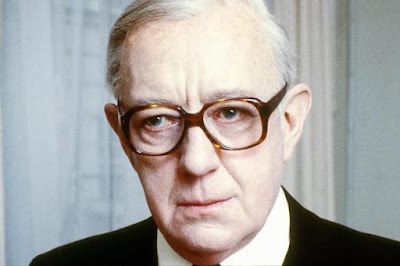

Alec Guinness, Smiley's People

And then fallen asleep.

Once again, it was Oliver Lacon who summons Smiley from retirement. One of Smiley’s old Russian defectors, General Vladimir, has been found murdered on Hampstead Heath.

Shot dead. This evening. George, for Heaven’s sake wake up, we need you…someone from his past, George. Someone who knew his little ways, can identify him, damp down potential scandal…Now. We need you George, wake up

“‘I need you’ thought Smiley…‘I love you, I hate you, I need you’. Such apocalyptic statements reminded him of Ann when she had run out of money or love. The heart of the sentence is the subject, he thought. It is not the verb, least of all the object. It is the ego, demanding its feed.

Lacon’s summons eventually leads to Karla…once again. Ann tells Smiley that Bill Haydon called Karla “the black Grail”. General Vladimir, now hiding in London, had realized the Russian spy boss set up Maria Ostrakova, a Russian expat in Paris, with fake citizenship papers for her daughter. 

As the novel unfolds, it becomes clear the fake citizenship papers for Maria’s daughter have been secretly used by The Sandman (Karla) as cover for his own schizophrenic daughter, now confined under a false name in the West at a Swiss sanatorium. For Smiley, it’s the chance he’s been waiting for; he can blackmail Karla and force him to defect to the West.

For the television adaptation of Smiley’s People (1982), there was a chance to get the band back together. Or what was left of it. 


Toby Esterhase (Bernard Hepton)


Alec Guinness as Smiley; Bernard Hepton as Toby Esterhase; Anthony Bate as Oliver Lacon; Beryl Reed as Connie Sachs, Patrick Stewart as Karla; Siân Phillips as Ann. The only unavailable cast member was Michael Jayston to play Peter Guillam. Jayston was committed to playing von Trapp in the London stage revival of The Sound of Music, of all things, so Michael Byrne filled in as Guillam.
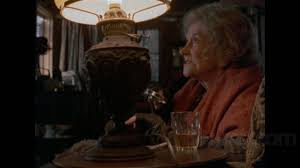

Connie Sachs (Beryl Reid)


Adhering to the “when you’re on a good thing, stick to it” axiom, scriptwriters John Hopkins and le Carré rely heavily on dialogue and structure from the novel (1979) and director Simon Langton takes the same measured and clear-eyed direction John Irvin achieved in Tinker Tailor Soldier Spy.

The often over-written and lengthy prose of The Honorable Schoolboy- 156,000 words compared with 92,000 for Tinker Tailor Soldier Spy and 104,000 for Smiley’s People- and its exotic locations, probably made any screen adaptation of the second novel in The Karla Trilogy unfeasible. 

But here, in the third, le Carré returns to the sparce, lean pacing of Tinker Tailer Soldier Spy and the television series unfolds with an unerring fidelity to the novel. 

Watching Alec Guinness return to the site of Vladimir’s murder, for instance, where Vladimir was to bring “two proofs” implicating The Sandman (“anyone who comes too close to him has a way of falling asleep”), is to watch a commensurate artist at work. Smiley follows Vladimir’s insistence on “Moscow Rules” and stalks the scene at Hampstead Heath, finding the tradecraft chalk mark and the new drawing pin on a park pavilion and pokes about in the bushes with his umbrella. 

He carefully steps along the Russian’s probable footmarks, trying not to over-balance:

Smiley peered sharply behind him and saw two small boys in blazers who had paused to watch this little round man in spectacles performing strange antics with his feet.”

He trawls through the park detritus - broken kites, Coca-Cola cans, torn-up porno mags, old shoes, a burnt blanket, beer bottles and cigarette packets - while other walkers, including a couple of typists and some Buddhist monks (a Hari Krishna in the television series), now watch on intently as the odd Homburg-hatted man finally stretches up to find his quarry hidden between branches in a tree. 

A similar set-piece takes place in Smiley’s Chelsea home, a near wordless sequence as he develops the photographic negative so carefully left by General Vladimir in the tree on Hampstead Health. There’s something reminiscent of Antonioni’s Blow-Up in these sequences and Guinness is riveting in both.

In the novel, but not its adaptation, the silence is broken by Ann. 

Smiley is waiting in an armchair for the photographic print to dry when he:

“…addressed himself to a pretty marquetry writing-desk in which Ann kept her ‘things’ with embarrassing openness. Such as a sheet of writing paper on which she had written the one word ‘Darling’ and not continued, perhaps uncertain which darling to write to.”

And then…

Ann rang. Once again, perhaps he had dozed off…‘George, George’ as if she had been crying for him a long time, and he had only now summoned the energy or the caring to answer her. They began their conversation as strangers, much as they began their love-making.

‘How are you?’ she asked.

‘Very well, thank you. How are you? What can I do for you?’

‘I meant it’ Ann insisted. ‘How are you? I want to know”.

To forget the hurts, the list of lovers; to forget Bill Haydon, the Circus traitor, whose shadow still fell across her face each time he reached for her…Bill the born deceiver, whose quest for the ultimate betrayal led him into the Russians’ bed, and Ann’s…

…but as he spoke he heard her whisper ‘George’…

‘You mustn’t’ he said. ‘Ann? Listen. You mustn’t come here…’

‘Then come here’, she said.

He rang off. He imagined her crying, then getting out her address book to see who from her First Eleven, as she called them, might console her in his place.”

When Smiley is forced into the dreaded dinner with Oliver Lacon to discuss each other’s marriage problems and as Lacon is seeing him off in a cab, Lacon actually says something quite funny:

If Ann had been your agent instead of your wife, you probably would have run her pretty well.”

To the plethora of spy-speak from Tinker Tailor Solder Spy, le Carré adds: the vicars, the postmen, the Neighbours, bromide jobs, Oddbins, the suitors, the babysitters, the pickets, the Cousins, lifelines, the whisperers, burning (blackmail), tradesmen and the loser’s corner.
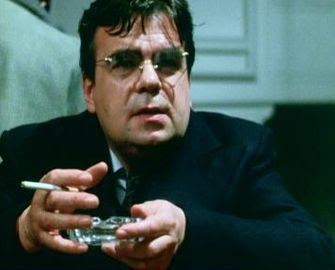

Anton Grigoriev (Michel Lonsdale)

The trail for Karla leads through several European counties, to strip-clubs, French safe-houses, Berne, feral German water camps and Soviet diplomats (Michael Lonsdale is superlative as the hapless diplomat Anton Grigoriev). 

Finally, Karla is forced to defect. Meeting Smiley at a Berlin Wall crossing at Oberbaumbrücke, he holds a cigarette lighter that once belonged to the British spy, engraved with a message from Ann: “To George from Ann, with all my love”. 

Decades before, Karla had taken the lighter from George in a Delhi jail cell.

As he crosses into the West, Karla drops the lighter at Smiley’s feet. Smiley glances at it, leaves it on the road and walks away with a barely concealed expression of disgust.

“‘There is no loyalty without betrayal’, Ann liked to tell him in their youth when he ventured to protest at her infidelities”.

Both series follow labyrinthine plots and Alec Guinness holds them together with a vice-like grip. His Smiley, continually swaps from contrived meekness to the distinctly bland to the fiercely determined; from the mild and reserved to the wounded, put-upon lover; and from the contemptuous to the very essence of British politeness.

Ten years ago, The New Yorker described Alec Guinness’s work in Tinker Tailor Soldier Spy and Smiley’s People, the two-television series that made him an icon, as:

“…almost Shakespearian…one of the great literary-cinematic creations of the post-war era, an actor’s masterpiece.”

 Previous: Click on title


Next: The Secret Pilgrim, A Legacy of Spies, and the feature film version of Tinker Tailor Soldier Spy (2011)