Showing posts with label Danish Cinema. Show all posts

Sunday, 4 December 2022

The Current Cinema - Rod Bishop examines The Discreet Charm of the Bourgeois–sea in TRIANGLE OF SADNESS (Ruben Östlund, Sweden and nine other countries, 2022)

Woody Harrelson, Triangle of Sadness

In the second act of this year’s Palme d’Or winner, a group of obnoxious,wealthy passengers on a $250 million yacht, skippered by an unhinged, alcoholic and dysfunctional captain (Woody Harrelson) sit down to fine-dining at the Captain’s Dinner. 

The yacht starts to wallow in a progressively strengthening storm and a lengthy sequence of vomiting and exploding toilets follows. 

Sight gags aside, as the mayhem swirls around them, a Russian businessman, who has made his fortune from manure (“I sell shit”) and the captain take over the yacht’s public address system and drunkenly trade quotations from Kennedy, Reagan, Twain, Thatcher, Marx and Lenin.

Passengers cringe in walkways in vomit-strained life jackets, avoiding floating excrement, runaway tables and other falling passengers, as the captain rants over the PA with “something that I wrote”:

My government murdered Martin Luther King, Malcolm X, Bobby Kennedy and John F Kennedy. My government overthrew good, honest, democratic leaders of the people in Chile, Venezuela, Argentina, Peru, El Salvador, Nicaragua, Panama and Bolivia. Along with Britain, we carved up the Middle East, creating artificial geographical boundaries and installed puppet dictators. War, itself, became our most lucrative industry. Every bomb that’s dropped makes someone a millionaire. You don’t have to know where those bombs are exploding. You don’t have to see the grieving mothers and the mangled bodies of their children”.

The last few sentences are overlaid with images of a pirate boat armed with grenades and automatic weapons silently approaching the luxury yacht.


So begins the third act, as a handful of these wealthy survivors make it to a tropical island only to discover one of the yacht’s employees, a Filipino “toilet manager”, is the only one capable of catching fish and making a fire.

After the setups, the second and third acts suffer from our ability to telegraph what comes next. But the first act is more intriguing. Two runway models – he and she – are in a relationship. She earns more money than he does (female models do) and she is also a social media influencer with a decent following. When she allows him to pick up the dinner bill one night (she’s distracted and texting), he confronts her about the inequalities in their relationship. The dinner bill dispute escalates and suddenly consumes all of their lives – will they survive this First World problem? Or will a cruise on a $25 million yacht revitalize their relationship?

After his similarly acerbic The Squarein 2014, this social satire from writer-director Ruben Östlund wasn’t universally acclaimed at Cannes. Peter Bradshaw in The Guardian described the film as “an unworthy winner” of the Palme d’Or:

There were no ideas in it that had not already been aired more subtly, more rewardingly, and yet also more powerfully in his previous film The Square, and it seemed very shallow to me”.


Östlund’s win places him a rare club of dual winners of the Palme d’Or - Coppola, Haneke, Kusterica, Loach, Imamura, the Dardeenes, Sjöberg and August. Does he deserve to be there? Does anyone really care? After all, Godard, Varda, Bertolucci, Tarkovsky and Bergman never once won a Palme d’Or, let alone two.

And the title? The Discreet Charm of the Bourgeois–sea would have been better.


Monday, 8 August 2022

Streaming on Stan and SBS On Demand - Janice Tong (re)discovers THE ASSASSIN (Hou Hsiao-hsien, Taiwan, 2015) + THE EXCEPTION (Jesper W Nielsen, Denmark, 2020)

"...beauty and aesthetics of the highest order...",
The Assassin

I have been a little remiss in writing about films in 2022, the year of supposed harmony (it’s turned out to be chaos really). Watching the world burn and drown simultaneously, I found that I’ve not had the heart for it. 


But art, music, literature, poetry and of course, cinema, have a profound role to play in shaping thought; inspiring beauty; giving the soul nourishment. At times it seemed that these traces, our humanness, had been abandoned in the face of an unfolding horror-field. It becomes impossible to switch on the TV, at the prescribed hour at 6:30pm. Just in time for tea. We have no stomach for it, our dinner, that is.


Let us travel back to an age of the mythic, where wuxia is a way of life. Hou Hsiao-Hsien’s oblique take on a classic seventh century fiction, Pei Xing’s Nie Yinniang is a slow burn; at once cinematically enigmatic and aesthetically stylised. There is little action in this wuxia pian. Whilst I haven’t read the text, the elliptical narrative would indicate that this was a loose and artistic retelling, rather than a faithful book-to-screen adaptation. Anyone who knows Hou’s cinema, would be familiar with his masterpiece A City of Sadness(1989), a meditative filmic elegy to the city of Taiwan and The Flowers of Shanghai (1998), my personal favourite – a languid film much like Bertrand Bonello’s House of Tolerance (2011). Hou’s focus is the flower houses of Shanghai in the 1880s versus Bonello’s nineteenth century Parisian take on the same subject.


In The Assassin, one can feel the same meditative languidness as FlowersMark Ping Lee’s cinematography is choreographic, lilting – like that of a sultry, brooding dance for one. The camera hides between billowing fabrics, between foliages, between the seen and the unseen; it sways like it’s yielding to the gentle breaths of Zephyrous. Set in the eighth century during the last years of the Tang Dynasty, which is at the summit of this dynasty’s art and culture; one should expect no less than beauty and aesthetics of the highest order in this film. 


Shu Qi plays Nie Yinniang, The Assassin


The wonderful Shu Qi plays the eponymous assassin Nie Yinniang, taken away to be trained when she was only 10 years old. She is the daughter of a general, who, years later, is sent on assassination assignments by her mentor, Jiaxin, a nun (in Chinese terms, she is actually a ‘holy person’ and not strictly in the sense of a ‘nun’ as Western culture understands) living in seclusion in the mountains (where the scenery is pristine and glorious to behold). In one of these assignments, Nie was to kill a corrupt general, but she weakened at the last moment and was unable to carry out her duty.  The target was holding his infant son. Nie returns to Jiaxin, but she has broken the assassin’s code and as punishment she is sent to Weibo in northern China to take the life of her cousin Tian Ji'an, to whom she was once betrothed – their union was meant as a seal for peace between two regions.


The film premiered at Cannes to critical acclaim (its legend written by none other than Manohla Dargis who described the screening to have been in ‘rapturous silence’ and ended with ‘thunderous applause’ – it won Hou the Best Director award. But many critics found the narrative to be intoxicating but frustratingly confounding in its narrative. To me, they seem to be saying that there is the most ravishing foreplay, but without the action that gets you off. I would like to return to the idea of dance – and ask whose eyes is this dance for? The answer is simply, it is for us, the audience, and as such, we are complicit in creating the film’s mysterious heart. 


"...ravishing foreplay, but without the action..."
The Assassin


This is not a story of connections, predestined or serendipitous, nor is it a story of contemplative lovers, like the last pairing between Chang Chen (here as the cousin Tian Ji'an) and Shu Qi – they were mesmeric in Three Times (2005). This film is also not a reinvention of the genre like Wong Kai-wai’s masterful and equally poetical Ashes of Time (1994). Hou films beauty, the costumes, the scenery and its compassionate heart is a must for those wanting a quiet moment’s solace, if only to enter into a dream during these tumultuous times.


The Exception was shown at the  Scandi Film Festival a couple of years ago, but I missed its theatrical screening at the time, so I was glad to have found it on Stan the other night. Do not confuse this small but incredibly thoughtful and tightly woven film with The Exception (2016) with Lily James and Christopher Plummer. No, The Exception I’m referring to is with Lene Maria Christensen, you would know her from Susanne Bier’s Brothers (2004) and Pernille Fischer Christensen’s En Famille (2010), Magnus Krepper (most recently seen in When the Dust Settles) and Danica Curcic (most recently seen in The Chestnut Man). If none of these names are familiar, the film also stars Sidse Babett Knudsen who is a household name these days, especially after the success of Borgen (the new series is on Netflix incidentally), not to mention 1864 (my favourite TV series, ever) and films like the blockbuster Tom Hanks vehicle Inferno or Peter Strickland’s The Duke of Burgundy. There’s also a small part for Johanne Louise Schmidt who plays the PM in the latest season of Borgen.


Anne-Lise (Sidse Babette Knudsen) - isolated by the others

Seen simply, Nielsen’s The Exception is a story about bullying, when a collective gangs up on another, for no apparent reason but just ‘because’ they can. Knudsen’s Anne-Lise is at the centre of the group’s insidious attacks; small jibes, the accumulation of uncomfortable moments, deliberate neglect, and a simmering and hurtful undercurrent of disdain. I’m sure we’ve all felt this at one time or another, by not-so-nice colleagues or ‘pretend friends’. 


Bullying is insidious- the collective from left Amanda Collin (Marlene),
Knudsen (Anne-Lise), Danica Curcic (Iben)
and Lene Maria Christensen (Camilla)


This thriller slowly unravels and Nielsen cleverly uses Iben’s (Curcic) piece on The Psychology of Evil to set up ideas (or perhaps to provide a more profound view of these behaviours) as he slowly unpicks the backstory of this ensemble. Seen in layers, their everyday lives are too complex for each other to grasp even a reasonable understanding of it. What lies under the surface, literally surfaces; but Nielsen makes a good point that it is impossible to grasp another’s pain when you are not in their skins.


The psychology of evil is not so much in question here, it exists, pure and simple; but it is its ubiquitousness and its rhizomatic behaviour that is brought to bear – the thin red line that separates survival and bloodlust, what mitigates one act from another. Wherefore our bloodline, our vessel to salvation?


The Assassin is currently showing on SBS on Demand and The Exception is currently showing on Stan.

Sunday, 17 October 2021

Streaming on SBS on Demand - Janice Tong catches up with the Oscar-winner ANOTHER ROUND/DRUK (Thomas Vinterberg, Denmark, 2020)

Despite its title and the obvious subject matter, druk is Danish for ‘binge drinking’, this film by Thomas Vinterberg of Festen/Dogme fame (1998), (and let’s not even get me started on the Dogme movement and my hostility against its craft) poses the very diaphanous question of what it means to be alive. 
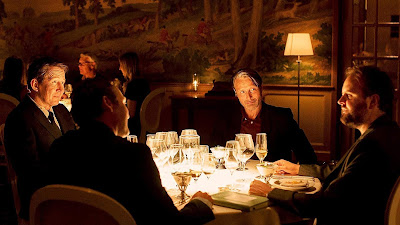

Four friends and the night where it all began, Druk

The answer is clearly multiple: some people go at it full pelt, whether it’s working yourself to death, or being excessive in consumption - alcohol, drugs, social media, shopping or some other thing; whilst some may live a balanced life (and a ‘balanced life’ would again mean different things to different people - work/life balance, spending time with family and friends etc); and yet still others may live a more sedentary life, having become complacent - many of us are simply existing, cruising through time and space - until you wake up one morning and are hit with the realisation of having to deal with the banality of living with oneself.


This problematic - the banality of life, and how to rise above it - is at the heart of this film. 


The story centers around Martin (a magnificent Mads Mikkelsen), a history high school teacher who is staring down the barrel of a fading youth, and having to face his dispassionate students for yet another year of his job. He looks somewhat like a lost lamb, or a ghost of his former self. His home life is not any better, he hardly sees his wife (she works the night shift), let alone have any intimacy with her, and his two kids are more interested in video games or screentime than his presence. Martin finds solace with three best mates who are also high school teachers, and I would add, are also suffering the same fate in varying degrees. Tommy (Thomas Bo Larsen) is a divorcee and a soccer/PE coach; Peter (Lars Ranthe) is a music teacher; and finally Nikolaj (Magnus Millang) teaches psychology, and as the film progresses, becomes, appropriately, the documenter of this group’s social experiment. 
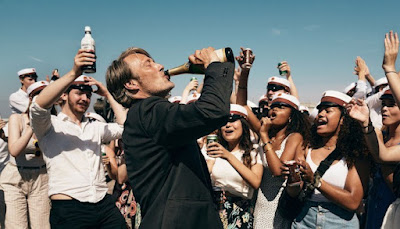

A celebration of being alive. Mikkelsen (centre) as
Martin, with all the young graduates whose
lives are just beginning watching on, Druk


It all comes to a head for Martin at the celebratory birthday dinner for Nicholaj. The whole crew were enjoying champagne and oysters, wine was being freely poured; all introduced with a flourish by the sommelier, “the champagne has a mineral note” and “this vodka would make a Tsar weep” that kind of thing. At the start of the evening, Martin was simply being Martin, conversative and sensible, refusing to taste any of the alcoholic beverages because he has to drive home. 


But gradually, as the talk turns, and after a few friendly jabs from his friends, his demeanour changes. He downs a shot of vodka and an entire glass of red without waiting for the toast, or luxuriating in the taste. His eyes water. His friends get a few details out of him and as the evening progresses and more alcohol is consumed, Martin becomes a happier version of himself. 


During the dinner, Nikolaj had referenced Finn Skarderud, a Norwegian psychiatrist, who had purportedly written that man was born with a deficit of 0.05 percent blood alcohol concentration (BAC). And the idea that in order to live a full and happy life, the bar must be set at maintaining a BAC of 0.05 to be able to live that happier and more satisfactory life. (This quote was taken from Skarderud’s introduction to the book "The Psychological Effects of Wine" by 19th century Italian author Edmondo de Amicis. It was actually the premise that was quoted, and Skarderud refuted this premise in the very next line. But far from being misquoted, Skarderud was in fact asked by Vinterberg to be a consultant during shooting. His initial concerns about being misconstrued, especially since he was a practising doctor, abated because he felt the story’s exploration into the effects of alcohol was balanced and measured throughout.)


How much is too much?


The next day back at school, Martin takes a pocket-sized bottle of Gordon’s gin with him and downs a good shot or two prior to class. The result was amazing, it was like he had switched gears, the world opened up and he was an illuminated man.


Once he confessed his actions and subsequent success to Nikolaj, the four friends met that afternoon and decided that they would test out Skarderud together. One of them even quoted Winston Churchill’s abstinence from drinking after 8pm as a rubber stamping of sorts for the whole shabang.


Mikkelsen’s performance took my breath away. He has always been a fine actor, and I remember him well in the The Royal Affair (2012). Nine years later, he’s still heart-achingly handsome and graced with a high degree of emotional intelligence. As Vinterberg said of his performance, Mikkelsen“is a finely tuned instrument”, highly nuanced; he is the emotional core the propels the film, and his range from a caring but desperately lost man to his soaring celebratory dance that closes the film, captures the very joy of being alive, and this transformation is nothing short of evocative, intoxicating, cathartic. 


His friends who make up this quartet, are a group of fine actors. Bo Larsen’s Tommy is pitch-perfect as the slow unwinding of a man, Millang’s Nikolaj is the voice of reason, and Ranthe’s Peter is also wonderfully portrayed. You can catch Ranthe in a new gripping nordic noir series The Chestnut Man (2021) on Netflix. Note though, the set is an entirely dry one, and even without a drop of alcohol in their systems, these actors are able to pull off the finesse of being lubricated by ‘just the right amount’ of alcohol with some laugh-out-loud moments. 


Although the deliverance afforded to Martin et al. took them by surprise, and in a good way to begin with; we all know that they’re treading on a fine edged sword that is difficult to balance on, one which can both quicken your release, or sink you like a stone.
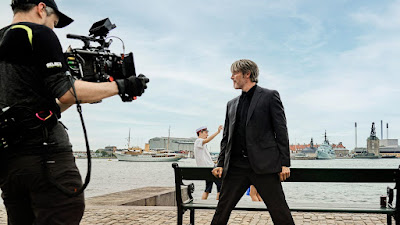
Grøvlen films Mikkelsen's dance moves


Beautifully shot, the cinematography by Sturla Brandth Grøvlen recalls his earlier work on   Sebastian Schipper’s hypnotic single-take film Victoria (2015). His ability to stay close to the characters immerses the audience into their world; sharing intimacy without ever being claustrophobic. 


To close, l’d like to take a moment to remember IdaVinterberg’s daughter, who died four days into the shoot. In his own words, Vinterberg wanted to continue to make this film because he wanted to dedicate this film and the making of this film to her; to do so would mean being able to feel her presence throughout the film, the heart of which is to grasp the essence of existence, and to celebrate this gift we have of being alive.


Druk is currently showing on SBS on Demand.

#filmfestivaleveryday #filmoftheday#jandnfilmfestival