Showing posts with label Paramount Pictures. Show all posts

Thursday, 9 April 2026

On Criterion 4K UHD and 2K Blu-ray - David Hare discovers "A perfect rescue of a perfect movie" - TROUBLE IN PARADISE (Ernst Lubitsch, USA, 1932)

 Criterion's new 4K disc of Trouble in Paradise is a giant step up from the screening of a "new" restoration from Universal which I saw back in 2017 at Bologna. It was good, certainly better than the older UK and US Blu-ray discs. But it had quite a few work-in-progress problems. All the opticals - and they are very many - tanked the grain and density. The new print (I recall it was screened on 35) had tramline emulsion scratches through 80% of the picture, and there were sundry other problems. But it was good enough to bring the very youthful house that day to its feet in what must have been for them the first discovery of a total, seamless masterpiece, a perfect movie, and for me, a joyous reunion after first seeing it in a lovely 16mm print at the Trinity Church Wall Street Sunday cine club Screening Nites way WAY back in December 1971.


When Criterion announced this I wondered how much further they might go with restoration. In the interim Universal did a superb 4K restoration of Leisen's 1939
Midnight (another perfect Paramount 30s film) which played to a knocked out full house at Sydney Cinema Reborn back in 2023. That superb 4K was curated from a previously wrongly identified dupe nitrate safety fine grain and other elements which had been lying around mislabelled as safety 35 copies at the Library of Congress until Universal dug it out and discovered to their surprise near-pristine material.
Unfortunately Criterion released a Blu-ray of Midnight only back last year which was hugely underwhelming displaying massive grain reduction to near zero grain, lowered black shadow detail, softer edges and overall a really shitty encode. I had hoped Criterion would release Midnight as a 4K but given such a mediocre master like this what was the point. Maybe someday another label will risk the budget and coax a reliable 4K master for disc encoding out of Universal.
The story for Trouble in Paradise is the total reverse of Midnight. Universal appears to have gone full hog on this and Criterion has stepped up to what looks like a perfect 4K encode with a flawless 4K disc AND Bluray/2K disc. Everything sings. It's unbelievable, especially for a pre-1935 slower-speed-neg-film and faster lenses era.
The softness now is totally supported without a hiccup through the grain which while always visible is a part of the images' "lifeblood." One of the biggest surprises is not a whisper of density bumps in the opticals all of which flow seamlessly. Grayscale is total, whites and deep black perfect, silver and reflective jewellery and glass shimmer with nitrate sparkle.
A perfect rescue of a perfect movie. Essential to life.

Saturday, 3 June 2023

At CINEMA REBORN 2023 - Geoff Gardner introduces RUGGLES OF RED GAP (Leo McCarey, USA, 1935)


Charlie Ruggles, Charles Laughton Ruggles of Red Gap

What can I tell you about a film which I think is a very simple work made by the Hollywood production system working at its most optimum levels of creation. 


I’ve listened to the other introductions delivered so far in this year’s Cinema Reborn season – They dealt with films that went to the heart of Italy’s post-war plight, the existential agony of a man caught up in forces beyond his control, an extraordinary  French film that had the nation and conservative institutions like the Catholic Church up in arms and a musical comedy from Germany about lovers finally falling into bed together. That one was made just as one society was being swept away by another and such frivolity disappeared for ever from that nation’s psyche.


But today it’s a Hollywood comedy with Hollywood actors, one of Hollywood’s great actors in fact. But he was an actor who both before and after this film who, to use the words of John Baxter in our Cinema Reborn catalogue, generally played tyrants, murderers, mad doctors and psychopaths. 


And it’s fair to say that Charles Laughton playing in this comedy has never met with universal approval. The great David Thomson in his Biographical Dictionary of Cinema has a rather disapproving view of Charles Laughton overall. He says that not much of his work stands up well and in a giant segue asks whether his choice of parts came about because the actor was desperate not to emerge as gay…. Hmmm…


Let’s take another tack. Charles Laughton wanted to break away from the psychopaths  and play Ruggles. He himself bought the rights to the novel on which the film was based and fussed around on the script. Three writers are credited and its said that the final uncredited polish was given by Laughton’s friend, the writer Arthur McCrae. It had already been filmed twice before in the silent era and would be filmed once more with Bob Hope in a movie called Fancy Pantsin 1950, a movie which in the interests of research I tried to watch a few weeks ago and gave up on after a couple of reels. 


But Laughton was very determined to make this project something special. For starters he wanted Leo McCarey as his director. McCarey was the man who had begun by spending a decade doing comedy for Hal Roach and his name should live forever as the man who decided to team Stan Laurel and Oliver Hardy.  McCarey had recently made the best Marx Brothers move Duck Soup. Perhaps unfortunately McCarey is now  better  remembered for  his mawkish movies with Bing Crosby as a Singing Priest one of which Going My Way won an Oscar. Still McCarey also made Love Affair, Make Way for Tomorrow and The Awful Truth. He was a pillar of the Hollywood establishment for thirty years. 
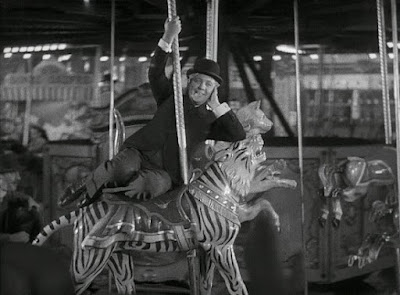


The situation of the film is of course, taking a moment’s reflection, ridiculous but you pay it no mind. An English aristocrat, played by Roland Young, has been in a poker game in Paris with a loud (and the loudness is personified by Charlie Ruggles check suits) American rancher. The American rancher however is totally under the control of his social climbing wife Effie played by the wonderful Mary Boland. The aristocrat has lost everything which includes the services of his faithful manservant.  Ruggles is to be unceremoniously packed off to the American west to serve the nouveau riche and more importantly to become an object of endless discussion among the family and the local denizens of Red Gap. Effie thinks Ruggles will add “….tone…”. 


Ruggles gradually works his way through this unfortunate circumstance and in what has become the film’s most famous scene proves himself to be a true man of the people in what is known as the Gettysburg address scene. I hope I haven’t given too much away just by saying that.


But back to Laughton. We recognise longstanding actors and stars, people who over their lifetime will play dozens of roles and bring unique variations. Their technique and their skill at voices, movements and creation of character is so good that its un-noticed. That’s how they want to be. They effortlessly remain someone we recognise while they play one character after another. But here Charles Laughton is doing something unusual for him. He’s playing a comic role and has to eschew his normal scenery chewing antics that he could deploy at the drop of a hat when playing everything from Hunchbacks of Notre Dame to Maigret to drunks, to murderers and murderous tycoons, to lawyers defending murderers. Late in life he was brilliant as a rascally Southern Senator in Otto Preminger’s Advise and Consent. 


Comedy however was thin on Laughton’s ground but in Ruggles of Red Gap Laughton and Leo McCarey pulled off a small comic miracle.


We are told what you are seeing today in in in fact the film’s first ever public screening since Universal Pictures went to the trouble, back in the Covid year of 2021 when all the festivals shut down, of restoring this Paramount film to its true 1935 glory. 


I hope by the time it’s over you’ll be glad that the trouble and the expense was worth it.

Thursday, 6 August 2020

Streaming - John Baxter explores the later career of Mitchell Leisen - BRIDE OF VENGEANCE (Paramount, USA, 1949)


         THE CHALICE FROM THE PALACE
It’s hard to know how seriously to take Bride of Vengeance. Faced with the need to recreate the pomp and pageantry of 16thcentury Italy on some poky Hollywood sets, and with a cast from the Paramount second string to impersonate the Borgias, Mitchell Leisen must have been tempted to throw up his hands, particularly after the scheduled lead, Ray Milland, preferred two months of unpaid suspension rather than play the lead role of Alfonso D'Este, Duke of Ferrara. Milland claimed to dislike both the film’s original title, “A Mask for Lucretia”, and the script, and would rather ski and sail for eight weeks; manly pursuits that didn’t require him to appear in....well, frocks. (Milland couldn’t carry off robes and hose, and never played in anything set earlier than the Regency.) 
John Lund (centre), Paulette Goddard
         One can see why they cast Milland. Alfonso is not too far from the superficially effete lawyer he played in Reap the Wild Wind. Under its tesselated floors, omnipresent statuary, staircases and velvet hangings, Bride of Vengeance is a sex comedy, with elements of The Scarlet Pimpernel andZorro.  Convinced by Cesare Borgia that Alfonso killed her husband, Lucretia is married off to him with the sole aim of murdering him and surrendering Ferrara to her brother. Playing the fop and fool, Alfonso neglects her to sneak off to his secret foundry, where he’s building an enormous cannon. His first few tries are duds -well, he’s new to this - but once Lucretia adds her expertise, the two experience a highly satisfying explosion.
MacDonald Carey, Paulette Goddard
What probably irked Milland more than the schmutter was the presence front and centre of Paulette Goddard as Lucretia Borgia. Eyes wide, teeth bared, and made up like a wicked sister in a pantomime Cinderella, she’s in almost every scene, and goes for the jugular in all of them. At times, the inoffensive John Lund as Alfonso, switched, after Milland’s defection, from his role as Cesare Borgia (John Lund - as Cesare Borgia??) looks in fear of his life. Maybe it’s only the contrast, but Macdonald Carey as Cesare is almost convincing, mostly because his political persona is submerged in some incestuous clinches with his sister. 
At 38, however, Goddard is simply too old for this foolery. The film terminated her time at Paramount. Within a few years she’d be reduced to Babes in Bagdad and Vice Squad, before disappearing into television – the fate also of Macdonald Carey, shortly to become a king in daytime drama. 
         That the script derives from a story called Chalice called instantly to mind Norman Panama and Mel Frank’s classic “Chalice from the palace” routine from The Court Jester. For those who haven’t seen it, the characters use a mnemonic to remind them which is the fatal cup (“The vessel with the pestle/Has the potion with the poison”), only to become confused when plans change (“It’s the flagon with the dragon...”) Incidentally, Panama and Frank first wrote it in 1948 for Red Skelton in A Southern Yankee, where something is secreted in a jacket with the placket. No doubt it appears first in a rip-off of Ralph Roister Doister and a rhyme about “Ye firkin with a jerkin” recited by the brothers Bollocks to Scrotum, a wrinkled old retainer.
         There’s so little to involve one in Bride of Vengeance that such random thoughts are unavoidable. One automatically recalls how much Orson Welles did with even fewer resources in Othello. An opening like his silhouetted funeral on the battlements would have lifted this one immeasurably. (And let’s not forget how imposing a Cesare Welles made in Prince of Foxes.) But Leisen is a director of interiors, so except for an occasional cut-away the film hasn’t a single scene set outside. Instead, he expends his energies on staging, and on the costumes, for the design of which he receives co-credit. Everything in the film looks back to his early career as Cecil B. DeMille’s costumier, a history that elicited from Billy Wilder the sneering insult “Window dresser!” Well, perhaps. Though with Leisen it’s not so much the windows as the bizarre nature of the life glimpsed through them. 

Editor's Note: John Baxter first wrote on the career of Mitchell Leisen in Film Digest, published by the WEA Film Group in Sydney in the sixties. The essay drew an approving letter to the editor from Leisen himself. The edition is now a collector's item though it is always possible a copy may be held by Sydney's best kept secret bookshop Badger Books
Editor's Further Notes: John Baxter recently published a piece on Leisen's 1934 Murder at the Vanities. You can read it if you click here A very good quality copy of Bride of Vengeance can be viewed free on a streaming service if you click here