 |
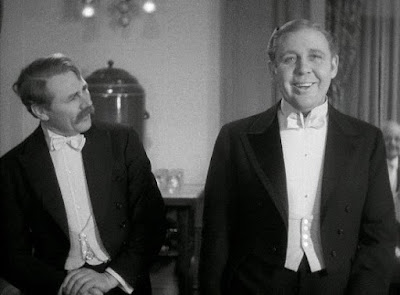
| Charlie Ruggles, Charles Laughton Ruggles of Red Gap |
What can I tell you about a film which I think is a very simple work made by the Hollywood production system working at its most optimum levels of creation.
I’ve listened to the other introductions delivered so far in this year’s Cinema Reborn season – They dealt with films that went to the heart of Italy’s post-war plight, the existential agony of a man caught up in forces beyond his control, an extraordinary French film that had the nation and conservative institutions like the Catholic Church up in arms and a musical comedy from Germany about lovers finally falling into bed together. That one was made just as one society was being swept away by another and such frivolity disappeared for ever from that nation’s psyche.
But today it’s a Hollywood comedy with Hollywood actors, one of Hollywood’s great actors in fact. But he was an actor who both before and after this film who, to use the words of John Baxter in our Cinema Reborn catalogue, generally played tyrants, murderers, mad doctors and psychopaths.
And it’s fair to say that Charles Laughton playing in this comedy has never met with universal approval. The great David Thomson in his Biographical Dictionary of Cinema has a rather disapproving view of Charles Laughton overall. He says that not much of his work stands up well and in a giant segue asks whether his choice of parts came about because the actor was desperate not to emerge as gay…. Hmmm…
Let’s take another tack. Charles Laughton wanted to break away from the psychopaths and play Ruggles. He himself bought the rights to the novel on which the film was based and fussed around on the script. Three writers are credited and its said that the final uncredited polish was given by Laughton’s friend, the writer Arthur McCrae. It had already been filmed twice before in the silent era and would be filmed once more with Bob Hope in a movie called Fancy Pantsin 1950, a movie which in the interests of research I tried to watch a few weeks ago and gave up on after a couple of reels.
But Laughton was very determined to make this project something special. For starters he wanted Leo McCarey as his director. McCarey was the man who had begun by spending a decade doing comedy for Hal Roach and his name should live forever as the man who decided to team Stan Laurel and Oliver Hardy. McCarey had recently made the best Marx Brothers move Duck Soup. Perhaps unfortunately McCarey is now better remembered for his mawkish movies with Bing Crosby as a Singing Priest one of which Going My Way won an Oscar. Still McCarey also made Love Affair, Make Way for Tomorrow and The Awful Truth. He was a pillar of the Hollywood establishment for thirty years.
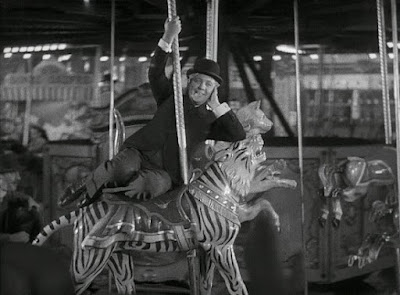
The situation of the film is of course, taking a moment’s reflection, ridiculous but you pay it no mind. An English aristocrat, played by Roland Young, has been in a poker game in Paris with a loud (and the loudness is personified by Charlie Ruggles check suits) American rancher. The American rancher however is totally under the control of his social climbing wife Effie played by the wonderful Mary Boland. The aristocrat has lost everything which includes the services of his faithful manservant. Ruggles is to be unceremoniously packed off to the American west to serve the nouveau riche and more importantly to become an object of endless discussion among the family and the local denizens of Red Gap. Effie thinks Ruggles will add “….tone…”.
Ruggles gradually works his way through this unfortunate circumstance and in what has become the film’s most famous scene proves himself to be a true man of the people in what is known as the Gettysburg address scene. I hope I haven’t given too much away just by saying that.
But back to Laughton. We recognise longstanding actors and stars, people who over their lifetime will play dozens of roles and bring unique variations. Their technique and their skill at voices, movements and creation of character is so good that its un-noticed. That’s how they want to be. They effortlessly remain someone we recognise while they play one character after another. But here Charles Laughton is doing something unusual for him. He’s playing a comic role and has to eschew his normal scenery chewing antics that he could deploy at the drop of a hat when playing everything from Hunchbacks of Notre Dame to Maigret to drunks, to murderers and murderous tycoons, to lawyers defending murderers. Late in life he was brilliant as a rascally Southern Senator in Otto Preminger’s Advise and Consent.
Comedy however was thin on Laughton’s ground but in Ruggles of Red Gap Laughton and Leo McCarey pulled off a small comic miracle.
We are told what you are seeing today in in in fact the film’s first ever public screening since Universal Pictures went to the trouble, back in the Covid year of 2021 when all the festivals shut down, of restoring this Paramount film to its true 1935 glory.
I hope by the time it’s over you’ll be glad that the trouble and the expense was worth it.


