Showing posts with label classic westerns. Show all posts

Sunday, 7 July 2024

Streaming on Amazon Prime - Barrie Pattison unearths DEAD FOR A DOLLAR (Walter Hill, USA, 2022)


Making a comeback at eighty may not have been one of Walter Hill’s best career moves. His 2022 Dead for a Dollar (no connection to the 1968 John Ireland film) is a presentable enough cowboy movie but it keeps on registering as something that isn’t quite right, despite nice camerawork and some good performances.

We kick off in 1897 at Albuquerque Federal prison, with Bounty Man Christoph Waltz, who turned him in for the reward, warning time served Willem Dafoe to stay clear when they let him loose. The ochre colour scheme that will persist through the film is already dominant. Strong colours are all but absent. Allow for a bit of red blood.

Willem Dafoe

Christoph Waltz

The military (“Rider approaching, sir”) have a new assignment for Waltz. A (black) deserter has kidnapped rich man Hamish Linklater’s wife and is waiting South of the border for the $10,000 ransom. Waltz gets $2000 to bring her back and they give him (black) sharp shooter Warren Burke as sidekick on the job. Burke has details of the payout location. Waltz is already suspicious. “Private Jones just hands out maps after he deserts and abducts a white woman!”

After taking down a few colourful minor characters, Waltz has the job well in hand, getting warned off (“I don’t think we made a new friend”) by local Grandee Benjamin Bratt. Rachel (The Marvelous Miss Maisel) Brosnahan’s “Decorative wife” part is built up to meet 2020s demands and comes with her own purse pistol, which is a plot element. With her alleged captor Brandon Scott in deceptively servile local Captain Fidel Gomez’ jail, in view of a couple of men who have been hanging on the main street gallows a few days, they wait for interested parties to converge

Rachel Brosnahan, Christoph Waltz, Warren Burke

The film is dedicated to Budd Boetticher but it's more The Professionals, with a bit of Joe Kid and Rio Bravo mixed in, and the comparisons don’t benefit Hill’s movie. He never did have John Sturges’ eye for western scenics. Horsemen don’t converse in the saddle. The gunfights are unmemorable. Dialogues interrupt proceedings to get in lines like “Find the Gringo scumbags and kill them.” What about the pair of nuns? The use of fades is tame, though there is a nice wipe on a sideways tracking. 

There are a few reminders, like a figure eight mask view and a bull whip duel to recalis l the ones in Song of Scheherazade or Lewis Milestone’s Kangaroo, along with suitable atmosphere touches like Brosnahan playing “Beautiful Dreamer” on the upright or a plate overrun by roaches. The Latins are gangbusters at violating stereotypes - Gomez (particulaly), Brat, Luis Chávez, Alfredo Quiroz and (nice surprise) Diane Villegas, who joins in the big shoot-out.

This one is good enough to drag out of its obscurity, particularly for admirers of Hill’s The Long Riders48 Hours and Last Man Standing.

Thursday, 26 January 2023

On Warner Archive Blu-ray - David Hare is thrilled by the new edition of Fritz Lang's RANCHO NOTORIOUS (USA, 1952)


This great montage above from Rancho Notorious, including the faces of Arthur Kennedy, George Reeves and Mel Ferrer among others, invokes Lang’s great angry mob sequence from M and the montage from that masterpiece. Indeed the last four shots in this Technicolor sequence are, like the M “j’accuse” montage barely half a dozen frames each. (Try getting screen captures from this piece of film!)


Indeed, the structure of Rancho Notorious, now released in a staggering new three strip restoration from Warner Archive to revive the glorious new year, salutes every great director who’s taken advantage of the pointed montage as a full-blooded caesura in the narrative to bring it to a momentous dramatic halt. 


So any one of these faces might be a rapist and killer, or none of them, despite the privilege of us as audience who witnessed the original crime. Which face is less “human” than the other, which if any is “not guilty”, but of what? Cinema is never purer than this.


Marlene Dietrich

Arthur Kennedy’s consuming need for revenge at any expense will of course lead to a confrontation in which the remaining woman in the narrative takes the hit for his anger. Just as Jocelyn Brando and Gloria Graham take a hit for Glenn Ford in The Big Heat. And Joan Bennett takes a hit for Walter Pidgeon, and so on in Lang. 


The sheer classicism of the sacrificial female is beyond biblical in Lang’s world and perhaps it’s that sheer outrageousness that now compels us to understand more fully the destructive futility of leading man after leading man in a world no longer making sense. Only the sheer supreme mythologies of the Indian temple, or the need for balance in a contemporary 1928 world gone mad like my favorite Lang, Spione (Spies) can save us. 


Rancho Notorious, like Moonfleet three years later, is another of Lang’s morality tales dressed in period costume with a mixture of sublimely photographed exteriors and even more studio and backdrop artifice shots (like the one I’ve printed above in deference to Ms Joyce Carol Oates’ dislike of Hitchcock’s similar tendency to such cinematic primitivism.) I think with Rancho Lang begins a final period in which he returns to the past for context, either as legend like the West and its codes of violence, or the child’s nightmare, missing father tale of Moonfleet with its tireless search through caves, tunnels and the underworld to reconcile both the lost father and the glittering spoils of the pirate overworld. 


Ultimately Lang will return sublimely in color and with Debra Paget to his own mythology with the completely wonderful Von Harbou written Indian Tomb/Eschnapur Tiger pictures which play in episodic style like a Feuillade serial, but one originally written by his then spouse, and directed by another, only to be finally realized by Lang himself, one of the first colony of auteurs on earth fifty years earlier. Lang has ridden full circle and just a few years later Godard imagines and directs him as himself directing the Odyssey in Le Mepris in which he addresses us for eternity through Raoul Coutard's camera. 


Rancho Notorious, with its many alternating styles, high montage mode with unexpected tracking shots and its tight clipped narrative, and meditation on the obsession of a wounded man who's lost his future is the beginning of Lang’s very last act. 


These are the last two shots from Rancho,  bridged with one of Lang's very rare cross dissolve opticals.


From legend to camera to "reality".


Not something recognized by the distinguished Ms Oates.


This new disc from Warner Archive is a tribute to that great outfit who after a year in hiatus is mercifully back on the boards, with a commitment to five titles of restored deep archive cinema a month. Long may the Archive, and oneself live.

Tuesday, 17 May 2022

CINEMA REBORN (for the record) - Jane Mills introduces Sergio Leone's ONCE UPON A TIME IN THE WEST (Extended version)

Editor's Note: What follows is an extended and complete version of Jane Mills' introduction to Sergio Leone's Once Upon a Time in the West/C’era una volta, il west (Italy, 1968). The theatrical Australian premiere of the 4K restoration took place at the Ritz Cinemas Randwick on Saturday 30 April. The introduction prior to the screening was shortened because of time constraints and what follows is the full set of notes Jane prepared for the screening. Jane Mills is Hon. Associate Professor  at the School of the Arts & Media, University of New South Wales, Australia.

*********************************

I acknowledge the Gadigal & Bidjigal people of the Eora Nation, the traditional owners of the unceded land that we’re on and I pay my respects to their Elders, past present and emerging. Always was, always will be, Aboriginal land.

On behalf of Cinema Reborn I give warm thanks to the Italian Cultural Institute for their generous support – not only for the screening of tonight’s film but also their support to Cinema Reborn in the past years. Cinema Reborn is an entirely voluntary organisation that runs on love; without sponsors like the Italian Cultural Institute, we simply wouldn’t see this or other films.
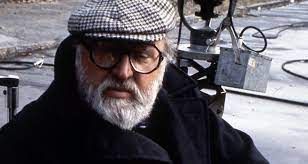

Sergio Leone


Introduction

How to explain how much I love Sergio Leone’s Once Upon A Time in the West? Let me count the ways… actually, that’s a bad idea as I’d be here several hours and we’d never get to see this film. So, let me recount just some of the ways I love it. 

I love it because it’s an elegy… it’s an opera… an opera of violence with achingly beautiful music (thanks, Ennio Morricone)… an opera with exquisite cinematography  (thanks, Tonino Delli Colli)… an opera with superlative attention to set and mise-en-scène (thanks, Carlo Simi)… 

Enough of the superlatives. 

It’s an opera with stares in place of arias… a Marxist tale of capitalist greed… the first postmodern film (that’s Italian cultural critic Umberto Eco)…

It’s an art western… the first art western… the longest art western ever made… the best art western ever made (sorry, it’s impossible to avoid the superlatives). Or, simply: a masterpiece. 

Legend and fact

All this. And more. The Italian title hints at what else this film promises and delivers: C’era una volta, il West.  This translates not as Once upon a time IN the West, but Once upon a time there WAS a West.

“Once upon a time…” We know what this heralds:  a fairy tale… a fable… childhood magic… imagination… fantasy.  But what’s with the next part: “…there was a West”? Is Leone saying the fairy tale magic of the genre has disappeared? Is he lamenting the end of an historical era? Or the end of the Western genre? Is he telling us that the legends are no longer fit to print? (1)

Certainly this film is about endings. But it’s about beginnings and newness, too. It tells of Leone’s determination to merge, to fuse, the legend and the fact, folk memory and historical reality. As well as inviting us to think about endings, he’s pointing towards the future of the Western: where bullets really hurt and kill; where greed rules; where top guns grow old; where heroes have clay feet; where macho masculinity is toxic. And, as with all fusions and hybridisations, he creates something new: not just the sum of two parts, but a third entity. This paves the way for future revisionist Westerns and hybrids such as Sam Peckinpah’s The Wild Bunch (1969), Robert Altman’s McCabe & Mrs Miller (1971), Clint Eastwood’s Unforgiven (1992), Quentin Tarantino’s The Hateful Eight (2015) and, most recently, Jane Campion’s wondrous The Power of the Dog (2021). I'm not suggesting these films wouldn’t have got made but for Once Upon A Time in the West, although I do think it gave filmmakers the courage to challenge the earlier romanticised films of the genre. Importantly, it led the way in showing audiences how to appreciate and love the Western again.  

Quotations and reversals

When seeing Once Upon A Time in the West for the first time, many of us get the eerie feeling that we’ve seen it before or, of always having seen it, as John Milius remarked (as writer and/or director, his films include: Apocalypse Now (Francis Ford Coppola, 1979); Conan the Barbarian (1979)). And in some ways, Milius was right. In fact, in many ways: in all, the film quotes from as many as 30 classic Hollywood Westerns – some are direct quotes (images and words) while others are more elusive allusions.  And not only Westerns. The film plunders and glories in Hollywood, treating it as an archive to enrich as well as to pay homage to. 


The High Noon homage opening scene

Undoubtedly, there’s fun to be had in spotting the quotations such as these:

     Men waiting at a station for the midday train to arrive? High Noon (Fred Zinnemann, 1952).

     A woman at the centre of the narrative? Nicholas Ray’s Johnny Guitar (1954)

     A former prostitute who runs a bar?  Johnny Guitar again.

     Henry Fonda as a character named Frank in a Western? By 1968 Fonda had been in 17 Westerns, in two of which his character’s name was Frank – Jesse James (Henry King, 1939) and The Return of Frank James (Fritz Lang, 1940).

     Monument Valley? The Searchers (John Ford, 1956)of course – and at least 24 other Westerns, 9 of which were directed by John Ford, much beloved by Leone. 

I don’t think you necessarily need to have seen all these Westerns or, indeed, any of them, to recognise the references. The borrowings (or plagiarisms? Leone was no stranger to failing acknowledge an original source), (2) the confidence, knowledge  and sheer love with which Once Upon A Time in the West visits and revisits Hollywood history, all contribute to that feeling that we’ve been here before, and that this is a mature film.   

More than reference-spotting, however, spotting the film’s ironic reversals can be even more fun. Here are a couple of examples for which it is famed. High Noon has us waiting for the train that arrives on time and from which the bad guy gets off. Leone, however, makes us wait for a train but this time it’s running late and it’s the good guy who eventually disembarks. The most famous reversal is the casting of Henry Fonda as the villain. Before the shoot began, Fonda was worried: with his reputation as Mr Nice Guy, forever the Young Mr Lincoln (John Ford 1939) and Tom Joad (Grapes Of Wrath (John Ford1940) his always clean-shaven face and baby blue eyes, he didn't look evil. So, to get into role, he grew a moustache and got some lenses that turned his blue eyes brown. Leone took one look at him and exploded: “Get rid of the moustache! I need your baby blue eyes!” Calming down, he explained to the baffled Fonda: when Frank first appears, audiences will not see his face, they will see the back of a man who is about to be truly evil. The camera will crab round and tilt up to his face, and they’ll go: “JESUS CHRIST! IT’S HENRY FONDA!” (3)

And they did. I do. Every time. 


“JESUS CHRIST! IT’S HENRY FONDA

Leone and his co-story writers, Bernardo Bertolucci (The Conformist/Il conformista (1970), Last Tango In Paris/
Ultimo tango a Parigi (1972)) and Dario Argento (Suspiria (1977)) and many other giallo (murder-mystery-thriller-horror-erotic) movies), aimed to create the impression that the audience was watching a film they’d seen before – only to be jolted into realising that they’d never seen the story told in quite this way before. (4)

It was Bertolucci, incidentally, who persuaded Leone, to put a female character at the centre of the narrative by taking him to see Johnny Guitar in which Joan Crawford plays a dominant role. This focus on a woman in a central and positive role was unusual, to say the least, in a Western: it is definitely unexpected in a Leone film. Bertolucci is also responsible for a story that I confess I suspect is apocryphal. He claimed that after much resistance, he finally persuaded Leone to have a woman dominate the narrative by asking him to imagine the scene when the audience first sees Claudia Cardinale’s character Jill get off the train dressed in the latest New Orleans fashions. The camera will be underneath the steps, Bertolucci enthused, it will look up her skirt and, Madre di Dio, she’s wearing no knickers! If this conversation did take place, thankfully, the shot didn’t. Legend or fact? Either way, it’s too good not to repeat! 
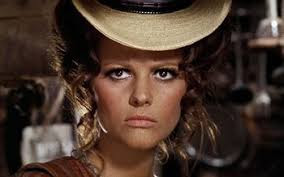

Claudia Cardinale as Jill

A grown up Western

Bertolucci speaks movingly of why this film has a special place in the history of one of Hollywood’s once best known and loved genres which by the 1960s was beginning to lack its earlier lustre. In Once Upon A Time in the West, Bertolucci said Leone 

gave back to the proper Western makers – I mean the directors from the USA – the confidence that a Western can be a great movie. He gave back something that had got lost…. The innocence…  He gave back a new identity for the Western, something that took off from Monument Valley, went to Almeria in Spain, & Cinecitta in Rome, and then goes back to Monument Valley. After this kind of little travel [that it needed] to grow up, when it was back in Monument Valley, it was a grown up.

Mystery and waiting

This is a grown up western, one with mystery. Some parts are like a mosaic that doesn't make sense until the final tile is dropped into place. Charles Bronson’s character, Harmonica, is particularly mysterious, almost supernatural: a ghostly avenger who appears and disappears from the frame, sometimes leaving only the trace of the sound of his harmonica floating in the air. (Incidentally, it wasn’t the first time Bronson played a harmonica in a Western. I’ll leave it to the quote-spotters to discover what film this was.)
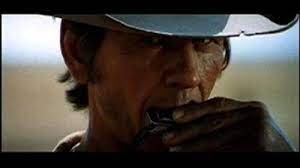

"...“a face made of marble”..." Charles Bronson as Harmonica

Leone says Paramount wanted to lock him up in an asylum for insisting upon casting the then not particularly well-known Bronson. But he wanted this actor with “a face made of marble”. Using undeniably racist stereotypes and language, Leone said only Bronson could portray:  

a half-breed who implacably pursues his revenge. A man who knows just how long to wait… since he is an Indian, he already hates the white man. He will torture his enemy. But he must always have an impassive look on his face. He doesn't talk much. He expresses his sadness with the harmonica. His music is a lament that comes from deep down. It is visceral – attached to an ancestral memory.”

Harmonica knows how to wait. Not all audiences and critics did. It bombed in the USA and the UK: It was too arty, too slow, too long. One reviewer called it: “Tedium in the Tumbleweed.”(5)

Politics: Marx and Coca-Coola

But it was hugely popular in Europe, especially in France where it ran non-stop in one Parisian cinema for 48 months. At the time, young Europeans were revolting against nationalism, racism and tradition: they loved the film’s bold depiction of naked capitalism that gives institutional support to white settler colonialism. These were the children of Karl Marx and Coca-Cola as British film critic and cultural commentator Christopher Frayling observes (6). Bertolucci summed it up astutely, pointing out that there was no way an Italian director could not be political at this time: “This was the 1960s.  Politics was in the air we were breathing, in the spaghetti we were eating, in the wine we were drinking.” 

Looking and listening

The young European audiences who embraced this film were mainly politicised cinephiles who appreciated a film that takes its time to teach audiences how to look differently. And how brilliantly Once Upon A Time in the West achieves this: like many, perhaps most, audiences, I can't help but follow the stares to notice every square centimetre of the frame, every fold in the long duster coats, every crinkle in the stone monuments in the Valley, every flutter of the red gingham tablecloths. 

Thanks to the collaboration between Morricone and Leone (who were at school together), it also teaches us how to listen. Famously, he gave each of the main characters their own theme which, Wagner-like, intertwine as the characters themselves connect and disconnect. Equally famously, he wrote and recorded the score before a single shot was made.
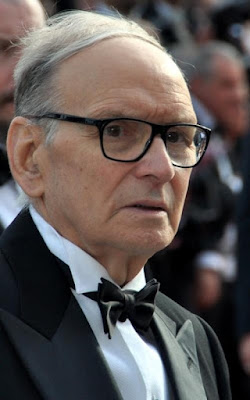

Ennio Morricone

The first music we hear, however, is different. When the score for the first sequence didn't work, Morricone came up with an  extraordinary solution – extraordinary in a popular genre movie. Leone’s favourite composer was a member of
 an avant garde improvisational music group, Gruppo di Improvvisazione Nuova Consonanza (also known as The Group or Il Gruppo), one of the first European experimental musical collectives. These musicians and composers used the noise of everyday objects – step ladders, kitchen sinks, a creaking door, to create music from noise. (7) The first scene in the station awaiting the late-running train does just this, innovatively and, some might say, outrageously. Chalk scratches on a blackboard, a fly buzzes around a chin, water drips on a hat, a tickertape machine ticks, the sails of a watermill creek, a train whistle screeches… And there’s silence: sometimes in synch, sometimes not. 

Let me set the scene to prepare us for this opening sequence of stares and sounds by listening to the “music” playing right now, here in this cinema. You don’t hear any music? Listen more carefully…

     The susurrating rustle of my notes as I turn the page; 

     A muffled thunk when I hit the microphone;

     The persistent whirr of the air conditioning;

     Crunch! Popcorn is being munched;

     A quiet click and birp: was someone turning off their phone?

     Glug: a swig of wine is swallowed…

For Morricone this would translate as something like this:

Rustle… whirr… clunk
                  Crunch… crunch… rustle 

      Click… birp...whirr…glug 

      Thunk… whirr… whirr

      Rustle…rustle

      Whiiiirrrrrrr…

Imperishable greatness

I hope that’s prepared you for one of the most inventive opening scenes in the history of cinema. It’s a scene that sets the pace and gives the audience a contract for how to look, listen and enjoy the rest of the film in the form of a duet between stare and noise, looking and listening, sound and silence, and between legend and historical reality. 

Yes, this is a movie that takes its time. But as one admiring critic wrote: “by the final credits, you know you're in the presence of imperishable greatness.” 


[1]This, of course, is a reference to John Ford’s The Man Who Shot Liberty Valance (1963), a film that Leone references himself in Once Upon a Time in the West.

[2]This is an unsubtle reference to Leone’s failure to credit Kurosawa Akira's Yojmbo (1963) for his “borrowing” of its narrative and many shots in A Fistful of Dollars/Per un pugno di dollari (1964).  

[3]In Sergio Leone: Something to do with Death Christopher Frayling writes that Leone told Fonda that he didn’t have to look evil, he had to be evil (Faber & Faber, 2000).

[4]Bertolucci and Argento spent several weeks with Leone researching and fleshing out the treatment, or story. The screenplay was then co-written by Leone and Sergio Donati.

[5]There are other mysteries for me, at least. I remain puzzled that we don’t get even a hint of Harmonica’s ethnicity until almost the very end. Why is Jason Robards’s supposedly Mexican character nick-named “Cheyenne”? Why is the final music over the credits Cheyenne’s theme when he is dead? As the future belongs to Jill, wouldn’t her theme be appropriate?

[6]I am indebted to Christopher Fraying’s excellent book, Sergio Leone: Something to do with death(Faber and Faber, 2000) from which I draw freely in this Introduction. Also to Adrian Danks’ equally excellent notes in the Cinema Reborn catalogue (see https://cinemareborn.org.au/). And to the commentary accompanying the DVD (Paramount Home Video, 2003).

[7]See Morricone playing in this group at https://www.youtube.com/watch?v=dqvAhBJ99wA

Friday, 18 March 2022

CINEMA REBORN 2022 - First Titles Announced - BEAU TRAVAIL (Claire Denis, France, 1999), ONCE UPON A TIME IN THE WEST (Sergio Leone, Italy, 1968), NIGHTMARE ALLEY (Edmund Goulding, USA, 1947)


It’s a big moment for a whole host of people who have been working to get the 2022 edition of Cinema Reborn up and running.

Cinema Reborn is devoted to carefully selected restorations of great films from cinema history. This year’s program comes from 10 countries - Italy, Iran, Japan, China, France, Australia, Angola, the Philippines, USSR and USA.

At the main evening and weekend sessions there will be a 10-minute introduction from an expert in the field and the new, pristine restorations - either 2K or 4K - will be presented in the Randwick  Ritz’s newly renovated and re-seated state-of-the-art cinemas. But this year there will be repeat weekday morning and afternoon screenings including on Monday 2 May and Tuesday 3 May to maximise your chances of seeing some very special moments in cinema history.

 Join us for one of the most unique events on the film calendar. 

 Join us for Cinema Reborn 2022.

 ******************************

Cinema Reborn will  start with an Opening Screening on Wednesday 27 April and close on Sunday 1 May…. 

BOOKINGS CAN NOW BE MADE FOR THE THREE FILMS ANNOUNCED BELOW VIA  LINKS THROUGH TO THE RITZ WEBSITE.  

Beau Travail (Claire Denis, France, 1999)

Our Opener 

BEAU TRAVAIL (1999)

“ALLEGORICAL TALE OF REVENGE AND JEALOUSY SET WITHIN A FRENCH FOREIGN LEGION OUTPOST IN AFRICA” – SLANT MAGAZINE

Veteran French director Claire Denis riffs off Herman Melville’s Billy Budd in this enthralling, lyrical drama about an officer, Galoup, recalling how his idyllic army days in Djibouti were destabilized by the arrival of a handsome young recruit who attracts the attention of Galoup’s commandant.

Claire Denis brings a female director’s eye to toxic male ego and unrequited homoeroticism. 

An unforgettable film with an even more unforgettable end-titles sequence. Luminously photographed by Agnès Godard.

Subtle brilliance that’s still relevant over twenty years later

-      Fresh Fiction

Introduced by Angelica Waite, Film Programmer and Member of the Cinema Reborn Organising Committee 

 WATCH THE TRAILER CLICK HERE

 RATING MA15+, 92 MINS, France, 1999, French, English subtitles WITH: Denis Lavant, Michel Subor, Grégoire Colin

 Screens on Thursday 27 April at 7.00 pm (with introduction)  and Thursday 28 April at 2.00pm TO MAKE A BOOKING

To read internationally renowned critic and scholar Adrian Martin’s superb Program Notes on Claire Denis and what is regarded as her finest film click through to the Cinema Reborn website HERE


Our Saturday Night Special 

ONCE UPON A TIME IN THE WEST (1968)

“QUITE SIMPLY A MASTERPIECE, LEONE’S REVISIONIST WESTERN IS A MYTHIC SPECTACLE OF A FILM AND A LANDMARK IN CINEMA HISTORY” – FILM4 STAFF

In hindsight, Sergio Leone’s earlier Westerns were mere warm-ups for this sprawling, operatic, epic about a mysterious stranger (Charles Bronson) and an ageing gunfighter (Jason Robards) joining forces to protect a widow (Claudia Cardinale) and her land from a gun-for-hire (Henry Fonda) and his gang of assassins who work for the railroad as it expands across the West.

It’s got everything – achingly beautiful music from the maestro Ennio Morricone; widescreen cinematography from Tonino Delli Colli; scriptwriters Bernardo Bertolucci, Dario Argento and Leone; perhaps the best pre-titles sequence ever made; Henry Fonda playing against type as a ruthless, vicious killer; and a story with all the frontier justice, frontier love, simmering revenge and lawless power you could wish for. A sumptuous, elegiac closing of an era.

The new 4K restoration includes scenes that were deleted for its first release.

Long live Leone’s timeless monument to the death of the West itself…Critical tools needed are eyes and ears. This is Cinema.”

-      Paul Taylor, Time Out Film Guide

Introduced by Jane Mills, Film-maker, critic, Hon. Associate Professor, School of the Arts and Media, University of New South Wales

WATCH A TRAILER CLICK HERE

RATING M, 166 MINS, Italy, English, CAST: Henry Fonda, Claudia Cardinale, Charles Bronson, Jason Robards

PRESENTED WITH THE SUPPORT OF THE ITALIAN INSTITUTE OF CULTURE, SYDNEY 

Screens on the big screen in the Ritz Cinema One on Saturday 30 April at 7.45 pm (with introduction)  and Tuesday 3 May at 1.00pm 

TO MAKE A BOOKING CLICK HERE

To read  the fine program notes on Sergio Leone, Italian Westerns and this great epic movie written by RMIT University scholar and Co-curator of the Melbourne Cinematheque Adrian Danks CLICK HERE


Our Closer

 NIGHTMARE ALLEY (1947)

“THIS RAW, BITTER DRAMA OF THE TOUGHER SIDE OF TRAVELLING CARNIVAL LIFE MAKES FEW CONCESSIONS” – DAILY TELEGRAPH 

Usually cast as a romantic lead, Tyrone Power goes well against type as a carnival worker who uses the codes of a fake mind reader to become a dinner-suited, blindfolded ‘mentalist’ in a reputable Chicago night club.

 Carny life at its most realistic, this film noir exposes the ‘lower depths’ of the entertainment world and has grown in reputation, now aided by this superb 4K restoration which premiered at Bologna's Il Cinema Ritrovato in 2021. 

Recently remade with a cast including Bradley Cooper, Cate Blanchett and Rooney Mara. Here’s a chance to see the original on the big screen.

The characterizations in Nightmare Alley are studies in film noir. People are shown as venal, gullible, and obsessed with success at any price.” 

-      Joan Cohen

“One of those films mentioned in lowered voices, a guilty secret, to be screened at midnight behind closed doors…”

-      John Baxter

Introduced by James Vaughan, film-maker, director of FRIENDS AND STRANGERS, Member of the Cinema Reborn Organising Committee

WATCH A TRAILER CLICK HERE

RATING M, 110 mins, USA, English, CAST: Tyrone Power, Joan Blondell, Coleen Grey, Helen Walker, DIRECTOR Edmund Goulding

Screens on Sunday 1 May at 7.45 pm (with introduction)  and Tuesday 3 May at 10.45 am 

TO MAKE A BOOKING CLICK HERE

To read author, critic and film-maker John Baxter’s insightful Program Notes on Edmund Goulding and the film's place in the film noir canon click through to the Cinema Reborn website CLICK HERE

*********************************************

Meanwhile dont forget to check out THE CINEMA REBORN FACEBOOK PAGE for news and if you are minded to make a tax deductible donation, large or small, to support the work of our all-volunteer group and bring more film classics back to the screen in Sydney click here for  THE AUSTRALIAN CULTURAL FUND

 ....and if you want to maximise your attendance think about joining THE RITZ ROYALTY CLUB and save on all admissions. Seniors get additional savings.

More news in a few days.