Showing posts with label Fritz Lang. Show all posts

Wednesday, 9 July 2025

On Blu-ray - David Hare looks at CARNAL KNOWLEDGE (Mike Nichols, USA, 1971) and THE BIG HEAT (Fritz Lang, USA, 1953)


Two Indicators and a Criterion

Let’s start with Carnal Knowledge. This is a fabulous, visually flawless delivery of an early 70s Panavision/Technicolor “serious” American post MPAA “adult” feature from Mike Nichols, shot for greater arthouse cred by the great Giuseppe Rotunno. I bought the Indicator edition not only because it beat the Criterion by two weeks but because I think Indicator’s extras have the edge. I gather the encode itself which was done by Dave McKenzie/FIM is also the basis for the Criterion. 

Having said all that I still can’t fathom the mountains of cinephilic dedication given to a movie about an unrepentantly toxic man, his trippy, passive buddy and a string of women who don’t seem to mind these appalling men. All the players are great, especially the women, but Nichols never lets the sponge rise beyond Jules Feiffer’s sour, unedifying screenplay. Nichols would go on to much better things - Primary Colours and The Birdcage are unalloyed comedic commentaries on post 70s America, and both are very much enhanced by the contribution of Elaine May.

Which leads us to compare Indicator’s terrific Blu-ray edition of Fritz Lang’s The Big Heat from only a few years ago, and the new Criterion 4K UHD disc. The Indicator is so good as a 2K delivery I am really fighting to find reasons to call Criterion’s new 4K (from Sony) as “better.” But this is always the impossible crux of things. In Dolby Vision, slightly more than HDR, the image is slightly more detailed, but with it the lighting (by the great Charles Lang ex Paramount Noir) becomes revelatory. 

One of the things 4K can resolve and display is grain, and especially the way it disperses light. The new 4K is startling in the way it makes the depth and sheer lighting quality quasi-three dimensional. It certainly emphasises Lang’s decision to shoot every sequence except one in the studio where he and Charles Lang can control not only light and shade but the small, constant camera movements, mostly circular which seem to affirm a dialogue of chance fighting with fate. This is a definition of Lang of course from the very beginning to the very end, and I dips me lid to everyone else who’s called this Lang’s greatest American movie. Watching this again, the penultimate scene with Debbie and Banion had me in tears, as the two of them remained totally alone, and totally without any peace with the furies. What a masterpiece, and what staggeringly beautiful home video deliveries of this masterpiece.

Thursday, 3 July 2025

IN PARIS - At the Champo on rue des Ecoles - Ghost stories - Random Restorations of films by Dino Risi and Fritz Lang

Romy Schneider, Marcello Mastroianni, Fantasma d'Amore

A selection of films featuring Marcello Mastroianni screening at Le Champo in rue des Ecoles revealed a host of titles seen plus one totally unknown, Fantasma d'Amore (Ghost of Love) made in 1981 by Dino Risi, somewhat out of character for a director whose forte is comedy and speedy narratives. Mastroianni plays an academic of some kind whose orderly life is interrupted by a woman (Romy Schneider) who races after a bus he usually doesn't take and then keeps turning up in his life. She's a former lover and he slowly becomes entranced with her all over again. Except she's not what he and at first we think she is...he is summoning up a ghost of a relationship and getting deeper and deeper into the fantasy.... Its formulaic and seems to be some sort of derivative of Dont Look Now. A quick check of the internet reveals that the film seems to have disappeared after its first release but now, after a superb restoration, it may be getting some recognition via Mastroianni tribute seasons. 


The Testament of Dr Mabuse
was Fritz Lang's second crack at Mabuse and Le Champo is screening a superb digital copy with both astonishingly good picture and sound. A title in German only at the start of the film explained I think the various iterations of the film's duration, 3300 metres+ when it premiered in Budapest. An excision of 500 metres or so shortly thereafter and the length of  the reconstructed version. I think. Released in 1933 it resurrects Mabuse as a ghost able to malignantly influence the course of human history by unleashing sheer terror on the population. I think. There are so many character strands that connecting the dots is a bit difficult. It was the last film Lang made in Germany before his exit for safer pastures first in France for Liliom and then on to the States for the next two decades. Le Champo is screening the film as part of a German Expressionism season alongside The Blue Angel, The Cabinet of Dr Caligari, Pandora's Box, M and Metropolis. 

Thursday, 26 January 2023

On Warner Archive Blu-ray - David Hare is thrilled by the new edition of Fritz Lang's RANCHO NOTORIOUS (USA, 1952)


This great montage above from Rancho Notorious, including the faces of Arthur Kennedy, George Reeves and Mel Ferrer among others, invokes Lang’s great angry mob sequence from M and the montage from that masterpiece. Indeed the last four shots in this Technicolor sequence are, like the M “j’accuse” montage barely half a dozen frames each. (Try getting screen captures from this piece of film!)


Indeed, the structure of Rancho Notorious, now released in a staggering new three strip restoration from Warner Archive to revive the glorious new year, salutes every great director who’s taken advantage of the pointed montage as a full-blooded caesura in the narrative to bring it to a momentous dramatic halt. 


So any one of these faces might be a rapist and killer, or none of them, despite the privilege of us as audience who witnessed the original crime. Which face is less “human” than the other, which if any is “not guilty”, but of what? Cinema is never purer than this.


Marlene Dietrich

Arthur Kennedy’s consuming need for revenge at any expense will of course lead to a confrontation in which the remaining woman in the narrative takes the hit for his anger. Just as Jocelyn Brando and Gloria Graham take a hit for Glenn Ford in The Big Heat. And Joan Bennett takes a hit for Walter Pidgeon, and so on in Lang. 


The sheer classicism of the sacrificial female is beyond biblical in Lang’s world and perhaps it’s that sheer outrageousness that now compels us to understand more fully the destructive futility of leading man after leading man in a world no longer making sense. Only the sheer supreme mythologies of the Indian temple, or the need for balance in a contemporary 1928 world gone mad like my favorite Lang, Spione (Spies) can save us. 


Rancho Notorious, like Moonfleet three years later, is another of Lang’s morality tales dressed in period costume with a mixture of sublimely photographed exteriors and even more studio and backdrop artifice shots (like the one I’ve printed above in deference to Ms Joyce Carol Oates’ dislike of Hitchcock’s similar tendency to such cinematic primitivism.) I think with Rancho Lang begins a final period in which he returns to the past for context, either as legend like the West and its codes of violence, or the child’s nightmare, missing father tale of Moonfleet with its tireless search through caves, tunnels and the underworld to reconcile both the lost father and the glittering spoils of the pirate overworld. 


Ultimately Lang will return sublimely in color and with Debra Paget to his own mythology with the completely wonderful Von Harbou written Indian Tomb/Eschnapur Tiger pictures which play in episodic style like a Feuillade serial, but one originally written by his then spouse, and directed by another, only to be finally realized by Lang himself, one of the first colony of auteurs on earth fifty years earlier. Lang has ridden full circle and just a few years later Godard imagines and directs him as himself directing the Odyssey in Le Mepris in which he addresses us for eternity through Raoul Coutard's camera. 


Rancho Notorious, with its many alternating styles, high montage mode with unexpected tracking shots and its tight clipped narrative, and meditation on the obsession of a wounded man who's lost his future is the beginning of Lang’s very last act. 


These are the last two shots from Rancho,  bridged with one of Lang's very rare cross dissolve opticals.


From legend to camera to "reality".


Not something recognized by the distinguished Ms Oates.


This new disc from Warner Archive is a tribute to that great outfit who after a year in hiatus is mercifully back on the boards, with a commitment to five titles of restored deep archive cinema a month. Long may the Archive, and oneself live.

Friday, 12 November 2021

Elvis and Me - Louis Skorecki recalls meeting the great man and remembers LOVE ME TENDER (Robert D Webb, USA 1956,


Louis Skorecki and Elvis, Paris, 1959

(Viewed on February 3, 2006/November 11, 2021)

I didn't know Elvis well, but I've been around him long enough and close enough to guess what wood he was heating up from. He was a real guy, a macho, a tough one.

All this happened in Paris, two or three years after his first film, one of the most beautiful, LOVE ME TENDER...

He was passing by. I had been on his case for several days. He was young and handsome, I was even younger and almost as handsome, as you can see in the pictures.

We both posed,. I had about a dozen records under my arm that he signed. Two or three days later, I came back to get the pictures signed.


Like an idiot, I traded the records for some dough (or swapped them for bad jazz records. I don't know anymore.. ) ... It wasn't worth anything back then.

I still have the pics. Frontal, classical, laughing. Looking at them today, it's hard to tell who looks dumber, the fan or the rocker. Let's just say it's me.

Love Me Tender sounds better than Cavalier du Twilight, the French title under which I saw the movie at the time. Nobody watched movies in Version Originale, especially Presley's.

That was the fifties, the best, the dumbest.

Elvis, Debra Paget, Love Me Tender

LOVE ME TENDER, has also has one of the most beautiful dances by Elvis Presley, a slow rock as they called it. He sings it for the beautiful Debra Paget, she who will sing Fritz Lang three years later, in the Bengali Tiger and the Hindu Tomb (Jean-Claude Biette loved her so much, the beautiful Debra Paget, that he went to see her many times... at the Touquet... )

Debra Paget, Love Me Tender
Debra Paget, The Tiger of Eschnapur

Robert D. Webb, filming Debra Paget and Elvis Presley, isn't Fritz Lang, but the movie rocks well. With Jaihouse Rock and Flaming Star, this is one of the best Presleys. King Creole ain't bad either.

How would Fritz Lang have filmed Presley? Like John Barrymore Jr, the "lipstick killer" in While the City Sleeps, filmed in 1956, the same year as Love Me Tender?

John Barrymore Jr, While the City Sleeps

Or like Marilyn Monroe, filmed four years earlier in Clash by Night?

Marilyn Monroe, Clash by Night

I would have loved to see that for sure.


Finally, above is Elvis and young Skorecki in a photo that is not part of my original ten or twelve photos. It's colorised (Elvis wasn't wearing a red sweatshirt that day) but it's very well done (see details of the original Loving You cover, very true to the original vinyl...)
I discovered this anonymous photo, by a stroke of luck, almost twenty years ago, a beautiful book in a PRESLEY/THE FIFTIES box. I'll never know who took it...

*******

Editors note: I first discovered the writings of Louis Skorecki when I stayed in Paris for awhile long, long ago in 2004. His daily column in Liberation was a highlight of each morning. Now he regularly posts on his Facebook page and shares these thoughts, translated into English, on the Facebook page Friends Who Like a Fuller Life. I hope I might publish more of Skorecki's wonderful mini-essays.

Tuesday, 2 February 2021

“They wouldn’t come on the set scratching their heads.” - Part 2 of Tom Ryan's legendary 3RRR 1980 interview with Lee Marvin


Editor’s note: This is the second instalment of a four part series devoted to a lengthy interview by Melbourne critic and scholar Tom Ryan with Lee Marvin. The interview was conducted on Melbourne Radio3RRR in 1980. This part deals with Martin’s time working with Fritz Lang, Henry Hathaway, Samuel Fuller and Marlon Brando among others and his work in series television. Part One can be accessed if you click here – 

*************************************


TR: In ’54, it was The Big Heat with Fritz Lang. Is that the first “great” film that you’re in?


LM: I did one right before that. I was hired in costume, with Brando, for The Wild One. It finished a week or so before the Fritz Lang film started. I talked to him and his people said, ‘No, he’s not right.’ So he says, ‘We’ll get him a haircut and shave the beard off and he’ll be alright. (then, mimicking) I high-er you for vat you are, not vat dey t’ink you are.’ Yes sir. Because he was from UFA, you know, the old Berlin film industry. A magnificent guy.
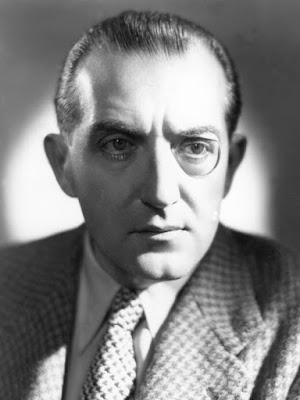
 

Fritz Lang

I’ve read interviews with Henry Fonda and others saying that he was a very difficult director to work with because he would stand just off camera, yelling directions.


Why not? He knew the medium. And he could lay the lines over later. But, no, I didn’t find him difficult at all. In fact, I wasn’t there for the first day of filming. I started about three days in. I went to work that day and I was standing around and there was a desk in the corner of the sound stage that had a name card on it saying ‘Fritz Lang’ along with this big magnum of champagne, well-iced, with about eight or ten glasses upended in it. I waited by it for him, he came over and I said, ‘Mr. Lang.’ I said, ‘Is there anything I should know before I get started?’ And he said, ‘No. I hire you for vat you are.’ He said, ‘Vould you care for a drink, yah?’ I said, ‘No, not when I’m working.’ He said, ‘That’s good. You I don’t worry about.’ And then, pointing to the leading man at the other end of the stage, he says, ‘It’s that SOB that I worry about.’


Glenn Ford?


Yeah, please. I went, ‘Mmm.’ So he gave me a little lift. And about eight weeks later, I happen to look over by the door and there’s a new actor comin’ on, and he’s pointin’ at me. They all had their technique.


Did he take a lot of time setting up shots. Was it a quick job or was it something he was gonna take a lot of time over?


No, he’d never ad-lib. He came to the set and, as they say, he’d done his homework. He knew exactly the scene, how he wanted it lit, and where everybody had to move. I mean you didn’t make any ‘Well, it feels better if I…’ ‘You shtand right zere.’ You didn’t become inventive in your movement for him ’cause he’d already cut the film in his head. It was a marvellous way to work, and once you got over that hump of being creative you simply did that part. And it fits in much better.
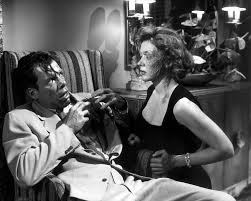
 

Marvin, Gloria Grahame, The Big Heat

Are you happy to accept that sort of a role in a film, when it’s all strictly defined, or do you prefer that ‘creative’ freedom that you didn’t get with Lang?


It depends on who’s directing. But absolutely. Some men I’d do anything for, others I’d say, ‘Now wait a minute. That’s not very natural,’ or something. But men like Lang knew, I mean they really knew. Hathaway, guys like that. They wouldn’t come on the set scratching their heads.


Were you under contract at this time?


I was never under contract. 


Why was that? You were working at Columbia when Harry Cohn was there.


Yeah. I did eight in a row there, but the reason for that was there’s a lot of roles in films that aren’t really well-described, or well-defined. And I kinda got to be called a trouble-shooter: they didn’t know what to do with a role, they’d say, ‘Give it to Lee Marvin, he’ll do something with it.’ Of course, the roles weren’t that important. Or maybe they were; I don’t know, but you know what I’m saying. When in doubt, they’d throw it at me.


Why do you think that was?


I dunno. Maybe it was because maybe I didn’t care. Maybe I knew I wasn’t going anyplace and in those days I couldn’t be intimidated. You know, I’d made it through the war and as Jimmy Whitmore, a friend of mine, said, ‘After 1945, it was all gravy.’


And you were seriously wounded in the war?


Yeah, yeah.


You worked with Brando on The Wild One and, of course, the inevitable question is: did he sit you on his knee as I heard he sat Sarah Douglas on his knee on the set of Superman, or was he somewhat more aloof than that?


He wasn’t aloof. He used to baby-sit for my children. No, he was straight. We had our shoot-out early in the film and he was just beautiful to me.


Marlon Brando, Marvin, The Wild One

That was when he’d just started too…


He’d done The Men before that. That was his first film, I believe.


How does his acting style sit next to your style, which seems to me far more relaxed?


Well, I think I know about as much about Method as he does because I studied with some pretty heavy guys. It’s just that I didn’t use it like he used it. He was dynamic. My God, I saw him in Streetcar on Broadway. He just flattened the house: they couldn’t belieeeve his Stanley Kowalski. Nothing like that had ever happened in the American theatre. He came out there and just went whammo and knocked everybody outta their chairs. He was just great, really stunning.


I get the sense that you’re very self-effacing which I suppose fits with the roles that you play. You’re very quiet about your approach to it. You’ve said that you had no ambitions, that you were going nowhere…


Well, it was a lot better than where I’d been, just let me put it that way. I didn’t think I’d ever get anywhere, that maybe someday I’d get to be a feature player or a supporting player. I never thought I’d get a lead in that industry. I’d started out with leads on live TV and worked my way down to bit parts. And the next thing you know, I was being called up for extra work and I realised the wheel was turning the wrong way, so I got outta town.


When M Squad came along – Frank Ballinger – was that the kind of work you’d been looking for?


No, I’d tried to avoid it. But a friend of mine had been touting me on it, not my agent, and I got trapped into that. But at least I hadn’t signed anything and they thought I had, so financially it worked out very well. 
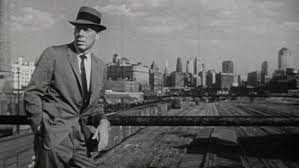

Marvin,  M Squad


Are you happy with M Squad?


Yep. A lot of hard work. The difficulty I had, I think any actor has, is tying his face and his name together. And TV could do that because so many people would see it once a week, and eventually they got to know the name Lee Marvin. Because, when I first started, they thought I was a girl. I’d get calls and I’d show and there’d be 35 ingenues and me and they’d say, ‘Whoops!’ I didn’t have a masculine-sounding name. 


What about The Lawbreaker, which came a few years later? Obviously you hadn’t been disillusioned by the strenuous TV work of television or by what’s become at this point an increasing number of more demanding film roles.


Well Lawbreaker was a very interesting thing, a documentary. We got the real people, if we could, and they’d recreate their own crimes. They’d shoot that and I’d just merely narrate it – like an over-the-shoulder thing – and I found it fascinating because I was into police work after M Squad. I went around the country, to the Chicago police, and dug into the system, so to speak. And I thought it was right to get the real performances. 


We had a cat burglar once, I remember, and I was talking to him and he’d spent about six or seven years in, and I asked him how long it would take him to cross a bedroom, say about 12 feet across. He said, ‘Oh, about 45 minutes.’ That’s with the person sleeping. I said, ‘Why don’t they wake up?’ He said, ‘Lee, what you do is think nice thoughts. Like autumn leaves and flowing creeks.’ He said, ‘If you have a bad thought, they’re gonna wake up.’ That’s spooky stuff. You’re talking to the real guy.


Babe Unger was the producer of that show, and also the writer. So he did the work. He’d done Highway Patrol with Broderick Crawford [Marvin appears to have mixed him up here with Lawbreaker co-producer Vernon E. Clark]. He’s a very fast, concise, exact man. So really my whole role in the thing was just the narration. In other words, it wasn’t that difficult. It wasn’t like carrying the series. The criminal was the guy we stuck with, or the policeman. Or whoever it might be.


To my knowledge it was never screened in Australia and I’ve never seen it. So it wasn’t the sort of thing where you’d come along and dub your voice-over afterwards?


No, no. I had kind of like a control room with this big screen. I’d do the lead for the day and you could see it off-air up there and I’d say, ‘This is Chief Dan so-and-so.’ And I’d say, ‘Dan, how’s it going?’ Then he’d talk to the camera. I didn’t have any acting scenes in it. I was just this authoritative voice, representing the ignorance of the audience as to how the law really works, the police part of it.


And around this time, you first worked with Sam Fuller in an episode of The Virginian, where you played a heavy again.


Yeah, that was kinda funny because they wanted me to be the judge and I said, ‘No, I don’t wanna be a judge.’ But I read the script and said, ‘I’ll play the heavy.’ So they got Lee J. Cobb to play the judge, and he ended up doing the series. It was a good heavy, though. I always liked good heavies. 
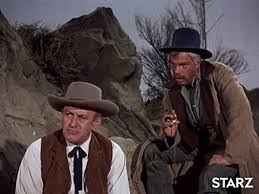
 

Lee J. Cobb, Marvin, "It Tolls for Thee" episode
from The Virginian  directed by Samuel Fuller

So Sam was the director. ‘Haha, my boy!’ (imitating Fuller) Nothing has changed: the cigars came out and off we went. And we had a lot of fun. We were on location on some very rocky mountainside, and he’s, ‘OK, kid, you see that rock over there? You climb on up there: it’ll take about a half hour. You take three rounds with you and when I give you the signal – I’ll drop my hat, right? – you fire at the stage-coach as it goes by. I said, ‘OK.’ So huffin'-and-puffin’ up the hill I climb and I‘m settling down behind a rock. I can see the camera and I’m just sittin’ there and waitin’ for the stage-coach and I look down and here are three blank cartridges from the same kind o’ rifle I’ve got. From years ago, all corroded in the sun. And I said, ‘Why that son of a gun, he’s done this shot before.’ Probably with the same stage-coach too, for all I know. Maybe the same horses as well.


Did you point that out to him?


I just looked at him and laughed and he looked at me and laughed. ‘Hahaha, kid. You’ll learn.’


Around this time, you also worked with Robert Aldrich, on Attack! And one gets the sense of the same things going on inside Robert Aldrich’s head that are going on inside Sam Fuller’s. A violence there, ready to explode.


Yeah, sure. Very much so. They were very similar in that respect, but it comes out in different ways for both men. 
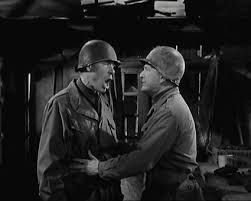
 

Marvin, Eddie Albert, Attack!

Aldrich wanted me to play the sergeant and I said, ‘No, I don’t want to play a sergeant,’ ’cause I’d already done one. So he said, ‘What about the colonel?’ What colonel? I’d forgotten that because, when you read a script that fast, you just read your own lines to see if it’s there or not. So I read the colonel and said, ‘I’d love to.’ Having been a private first-class, I knew what colonels were really like. So I made him a bit of a bastard.


And that’s the first time you worked with Jack Palance as well, isn’t it?


Is it?


It’s a question tentatively posed.


I know I’ve done four or five with Jack. No! I dunno. When did I Died A Thousand Times  come out?


It’s before that, about ’56 I think. And Attack! was ’57.


OK. So it was my second time with Jack.
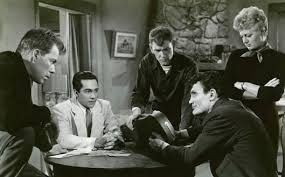

Marvin (left), Jack Palance (seated right),  
I Died a Thousand Times

Coming Soon Part 3: The Duke, the Hungarian & the Irishman – “All my dearest memories about some of the great old-time guys are to do with their screaming ability.”