ROAD RAGE
Maybe it’s because driving has become so routine that we relish the image of The Driver, a freeway buccaneer, pedal to the metal, mill roaring under the hood, speedometer creeping past the hundred, eyes fixed on that ever receding spot where road meets horizon.
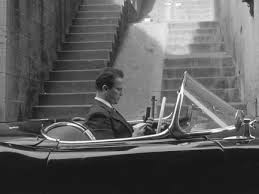 |
| Ralph Meeker, Kiss Me Deadly |
Petrolheads didn’t show up on Hollywood’s radar until the fifties, and when they did, it was usually someone like Nick Cravat in Robert Aldrich’s Kiss Me Deadly, a man in grimy overalls crawling around under battered Fords and Buicks, muttering “VaVaVaVoom!” Mickey Rooney played one such in Drive a Crooked Road, suckered by a gangster’s girl into driving a cross-country getaway car, but “sensuous” and “visionary” are not adjectives his performance brings to mind.
The true harbinger of auto chic was Tom Wolfe. His 1965 celebration for Esquire of Nascar champion Junior Johnson tagged this former moonshine runner The Last American Hero. “Cars, miles of cars, in every direction,” Wolfe wrote breathlessly of Johnson’s milieu, the world of rural stock car racing, “millions of cars, pastel cars, Aqua Green, Aqua Blue, Aqua Beige, Aqua Buff, Aqua Dawn, Aqua Dusk, Aqua Malacca, Malacca Lacquer, Cloud Lavender, Assassin Pink, Rake-a-cheek Raspberry, Nude Strand Coral, Honest Thrill Orange, and Baby Fawn Lust cream-colored cars are all going to the stock car races, and that old mothering North Carolina sun keeps exploding off the windshields.” Well, all right!
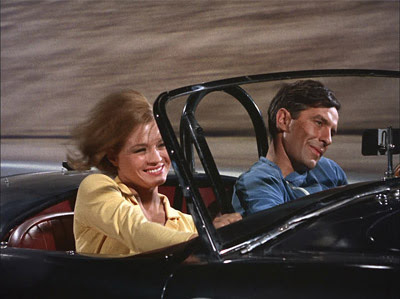 |
Angie Dickinson, John Cassavetes,
Ernest Hemingway's The Killers |
Don Siegel’s Ernest Hemingway’s The Killers helped Hollywood catch up, casting John Cassavettes as the racing driver gone bad and Angie Dickinson as the luscious bait, but it took Monte Hellman’s Two-Lane Blacktop to pinpoint an emerging sub-culture of drivers for whom there was no reality but the road.
The film’s James Taylor and Dennis Wilson are ascetics; Zen devotees, without name or history, and no life beyond the pursuit of automotive perfection. Warren Oates’s GTO , however, embodies a new arrival, the amateur, seduced by “muscle cars” and their paraphenalia. A dispiriting answer to the question “What kind of man reads Playboy?”, they know the James Bond books backwards, and believe Ian Fleming’s fantasy that a woman, after a sustained drive at speed, loses all will and can he lifted from the passenger seat, tremulous as a bird, and laid down on the grassy verge, helpless to resist. Soon, Debbie in American Graffiti will be fondling the Tuckahoe upholstery of Terry the Toad’s borrowed wheels and murmuring “Peel out. I love it when guys peel out.”
 |
| Ryan O'Neal, Isabelle Adjani, The Driver |
1978 brought Walter Hill’s The Driver. Ryan O’Neal, struggling to embody Hill’s concept of the samurai wheel-man, Melvillian, taciturn, entire unto himself, was upstaged by Isabelle Adjani, the accent grave of whose smouldering presence trumped O’Neal’s attempt at the more irregular verbs.In the hands of someone less languidly cherubic, his character might have trademarked the new genre. Instead, that distinction went to Richard Sarafian’s Vanishing Point, and an unglamorous Barry Newman whose wild man of the highway ignited a generation of car junkies.
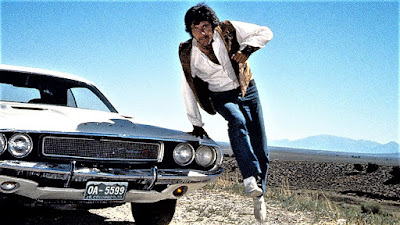 |
| Barry Newman, Vanishing Point |
The script for Vanishing Point by Cuban novelist Guillermo Cabrera Infante, writing as Guillermo Cain, is as stripped down as any stock car. Newman’s Kowalski, first name and last, ferries cars for a living, speeding across the American west, high on amphetamines and the rock and soul of isolated radio stations run by such fellow outcasts as the blind Super Soul (Cleavon Little). Occasionally he veers into the desert, encountering snake-handling mystic Dean Jagger and a blonde Gilda Texter cruising nude on a motor cycle.
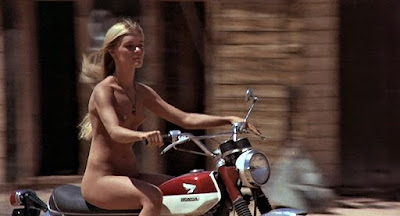 |
| Gilda Texter, Vanishing Point |
Fragmentary flashbacks establish Kowalski’s sorehead credentials but for this existential fable motivation is an optional extra. A run-in with the road police ignites his fuse and for the next hour he evades their increasingly impotent fury until, in a one-horse-and-a-dog town - perhaps the Bumfuck, Nevada of legend? - they offer apotheosis in the form of two bulldozers set, blades out, across the road. Following a brief dalliance with the Angel of Death in the person of Charlotte Rampling, the world’s least likely hitch-hiker, he revs up the Challenger and casually slams it into them for a fiery consummation.
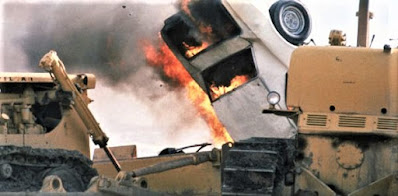 |
| "...a fiery consummation" Vanishing Point |
This indifference to character and motivation had the car community buzzing. It didn’t hurt that the legendary Cary Loftin, veteran of Duel and Bullitt, ramrodded the film’s stunts. He had the idea to tow an explosive-packed shell of a car into the blades, hoping it would somersault over them. Instead it stuck upright, a fiery exclamation mark, terminating an illustration of James Agee’s dictum that “Action is the natural language of the screen, and the instant present is its tense.”
A well-meaning 1997 remake of Vanishing Point with Viggo Mortensen as Kowalski strove to impose Significance on his character, draping him and his adventures in quasi-Christian symbolism – events take place between Good Friday and Easter Sunday – and offering motivation in the form of an ailing wife whose demise convinces him he has nothing to live for. (Typically, the nude motor cyclist of the first film is given a back-story, and clothes.) Imagine a grease-thumbed Hustler calendar replaced by a Hallmark greeting card.
For the real deal, look no further than Death Proof, Quentin Tarantino’s hommage to Roger Corman’s girlfriends-in-peril fantasies - Candy Stripe Nurses, Street Girls, Summer School Teachers - with Kurt Russell as an ageing, embittered and homicidal stunt man preying on some Texas bad girls who spend their time cruising Austin, talking trash and drinking in a bar run by Tarantino himself.
Russell meets his comeuppance at their hands, or rather feet, stomped to death by, among others, New Zealander Zoe Bell. Co-opting a 1970 Dodge Challenger similar to Kowalski’s, Bell climbs out onto the hood at speed to sprawl above its throbbing 440 Magnum engine. Casting Bell reaffirms Tarantino’s admiration for antipodean road movies, articulated at length and with passion in Mark Hartley’s enormously entertaining documentary Not Quite Hollywood.
The in-jokes of Death Proof – artfully scratched shots, “missing” frames, cue marks of smeared marker pen – can irritate more than they amuse, but it has more than usual interest as an early sketch for Once Upon a Time in Hollywood. Stuntman Mike with his outdated resumé of forgotten TV shows is Rick Dalton in embryo and its girls a foretaste of the Manson tribe.
 |
| Real Crash, No CGI, Death Proof |
Insiders of the action film like it more as a valedictory for the days before CGI, when such drivers as Cary Loftin comprised an understated aristocracy, reticent, dryly humorous, gifted with the kind of knowledge that comes only with experience. In such a world, Mike might not have turned deadly predator but at least have aspired to become, as Super Soul says in his epitaph for Kowalski, “the last American hero, the electric centaur, the demi-god, the super driver of the golden west.”
SOME OF THE FILMS MENTIONED ABOVE ARE STREAMING AT THESE LINKS
DEATH PROOF.
VANISHING POINT
DRIVE A CROOKED ROAD
THE DRIVER


