Amongst the most political of cinemas not only in subject matter but 'on the making of films politically', the cinema of Jean-Luc Godard (1930-2022) is premised by apparent paradoxes between often seemingly conflicting or opposing ideas/drives as identified in 1995 by Phillip Drummond:
His key themes are money, sexuality, politics and cinema itself as representational machine. He is a materialist with powerful Romantic drives, and a Marxist with strong existential leanings. Steeped in the classicism of Hollywood cinema, his films are marked by a thoroughgoing European modernism which, at its best, creates intensely novel regimes of pleasurable looking and listening. He is a radical anti-realist for whom the real remains a key priority. He is the narrator par excellence in a medium with too many tales to sell and un-sell, and the supreme semiotician of the cinema, with a lifetime's exploration of the complex links - and distances - between the sounds and images of cinema in its engagement with the human subject and the social (in ‘World Cinema’ Nowell-Smith ed.753)
The opening lines in Geoffrey Nowell-Smith's chapter entitled 'Young Godard' in his book on the new wave cinemas of the 1960s, 'Making Waves', published in 2008, describes Godard as “the most important and revolutionary filmmaker of the last fifty years […] The revolution he carried out, in how films could be made and how the cinema could be thought, belongs mainly to the 1960s.” In 1968 in a review of La Chinoise Pauline Kael acknowledged Godard “as the most important single force keeping the art of film alive - that is to say, responsive to the modern world, moving, reaching out for new themes.”
Robin Wood in his entry on Godard in “The International Dictionary of Directors” published in 1984 concludes: “if influence on the development of world cinema be a criterion, Godard is certainly the most important director of the past 30 years,” Wood adding the rider that “he is also the most problematic.” The central task of Godard criticism “is to sort out the remarkable and salutary nature of the positive achievement from the temperamental limitations that flaw it.” In Wood's view, “Godard rejects society because society has rejected tradition. This is most vividly and concisely expressed through the 'simple metaphor' of the party at the beginning of Pierrot le fou” and more explicitly in Alphaville “in the form of a comic strip merging into myth or legend […] Godard has insisted repeatedly that Alphaville is not really futuristic […it] is in fact contemporary Paris.”
 |
| Shooting Le Petit Soldat, Raoul Coutard (centre) Godard (r) |
In reply, while he agreed that the issues Wood raises are key ones, Peter Wollen rejected Wood’s critical method. His terminology “is largely derived from that of F. R. Leavis,” the provenance made clear, Wollen suggested, by the use of words such as 'tradition', 'indentity' (sic), 'wholeness', etc. “implying not just a clash of opinions but of methods, and “in the last analysis, a clash of world-views.” Also while Wollen did not dispute Wood's assessment “that the cultural references in Godard's films are 'not decorative but integral', he insisted that “for Godard culture is hardly able to sustain itself; it is not intelligence, but violence, that makes the world go round” (ibid).Godard at work
Godard never worked with a script writer (Anne-Marie Miéville was the exception) and never gave traditional acting directions preferring to let actors decide for themselves, “his films tending to turn into documentaries about their actors” (Wollen 76). Raoul Coutard, Godard’s cinematographer on 17 of his features said the shooting plan was devised as they went along. The freedom he achieved with the absence of a prepared script permitted “an enormous flexibility in shooting.” For Coutard Godard believed in “truth” to the extent that he would not fake an exterior, refuse to light a room if shooting was possible without it, and used direct sound “under any and all conditions” (Collet 165-6).
 |
Shooting Breathless on the Champs-Elysée
Godard, Seberg, Belmondo |
After admitting that he had made mistakes that created post-synchronisation and editing difficulties as well as being required to cut more than 30 minutes from the rough cut for release of Breathless, Godard and his editor Cécile Decugis threw away the rule book. He confessed to just choosing the shots he liked best. He was then openly disdainful of the rules of continuity. As critics also making short films in the mid-late 50s, both Godard and Truffaut became increasingly focused on departing from the invisible editing of classical cinema in conceptualising how the content of a scene rather than convention should dictate the form taken by the shots that make up the scene. Godard rarely used visual jump cuts again. After Breathless discontinuities tended to shift from images to sound.Michel Marie reveals in his book La Nouvelle Vague (1997) that painstaking shot by shot analysis of Breathless found that it was largely edited according to classic codes (41-8). This is more fully the case with his second feature Le Petit Soldat which is indicative of a fast-paced realist form Godard originally intended for Breathless. Vivre sa vie is the fullest initial expression of his commitment to experimenting with narrative in terms of foregrounding film form/materiality.
In the first period beginning with Breathless “the traditional relationship between signifier (image, sound) and signified (meaning) shows a continuous tendency to come adrift so that the process of narration (which the mainstream cinema strives everywhere to conceal) becomes foregrounded” (Wood), so Breathless is about the cinema as much as it is about the story and characters. This materialist style - foregrounding of process - continues in an increasingly pronounced way in the following films up to Masculin-Féminin (1966) with the bonds of traditional realism shattered in Pierrot le fou (1965) in which the “freedom is established,” Wood suggests, “for the filmmaker to do pretty much whatever he wants with the narrative.” Gradually, however, at this time the political motivation connected to the influence of Brecht invoked from Vivre sa vie (1962) onwards, takes over. Godard and Gorin re-established an historical connection with Soviet Filmmaker Dziga Vertov in forming a collective that aimed to reanimate some of Vertov's political and aesthetic goals.
Vivre sa vie / My Life to Live (1962)
One of Godard’s most composed films suddenly becomes an engagement with the inner details of film style - shots and cuts becoming a seriously engaged study of form. Scenes from Nana’s life are each layered in long takes. At the base level is the dilemma: how to represent Karina? Overlying it are 12 inconclusive ‘replies’ across about 20 separate scenes in anchoring Vivre sa vie’s diverse strands, Rubin concludes “without subsuming them into static harmony.” **
 |
| Anna Karina, Vivre sa vie |
“Like many film projects of Jean-Luc Godard, in Adrian Martin’s words, Vivre sa vie is “a virtual modernist manifesto (39) […] held together by the tension between opposing impulses.” On one hand described by Godard as being “made right off the bat like an article written on the go” yet having, Godard acknowledges, “a kind of equilibrium” ( quoted Cahiers du Cinéma, Dec 62) apparently as carefully composed in its images and sounds as any of Godard’s films. It is the first film in which his own voice is clear “as if emerging from the shadows of Hollywood genres.” Long takes replace the contingent flurry of shots and cuts of his first feature, giving way, as already identified, in a more considered study of form. Breathless, mistakenly I think, historically continues to hold its place in the canon, relatively overvalued for its rakish accessibility as a landmark play with narrative conventions which was influential because less expressively radical. Breathless left us more securely in touch with genre, Vivre sa vie had many of us both engaged and confused. Susan Sontag** recognised a rejection of causality. Godard was demonstrating something, not Nana’s fall, in 12 tableaux, opening up the narrative to separate incongruent topics and events linked by Brechtian inter-titles.
Sontag notes the dissociation - the lack of balance - between word and image permitting quite separate accumulations of intensity for both idea and feeling. Harcourt on the other hand refers to “the film’s rhetorical nature, its stylistically assertive characteristics in attempting to make valid and inevitable a certain way of life” (224). It is not a particular psychological study. Nana/Karina for Harcourt is one image among many, albeit the most pervasive, embodying a particular set of ideas.
 |
Nana watches The Passion of Joan of Arc
Vivre sa Vie |
To Morrey, Vivre sa vie, appears in places “to appropriate a kind of existentialist narrative form, only to move beyond it into something much stranger and more troubling (38). He finds that visually and in the use of sound Godard goes beyond realism in a Bressonian manner. Nana is compared with Falconetti as she tearfully with portent watches Dreyer’s La Passion de Jeanne d’Arc in a cinema. Brody quotes Godard as acknowledging that his second feature, Le Petit Soldat , was really made under the influence of Bresson (Pickpocket) that Brody describes as “profound and enduring… as a model and challenge” (97).Morrey nominates a number of formal similarities between Vivre sa vie and Bresson’s work in what is Godard’s most austere film, the minimalism in the way many scenes are shot, resembles Bresson. Godard, like Bresson, “makes us feel the weight of things in the use of natural light. Godard wrestles in other ways with how he might make us see the world anew in order for cinema to play an important social and political role. In addition to an “arrival” Morrey suggests Vivre sa vie marks the beginning of a departure for Godard.
Discussions of Vivre sa vie, led by Godard’s own expressed intentions, have tended to focus on his use of techniques of distanciation inherited from Brecht. The division into 12 tableaux was intended to emphasise the theatrical Brechtian side, the refusal to show the characters’ faces in the opening tableau immediately impedes identification. Godard said that Vivre sa vie was an arrival for him in which he discovered theatre, consciously imitating Brechtian methods in combining fiction and documentary (Milne 82). Godard subsequently suppressed savagely parodistic yet detached Brechtian performance for which he felt Karina was unsuited, cancelling a sardonically happy ending that would have required the actor’s fully engaged emotional sincerity (Brody 133).
Within a broadly realist framework Godard reflects on the relation of his work in cinema, as in the penultimate tableau where his own voice reads the text of an Edgar Allan Poe story to the lovingly framed image of Karina. This appears to be a kind of mea culpa for his role in the difficulties of their failing relationship (Morrey 44-5). As kind of coda to Montaigne’s motto quoted at the film’s opening - “we must lend ourselves to others, and give ourselves to our ourselves” - Godard is alluding, as David Thomson notes, to the extent to which the film had offered an entrance to Anna Karina in her character, Nana; it was a role essential for her career, but for which she was, in her own mind, not attuned.
Anna Karina took her husband to task, claiming he made her look ugly in his film. Godard acknowledged, however, that she gave her best with the aid of Coutard doing his best work behind the camera. It was the worst of times in their relationship marked by fearful rows and attempted suicides by Karina that ended in their divorce. Believing that her wish was to act in an “intellectual musical” in Hollywood, Jean-Luc worked towards that end, just how realistically remains unknown since plans were abandoned following the death of William Faulkner in June 1962 who was purportedly to appear in it co-starring with Gene Kelly and Karina! (Brody 142). Godard worked effectively for Karina to be given the lead in a play based on Diderot’s novel La Religieuse, and subsequently the film, both of which were adapted and directed by Jacques Rivette. The film was promptly banned on the grounds of the original’s anti-Catholicism to be finally successfully released three years later. There was a reconciliation of sorts and Karina appeared in three more Godard features during 1965-6.
 |
| Anna Karina, La Religieuse |
It was just after the completion of 2 or 3 Things I Know About Her (1966) that Godard began to consistently describe himself as a film essayist (“instead of writing a critical essay I make a film”), a distinctive cinema of ideas whose sole purpose is to put forward a thesis that actually stretches back to Griffith and Eisenstein, also to be found in films by Franju, Resnais, Varda and Marker and proliferating trans-nationally across many cinemas and film cultures from the 1970s.In line with the generally agreed view, Robin Wood divides Godard's first decade in feature films into two periods: the 15 early works (1959-67) from A bout de souffle/Breathless to Weekend inclusive, a period whose end Wood identifies as being marked decisively by the latter film's final caption: “Fin de Cinéma.” In the period of intense politicisation during which Godard collaborated with Jean-Pierre Gorin, Wood suggests that the 5 films in the later first period from Masculin-fèminin (1966) to Weekend inclusive, can be represented as transitional to the first phase to the Dziga-Vertov period.
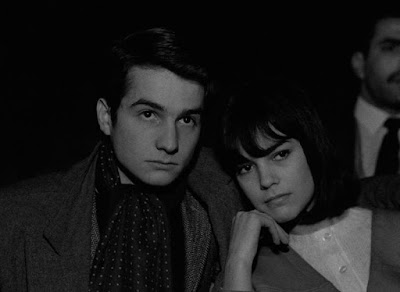 |
Jean-Pierre Léaud (Paul) and Chantal Goya (Madeleine)
watching the film within the film, Masculin Feminin |
Bordwell contends that 1968 does not mark the break between the non-political and the political in Godard's work, that the pre-68 films “are political in the sense that Godard and his colleagues would have acknowledged: they take as their subject matter the politics of everyday life, a notion that owes a good deal to Marxist thought (332 Narrative). Bordwell further contends that “the periodization by “politics”...does not reflect the change in narrational procedures that Godard's work undergoes.” Bordwell suggests that “the crucial dividing line is “Camera Eye” [Godard's manipulation of the camera in his Far from Vietnam contribution in 1967] which marks the emergence of truly essayist forms in his work (ibid).” ** Susan Sontag encapsulates in her reading of Vivre sa vie “that freedom has no psychological interior. It is more like physical grace, being what one is.” Nana’s “twelve stations of the cross” in the film, “the values of sanctity and martyrdom, are transposed to a totally secular plane” which Sontag describes as “something akin to the mood and intensity of Bressonian spirituality but without Catholicism.” Sontag suggests that the whole of Vivre sa vie can usefully be seen to be a text [distinguishable from say the element of a story in a screenplay] stripping Nana bare. “A text in, a study of, lucidity; it is about [in itself] seriousness.” The film employs another text in all but two (5 & 10) of its 12 tableaux each showing Nana picking up a client in the street. A text in the film ranges, for example, from the little girl’s essay on a chicken (the story of Nana) told by Paul (in 1), a passage from a pulp magazine recited by a salesgirl (2), Nana’s empathy with Falconetti’s image on the screen as Jeanne d’Arc (3), Nana’s “I am responsible’ speech as if knowing herself to be free (6), to the most elaborate intellectually, Nana’s conversation with philosopher Brice Parain in which they discuss the nature of language (11).
***************************************
Previous entries in this series can be found if you click the following links
Sixty Years of International Art Cinema: 1960-2020 - Tables and Directors Lists to Accompany Bruce Hodsdon's Series
Notes on canons, methods, national cinemas and more
Part One - Introduction
Part Two - Defining Art Cinema
Part Three - From Classicism to Modernism
Part Four - Authorship and Narrative
Part Five - International Film Guide Directors of the Year, The Sight and Sound World Poll, Art-Horror
Part Six (1) - The Sixties, the United States and Orson Welles
Part Six (2) - Hitchcock, Romero and Art Horror
Part Six (3) - New York Film-makers - Elia Kazan & Shirley Clarke
Part Six (4) - New York Film-makers - Stanley Kubrick Creator of Forms
Part Six (5) ‘New Hollywood’ (1) - Arthur Penn, Warren Beatty, Pauline Kael and BONNIE AND CLYDE
Part Six (6) Francis Ford Coppola: Standing at the crossroads of art and industry
Part 6(7) Altman
6(8) Great Britain - Joseph Losey, Lindsay Anderson, Karel Reisz, Richard Lester, Peter Watkins, Barney Platts-Mills
6(9) France - Part One The New Wave and The Cahiers du Cinema Group
6(10) France - Part Two - The Left Bank/Rive Gauche Group and an Independent


