Showing posts with label Jean-Luc Godard. Show all posts

Saturday, 17 January 2026

The Current Cinema - Barrie Pattison takes another look at NOUVELLE VAGUE (Richard Linklater, USA, 2024)


Nouvelle Vague, t
he new Richard Linklater film, has arrived. It is an Academy frame black and white effort, in English sub-titled French, claiming to present the break out film-making of the sixties as we follow Jean-Luc Godard putting together À bout de souffle/Breathless.

Lookalikes appear as the celebrities of the French film making scene - Jean Cocteau, (“Art is not a business. It’s a priesthood”) Jean-Pierre Melville in his cowboy hat or Roberto Rossellini hitting up his driver for a loan. They are filmed in the original locations in the Paris of Linklater’s After Midnight. There's Guillaume Marbeck/Godard’s contemporaries grouped outside the Le Champo display with a Jerry Lewis poster prominent, a script conference on a bench in Richelieu-Drouot Metro, wheeling Matthieu Penchinat/Raoul Coutard’s camera concealed as a baby carriage  down the Champs Elysées following Zoey Deutch in her Jean Seberg Herald-Tribune T-Shirt or the unit playing pin ball in (is that?) the bar where they launched into spontaneous dance in Bande à part. Visitors on the nude scene shoot include Georges de Beauregard because he’s the producer and José Bénazeraf because he’s a lech.  There is a nice moment where Benjamin Clery, their Pierre Rissient, has a camera set up calculated to film the Latin Quarter street lights coming on. 

Aubry Dullin & Zoey Deutch and the Arc de Triomphe

Linklater was clearly aiming at evoking Godard’s free-wheeling style, which was so electrifying to those sixties audiences I saw sit stony faced through the earlier, master-crafted classic French films which I absorbed with such enthusiasm.

Linklater is likely to bluff viewers who didn’t live through that era but I’m continually distracted by departures from narratives with which I’m familiar. The story was that Godard made off with Cahiers du Cinéma’s petty cash to bankroll his first attempt at filmmaking. Here he uses it to get to the Cannes festival. We heard Truffaut's credited original story for A bout de souffle was a handwritten page which he scribbled to provide name prestige from his bonanza success with Les 400 Coups to fundraising.  

I haven’t handled a copy of the film but wide screen was firmly established by 1959 and the film's projections that I watched all seemed to fit comfortably on that.  We heard that Godard’s first cut was stunningly boring, so he just went through and lopped out the bits he didn’t like, joining up what was left and claiming to have invented the jump cut, which incidentally was already part of the classic film vocabulary. Look at William Wyler’s 1958 archetypically traditional The Big Country! What about the nose job Belmondo got between his earlier Godard short and their feature.Throw in an inexplicable glimpse of Françoise Arnoul’s birthday party.  

History is repeating itself here when unknown Aubry Dullin and lively visiting U.S. starlet Zoey Deutch get to animate the original movie star characters. 

Guillaume Marbeck & Richard Linklater

I’m a fan of Linklater and I can see the appeal of his version to the director of Dazed & Confused or Boyhood  but personally I’m getting over-familiar with the Godard narrative - the Richard Gere Breathless, Kristen Stewart in Seberg. By and large, I find Michel Hazanavicius’ 2017 Godard mon amour, with Lou Garrel as a  cantankerous Jean-Luc, battling middle-aged celebrity, more convincing. He always struck me as someone disturbingly undisciplined, who lucked out because he recruited talented people like Seberg and Belmondo, Raoul Coutard and Michel Legrand and I don’t know that we need two Godard bios, while Agnes Varda’s beautiful study of Jaques Demy,  Jacquot de Nantes, is all but unknown.

Maybe I’d have regarded the uneven J-LG output with more sympathy if he hadn’t been unable to come up with the names of any of the Monogram movies he’d dedicated  À bout de souffle to, when called on, a plausible test of poltroonhood.

********************************

For another report on the film click here to read Rod Bishop's thoughts


Saturday, 13 December 2025

At the Melbourne, Adelaide and Brisbane Film Festivals and the Current Cinema from 9 January 2026 - Rod Bishop analyses NOUVELLE VAGUE (Richard Linklater, France/USA, 2025)


Christmas/New Year is a bumper season for cinemas, but you have to wonder how Nouvelle Vague, Richard Linklater’s loving tribute to the French New Wave, will fair in Event Cinemas at this time of year. 

Godard, Breathless and the French New Wave are probably not top-of-mind interests for most holiday punters, when they can opt for Avatar: Fire and Ash or a day at the beach, or the tennis, or the cricket...maybe not the cricket…

So far, Nouvelle Vague’s box office in cinemas has been minimal.

Made on a budget of $US10m with Netflix acquiring the streaming rights for $4m; at the time of writing this note, it has only had a cinema release in four territories: France, where it grossed $862,000; Romania, $11,600; Russia, $159,000; and The Netherlands, $53,500. Some ‘select’ cinemas in USA have screened the film to qualify it for the Oscars.

This Australian release will come before cinema releases in the UK, Germany, Italy and Spain.

In Nouvelle Vague, Roberto Rossellini refers to the Cahiers du Cinema crowd as “a circle of cinemaniacs”. It’s an apt description of Film Alert 101 readers also, but is there an audience for this film beyond such cinemania?


Jade Phan-Gia as Phuong Maittret; Zoey Deutch as Jean Seberg; Guillaume Marbeck as Jean-Luc Godard;
Aubry Dullin as Jean-Paul Belmondo

Instead of developing characters, Linklater has reduced everyone to a caricature, played by lookalike actors. There’s a solitary, notable exception in Zoey Deutch playing Jean Seberg, and she manages to come close to a three-dimensional performance in a film populated by two-dimensional cut-outs.

The lookalikes stream by: there’s Godard, Truffaut, Chabrol, Rivette, Rohmer, Belmondo, Demy, Varda, Resnais, Rouch, Rissient, Melville, Seberg, Coutard, Bresson, Schiffman and de Beauregard.

But the high-point of this film is Linklater’s 60-minute recreation of the Breathless shoot. 


Aubry Dullin as Jean-Paul Belmondo; Zoey Deutch as Jean Seberg

In pre-production, Godard (Guillaume Marbeck) tells his cameraman Raoul Coutard (Matthieu Penchinat) that he wants “guerilla” filmmaking. Handheld, no lights and no sync sound as he’ll be using the very lightweight and very noisy Cameflex Éclair, a camera Coutard at least had some experience with during World War II. 

Godard also wants Ilford film stock, designed for stills photography, not movies, and he believes it can be used by splicing the small rolls together for the movie camera. Coutard agrees: if the splices go through a projector, they should go through the camera. 

True to his word, the debut director’s frenzied guerilla shooting style, with no lip sync, drives most on set into bewilderment and despair.

The first day’s shoot ends after two hours, with Godard claiming “I’m out of ideas”. 

Day two and the cast and crew are in the Dupont Montparnasse café having finished shooting well before lunch. 

Godard deliberately disregards continuity; Seberg’s make-up artist is told to leave because “there is no make-up in this movie”; Seberg wants to quit on day three; by day five the script girl is asking Godard “Let me get this straight. Tolmachoff wants to play a gangster named Balducci. He didn’t show up so our publicist named Balducci, is going to play the gangster, but you’ve changed his name to Tolmachoff?” “Exactly” is the reply.

Coutard deadpans to Godard: “If they never let you make another film, you’ll be a world-class dolly grip”. On day six an expensive stuntman is stood down and Rivette gets to play his dead corpse instead.

Richard Linklater

By day eight, the cast and crew have an early morning call and wait in the café until Godard abruptly cancels the day’s shoot. “Maybe he’s quitting” says Seberg hopefully.

Next day, they meet up again in the café with Godard directing only one exterior shot before declaring “Let’s go eat. We’re done for the day. I’m hungry”. 

By day 10 he’s called in sick and producer de Beauregard finds him in the café playing pinball. “You can’t call in sick. In two weeks, we’ve had eight half days of work, some only two hours long”. He threatens to close the production down. 

They are not even halfway through the shoot, or halfway through Linklater’s recreation of the shoot. Somebody asks about the schedule. Someone else replies: “What schedule?”

For a film destined to be so influential on filmmakers and audiences alike, it’s a remarkably irreverent approach from a director marked out for greatness and blessed with an ego that would put the current English Test team to shame.

Godard’s jump-cut in Breathless revolutionized filmmaking, and he’s often mentioned as one of a handful of directors considered to have changed film language, forever. There’s only a passing reference to jump cuts in Nouvelle Vague, and it comes during a conversation between Godard and his bemused editors:

We are not cutting any scene. We’re cutting within a scene…we’re going to cut what we can to create a new rhythm.”

It’ll be choppy. Abrupt.”

It’ll be amazing.”

It’ll be disconnected like jumping everywhere.”

Absolutely. Let’s make everything jump.”

Perhaps Godard’s approach to filmmaking is best condensed in his own words: 

Three-quarters of directors waste four hours on a shot that requires four minutes of actual directing. I prefer to have five minutes work for the crew – and keep the three hours to myself for thought.”

Others mentioned: Marc Pierret (on-set reporter); Richard Balducci (publicist); Jacques Doniol-Valcroze (critic, actor); Amarilù Parolini (screenwriter, secretary Cahiers du Cinema); Michel Mourlet (critic); Pierre Kast (screenwriter, director); Claude Mauriac (essayist); Jacques Rozier (screenwriter, director); André Labarthe (actor, producer); Françoise Arnoul (actress); Juliet Greco (singer, actress); Jean Cocteau; Liliane David (actress); Georges Sadoul (critic); Pierre Braunberger (producer)José Bénazéraf (erotic filmmaker); Phuong Maittret (make-up); Daniel Boulanger (novelist); Michel Fabre (writer)


Sunday, 21 May 2023

Sixty Years of International Art Cinema: 1960-2020 - Continuing Bruce Hodsdon's series - 6 (13) France Part 5 Godard with Gorin, Miéville : Searching for an activist voice

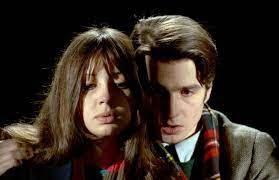
Anne Wiazemsky, Jean-Pierre Leaud, La Chinoise


The sociological interest to be found in earlier Godard films such as Vivre sa vie and Une Femme Mariée (1964), in Masculin-Féminin “becomes the voice of revolutionary politics through the voice of  the political activist” ( Wood 221 ed. Lyon). The activist becomes dominant following the suicide of the other young male protagonist (played by Leaud) who had been seeking fulfilment through personal relationships. Eventually, in each of the Dziga Vertov Group films, the voice of revolutionary politics becomes the film's own voice. 

La Chinoise (1967) was commonly perceived, on its release, as a caricature, not a representation of  an ultra - left Maoist group, at times ironically infantile in the dangerous excess of their plans to use the terrorism of the Chinese cultural revolution to create similar upheaval in the West. Such perception ignores Godard's dominant refrain for La Chinoise that “art is not the reflection of reality but the reality of the reflection.” 

James MacBean warns that, given “Godard's taste for contradiction” and “ability to achieve a dynamic balance amid seeming oppositions,” it is a mistake to reduce La Chinoise to a single category such as “hilarious spoof, or dead-serious militance, insouciance or hard-line propaganda, aesthetic dilettantism or didactic non-art” (21). By Weekend (1968) the take on capitalism is angry, as MacBean puts it, “pushing the cinema of spectacle to the limit” as “civilisation devours itself,” the final image announcing “the end of cinema.” 

With La Chinoise and Weekend Godard was still engaged in making films for commercial screening. After May 68 this all changed as he “turned his back on the bourgeois audience,” instead making films on 16mm for television and militant audiences. 

Juliet Berto, Jean-Pierre Leaud, Le Gai Savoir

Le Gai Savoir (1969)

Geoffrey Nowell-Smith sees the legacy in Godard's work in this turbulent period, 1968-71, as basically to be found in two films. One is Le Gai Savoir/The Joy of Learning (1969), commissioned by French TV – but never televised, seen only by political groups and film societies.

Godard's first break with the established means of film distribution and exhibition via the deconstruction of narrative, seeks a return to cinema’s ‘degree zero’. This he does in Le Gai Savoir  making demands on the viewer by stripping away the conventions in the relations between image and sound described by Nowell-Smith as “intellectually ferocious” which “thirty years later continues to amaze” (ibid 195). Tony Rayns in ‘Time Out’ saw it as “a confused, idiosyncratic attempt at an analysis of the way things are, not yet a committed attempt to construct the way they should be.”

This first film marking Godard’s radical break from fictional concerns is ostensibly an adaptation of Rousseau's Emile, a classic of education theory, in its original form a fictional account of how a child is educated by being allowed to develop her own interests and thoughts rather than having to follow a rigid pre-ordained pattern. 

Two students, Emile Rousseau (Jean-Pierre Léaud) and Patricia Lumumba (Juliette Berto) undertake a three-stage ('three year') course of study filmed with a single light source in the otherwise black void of an abandoned television studio. First by collecting collages of pre-existing words and images then criticising them before finally constructing models to discuss the relations between image and sound, ideology and politics, for it is frequently this combination that is most powerful in communicating ideology. Godard is obliged to question the role of cinema in this dialogue, issuing a manifesto in which he demands that directors worldwide create films that challenge and provoke. 
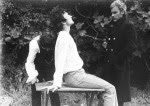


Gian-Maria  Volonte (r), Wind from the East

Counter cinema and after : Wind from the East (1970) , Tout va bien (1972)

The other film in which Nowell-Smith finds the legacy of Godard's work in the Dziga-Vertov period is Vent d'est/ Wind from the East (1970), one of seven completed films ranging from 50 mins to feature length, beginning with Un film comme les autres/A Film Like All the Others (1968) and ending with Vladimir et Rosa (1971). Five of these, including Vent d’est , were directed in name by the Dziga-Vertov Group (DVG) but in practice, for the most part, by Godard in collaboration with Jean-Pierre Gorin, an informed and engaged cinephile and Maoist, although more fellow traveller than activist. Godard insisted that auteurism be subsumed by the socialist collective. The expectation for the DVG films was as forerunners of a counter-cinema, “an open-ended polyphonic form,” as proposed in a seminal essay in 'After Image' by film theorist   Peter Wollen, taking up the post-May 68 political opportunity among a large section of the French population and elsewhere in Europe thought to be open to revolutionary ideas. 

Although funded for, and mostly by, television the group's political initiatives were ultimately all rejected for screening on TV. Instead of seeking open-ended communication with a TV audience, a 'deconstructive western', Wind from the East starring Gian Maria Volonte, was held up by Wollen as an example of counter-cinema, of 'making films politically'. It was originally to be made with student radical Daniel Cohn-Bendit who dropped out early to be replaced, problematically as it turned out, by Brazilian filmmaker Glauber Rocha. Not unlike the role of citation in the first phase of Godard's work, ambition for integration with genre here in the service of revolutionary ideas remains unrealised - the overall 'closed off' effect is “oppressive” (Morrey 95). Such critiques amplified by the negative reactions of audiences at Cannes and the New York Film Festival highlighted the contradiction at the heart of making “political films politically” or specifically, in this case Godard's stated intent of showing the way to “destroying (bourgeois) cinema” which brought him into conflict with Glauber Rocha.

Godard acknowledged Gorin's work in a crisis in bringing a new philosophical rigour to the film's structuring. If the negative reception by 'bourgeois' audiences might be taken as an indication of Wind  hitting its political target, at the same time it severely limited scope for its wider circulation. For further discussion of these issues see James MacBean's essay - "Godard and Rocha at the Crossroads" - in 'Film and Revolution' op cit., also Richard Brody 347-8)

Robin Wood commented that “the assumption behind the DVG films was clearly that the revolutionary impetus of May 68 would not be sustained and it had not been easy for Godard to adjust to its collapse”    (Lyon ed. 221). After he had sufficiently recovered from near fatal injuries sustained in a mid-1971 motorcycle accident, he and Gorin took stock. It was decided to attempt a return to commercial cinema without abandoning the aesthetic and political principles of the preceding years. Godard's problem remained foregrounded: how does a political radical make a film within the capitalist system? For Phillip Drummond (see his opening quote in 6(11)  summarising Godard's work), the DVG films are too often “raw, inchoate and struggling to convince.” 
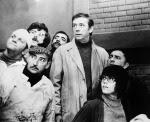
Yves Montand (centre), Jane Fonda (right) Tout Va Bien


In Tout va bien/All's Well (1972),  Yves Montand is a former New Wave film director radicalised by May 68 and Jane Fonda an American radio broadcaster doing political commentary, a media couple who become involved in a workers' factory occupation. The couple begin to see how they too are systematically alienated and exploited in their work situations. The DVG was replaced by Godard and Gorin in the credits. The heavy use of rhetorical Marxist-Leninist commentary by Godard and Gorin in much of their other work together is abandoned, “the tyranny of words” giving way to what MacBean refers to as “a materialist mise-en-scène solidly rooted in things” (178).  Complex use is made of Montand  and Fonda in a dialectic of star personalities/fictional characters to explore the relationship of intellectuals to the class struggle, in what Wood called the “most authentically Brechtian of Godard's films to date” (ibid 222). 
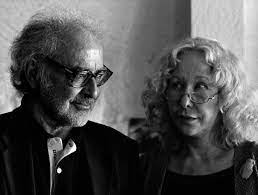
Godard, and Anne-Marie Miéville

Sonimage

Anne-Marie Miéville nursed Godard through more than two years of intermittent hospital treatment following his accident. For the first time he found himself involved with a woman who as a stills photographer, director and screenwriter “was on the same side of the camera as himself.” 

“For her he was simply Jean-Luc. She relentlessly criticised the assumptions of the Maoist revolutionary discourse and argued that it had continuously ignored the reality of daily life in France. The answer to the inadequacies of commercial cinema was to be found in the analysis of how the image functioned in daily life, not in didactic revolutionary films.”  (MacCabe) There is a certain irony here given an original platform in Godard's cinema is the politics of everyday life.

Godard and Miéville set up a small studio 'Sonimage' in Paris but soon moved to Grenoble in 1974 and subsequently to Rolle. They used footage from an unfinished DVG film on the Palestinian issue edited into the little-seen Ici et ailleurs/Here and Elsewhere (1974) as “a classic feminist work” to dramatise the debates that informed Godard and Miéville's Numero Deux (1975) in which film and video are combined to examine sex and politics in the home. “The argument, however, is not based on a simple moralism but an analysis which links global political relationships to our familial conflicts” the images as the mediating term: “we cannot understand the ‘elsewhere’ of Palestine because we do not understand the ‘here’ in France” (McCabe (245). Further collaborative work followed on two series for French television constituting a whole new use of the small screen.
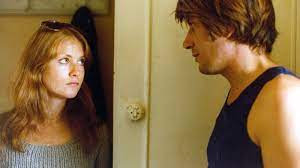
Isabelle Huppert, Jacques Dutronc, Sauve qui peut (la vie)

In 1979 Miéville urged Godard to return to cinema and to use what they had learned from their experiments. The result, Sauve qui peut (la vie)/Every Man for Himself (1980) co-scripted by Miéville with Jean-Claude Carriére, was shot with a tiny crew and was more frankly autobiographical than Godard's earlier features  (Colin MacCabe in “Jean-Luc Godard a life in Seven Episodes (to date)” in Son + Image 1992.                                                                                                                  

At the time of completing “Godard and Narrative” in 'Narration in the Fiction Film' following Godard's return to cinema, Bordwell had seen only Sauve qui peut (la vie) (1979) and Passion (1981), in both of which there appears to be “a retreat from radicalism.” Bordwell found them “almost completely assimilable to art cinema's narrational mode” with a fairly straightforward use of art-film schemata, protagonists revealing reasonably consistent character traits and a quiet use of disjunction never posing the “glaring problems” of his early films by opening up to scrutiny stylistic work no less experimental than in the years 1968-72 (334). 

Myriem Roussel, Hail Mary

The above two films are closely linked with Prénom Carmen (1983) and Je vous salue Marie/ Hail  Mary (84). Their fictional worlds are interchangeable and characters overlapping, suggesting ambiguously that “a new beginning” might still be on track with the innovative use  of images and music from the preceding two films forming the so-called 'cosmic' period (Morrey 132). Adrian Martin finds “a more expansive, lyrical, poetic Godard - if still iconoclastic and cheeky, but now interested in classical art, classical music, religion and the great myths (review of Helas pour moi, Film Critic 1995).”  


Morrey sees these films almost splitting Godard's career in half with “the development of an approach to narrative, character, dialogue and shot composition that will characterise all of his major features through the 80s and 90s up to and including Éloge de l'amour (2001).” Despite the stylistic rupture Godard's interest continues in the recurring theme of the pairing of love and work, a preoccupation noted in Masculin féminim that is irrevocably separated in our societies by the capitalist division of work and leisure (ibid 133).
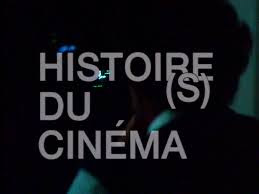


After the first four films of his return to cinema, Godard’s succeeding work, perhaps with the exception of Nouvelle Vague (1990)seemed to be suggesting a 'forever unreeling Godard,' his films increasingly perceived as 'inscrutable and hermetic'. In his video work, Histoire(s) du cinema ,10 years in the making of cinema's epitaph, the deeper concern with history and its relationship with collective and individual memory is apparent. A more than complete recovery of critical consensus or, one might say, vindication if any was needed, came with what are Godard's testimonials on cinema and politics: Goodbye to Language (2014) and The Image Book (2018).


Goodbye to Language is a visually revelatory experience in revivified 3D with an opaque plot. The opacity is a defensible challenge in which David Bordwell, for one, locates a theme : “the idea that language alienates us from some primordial connections to things” (see Wikipedia entry).  This seemingly carries an echo in Alexander Kluge's not well-known (at least in the anglo-sphere) theorising and work with film collage in the New German cinema  - see forthcoming part 6 (17) of this series. 


Godard made more than 100 films including 30 fiction features (15 between 1959-67) and 4 feature length essays for cinema exhibition. From 1976-8 Godard and Miéville made 15 hours of television in two series: Six fois/Suret sous la communication (1976) 6 programs of 100 mins, each in 2 segments - “an end point of the earlier essayist tendency in his films.” France tour détour deux enfants (1978) 12 programs each 26 mins “more of an announcement of what is to come in the early 80s - more philosophical and poetic”.            


In the 2012 'Sight & Sound' Ten year World Poll Godard was rated second top director by the critics with 238 votes after Hitchcock (318) and just above Welles (231), then Ozu (189) and Renoir (179). Godard (with Hitchcock and Bergman) is one of only three directors with 4 in the top 100.
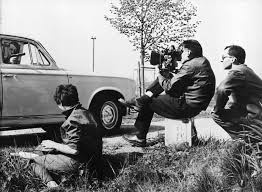

Godard (r) shooting Breathless (1959)


The results of 2012 and 2022 polls are respectively juxtaposed in this summary. Breathless (13/38), Le Mépris (21/54), Pierrot le fou (42/84), and Histoire(s) du Cinéma (48/84). 2 or 3 Things I Know About Her (106), Vivre sa vie /My Lfe to Live  (152) are also in the top 250. 


Godard and Cinema 

Filmography                                                                                                                                                              

New Wave 15 features 1959-67:  Breathless to Weekend   Dziga-Vertov Group (Gorin): Vent d’ Est/Wind from the East (69) Tout va bien (72)  Letter to Jane (72)   Sonimage (Miéville) : Numero deux (75)   'Second New Wave' : Sauve qui peut (la vie)/Every Man for Himself/SlowMotion (80)  Passion (81) JLG Films Prénom Carmen (82)  Je vous salue Marie/Hail Mary (83)  Détective (84)   Soigne ta droite/Keep Your Right Up (87)  King Lear (87)  Nouvelle Vague (90)  Allemagne 90 neuf zero/ Germany Year 90 Nine Zero (91)   Hélas pour moi (93)   For Ever Mozart (96)   Éloge de l'amour/ In Praise of Love (01)  Feature length essays:  Notre Musique  (04)  Film Socialisme (10)  Adieu au langage/ Goodbye to Language (14)  Le livre de image/The Image Book (18)   Select other: Le Gai Savoir/The Joy of Learning (68)  Ici et ailleurs/ Here and Elsewhere (76) Scenario du film Passion (82) Histoire(s) du Cinéma (88-98) The Old Place (98) 

*************************************

Douglas Morrey Jean-Luc Godard  French Film Directors Series  Manchester University Press 2005                        

James Roy MacBean  Film and Revolution   Indiana University Press  1975                                                                          

Richard Brody  Everything is Cinema: The Working Life of Jean-Luc Godard  2008                                                              

Colin MacCabe  Godard:A Portrait of the Artist at Seventy 2004 

Pam Cook “The French New Wave” pp. 253-5; “Authorship:Counter-Cinema” pp. 305-8  Cook & Bernink eds.                     

Peter Wollen  “JLG” essay in Paris Hollywood : Writings on Film  2002;  “Godard and Counter Cinema: Vent d'Est” essay Readings and Writings Verso 1982  first published in Afterimage 4 Autumn 1972                                                                                                                                                                                                                            

Raymond Bellour & Mary Lea Bandy  Jean-Luc Godard Son + Image 1974-1991  MOMA 1992                                           

Robin Wood “Jean-Luc Godard” International Dictionary Directors Ed. Christopher Lyon 1984                                      

Michael Witt  “The Death(s) of Cinema According to Godard” Screen 40/3 Autumn 1999      

David Bordwell  “Godard and Narration”  Narration in the Fiction Film  1985                                                         

V.F.Perkins  “Vivre sa vie” review in The Films of Jean-Luc Godard” Movie Paperback 1969                      

Adrian Martin  “Beyond the Fragments of Cinephilia” in Cinephilia in the Age of Digital Reproduction 2009

Susan Sontag  “Godard’s Vivre Sa Vie” essay in Moviegoer republished in Against Interpretation 1967    

Jean Collet  Jean-Luc Godard  An investigation into his films and philosophy  English edition 1970                     

Martin Rubin  entry on Vivre sa vie in 1001 Movies You Must See Before You Die  2003 edition                              

Craig Keller  Jean-Luc Godard  Great Directors  Senses of Cinema  2003


Previous entries in this series can be found if you click the following links


Sixty Years of International Art Cinema: 1960-2020 - Tables and Directors Lists to Accompany Bruce Hodsdon's Series


Notes on canons, methods, national cinemas and more


Part One - Introduction

Part Two - Defining Art Cinema

Part Three - From Classicism to Modernism

Part Four - Authorship and Narrative

Part Five - International Film Guide Directors of the Year, The Sight and Sound World Poll, Art-Horror

Part Six (1) - The Sixties, the United States and Orson Welles

Part Six (2) - Hitchcock, Romero and Art Horror

Part Six (3) - New York Film-makers - Elia Kazan & Shirley Clarke  

Part Six (4) - New York Film-makers - Stanley Kubrick Creator of Forms

Part Six (5) ‘New Hollywood’ (1) - Arthur Penn, Warren Beatty, Pauline Kael and BONNIE AND CLYDE

Part Six (6) Francis Ford Coppola: Standing at the crossroads of art and industry

Part 6(7) Altman

6(8) Great Britain - Joseph Losey, Lindsay Anderson, Karel Reisz, Richard Lester, Peter Watkins, Barney Platts-Mills

6(9) France - Part One The New Wave and The Cahiers du Cinema Group

6(10) France - Part Two - The Left Bank/Rive Gauche Group and an Independent

6(11) France - Part Three - Young Godard

6(12) France - Part Four - Godard:Visionary and Rebel

Saturday, 8 April 2023

Sixty Years of International Art Cinema: 1960-2020 - Part 6(12) - of Bruce Hodsdon's new series on the history of art cinema - France Part 4 - GODARD: VISIONARY AND REBEL


Peter Wollen reflected (Writings pp.87-92) on Fredric Jameson's observation that Godard began the 60s as a premature post-modernist avant la lettre.  The claim is based on Godard's lifelong penchant for citation and recycling and his view that cinema should be a form of journalism or, perhaps instant ethnography seeking to grasp what is happening at the time of production. This he presented in a kind of visual mosaic - but ending up two decades later, “the ultimate survivor of the modern as such”, always swimming against the current of the age. The futurist visionary and rebel eventually turned into the disenchanted historian [of Histoire(s) du Cinema] in search of transcendence”. 

Wollen further commented on what Godard saw as the debasement of public life in post oil-shock society he “came to distrust spectacle more and more […] without abandoning his fundamental cinephilia.” His disenchantment sprang from what he saw as the cinema's inability to respond to its times. “He became convinced that cinema was indeed a doomed art (Michael Witt quoted Wollen 90), that it had lost the will to live.” “Cinema will disappear,” he predicted in 1996, “when it is no longer projected in the dark, when the beam of light has gone.” Television, on the other hand “is ephemeral...domesticated and insulated,” concludes Wollen who sees Godard's own work in television “as a form of resistance against a symbolic but real occupation, a way of infiltrating enemy-held territory in order to maintain the memory of cinema, to keep a desire for true cinema somehow flickeringly alive in the new millennium.” (ibid)  

In addition to his 'postmodern penchant' already mentioned, Wollen notes a strain of life-style modernism in films of Godard's first phase, “a journalistic sense of the topical, a more sociologically oriented mode of investigation and an attachment to 'the critique of everyday life'... that made him seem both a cultural 'barometer' and an emergent political critic,”  Wollen adding that this strain owed a great deal to the films of Jean Rouch (ibid 77-8). 

Marina Vlady, Two or Three Things I Know about Her

A second strain was Godard's “profound and paradoxical attachment to the idea of art which simultaneously required both the re-inscription and the destruction of that heritage,” his films showing  “a contradictory reverence for the art of the past and a delinquent refusal to obey any of its rules.” At the same time “Godard often seemed to oscillate between a critique of consumerism and mass culture and a delighted fascination with it” (77-8 ibid).  As Nowell-Smith points out, he was still some distance from the radical anti-capitalist and quasi-Marxist position taken up in Two or Three Things...The thinking is more humanist than determinist as the heroine Nana in Vivre sa vie makes an existential choice to be a prostitute. The story, in Godard's words, of the 'last romantic couple' in Pierrot le fou (1965) signified in his “last romantic film and the last for some time in which the search behind appearances is conducted in humanist and existentialist terms.” (N-S 193)  
 

In 1985, in Narration in the Fiction Film, Bordwell found the films from 1959-67 offered the occasion to test many of the narrational concepts Bordwell had explored and proposed in the rest of the book in which, as previously outlined in part 4 of this series of essays, he formulates four different narrative modes including Classical narrative (the Hollywood model) and Art-cinema narration. He concludes with a chapter on Godard and narration. Bordwell emphasises that his main intention was analytical rather than evaluative, the modes being “full of internal harmonies and disharmonies ...[of which] the work of Jean-Luc Godard affords vivid examples of such heterogeneity” (155). 

Bordwell started at the point where he found that films of Godard's first phase 1959-67 resisted narrative comprehension not simply as a problem of interpretation that arises in response to the narrative's ambiguity or profundity but at the level of what is being denoted sequence by sequence - what is actually happening on the screen in the telling of the story so leaving the field open to randomly itemising themes.  “Godard's films invite interpretations but discourage, even defy analysis” (311). 

Colliding narratives

Although Godard’s work embodies the mixing of narrational modes in disorienting ways, they remain fundamentally narratives in this phase organised around cause and effect, inviting the viewer to sort out plot and story and treat intertextual material as digressions. Godard employs both recognisable goal-oriented narratives of classical cinema and the psychological uncertainty and ambiguity of art cinema. He invokes norms of classical Hollywood cinema but rather than synthesise them with art cinema norms, Godard lets them collide which led some critics at the time to see him as a cineaste of the isolated moment rather than meeting the demands of a higher order of meaning. “Much of Godard's film practice,” writes Bordwell,”leads to perpetual and cognitive overload” exacerbated by inter-textuality [also called hypertextuality], “the derivation of one text from another by transformation (satire, parody) or imitation (pastiche, remake)” (ibid 312). 

Brigitte Bardot, Michel Piccoli, Contempt

Amidst this disorientating disruption of cinematic unity with “the violation in his films of nearly every tenet of correct continuity,” as Bordwell notes (327), are the potential explanatory factors: the employment of the concept of “collage” in referring to Godard's disorienting style, what Bordwell sees as  Godard's working towards “spatialization” of narration. This involves the use of paradigmatic form (typically deploying a recurring visual pattern) in a film which, after quoting Godard's detailed  explanation of the treatment of a montage sequence in La Chinoise  Bordwell admits “will seem about as comprehensible as ballet on the radio” (321). He describes at some length the extent of Godard's discarding of the rules of continuity, editing which stems from his routine of shooting a scene in a single take camera set-up. Bordwell quotes Luc Moullet in 1960 as “asserting the only thing that held a Godard film together was his personality” (324). As noted above Godard explained this break down by claiming to think of himself as an essayist.  

Narrator’s role

Despite the problems presented by his films Bordwell acknowledges that “reflexivity,” i.e., the process of self-conscious narration, is organised by Godard “with a thoroughness seldom attained elsewhere in the cinema.” In his films from the beginning the narrator is present to a greater degree than is the case with self-conscious narration in art cinema whose role would be to stress a point or introduce ambiguity as an intrusion into the fictional world which remains intact, continuous and independent. He further points out that “Godard's work could have been created only in the era of art cinema, [ as with the New Wave] with its valorization of an authorial presence hovering over the text, its drift towards confusing narrator and creator” (332).

In 1966 there was within Godard what Nowell-Smith terms “an epistemological shift” which Robin Wood also identifies although, as N-S points out, references to these elements can be found in Godard's previous films: revolution in Les Carabiniers (1963), Brechtian theatre in 2 or 3 Things I Know About Her (1967) and quoted by Fritz Lang in Le Mépris/Contempt (1963). Beginning in Masculin-Féminin (1967) references to revolution and adoption of principles of Brechtian theatre become more central. “The targets are structures of power and of commodity production as analysed by Marx. Hollywood now tends to be referenced as dangerous rather than seductive (N-S, Waves 194).” Deployment of sound/image dialectic in relation to the content of the message is subtly heightened to become more challenging.  


Previous entries in this series can be found if you click the following links


Sixty Years of International Art Cinema: 1960-2020 - Tables and Directors Lists to Accompany Bruce Hodsdon's Series


Notes on canons, methods, national cinemas and more


Part One - Introduction

Part Two - Defining Art Cinema

Part Three - From Classicism to Modernism

Part Four - Authorship and Narrative

Part Five - International Film Guide Directors of the Year, The Sight and Sound World Poll, Art-Horror

Part Six (1) - The Sixties, the United States and Orson Welles

Part Six (2) - Hitchcock, Romero and Art Horror

Part Six (3) - New York Film-makers - Elia Kazan & Shirley Clarke  

Part Six (4) - New York Film-makers - Stanley Kubrick Creator of Forms

Part Six (5) ‘New Hollywood’ (1) - Arthur Penn, Warren Beatty, Pauline Kael and BONNIE AND CLYDE

Part Six (6) Francis Ford Coppola: Standing at the crossroads of art and industry

Part 6(7) Altman

6(8) Great Britain - Joseph Losey, Lindsay Anderson, Karel Reisz, Richard Lester, Peter Watkins, Barney Platts-Mills

6(9) France - Part One The New Wave and The Cahiers du Cinema Group

6(10) France - Part Two - The Left Bank/Rive Gauche Group and an Independent

6(11) France - Part Three - Young Godard