Showing posts with label Spy fiction. Show all posts

Thursday, 26 December 2024

On Foxtel and streaming on Binge - A new version of THE DAY OF THE JACKAL (Ronan Bennett writer and creator, UK, 2024)


In disguise. Eddie Redmayne as The Jackal

I remember I think about four things from Fred Zinnemann’s long but quite involving The Day of the Jackal from 1973. The dead child’s tombstone used for a fake passport, the watermelon being exploded, the tracking of the Jackal across France via those little cards that you used to fill out at every lodging place and then the moment when he has De Gaulle in his gunsights…. The last one was essential. The assassin had to get that close… 


The book developed a life of its own. Infamous Venezuelan terrorist Ilich Ramirez Sanchez who was given the code name "Carlos" because of his South American roots. was later dubbed "The Jackal" by The Guardian  after one of its correspondents reportedly spotted the novel  on the bookshelf of a friend's apartment in which Sánchez had stashed some weapons. Wikipedia punctures this a little by noting the book belonged to a resident in the apartment, not Sánchez, who probably never read it. Still the name stuck and the two Jackals are probably confused in the public mind.


Ronan Bennett’s update dispenses with the passport business. The Jackal has a whole draw full of fake passports at his disposal, revealed when his wife breaks into his sealed room and discovers that the 21st century Jackal is, like Fantomas and Judex from a century ago, a master of disguise. 


In a piece in The Guardian writer and creator Ronan Bennett delves into the novel To him "the Jackal is an enigma -  cold, ruthless and solitary, we never learn his real name. My first inclination was to go with this stripped back version, the assassin as ghost.


“But the more I thought about it….the more I could see that it would be interesting to watch the lone wolf in action – no name, no identity, no family, no lovers – only to slowly reveal that this is a man with an identity, a history and psychological and emotional needs. In reality, no one is totally alone.”


Which is a large part of the reason why the series is strung out to more than nine hours – Feuillade indeed. But also with the later eps whole hours pass by with the plot which we assume will end as in the book and the Zinnemann film with the Jackal’s capture or demise, barely moving towards the final showdown. Episode 9 seemed to take that to extremes with the lengthy explanations of the Jackal’s military history and his slide into contract killing. How he became a master of disguise remains unexplained.


Then comes the biggest shock of all. The Jackal is too good to let go and every expectation is reversed. The last we see of him is of the hot pursuit by motor boat into…series 2…and there is a major character loss just before all this happens. That stopped me dead almost as much as the exploding watermelon.

Monday, 1 August 2022

GEORGE SMILEY novels and screen - Rod Bishop concludes his series looking over THE SECRET PILGRIM, A LEGACY OF SPIES and the feature film of TINKER, TAILOR, SOLDIER, SPY (Tomas Alfredson, UK, 2011)

The Secret Pilgrim

Then the legend began talking, and I realized I had never heard Smiley address a social gathering before. I had assumed it was a thing he would be congenitally bad at, like forcing his opinions on people, or referring to a joe by his real name. So the sovereign way in which he addressed us surprised me…This was the actor who had always lain hidden within him, the secret Pied Piper. This was the man Ann Smiley had loved and Bill Haydon had deceived and the rest of us had loyally followed, to the mystification of outsiders.” 

Removing his spectacles from his ears, he fumbled distractedly with his shirt front, looking for what, I could not imagine what, until I realized that it was the fat end of the necktie on which he was accustomed to polish his lenses. But an awkwardly assembled black bow tie provides no such conveniences, so he used a silk handkerchief from his pocket instead.” 

Smiley lectures to trainee intelligence students at Sarratt. He is introduced by Ned, an intelligence veteran and former head of Sarratt training programs. With each subject Smiley broaches, Ned reminisces about his own career as a spy, including his time before The Fall, after The Fall and post-Cold War.

Ned, whom we first met in le Carré’s previous novel The Russia House, is the central character in The Secret Pilgrim (1990), and le Carré, who makes a virtue out of detailed back-stories for his characters, probably built out Ned’s career from his notes for The Russia House.

Smiley’s role here is quite tangential, although his questioning of the moral ambiguities of intelligence work is used to trigger Ned’s recollections.

It’s a series of short stories, each bookended by Smiley’s brief inputs as he lectures to the trainees at Sarratt.

Like all le Carré’s books with George Smiley, there’s plenty of opportunity to ask about Ann. Ned is talking with Peter Guillam:

And Ann, his wife, I asked Peter, lowering my voice as one does when Ann’s name comes up – for it was an open secret, and a painful one, that Bill Haydon had counted among Ann’s many lovers.

Ann was Ann, said Peter, with a Gallic shrug. She had bits of family with grand houses on Helford Estuary. Sometimes she stayed with them, sometimes she stayed with George.”


A Legacy of Spies

Fifty-four years after publication of The Spy Who Came in from The Cold, le Carré gathered up its characters - Alec Leamas, George Smiley, Peter Guillam, Liz Gold, Josef Fieldler, Karl Riemeck, Control and Hans-Dieter Mundt - for this backstory to his famous novel. 

A Legacy of Spies (2017) also draws in le Carré characters from Call for the Dead (Inspector Mendel) and Tinker Tailor Soldier Spy (Jim Prideaux, Connie Sachs, Percy Alleline, Oliver Lacon, Bill Haydon, Toby Esterhase, Roy Bland) into a sort of memoir narrated by Peter Guillam, now called out of retirement in Brittany. The Circus is facing legal threat and public humiliation from the children of Alec Leamas and Liz Gold and must reopen and investigate the events leading to their deaths at the Berlin Wall.

Although talked about a lot, Smiley doesn’t appear until seven pages from the end, when Guillam finds him in a German reading room for visiting scholars.

“…since this is no sort of place for my planned confrontation, I ask him instead how Ann is.

‘She is very well, thank you, Peter. Yes. Very well, considering…she visits now and then. We walk. In the Black Forest. Not quite the marathons of old, I admit. But we walk’”.


Tinker Tailor Soldier Spy (2011), feature film

Directed by Tomas Alfredson, written by Bridget O‘Connor and Peter Straughan with Gary Oldman (George Smiley), Colin Firth (Bill Haydon), Tom Hardy (Ricki Tarr), Mark Strong (Jim Prideaux), John Hurt (Control), Benedict Cumberbatch (Peter Guillam), Toby Jones (Percy Alleline), David Dencik (Toby Esterhase); Ciarán Hinds (Roy Bland), Kathy Burke (Connie Sachs), Stephen Graham (Jerry Westerby), Simon McBurney (Oliver Lacon). 

Oh, dear.

Sometimes filmmakers suck the very life out of their source material, giving birth to a crippled and inert project. 

Worse still, this one seems to have come from a 12-year-old’s computer program with simultaneous failures of script and direction and a casting strategy of jobs-for-the-boys.

It’s more than two-hours of drama-draining mistakes.

Jim Prideaux (Mark Strong), Tinker, Tailor, Soldier, Spy

Why cast Mark Strong, for instance, perhaps the UK’s most passive and stony-faced actor, to play Jim Prideaux, a man crippled by gunshots and betrayed by an old friend, boiling with rage and fixated on revenge? Mark Strong is incapable of showing any of that, and his Jim Prideaux - so powerful in the novel and television series - is just colourless and limp.

Another example: the capture of the mole Haydon, arguably the most dramatic moment in the novel and television series, was tension-packed during the meticulous bugging of the safe house; the listening room set up; the avoidance of creaking floorboards; with Jim Prideaux lurking outside, spying on the spies, hiding from the street lights and from Esterhase’s surveillance “lamplighters”. When Haydon is captured, a furious Guillam attacks him as the Russian diplomat Polyakov screams for his immunity. 

In this feature film, this sequence amounts to little more than a few set-up shots of the safe house rooms with Guillam walking up, opening the front door and finding Haydon and Smiley sitting silently in chairs with Smiley holding a gun on the mole. Tension and impact are almost non-existent. 

And for dodgy decisions, there’s a lot more where that came from. 

Gary Oldman apparently hoped to move on to a remake Smiley’s People.

Hmm.

Dramatis personae of Tnker, Tailor, Soldier, Spy, le Carre front row, 2nd from right, Gary Oldman (Smiley) front row right


Friday, 29 July 2022

GEORGE SMILEY novels and screen - Part Seven - Rod Bishop continues his series - SMILEY'S PEOPLE (1982)


The Sandman is making a legend for a girl…for this story I should go to Hamburg, unofficial, no cover, no baby-sitter. Know where the East German border is up there? From Lübeck two kilometres? Less? Remember? In Travemünde you got to stay on the left side of the street or you’ve defected by mistake.”

-       Toby Esterhase


“…[George Smiley] was toiling at his habitual desk in the London Library in St James’s Square…in the Parnassian field of German baroque poetry, for at that time he was composing a monograph on the bard Opitz…

…The summons came to Smiley that same night…he had come home straight from the library, then dined poorly at an Italian restaurant in Kings Road, taking Voyages of Olearius with him for protection. He had returned to his house on Bywater Street and resumed work on his monograph with the devotion of a man who had nothing else to do.”
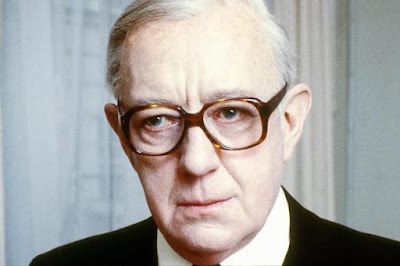

Alec Guinness, Smiley's People

And then fallen asleep.

Once again, it was Oliver Lacon who summons Smiley from retirement. One of Smiley’s old Russian defectors, General Vladimir, has been found murdered on Hampstead Heath.

Shot dead. This evening. George, for Heaven’s sake wake up, we need you…someone from his past, George. Someone who knew his little ways, can identify him, damp down potential scandal…Now. We need you George, wake up

“‘I need you’ thought Smiley…‘I love you, I hate you, I need you’. Such apocalyptic statements reminded him of Ann when she had run out of money or love. The heart of the sentence is the subject, he thought. It is not the verb, least of all the object. It is the ego, demanding its feed.

Lacon’s summons eventually leads to Karla…once again. Ann tells Smiley that Bill Haydon called Karla “the black Grail”. General Vladimir, now hiding in London, had realized the Russian spy boss set up Maria Ostrakova, a Russian expat in Paris, with fake citizenship papers for her daughter. 

As the novel unfolds, it becomes clear the fake citizenship papers for Maria’s daughter have been secretly used by The Sandman (Karla) as cover for his own schizophrenic daughter, now confined under a false name in the West at a Swiss sanatorium. For Smiley, it’s the chance he’s been waiting for; he can blackmail Karla and force him to defect to the West.

For the television adaptation of Smiley’s People (1982), there was a chance to get the band back together. Or what was left of it. 


Toby Esterhase (Bernard Hepton)


Alec Guinness as Smiley; Bernard Hepton as Toby Esterhase; Anthony Bate as Oliver Lacon; Beryl Reed as Connie Sachs, Patrick Stewart as Karla; Siân Phillips as Ann. The only unavailable cast member was Michael Jayston to play Peter Guillam. Jayston was committed to playing von Trapp in the London stage revival of The Sound of Music, of all things, so Michael Byrne filled in as Guillam.

Connie Sachs (Beryl Reid)


Adhering to the “when you’re on a good thing, stick to it” axiom, scriptwriters John Hopkins and le Carré rely heavily on dialogue and structure from the novel (1979) and director Simon Langton takes the same measured and clear-eyed direction John Irvin achieved in Tinker Tailor Soldier Spy.

The often over-written and lengthy prose of The Honorable Schoolboy- 156,000 words compared with 92,000 for Tinker Tailor Soldier Spy and 104,000 for Smiley’s People- and its exotic locations, probably made any screen adaptation of the second novel in The Karla Trilogy unfeasible. 

But here, in the third, le Carré returns to the sparce, lean pacing of Tinker Tailer Soldier Spy and the television series unfolds with an unerring fidelity to the novel. 

Watching Alec Guinness return to the site of Vladimir’s murder, for instance, where Vladimir was to bring “two proofs” implicating The Sandman (“anyone who comes too close to him has a way of falling asleep”), is to watch a commensurate artist at work. Smiley follows Vladimir’s insistence on “Moscow Rules” and stalks the scene at Hampstead Heath, finding the tradecraft chalk mark and the new drawing pin on a park pavilion and pokes about in the bushes with his umbrella. 

He carefully steps along the Russian’s probable footmarks, trying not to over-balance:

Smiley peered sharply behind him and saw two small boys in blazers who had paused to watch this little round man in spectacles performing strange antics with his feet.”

He trawls through the park detritus - broken kites, Coca-Cola cans, torn-up porno mags, old shoes, a burnt blanket, beer bottles and cigarette packets - while other walkers, including a couple of typists and some Buddhist monks (a Hari Krishna in the television series), now watch on intently as the odd Homburg-hatted man finally stretches up to find his quarry hidden between branches in a tree. 

A similar set-piece takes place in Smiley’s Chelsea home, a near wordless sequence as he develops the photographic negative so carefully left by General Vladimir in the tree on Hampstead Health. There’s something reminiscent of Antonioni’s Blow-Up in these sequences and Guinness is riveting in both.

In the novel, but not its adaptation, the silence is broken by Ann. 

Smiley is waiting in an armchair for the photographic print to dry when he:

“…addressed himself to a pretty marquetry writing-desk in which Ann kept her ‘things’ with embarrassing openness. Such as a sheet of writing paper on which she had written the one word ‘Darling’ and not continued, perhaps uncertain which darling to write to.”

And then…

Ann rang. Once again, perhaps he had dozed off…‘George, George’ as if she had been crying for him a long time, and he had only now summoned the energy or the caring to answer her. They began their conversation as strangers, much as they began their love-making.

‘How are you?’ she asked.

‘Very well, thank you. How are you? What can I do for you?’

‘I meant it’ Ann insisted. ‘How are you? I want to know”.

To forget the hurts, the list of lovers; to forget Bill Haydon, the Circus traitor, whose shadow still fell across her face each time he reached for her…Bill the born deceiver, whose quest for the ultimate betrayal led him into the Russians’ bed, and Ann’s…

…but as he spoke he heard her whisper ‘George’…

‘You mustn’t’ he said. ‘Ann? Listen. You mustn’t come here…’

‘Then come here’, she said.

He rang off. He imagined her crying, then getting out her address book to see who from her First Eleven, as she called them, might console her in his place.”

When Smiley is forced into the dreaded dinner with Oliver Lacon to discuss each other’s marriage problems and as Lacon is seeing him off in a cab, Lacon actually says something quite funny:

If Ann had been your agent instead of your wife, you probably would have run her pretty well.”

To the plethora of spy-speak from Tinker Tailor Solder Spy, le Carré adds: the vicars, the postmen, the Neighbours, bromide jobs, Oddbins, the suitors, the babysitters, the pickets, the Cousins, lifelines, the whisperers, burning (blackmail), tradesmen and the loser’s corner.
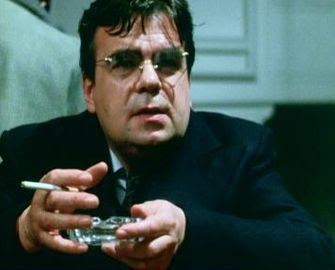

Anton Grigoriev (Michel Lonsdale)

The trail for Karla leads through several European counties, to strip-clubs, French safe-houses, Berne, feral German water camps and Soviet diplomats (Michael Lonsdale is superlative as the hapless diplomat Anton Grigoriev). 

Finally, Karla is forced to defect. Meeting Smiley at a Berlin Wall crossing at Oberbaumbrücke, he holds a cigarette lighter that once belonged to the British spy, engraved with a message from Ann: “To George from Ann, with all my love”. 

Decades before, Karla had taken the lighter from George in a Delhi jail cell.

As he crosses into the West, Karla drops the lighter at Smiley’s feet. Smiley glances at it, leaves it on the road and walks away with a barely concealed expression of disgust.

“‘There is no loyalty without betrayal’, Ann liked to tell him in their youth when he ventured to protest at her infidelities”.

Both series follow labyrinthine plots and Alec Guinness holds them together with a vice-like grip. His Smiley, continually swaps from contrived meekness to the distinctly bland to the fiercely determined; from the mild and reserved to the wounded, put-upon lover; and from the contemptuous to the very essence of British politeness.

Ten years ago, The New Yorker described Alec Guinness’s work in Tinker Tailor Soldier Spy and Smiley’s People, the two-television series that made him an icon, as:

“…almost Shakespearian…one of the great literary-cinematic creations of the post-war era, an actor’s masterpiece.”

 Previous: Click on title


Next: The Secret Pilgrim, A Legacy of Spies, and the feature film version of Tinker Tailor Soldier Spy (2011)

Tuesday, 26 July 2022

GEORGE SMILEY novels and screen - Part Six - Rod Bishop examines THE HONOURABLE SCHOOLBOY (1977)


Cover of the 1st edition

“It was remembered that Bill Haydon had not merely been George Smiley’s colleague, but Ann’s cousin and something more besides.

Smiley’s fury against him, they said, had not stopped at Haydon’s death: he was positively dancing on Bill’s grave. George had personally supervised the clearing of Haydon’s fabled pepper-pot room overlooking Charing Cross Road, and the destruction of every last sign of himfrom his indifferent oil-paintings by his own hand to the left-over oddments in the drawers of his desk; even the desk itself, which he ordered sawn up, and burned.And when that was done, he had called in the Circus workmen to tear down the partition walls.”

“[Smiley] gave a studious frown, and blinked, then whipped off his spectacles and, to the secret delight of everyone, unconsciously subscribed to his own legend by polishing them on the fat end of his tie.”


This second part of The Karla Trilogy, published in 1977, opens with a group of rowdy, drunken, cartoonish journalists at the Hong Kong Foreign Correspondents Club in 1974. They have discovered one of their drinking crowd, the British diplomat Tufty Thesinger, and all who sail in him, have disappeared overnight and are thought to have scuttled home to the Old Dart.

It's part of the dismantling and rolling up of British spy networks around the world - a necessity brought about by Bill Haydon’s betrayal and his years of passing on security information to Karla and Moscow Centre, including the names of British spies. An event now known in spy circles as “the Fall” – as in the Circus before the Fall and the Circus after The Fall.

Immediately after Hayden’s capture, all nine Soviet and East European networks went dead and in the Far East, it’s not just Hong Kong, but also Bangkok, Singapore, Saigon, Tokyo, Manila and Djakarta that are rolled up.

Richard Hughes

Journalist/spy Craw, a character based on the fabled Australian Richard (Dick) Hughes, called it:

A hoods’ Dunkirk…in which Charter DC8s replaced the Kent fishing fleets.”

Smiley, meanwhile, has the ‘ferrets’ completely rewiring the Circus after the discovery of surveillance bugs planted by Haydon for the Russians:

…Smiley now staged a modest piece of theatre. He ordered the ferrets to reactivate [Haydon’s] radio-microphones in the conference room and to modify the receiver on one of the Circus’s few remaining surveillance cars. He then invited three of the least bending Whitehall desk-jockeys…to drive in a half-mile radius round the building while they listened to a pre-scripted discussion…Word for word. Not a syllable out of place. After which Smiley swore them to absolute secrecy and for good measure made them sign a declaration…Peter Guillam reckoned it would keep them quiet for about a month. ‘Or less if it rains’, he added sourly.”

Smiley also aims to scrap all the UK outstations – the safe houses “now totally unsafe”; the holding and training centre known as the Sarratt Nursery; audio labs in Harlow; the Argyll “stink and bangs school”; the water school in Helford Estuary; the radio transmission base at Canterbury; and the wranglers’ headquarters in Bath.

“‘Scrap the lot’ he told Lacon.”

The Circus is now run by a hand-picked Group of Five:

Smiley himself; Peter Guillam, his cupbearer; big, flowing Connie Sachs; Fawn, the dark-eyed factotum who wore black gym-shoes and manned the Russian-style copper samovar and gave out biscuits; and lastly Doc di Salis, known as the mad Jesuit, the Circus’s head China-watcher…to have been one of them, said di Salis was like ‘holding a Communist Party card with a single-figure membership number.’”

“‘George Smiley isn’t just cleaning the stable’…Roddy Martindale remarked…he’s carrying the horse up the hill as well. Haw haw.’”

The reinstated Head of Research, Connie Sachs, has discovered “a goldseam” in Hong Kong and in the words of another British literary figure: “the game’s afoot”. 

In Tinker Tailer Soldier Spy, Jerry Westerby, the journalist who called the newspaper he works for “the comic”, was fired from his part-time job as a spy at the Circus for daring to pass on information about a mole at the top. Smiley now calls him out of retirement from Lucca, Tuscany and sends him to Hong Kong.

Most of this very long novel is based around the pursuit of two brothers, Drake and Nelson Ko, whose deceased parents were Chiu Chow boat people. The brothers were raised by the Reverend and Liese Hibbert and Drake escapes from Mainland China to Hong Kong where he becomes extremely wealthy from smuggling and prostitution. He also gets an OBE.

“[Drake Ko is]a Chiu Chow poor-boy who becomes a Jockey Club Steward with an OBE and hoses down his horse before a race. A Hakka water-gypsy who gives his child a Baptist funeral and an English effigy. A capitalist who hates politics. A failed lawyer, a gang boss, a builder of hospitals who runs an opium airline, a supporter of spirit temples who plays croquet and rides about in a Rolls-Royce. An American bar in his Chinese garden, and Russian gold in his bank account.”

His brother Nelson, a dedicated communist, was studying marine engineering in Leningrad when Karla recruited him to spy on China for Moscow Centre. Drake is fixated on having his brother Nelson join him in Hong Kong.

The ‘goldseam’ Connie Sachs discovers is $US25,000 a month ($US500,000 in all) from Moscow Centre transferred to Drake Ko who is to hand it over to his brother, in payment for Nelson’s spying activities in China. 

Nelson Ko is believed to have high quality intelligence on both the Soviet Union and China and Smiley’s pursuit of Nelson is another opportunity to take revenge on Karla and Moscow Centre.

There are assassinations; botched assassinations; opium smuggling into China; blackmail; territorial tussles between the Circus and the CIA; and even Jerry Westerby getting engaged in some Hunter S Thompson-style escapades in Cambodia, Thailand, Laos and Vietnam.

In North East Thailand, Westerby:

“…passed a village and a cinema. Even the latest films up here are silents, Jerry recalled. He had once done a story about them. Local actors made the voices, and invented whatever plots came into their heads. He remembered John Wayne with a squeaky Thai voice, and the audience ecstatic, and the interpreter explaining to him they were hearing an imitation of the local mayor who was a famous queen.” 

And Ann?

“‘…don’t ask him about his wife,’ Guillam warned in a fast, soft murmur.”

With Haydon dead and the past buried, the Smileys had made up their differences and together, with some small ceremony, the united couple had moved back into their little Chelsea house. They even made a stab at being in society…had even for a few weeks made a modestly exotic couple around the higher bureaucratic circuit. Till overnight, to his wife’s unmistakable discomfort, George Smiley had removed himself from her sight, and set up camp in the meagre attics behind his throne-room in the Circus…while in Chelsea, Ann Smiley pined, taking very hardly to her unaccustomed role of wife abandoned.”

News that brought another bellow from Roddy Martindale:

The gall! Him a complete nobody and her half a Sawley!..After years of putting up with her perfectly healthy peccadillos…what does the little man do?...kicks her in the teeth…Smiley has gone too far.” 

No feature film or television series has been made of The Honourable Schoolboy. In 1983, the BBC adapted the novel for radio.


Previous: Click on title


Next: Smiley’s People

Saturday, 23 July 2022

GEORGE SMILEY novels and screen - Part Five - Rod Bishop continues his series with TINKER TAILOR SOLDIER SPY


To Guillam, Haydon was of that unrepeatable, fading Circus generation, to which his parents, and George Smiley also belonged – exclusive and in Haydon’s case blue-blooded – which had lived a dozen leisured lives to his own hasty one, and still, thirty years later, gave the Circus its dying flavour of adventure.”

George is like a swift…he cuts down his body temperature ‘till it’s the same as the environment. Then he doesn’t lose energy adjusting.” - 

Ann to Bill Haydon


Le Carré’s most accomplished work, Tinker Tailor Soldier Spy (1974) fleshes out the secret intelligence world of the Circus and its tradecraft - previously only sketched in Call for the Dead and The Spy Who Came in from the Cold.

In this, le Carré’s seventh novel, the tradecraft spy-speak arrives in abundance.

There are the lamplighters, the forgers, the listeners, the wranglers, the ju-ju men, Nuts and Bolts, the networks, the safe houses, the surveillance teams, the silk-shirt agents, the talent spotters, the couriers, the reptile fund, the mothers, the scalphunters, the legmen, the Funnies, the cut-outs, the translators, the inquisitors, the janitors, the housekeepers, the dead-letter boxes, the codists, the pavement artists, the evaluators, transcribers and cypher clerks.

The first chapter is devoted to Jim Prideaux, the agent shot twice in the back in Czechoslovakia during Operation Testify. Prideaux goes into hiding (“relocation”) as a teacher at the Thursgood prep school in Taunton. Smiley suspects the shooting was caused by a mole in the Circus. 

Smiley was centre stage in le Carré’s first two novels and then a peripheral background presence in novels three and four. He did not appear in the fifth and sixth novels (A Small Town in GermanyThe Naïve and Sentimental Lover). His return in Tinker Tailor Soldier Spy comes as a fully-formed, commanding and complex presence. 

In the second chapter, Smiley is introduced as: 

Small, podgy and at best middle-aged, he was by appearance one of London’s meek who do not inherit the earth. His legs were short, his gait anything but agile, his dress costly, ill-fitting and extremely wet.”

On his way to his favourite Curzon Street bookseller, clutching an early edition of Grimmelshausen, he unfortunately runs into the blustering Roddy Martindale, a Foreign Office representative on the Intelligence Steering Committee:

If it isn’t the maestro himself! They told me you were locked up with the monks in St Gallen or somewhere, poring over manuscripts! Confess to me at once. I want to know all you’ve been doing, every little bit. Are you well? Do you love England still? How’s the delicious Ann?”

In this novel, it's the first of many barely veiled references to Smiley’s wayward wife and her affair with his colleague, Circus heavy-weight Bill Haydon. 

Martindale gossips heavily, including who might have replaced the now deceased Control at the Circus:

So who’s the cleverboots? Not Percy that’s for sure. And don’t tell me the Americans are trusting us again either…Dashing Bill Haydon, our latter-day Lawrence of Arabia, bless him; there you are, it’s Bill, your old rival…I’m told that you and Bill shared everything once upon a time…still he never was orthodox, was he? Genius never is.”

The novel doesn’t take a false step. Tight, funny, absorbing, exquisitely detailed and intriguingly plotted, it follows Smiley, brought out of retirement, to uncover the Russian mole in the higher echelon of the Circus.

When still alive, Control gave the echelon code-names. Is the mole Alleline? (Tinker). Haydon? (Tailor). Bland? (Soldier). Esterhase? (Poorman). Or even Smiley (Beggarman).

Smiley takes Control’s same route of discovery:

“[Control’s] way of dealing with them was to literally close the door: to withdraw into the dingy solitude of his upper rooms, receive no visitors and have all his phone calls fed to him by the mothers. The same quiet ladies fed him jasmine tea and the countless office files which he sent for and returned in heaps. Smiley would see them piled before the door as he went about his own business trying to keep the Circus afloat…But Smiley – as he now patiently leafed through file after file – knew, and in a real way took comfort from the knowledge, that he was not after all the first to take this journey of exploration; that Control’s ghost was his companion.”


Title for the BBC-TV series

A great deal of dialogue in John le Carré and Arthur Hopcraft’s script for the 1979 television series, is lifted directly from the book, but there are additions. After Ricki Tarr has spent all night at Lacon’s country house laying out the evidence for a mole, Lacon looks to George: “Fit George?…Natter?..Garden?”. Smiley mutters “Super” under his breath before joining Lacon in the greenhouse and the neighbouring golf course to hear Lacon apologize for not believing there was a mole when Smiley was still at the Circus. He then presses Smiley to take the job and “clean the stables”.

Another addition is the final scene of the series when Smiley visits Ann at her country pile to tell her of Bill Haydon’s fate. In a peerless exchange between the two, Ann says she is actually glad Haydon is dead and that he had “loved being a traitor”. Smiley asks her if she loved Haydon. She replies: “No, George. Poor George. Life’s such a puzzle to you, isn’t it?”

Including Ann for this final scene also takes full advantage of that screen-and-stage trick: talk about someone continuously without them appearing until late in the story. When they do, audience expectation greatly compounds the impact of their presence and charisma. 

Ann appears only once in the novel. Smiley is hoping she will pick him up at the train station. She is late. He waits in a taxi queue and watches from a distance as she drives down a bus lane, parks and goes into the station to find him. And that’s it, but the continuous “How’s Ann?”How’s the lovely Ann?” has chased Smiley around in the novel from beginning to end.


Ian Bannen as Jim Prideaux

The other major alteration in the television series is the opening twenty-minute sequence (brought forward from much later in the novel) to show Jim Prideaux’s enlistment by Control to bring Stevcek, a defecting Czech general of artillery to England. Control, duped by Karla, Moscow Centre and Bill Haydon, believes Stevcek knows the identity of the Circus mole.

After the struggling attempts by James Mason, Denholm Elliot and Rupert Davies, casting Alec Guinness as Smiley proved to be a master-stoke.


Alec Guinness as Smiley

Guinness looks nothing like le Carré’s various descriptions of Smiley; he is nearly six feet tall when Smiley is always described as short; he is slim and certainly not overweight when the novels always describe him as fat and podgy; and he is conservatively well-dressed where le Carré sometimes described only cheap suits hanging off a squat frame.

But like Richard Burton before him, he nails his character from his very first scene and doesn’t let up for the 11 hours running time of Tinker Tailor Soldier Spy and Smiley’s People. And like Burton, his strongest moments are silent facial expressions and eye-movements that virtually convey plot developments in themselves.

Director John Irvin has said Guinness needed considerable persuasion to take the role - three lunches with Irvin, one with David Cornwell (le Carré) and one with the Head of MI6. It all paid off and it’s arguably the greatest spy television series to have emerged from the Cold War.

The opening meeting at the Circus. Bill Haydon
(Ian Richardson) second from left

As the novel draws to its conclusion with the imminent capture of the mole, le Carré is still building the sort of character development that screen adaptations simply don’t have time for. The taciturn Mendel, for instance, a retired police inspector, who appears in Call for the DeadA Murder of Quality, Tinker Tailor Solder SpySmiley’s People and A Legacy of Spies is hidden in a building opposite the Circus waiting for the mole to be flushed out:

Funnies, Mendel mused. A lifetime of chasing villains and how do I end up? Breaking and entering, standing in the dark and spying on the Funnies. He’d never held with the Funnies til he met Smiley. Thought they were an interfering lot of amateurs and college boys; thought they were unconstitutional; thought the best thing the Branch could do, for its own sake and the public’s was say ‘yes, sir, no, sir’ and lose the correspondence.”

Mrs McCraig, housekeeper at the safe house where the mole meets the Russian Polyakov, is barely glimpsed in the television series, but in the novel:

She was a wiry Scottish widow with brown stockings and bobbed hair and the polished, wrinkled skin of an old man. In the interest of God and the Circus she had run Bible Schools in Mozambique and a seaman’s mission in Hamburg and although she had been a professional eavesdropper for twenty years since then, she was still inclined to treat all men as transgressors. Smiley had no way of telling what she thought.”

And Smiley, hiding in the dark in Mrs McCraig’s safe house, awaiting the arrival of the mole and unconvincingly fiddling with a gun:

He thought again about the day he buried Control. He thought about treason and whether there was mindless treason in the same way, supposedly, as there was mindless violence. It worried him…that whatever intellectual or philosophical precepts he clung to broke down entirely now that he was faced with the human situation.

…a fat, barefooted spy, as Ann would say, deceived in love and impotent in hate, clutching a gun in one hand, a bit of string in the other, as he waited in the darkness.”

"...clutching a gun in one hand,a bit of
string in the other..."


Previous: Click on title