 |
| Shōhei Imamura |
Shōhei ImamuraLike other New Wave directors Shōhei Imamura (1926-2018) rejected Shochiku’s sentimental formally rigorous melodramas focused on the lives of the urban middle classes, the New Wave’s most feminisuto director was even seen as bordering on feminist by some. In contrast to Mizoguchi's favouring of the princess archetype Imamura is, in Desser's words, “definitely the poet of the peasant...his heroines, almost without exception, drawn from Japan's traditional village life in a world characterised by power, and by political, social and sexual difference.” (123). Mark Cousins notes in his The Story of Film “that decades earlier Mizoguchi's and Naruse's women suffered for their men. Imamura says forget that” (297). In his first two “Imamura” films, (his fifth and sixth features and his last with Nikkatsu), both the leads are lower class women forced into prostitution, not out of desperation or male domination, but from a rational determination to survive.
Both Desser and Audie Bock recognise that, “Imamura searches ['with an anthropologist's footwork'] for the essence of Japaneseness through his works.” He told Bock in 1977, that he feels “the Japanese did not change as a result of the Pacific war - they haven't changed in a thousand years!” (Bock 287). Desser adds that “his characters, especially the women, are representative of Japan - not the Japan as it appears to Westerners, nor the Japan that the Japanese would like to project to the world, but the Japan that persists despite modernisation and Westernisation.” (122)
 |
| Pigs and Battleships |
Haruko, in the tragi-comic climax of Pigs and Battleships (1961), dismisses the gang killing of her small time gangster boyfriend as the death of a fool for ignoring her efforts to persuade him to end his involvement in petty crime further generated by American encroachments in Japan. It is the woman who holds to a deeper spirit of survival, as Haruko takes off to find herself a factory job. If Imamura sees this as close to the Japanese spirit resting within women, Tome in The Insect Woman (1963) represents the essence of that spirit, leaving a life “grubbing like an insect” in rural poverty, to become a prostitute and then a madam, to be ultimately impressed by her daughter's practical ability to find her own happiness: “Three generations of illegitimate women prove to succeed, unfazed by the war, conventional morality, poverty or weak exploitative men.” (Bock 305) Not content merely with focusing on the lack of spirit in his male characters, Imamura followed with Intentions of Murder (1964), perhaps his most tightly structured drama, set in the rigid family system of northern Japan. Another inarticulate country girl, Sadako, not only survives but achieves an unexpected complete victory over a rapist who insinuates himself into her life and releases the deepest impulses of her inner nature previously suppressed by the patriarchal order.
Imamura's subjects are sex and the social underclass, or as he put it, “the lower part of the body and the lower part of the social structure.” To summarise the plots of his films overstates their seeming eccentricity, a frequent off-centre preoccupation with sex, rape, murder and prostitution, which obscures the earthy, subversive humour, his stated individualistic preference being for keeping his films “messy” in disconcertingly mixing documentary and fictional modes, fact and fantasy. He began his film career as an assistant to Ozu but then set off in a very different direction. “I wouldn't say I wasn't influenced by Ozu,” he insists, “I would say I didn't want to be influenced by him. The fact that his directing of actors, for example, was cast in too rigid a mould, was repugnant to me.” (ibid 289)
 |
| The Pornographers: Introduction to Anthropology |
The Pornographers: Introduction to Anthropology (1966), a social satire centred around a small-time producer of 8mm porno loops, involves the merging of documentary and fiction through the use of a film-within-film structure with Imamura presiding over the opening and closing of the film, and use of films in the main body of the work. Voyeurism is alluded to, not just in scenes involving sexual activity, by filming through windows in long takes, the camera moving inwards. The link between familial and family relationships is expressed in the motif of incest which, as Desser points out, also found expression in the films of other New Wave filmmakers, Oshima, Yoshida and Shinoda. The issue is complicated by Japan's creation myth from Shinto tradition, attributing the birth of the Japanese archipelago to the union between brother and sister gods. “The homogeneity of the Japanese people and their traditional insularity, encourages an image of incest as marriage within a tribe.” (Desser 84). Desser further points out that “the issue is complicated, in a strange way, by Japanese architecture, and the nature of the house itself, where concepts of privacy do not hold sway as in the West.” Imamura's frequent use of the carp in the film is suggested as his way of satirising Japanese family ancestor worship. Not content with variations on a single theme, following “anthropological” inclinations in A Man Vanishes (1967), Imamura set up an actual documentary about a woman's search for her missing fiancee which mutates it into a story about her loss of interest in the search as a result of her falling in love with the interviewer (actually an actor), while somewhat tendentious for some, but in the light of his work as a whole, A Man Vanishes can be seen as taking “women's relation with men into philosophically new areas.” (Cousins 297). In a final deconstruction the film alludes to the irrationality of its lack of resolution as the walls of the surrounding teahouse fall away to reveal a studio set.
 |
| The Profound Desire of the Gods |
The Profound Desire of the Gods/Kuragejima: Tales From a Southern Island (1968) was welcomed by the initiated as Imamura's most important (“most auteurist”) film to date bringing together his concerns in an allegorical tale set in a southern island, Kuregejima, where ancient freedoms appearing mad, have been destroyed by modern rationality as we have been rendered mad ourselves by the greed of urban life. “Imamura's response,” Joan Mellen suggests, “to the laissez faire destruction of Japan is essentially religious. It is Buddhist in its distance from social injustice. Rather than attacking social ills, it seeks solace”. Imamura seemed to support this conclusion, being quoted by Mellen as saying “If you think of life as a cycle it is less threatening” (13). At the same time, Desser notes that while Imamura sees much to admire in the islanders' attempts to maintain their traditional ways against encroaching capitalism, “he sees that these traditions have a degree of cruelty about them that cannot be ignored. The only way around this insoluble conflict of tradition vs progress,” it is further suggested, “ is through recourse to the irrational” (ibid 87) Imamura and Oshima in the seventies and beyond
Imamura made two documentaries in the 70s: In Search of Unreturned Soldiers (1971), separate parts in Malaya and Thailand where he sought out Japanese soldiers who did not return home in search of the many and varied reasons which included dissatisfaction with the conditions of greed and selfishness in their home country. Karayuki-san: the Making of a Prostitute (1975), is part of the series made for television of unreturned Japanese. Here Karayuki-san or 'comfort women' were sold into prostitution in service to the military, many by poor families. History of Postwar Japan as Told by a Bar Hostess (1970) is structured around an interview by Imamura with a bar maid on her life and career (1970) inspired by the director's persistent fascination with the American military port of Yokowuka and the production company's request for a report on Japan in the 25 years since the War.
 |
| Vengeance is Mine |
Vengeance is Mine (1979) described as “an eclectically horrifying mosaic of entwined flashbacks about a psychopathic criminal, Iwao Enokizu,” marked Imamura's return to narrative features after a decade. Vengeance is based on police records and a ‘nonfiction novel’ by Ryuzo Saki. “ The very title begins implicating the viewer in a mystery play that is both compelling and repelling. Iwao is a truly dangerous creature without conscience or remorse, yet “he is fully immersed in a stream of humanity,” having been raised in a devoutly Catholic family. (Tom Allen The Village Voice 22/10/79)Ejianaika (1981) “a colourful pageant of bawdy tales against the background of Japan's transition from shogun to restoration of the Emperor... (is) both joyful and melancholic but rarely faithful to the period and its modern resonances...clearly designed [by Imamura] to chime with the latent irrationality already diagnosed in The Profound Desire of the Gods and Vengeance is Mine, the latter based on Japan's 'most wanted man' of the seventies whose criminal career Imamura “charts dispassionately, inviting neither complicity nor sympathy.” (Tony Rayns AFI 2nd national event programme notes)
Imamura's films, like those of Ozu, in Japan were long considered quintessentially Japanese and thus beyond the comprehension of gaijin ('outsider') audiences. Imamura was perversely criticised by some as pandering to international art house and festival audiences when he won the Golden Palm at Cannes 1983 with The Ballad of Narayama (1983), ostensibly a remake of the film version of the novel of the same name by Shichiro Fukazawa directed by Kinoshita in 1958. In fact while faithfully transposing “Fukazawa's neo-primitivist story of Orin and her preparations for her death, rooted in a folklore tradition and the most ancient Japanese myths, Imamura found a means of re-reading a set of themes and concerns that can be thought of as distinctively his own.” Tony Rayns identifies what he sees is “Imamura's masterstroke: to treat these stories as a kind of pantheistic documentary. An immaculate instance,” Rayns concludes, “of an artist redefining his own work through that of another.” He sees the other Imamura film that Ballad most closely resembles is The Profound Desire of the Gods while also being “a companion piece to its immediate predecessors, Vengeance is Mine and Eijanaika.”
Imamura won his second Golden Palm at Cannes with one of his simplest stories in The Eel (1998) providing grounds for renewal of speculation that he might either be mellowing or removing rough edges of his narrative for the international art house market. A middle-aged man, Takio Yamashita, is paroled after 8 years in gaol for murdering his wife after catching her having wild sex with another man. He tries to reestablish his life by setting up as a barber in a rural backwater. Withdrawn into himself, he confides his thoughts only to a pet eel. A chance encounter with a young woman, Keiko, facing her own difficulties, gradually draws him out of his shell. Unusually for an Imamura film despite Yamashita's pending return to prison for breaching the terms of his parole there is an implied happy ending in an image beneath the end credits.
Of further note is Imamura's departure, in The Eel, “from the rules of conventional storytelling: its odd emphases, its unpredictable ellipses, its awareness of comic absurdity even in moments of high drama. In a word in its messiness it's a film with all the rough edges that Hollywood routinely smooths away.” The key to the film's idiosyncrasy, Rayns concludes, is “Imamura's characteristic assumption that fantasy is an integral part of reality suggesting that little in the film can be taken on face value.” (Sight & Sound March 2019). “The Eel fits cleanly into Imamura's filmography because, like everything else that he's done, it respects the intelligence and integrity of its characters and viewers alike ” (ibid).
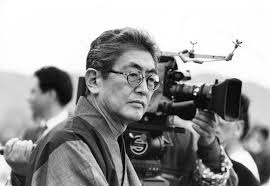 |
| Nagisa Oshima |
Nagisa OshimaAi no Corrida/ In the Realm of the Senses/ Empire of the Senses (1976) Oshima's erotic masterpiece which attracted attention for its hardcore elements, should be seen in the context of his other films. The central couple are archetypal Oshima outsiders turning their backs on the militaristic realities of 1935 and plunging into an erotic world of their own created and sustained by their own fantasies of hyper-virility and hyper-arousal. “The film celebrates their passion, confronting even its most alarming implications […] As ever, Oshima broaches taboos not in the spirit of adolescent daring, but in the knowledge that the most deep-rooted taboos are personal not social” (Tony Rayns ‘Time Out’ 2009)
 |
| Empire of Passion |
Empire of Passion (1978) while indebted thematically to Ai no Corrida, is given an unexpectedly studied, almost academic treatment as if Oshima is (arguably) uncharacteristically backing off rather than riding on the wake of scandal generated by his full-on return in Ai no Corrida to his recurring theme of the challenge to society embodied “not only in the “sexual crime” but the ability of human beings to expend their energy in the most complete and positive way” (Tessier 83). More conventionally dominant in Empire of Passion are guilt, repression and censorship set in rural Japan around the turn of the nineteenth century centred on the murder of an elderly rickshaw man by his wife and her lover, a soldier recently discharged from the army. The couple, literally haunted by the old man's ghost, cannot separate themselves from their society and finally pay for their crime at the hands of “a grotesquely cruel policeman.” While he made it, Oshima was undergoing a prosecution for publishing the script of his previous film. “His hatred of the authority figure here reaches heights not seen since Death by Hanging” ( Rayns).Although continuing his outspoken focus on Japan's cultural history, these last two films were co-productions marking a shift to wider aspiration as an international filmmaker. The subsequent films were Merry Christmas Mr Lawrence (1982) and Max Mon Amour (1986).
 |
| Taboo |
Oshima's final film, a return to Japan, Taboo/Gohatto (1999), set in the 1860s Tokugawa shogunate militia, “to produce one of his most bitter accounts of passion and individuality snuffed out” (Grossman).Oshima's independence seemed to produce paradoxical positions in relation to form and content. This may be most apparent in Taboo which has been criticised for its “mellowed old age acceptance of the romanticised Mizoguchi aesthetic” (ibid). Oshima's compulsion not to repeat took on a new complexion with In the Realm of the Senses. How much this shift to international co-productions reflected his disillusionment with the culture of Japanese society and politics and how much to the increasing difficulty in financing independent productions in Japan, Grossman finds difficult to conclude. Oshima went out of his way to claim that Max Mon Amour, the penultimate film of his five co-productions “was not a Japanese film at all.”
In his contribution to the BFI's Centenary of Cinema series in 1994, One Hundred Years of Japanese Cinema, Oshima speculated that during its second century Japanese cinema will cease to be Japanese, “blossoming as pure cinema.” These internationalist aspirations were not inconsistent with a surrealism most overt in Diary of a Shinjuku Thief, Death by Hanging, Empire of the Senses (his preferred title for In the Realm of the Senses) and Max Mon Amour.An affinity with surrealism marks all his work.
In 1979 Noël Burch saw Oshima as “functioning within several separate ideological frameworks: that of traditional Japan, which obviously both fascinates and repels him; that of a Western (cosmopolitan) bourgeoisie, still problematic for the Japanese Left, and which is complicated by the libertarianism so virulent and ambivalent in Japan. And somewhere in all that is Marxism. This is an extremely complicated task for one man” (344).
More than a decade later Max Tessier summed him up as “ an open, eclectic film-maker, never imprisoned by one ideology or one party, relentlessly questioning his country and the power which rules over it, Oshima remains a unique figure in the history of Japanese cinema, even in its contemporary phase” (84).
*******************************************
This bibliography provides references for all three parts of the entries on Japanese cinema in this series.
Hiroshi Komatsu “The Modernization of Japanese Film” essay World Cinema, ed. Nowell-Smith 714-21
Audie Bock Japanese Film Directors 1978
David Desser Eros plus Massacre An Introduction to the Japanese New Wave Cinema 1988
Geoffrey Nowell-Smith, Nagisa Oshima (1932-2013), a Tribute
Film Studies for Free 22/1/13 https://filmstudiesforfree.blogspot.com/2013/01/nagisa-oshima-1932-2013-tribute-by.html
Arthur Nolletti & David Desser eds. Reframing Japanese Cinema 1992
Max Tessier, “Oshima, Nagisa, or The Battered Energy of Desire” essay in N&D eds, (Ibid).
Tony Rayns, review of The Ballad of Narayama, Monthly Film Bulletin May 1984
Andrew Grossman, “Gohatto or, the End of Oshima, Nagisa, Bright Lights, July 2001
Phillip Strick, “Love, honour and obey” review of “Gohatto”, Sight and Sound, August 2001
Noël Burch To the Distant Observer: Form and Meaning in the Japanese Cinema 1979
Tadao Sato Currents in Japanese Cinema 1982
Joan Mellon Voices from the Japanese Cinema 1975; The Waves at Genji’s Door 1976
Simon Field, Tony Rayns eds. Branded to Thrill The Delirious Cinema of Suzuki Seijun 1994
Freda Freiberg “Japanese Cinema” Oxford Guide to Film Studies Eds. John Hill & Paula C Gibson 1998
Nelson Kim, Great Directors: Nagisa Oshima Senses of Cinema April 2004
Nelson Kim, Great Directors: Shoei Imamura Senses of Cinema July 2003
Dan Harper, Great Directors: Hiroshi Teshigahara Senses of Cinema May 2003
Dan Harper, Great Directors: Akira Kurosawa Senses of Cinema July 2002
Andrea Grunet, Great Directors: Masaki Kobayashi Senses of Cinema July 2016
Alexander Jacoby, Great Directors: Kon Ichikawa Senses of Cinema April 2004
Nick Wrigley, Great Directors: Yasijiro Ozu Senses of Cinema May 2003
**********************


