Friday, 25 March 2022

Streaming on SBS On Demand and on Foxtel - Janice Tong 🎥 - examines STAY STILL (Elisa Mishto, Germany, 2019) and THE ART DEALER (François Margolin, France, 2015)

Natalia Belitski as the yellow rubber glove donning Julie,
Stay Still

(Editor’s Note: Somehow this contribution from Janice Tong didn’t emerge from the inbox in its proper time. I’m publishing it as submitted. Some of Janice’s thoughts on the French Film Festival are already published here and here)
 

A little late in starting this year’s film selection, though that’s not from a lack of good films to write about. In fact, I’ve had the pleasure to see 37 films thus far and am very much looking forward to the French Film Festival, which started this week. But more on that once I get a few of the festival’s films under my belt. 


To kick off this ‘season’, here’s an introduction to two small but exquisite films for you to look up and savour.


To enter Elisa Mishto’s debut feature, Stay Still (Stillsehen), is to enter into a world where the measure between action and inaction, right or wrong, sanity or insanity needs to be discarded. These boundaries drawn by invisible guiding rules, invented over the centuries are at best permeable. It just takes us a little while to remember this: think of the white lines painted on the road, it ispossible to drive over them, you simply don’t.


Natalia Belitski (above) is wonderfully quirky as Julie, a woman who claims to ‘stay still’ but who does anything but. We first meet her when she’s lying on her bed, she had donned on her trademark yellow rubber gloves, the kind you wear when you’re doing housework, like when you’re washing the dishes or cleaning the bathroom; for her, she wears them as though they define her, as though they exemplify her identity. Next, we see her shopping for said gloves, by the dozens, and after a pick-me-up-session of quick hot car sex with a guy who crashed his shopping trolley into hers, and then promptly set fire to his car; we enter into her world. Stay still, my friend, stay still.


How do we appropriate a phrase that describes a feeling to which we are all bound – we stay still whilst the world is in motion and chaos, we stay still to observe and think, to take in and to resist – into a film? 


Stillstehen  is a word that conjures up motionlessness and at the same time, its opposite. The metaphor of stillness depends on the energy we put into being inert. Think about it. When whispered, the words ‘stay still’ can serve as a warning: to abandon action, to cease movement, to still advancement; to remain, as you are, fixed in spot, rooted to the ground (in case you are caught out). In doing so, you are forgoing a future to which you’re destined. To resist movement is harder than one realises.


After setting fire to the car, and fire is the running metaphor here, of transfiguration, and the gift to rise from the ashes like a phoenix – in order to be reborn, Julie volunteers to be incarcerated in an institution – this is an old shoe she keeps slipping back into for comfort; it is also something she needs to resist. For her, the institution is like a spa retreat, think of the one that Valeria Bruni Tedeschi checked into in the film Like Crazy (2016). Being in the Villa Biondi psychiatric hospital in Tuscany is like establishing your life in a room at a historic villa; or think David Duchovny, as Carrie Bradshaw’s high school crush, Jeremy, in an episode of Sex and the City where it was described (by Samantha) that: getting a spot at Juno Spears in Connecticut (he had voluntarily checked himself into) was harder than being a card-carrying member of the Soho House (the downtown ‘it’ place to be).


Having written the above, perhaps it'd be good to note that this film does not mock mental disorders, in fact, it's a film that enables us to examine life and its complexities philosophically and sometimes, if we’re lucky, we even get to laugh at its absurdities. 


Attraction and the dreamic, Luisa-Celine Gaffron Stay Still

There are many beautiful moments in Stillstehen, in particular, two poignant scenes between its two main characters, Julie and the nurse Agnes, who is played by the wonderful Luisa-CĂ©line Gaffron last reviewed in And Tomorrow the Entire World (2020). My favourite is towards the beginning of the film, where we see an out-of-focus Julie who then walks towards camera. She looks mesmerised; we hear an equally mesmerising song. We then get to see her POV – a hypnotic slo-mo performance on stage by Agnes, the garish tinselled curtains a perfect backdrop for her spotlit dance. The lyricism of Wong Kar-wai is present here, creating a mood that makes the film intimate to the viewer, half-saturnine, ruminative and drugged – it leaves you desiring more, despite the song telling us (and the character, Julie) that this is ‘not what you wanted, not what you had in mind’.


More of the wonderful Luisa-Celine Gaffron as Agnes in a
hypnotic sequence, Stay Still

What makes us gravitate towards another? And why to a specific person and not to another? How am I to write about the mysteries of attraction, or to claim an understanding and hone my articulation of it? Doing it well would mean to unveil its secret and by this, break the spell it casts over us, over lovers, over the enigmatic. And who would want that?


Whilst the denouement is inevitable, (both times or perhaps even three times) films are not about predictability – just as when you’re listening to a piece of music, your anticipation of what comes next is not the same as when it actually arrives, or the way the sound is navigated to get there. And the wait for this arrival is as sweet as when we hear those notes that satisfy or surprise us.


Belitski’s performance as Julie is finely modulated – this film was shot a year after the TV series Perfume (2018), where she was one of the main characters – her persona from Perfume extends its ghostly presence here. Julie is ridiculously elliptical, sometimes to an annoying degree, in fact, she is highly flawed in judgement and attitude, but is not without heart or conscience. And Agnes, her carer, needs care. There are no chance encounters – and the two make a great pair – thrown into a situation where humanity, friendship and perhaps even desire ride pillion to freedom, and that, sits at the cusp of what society deems as madness. 


 Katrin (Katharina Schuttler) and the rest of the gang, Stay Still


The second scene that I love, I will not spoil by describing it – where Italy-born director, Elisa Mishto’s clever sleight of hand at Julie’s mother’s house tugs at our hearts and our imaginations. Mishto’s eye and the Francesco Di Giacomocinematography charm us into a world where a detachment from reality only means to be lulled into living a more intimate and seductive reality – this other world is a means of erasing the burden of real life. Although, when the real erupts, through Katrin, (played by Katharina SchĂĽttler— you may have seen her in the TV series Beneath the Surface (2021) - if not, please do yourself a favour and watch it!), it delivers ruinous consequences. 


This atmospheric film comes with a killer soundtrack by Apparat, and an excellent collection of grungy music, though not sourced from the 90s but are just as good as The Jesus and Mary Chainor Cowboy Junkies; the names SwansGhostpoet,WU LYFLea Porcelain have now been noted, bought and included in my playlist. 


The second film proposes a somewhat different, and obliquely opposite perspective; in that once the real presents its truth to us, it is impossible to not be affected by it.  In fact, truth forces you to act, you are obliged to do so – even if you choose to remain passive, your act is inherent in your passivity, and this turning away, in some ways, is more violent then confronting the truth. François Margolin’s The Art Dealer is based on real-life events; but the way it is told, is like solving the cryptic puzzle it presents to us. Multilayered and rhizomatic, the story and the history of it bifurcates and fractures into fictional narratives and hidden truths.


Anna Sigalevitch as Esther, in search of the truth, The Art Dealer


Anna Sigalevitch is Esther, a mother, wife, journalist, but above all, the granddaughter of a renowned art collector and art dealer, Jean Stegman. One day, her father Simon, wonderfully acted by François BerlĂ©and– it’s so good to see François in fine form; I’ve missed his more active years in cinema, it’s been a while since Chabrol’s  A Girl Cut in Two (2007) – visits Esther and her auctioneer husband Melchior (played by Louis-Do de Lencquesaing– those who know me would know how much I adore Do-do). Simon disappears in her apartment for a long moment, too long, Esther goes in search of him and he is found in a darkened room, gazing, transfixed and highly affected, at a painting of two leopards, that Melchior had brought home from a deceased estate the day prior. And so, with this very poignant moment, our story begins. 


Louis-Do de Lencquesaing as Melchior, exploring the
provenance of all things, The Art Dealer


The past is an uninhabitable place; uninhabitable, because those who seek it out become relics of themselves, and those who delve inside its continent become lost within its labyrinthine corridors. The path forward is temporal rather than spatial, and whilst the advantage is that this ‘place’ can be visited at any time, but its visiting hours are perhaps not always of your own choosing. 


François Berléand and Anna Sigalevitch as father and
daughter, The Art Dealer


What Esther uncovers are secrets that have been passed down three generations, her grandfather’s and those who were present at the time of the Second World War; her father’s generation who have come out of the war and whose buried memories would rather be forgotten; and finally, her own generation who face anew what it means to have a family and a history; and with that, their rightful claim to memories, secrets and heritage.


There have been a few films in past 10 years or so, that dealt with stolen artwork by the Nazis: Woman in Gold (2015) and The Monuments Men (2014). Margolin’sThe Art Dealer comes from a similar ilk: to bring into the open the troubling lack of decisive action in returning stolen art to their rightful families. France’s own ambiguous stance is being critiqued here. But Magolin’s film is also unlike the others in its sensitive weaving of the very personal quest that so compels its seeker, and in this case, Esther, to uncover the truth. Even if it means that along the way, she forgets her family, abandons her job, is cut off by her elders and winds up nearly losing herself in its mystery. Her search is a profound mix of collective and fictitious memories, forgotten and forged identities and the question of one’s moral code.


Niels Schneider as Klaus Vogel... real or imagined?, The Art Dealer


In The Art Dealer, the truth peels back in a dance between the imaginary (the mind is the master to unlocking memories, even those that do not belong to you), found footages, and others’ recollections. The historic and imagined role of Klaus Vogel played by Niels Schneider is the heady mix born of this union. Esther’s drive in unlocking the intrigue, of why the painting delivered such an emotional response for her father, must start from understanding her own history, and the search for the provenance of the painting is actually a search for her own provenance – to untangle the truth from the dead ends, to read into the fiction the characters of her own family members, to search for her own future through the uninhabitable, and the ineffable.


Stay Still  is currently showing on SBS on Demand and The Art Dealer  is available on Binge or Foxtel.

Thursday, 24 March 2022

Streaming on Foxtel Binge - Rod Bishop recommends the 'fast-moving, quite bonkers' RAISED BY WOLVES, Season 2 (Aaron Guzikowski, USA, 2022)


“Bonkers” is the most apt description for this Ridley Scott led TV series, now back for a second season. Like the first, his production company Scott Free has ensured everyone has plenty to spend on creating this sci-fi world.
 

Season One  (click here for earlier thoughts) listed close to 400 eager beavers working on special effects and we were introduced to the mysterious Mithraic religion and its battle against The Atheists for control of the Earth during the 22ndCentury.

 Actually, this bit isn’t as bonkers as it sounds. Mithraism was a real religion, popular among Roman centurions and slaves between the 1stand 4thCenturies CE. 

Known as Mithraeum, remains of their temples have been found across the Roman Empire in Italy (9), Germany (17), France (6), the UK (4), Israel (2), Spain (3), Syria (2), Hungary (3), Romania (2), Bosnia (2), Belgium (1) and Switzerland (1).

An offshoot of the ancient Persian religion of Zoroastrianism, Mithraism lost popularity to the rise of Christianity. 

Martin Luther King Jr in his “A Study of Mithraism” (1949) points out the similarities between the two religions at the time of the Roman Empire – rebirth, sacramental rites, ethical behaviour, immortality and mediators between God and man.

Some believe had Christianity not risen in the Western world when it did, the popularity of Mithraism might well have made it the dominant religion of the Western world. 


In Raised by Wolves, there’s no suggestion Christianity ever existed. Rather Mithraism survived, thrived and dominated world religion into the 22ndCentury.

The Atheists have been at war with the Mithraics for god knows how long and the Earth is ravaged. The Atheists send a couple of robot parents and some human children to the Keplar 22b planet to start a new world free of religion. Not to be outdone, the Mithraics send their own space craft to 22b, packed with believer settlers and unsurprisingly, the war between the two continues.

By the time Season Two starts, the robot parent known as “Mother” has mated with a computer simulation and given birth - not to a human child as planned - but to a gigantic serpent the size of a Western Australian iron ore train. As the plot beds down, it concentrates on what it’s like to be robot parents to a brood of unruly children in an extraterrestrial landscape populated by boab trees (that seem to have mated with the Michelin Man); oceans so acidic you die and melt in minutes; and a rampaging Mithraic terrorist trying to assemble a congregation of believers.

Mother sets out to destroy the serpent, but having given birth to it, she can’t overcome her ‘care-giving’ programming and her emotions. Father, meanwhile has assembled some old relics and brought an ancient robot back to life. She too, quickly becomes all broody over the kids, exhibiting more artificial intelligence emotions.

So, despite his sole credit as an executive producer on Season Two - Ridley Scott has, after all, been off making The Last Duel and The House of Gucci – his decades long fascination with artificial intelligence and its intersection with homo sapiens is all over Raised by Wolves.

If a fast-moving, quite bonkers sci-fi series made on a decent budget is your thing, then give it a go. But remember, despite the new family emotions Mother robot is feeling, when she pops her eyes out, she transforms into a necromancer. And like Series One, she becomes terrifying and vengeful and still a whole lot of trouble.  


Saturday, 19 March 2022

33rd Alliance Française French Film Festival 2022 - Janice Tong's second Filmic Postcard - PARIS 13TH DISTRICT (Jacques Audiard) and LOST ILLUSIONS (Xavier Giannoli)

Lucie Zhang, Makia Samba - no ordinary lovers in
Jacques Audiard’s Les Olympiades

The complexities of the now – where cultural and sexual fluidity creates a hyper-real feast that promises the world, but in this attempt, delivers only a dull ache in the final show down – and this dull ache, if any sensation at all, is the way we chart our lives these days. Jacques Audiard’s Les Olympiades, Paris 13e Paris, 13th District (2021) opens with a searching shot across a night-time skyline: factories with smoke pouring out, large expanses of sprawling inhabited land on which featureless massive apartment blocks present themselves. This eye is not the god-eye view of Wings of Desire (1987), nor the eye of the vitriolic, Enter the Void (Gaspar NoĂ©, 2009). No, it is the eye of a lesser being, the mechanical ‘us’. Just like a drone in search of a story; this eye finally settles on scanning the windows of one such lifeless apartment block to reveal a few illuminated inhabitants, those of switched-on machines and TV watchers. 

We live in a world of disillusionment. 


Enter into the life-erotic, that of Émilie Wong’s (Lucie Zhang); we first see her lazing on a couch, naked, her breasts framing her more than the camera frames the shot, as in, that is all we see – her breasts, her nakedness, her otherness. This striking opening sequence will remain the film’s highlight: Émilie is singing a song in Mandarin, the lyrics of which have not been translated…her voice is lilting and haunting, an effect from one of those kitschy Karaoke microphones – the kind with built-in speakers that reverberate and echo when you sing into it. She is then joined by a guy, black, handsome, amazing head of hair (short Afro), also naked; we’d heard his voice first, off-screen, asking whether she wanted some yoghurt. We’re unsure of the relationship between these two…are they lovers? The kind that share their bodies as well as a dwelling and food? Or, is she a whore, and he, her pimp? Or, her customer?


Who is whose doppelganger? Noémie Merlant
as Amber Sweet 


This scene, in fact, is a flash forward, and as an audience, we get to begin again, and enter into a series of episodic and overlapping stories ‘from the beginning’ – loosely following Émilie’s life in Paris, her exchange with Camille (Makia Samba), the guy from the opening sequence, before handing the baton, so to speak, over to Nora (NoĂ©mie Merlant, you would know her from Portrait of a Lady on Fire (2019)). Her story is one of mistaken identity, having been taken for an online porn-star Amber Sweet. 


All through the film, there is a strong sense of the frantic and the mundane in all of their stories. We are continuously reminded that we live in a world of disillusionment; and although this film can be seen as a fresh new kind of love story; dripping in ennui, it isn’t really that at all. Émilie’s dance of joy perhaps can be understood as a flight into freedom or exhilaration, I’m thinking specifically of Les Amants du Pont-Neuf (1991), although you see it and understand its intended meaning, but unlikeLes Amants, I couldn’t feel it. 


The dance euphoric


Audiard’s exploration into the flaws of human connection hasn’t moved far from his most well-received film to date, A Prophet (2009) which launched the career of the talented Tahar Rahim. This latest film doesn’t deliver the kind of fatalist but euphoric quality of The Beat That My Heart Skipped (2005) or the deterministic thrust of Read My Lips (2001). The fresh and naturalistic performance from relative newcomer Lucie Zhang, however, is captivating; and there are some moments of this film that is beautifully shot too. The story is in part based on the graphic novels by American cartoonist, Adrian Tomine


In the literary world, everyone is someone, until you are not. And please, don’t even try to be that someone, for this is a gated guild that an invitation to join is not always what it seems. With a little first-hand experience of such a world, I found it is even more important in this universe than in the business world, of who you know and who your influencers are, rather than necessarily what you write, and even less so, the quality of your writing. 


Cécile de France, Benjamin Voisin,Lost Illusions
 

Illusions perduesLost Illusions (2021) directed by Xavier Giannoli is a luminous affair, coloured by a kind of self-illumination of the chosen and the elite; and with this fantastical circus, the self-proclaimed patrons of the arts dance in their finest trickery to push through the receding darkness of what graces they have bought. Cretinous journalism indeed; we are in the land of the jackals and the wolves; with a paddling of ducks to sing or sink. 


I have not read Balzac’s book, Illusions perdues, which was written in three parts between 1837 and 1843, but I can immediately galvanise its context into our current times. The film tracked two of the three volumes, and to do this justice, has a running time of 2 hours and 48 mins (actually, the running time differs when you seek out different websites, but I am pretty sure that the one shown at the AFFF is the longer cut), but the tempo in which the story builds, buoyed by meticulous art direction, fine acting and a pacey script; paints the screen with resplendent costumes haloed in a kind of golden hue. It forms a raft on which the viewer can only breathe the whole thing in, in one single glorious take. There isn’t much room for contemplation; which perhaps was how it must have felt for the doe-eyed innocent Lucien, the hero cum anti-hero of the story. Beautifully played by Benjamin Voisin, (last seen as the young lover in Ozon’s Summer of ‘85 (2020)), a young love-lorn self-published poet from AngoulĂŞme who followed his love interest, a lonely but wealthy patron of his “Marguerite” poems, Louise de Bargeton (CĂ©cile de France), to seek out a writerly life in Paris. Heartbreak and destitution, fame and fortune, and finally the fall of the unguarded all came in a blink of an eye. 


SalomĂ© Dewaels as Coralie - lovely, but doomed, Lost Illusions

There is little else to do but for us to continue to dream of Lucien, from far away. We still wish for his innocence and success; we still pray for his dreams and talent to be taken for what they are. But, this is not the life illuminated, it is a life of lost illusions; where the dreamic persists only within the dunk of a madeleine.


There were many fine support cast in this film, my favourite once-upon-a-time enfant terribleXavier Dolan, was a joy to watch; perhaps his best since Tom at the Farm (2013) and that’s saying something; my other two all-time favourite actors, Jeanne Balibar and Louis-Do de Lencquesaing were very fine in their roles. Relative newcomer SalomĂ© Dewaels was perfect as the good-hearted but ultimately doomed Coralie and even Vincent Lacoste as the conniving editor of the paper that Lucien penned for was convincingly duplicitous.


The 'crowning' of Lucien, Louis-Do de Lencquesaing  (left, front)00) 
Lost Illusions  


The Alliance Française French Film Festival is currently showing in SydneyMelbourneCanberra and Perth from now to the 6th April across a number of theatres. Hobart from 9th to 20th March, Brisbane from 16th March to 13th April, and a little later in Byron Bay, 30th March to 13th April, Victor Harbour 4th to 11th April and Adelaide from 24th March to 26th April.

Friday, 18 March 2022

CINEMA REBORN 2022 - First Titles Announced - BEAU TRAVAIL (Claire Denis, France, 1999), ONCE UPON A TIME IN THE WEST (Sergio Leone, Italy, 1968), NIGHTMARE ALLEY (Edmund Goulding, USA, 1947)


It’s a big moment for a whole host of people who have been working to get the 2022 edition of Cinema Reborn up and running.

Cinema Reborn is devoted to carefully selected restorations of great films from cinema history. This year’s program comes from 10 countries - Italy, Iran, Japan, China, France, Australia, Angola, the Philippines, USSR and USA.

At the main evening and weekend sessions there will be a 10-minute introduction from an expert in the field and the new, pristine restorations - either 2K or 4K - will be presented in the Randwick  Ritz’s newly renovated and re-seated state-of-the-art cinemas. But this year there will be repeat weekday morning and afternoon screenings including on Monday 2 May and Tuesday 3 May to maximise your chances of seeing some very special moments in cinema history.

 Join us for one of the most unique events on the film calendar. 

 Join us for Cinema Reborn 2022.

 ******************************

Cinema Reborn will  start with an Opening Screening on Wednesday 27 April and close on Sunday 1 May…. 

BOOKINGS CAN NOW BE MADE FOR THE THREE FILMS ANNOUNCED BELOW VIA  LINKS THROUGH TO THE RITZ WEBSITE.  

Beau Travail (Claire Denis, France, 1999)

Our Opener 

BEAU TRAVAIL (1999)

“ALLEGORICAL TALE OF REVENGE AND JEALOUSY SET WITHIN A FRENCH FOREIGN LEGION OUTPOST IN AFRICA” – SLANT MAGAZINE

Veteran French director Claire Denis riffs off Herman Melville’s Billy Budd in this enthralling, lyrical drama about an officer, Galoup, recalling how his idyllic army days in Djibouti were destabilized by the arrival of a handsome young recruit who attracts the attention of Galoup’s commandant.

Claire Denis brings a female director’s eye to toxic male ego and unrequited homoeroticism. 

An unforgettable film with an even more unforgettable end-titles sequence. Luminously photographed by Agnès Godard.

Subtle brilliance that’s still relevant over twenty years later

-      Fresh Fiction

Introduced by Angelica Waite, Film Programmer and Member of the Cinema Reborn Organising Committee 

 WATCH THE TRAILER CLICK HERE

 RATING MA15+, 92 MINS, France, 1999, French, English subtitles WITH: Denis Lavant, Michel Subor, GrĂ©goire Colin

 Screens on Thursday 27 April at 7.00 pm (with introduction)  and Thursday 28 April at 2.00pm TO MAKE A BOOKING

To read internationally renowned critic and scholar Adrian Martin’s superb Program Notes on Claire Denis and what is regarded as her finest film click through to the Cinema Reborn website HERE


Our Saturday Night Special 

ONCE UPON A TIME IN THE WEST (1968)

“QUITE SIMPLY A MASTERPIECE, LEONE’S REVISIONIST WESTERN IS A MYTHIC SPECTACLE OF A FILM AND A LANDMARK IN CINEMA HISTORY” – FILM4 STAFF

In hindsight, Sergio Leone’s earlier Westerns were mere warm-ups for this sprawling, operatic, epic about a mysterious stranger (Charles Bronson) and an ageing gunfighter (Jason Robards) joining forces to protect a widow (Claudia Cardinale) and her land from a gun-for-hire (Henry Fonda) and his gang of assassins who work for the railroad as it expands across the West.

It’s got everything – achingly beautiful music from the maestro Ennio Morricone; widescreen cinematography from Tonino Delli Colli; scriptwriters Bernardo Bertolucci, Dario Argento and Leone; perhaps the best pre-titles sequence ever made; Henry Fonda playing against type as a ruthless, vicious killer; and a story with all the frontier justice, frontier love, simmering revenge and lawless power you could wish for. A sumptuous, elegiac closing of an era.

The new 4K restoration includes scenes that were deleted for its first release.

Long live Leone’s timeless monument to the death of the West itself…Critical tools needed are eyes and ears. This is Cinema.”

-      Paul Taylor, Time Out Film Guide

Introduced by Jane Mills, Film-maker, critic, Hon. Associate Professor, School of the Arts and Media, University of New South Wales

WATCH A TRAILER CLICK HERE

RATING M, 166 MINS, Italy, English, CAST: Henry Fonda, Claudia Cardinale, Charles Bronson, Jason Robards

PRESENTED WITH THE SUPPORT OF THE ITALIAN INSTITUTE OF CULTURE, SYDNEY 

Screens on the big screen in the Ritz Cinema One on Saturday 30 April at 7.45 pm (with introduction)  and Tuesday 3 May at 1.00pm 

TO MAKE A BOOKING CLICK HERE

To read  the fine program notes on Sergio Leone, Italian Westerns and this great epic movie written by RMIT University scholar and Co-curator of the Melbourne Cinematheque Adrian Danks CLICK HERE


Our Closer

 NIGHTMARE ALLEY (1947)

“THIS RAW, BITTER DRAMA OF THE TOUGHER SIDE OF TRAVELLING CARNIVAL LIFE MAKES FEW CONCESSIONS” – DAILY TELEGRAPH 

Usually cast as a romantic lead, Tyrone Power goes well against type as a carnival worker who uses the codes of a fake mind reader to become a dinner-suited, blindfolded ‘mentalist’ in a reputable Chicago night club.

 Carny life at its most realistic, this film noir exposes the ‘lower depths’ of the entertainment world and has grown in reputation, now aided by this superb 4K restoration which premiered at Bologna's Il Cinema Ritrovato in 2021. 

Recently remade with a cast including Bradley Cooper, Cate Blanchett and Rooney Mara. Here’s a chance to see the original on the big screen.

The characterizations in Nightmare Alley are studies in film noir. People are shown as venal, gullible, and obsessed with success at any price.” 

-      Joan Cohen

“One of those films mentioned in lowered voices, a guilty secret, to be screened at midnight behind closed doors…”

-      John Baxter

Introduced by James Vaughan, film-maker, director of FRIENDS AND STRANGERS, Member of the Cinema Reborn Organising Committee

WATCH A TRAILER CLICK HERE

RATING M, 110 mins, USA, English, CAST: Tyrone Power, Joan Blondell, Coleen Grey, Helen Walker, DIRECTOR Edmund Goulding

Screens on Sunday 1 May at 7.45 pm (with introduction)  and Tuesday 3 May at 10.45 am 

TO MAKE A BOOKING CLICK HERE

To read author, critic and film-maker John Baxter’s insightful Program Notes on Edmund Goulding and the film's place in the film noir canon click through to the Cinema Reborn website CLICK HERE

*********************************************

Meanwhile dont forget to check out THE CINEMA REBORN FACEBOOK PAGE for news and if you are minded to make a tax deductible donation, large or small, to support the work of our all-volunteer group and bring more film classics back to the screen in Sydney click here for  THE AUSTRALIAN CULTURAL FUND

 ....and if you want to maximise your attendance think about joining THE RITZ ROYALTY CLUB and save on all admissions. Seniors get additional savings.

More news in a few days.


Thursday, 17 March 2022

On 4K Ultra HD and Blu-ray - David Hare welcomes "a killer" disc of Spielberg's remake of WEST SIDE STORY (USA, 2021)


Inexplicably this UHD disc went on sale in Oz a week earlier than other territories.

I’m going to say something I’ve been feeling about what I guess is my favorite musical score.
With Spielberg’s movie I think I’ve watched the perfect production. His new picture simply blows Robert Wise’s 1961 movie out of the water. Even Robbins’ choreography here is given literally rhapsodic open air mise-en-scène that takes the breath away. Casting, actors even Kushner’s tweaks to the dialogue breathe fresh air into the screenplay. This is my best movie of 2021.
There, I’ve said it. This should haven been up for every major Oscar nomination, and it should have really blown the box office. But Spielberg and Kushner and the team have created timeless magic and a flawless tribute to the late Sondheim.
The disc itself is a killer.

Wednesday, 16 March 2022

Streaming - John Baxter recovers ROLLOVER (Alan J Pakula, USA, 1981)


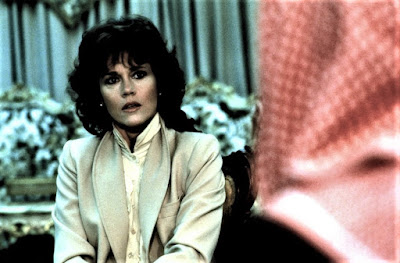
Jane Fonda seeks Arab money, Rollover

        When it comes to depictions of political paranoia, it’s hard to see past Alan J. Pakula’s The Parallax View. As the investigative journalist sucked into a whirlpool of suspicion and delusion when he uncovers a system for recruiting assassins, Warren Beatty gives one of his better performances. Add All the President’s Men and Klute to the Pakula balance sheet and the 1981 Rollover scarcely tips the scales. In lesser company its reputation would be higher but the panicky parable of The Parallax View is a hard act to follow.

         What’s worse, this is a thriller about high finance, a traditionally unhappy form that has only recently been redeemed by Margin Call and the series Billions. (“Rollover” doesn’t refer to the bedroom activities of its leads, incidentally, but to the process of renewing expired investments.)  All films about money field a strong team of unreliables and this is no exception.  The well-cut suits of Hume Cronyn, playing the Grand Old Man of Wall Street, belie his duplicity, while Josef Sommer is customarily shifty as a genially incompetent bank president.

         Bob Gunton’s middle man gives new meaning to the label “oily Levantine”. The slur has added force on this occasion, since the oil is real, the menace provided by those popular villains of the ‘eighties, the Arabs. Their presenceplacesRollover in the same ghetto of bad guesses as those celebrations of Japanese corporate supremacy such as Gung Ho!  and Other People’s Money.  Spare a thought for all those executives who studied the language, now useful only for ordering sushi. 

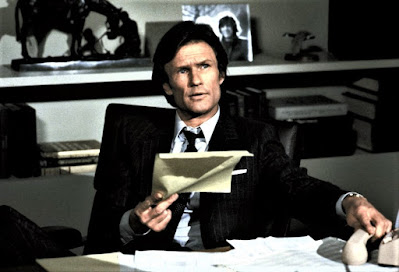
Kris Kristofferson as baby-faced financier

         Fonda, whose company made Rollover, plays, with scant originality, a film star who marries an industrialist. When he’s murdered, she takes over his empire, helped by Kris Kristofferson, a hired financial gun. He lures her into bed but also into the less welcoming arms of the Saudis as a source of new money.

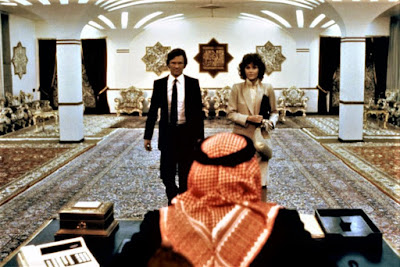
         To this end, they must go hat in hand to the Gulf, crossing the desert by limo to convene with some falcon-loving sheiks before repairing to a large black tent where, as Fonda sits meekly behind the men, they demolish most of a roasted sheep. It’s not clear who gets the eyeballs but after this episode there can be no doubt that Fonda has cojones  to spare

Kristofferson, Fonda go begging`

         Although the Arabs fund her expansion plans, their price proves catastrophic, igniting a world-wide slump. The film’s final image shows the couple huddled over a bottle amid the shrouded desks of a darkened bank, metaphor for an economy in ruins.  

         Paul Newman and Jeff Bridges were both approached for Rollover but  Kristofferson took the job, subject to retaining his Heaven’s Gate  beard. Pakula acquiesced – if he could produce even one real-life banker with comparable facial foliage. A somewhat baby-faced clean shaven appearance attests to his failure. 

         Fonda models a succession of gowns and furs that help soften a body grown muscular and bony in the maintenance of her exercise franchise. As Kristofferson lounges around her Architectural Digest  mansion, one expects Jane to pop out at any moment in a leotard and lead a session of jumping jacks and knee bends.

         Pakula’s regular production designer George Jenkins and cinematographer Giuseppe Rotunno dominate a film that is mainly about the high life and the price one pays for living it. Anyone looking for evidence of Scott Fitzgerald’s suggestion that the rich are very different will find it here in abundance. Even the assassins wear Armani.

         A dark palette of murky blues and greens, typical of Pakula, imbues the film with a painterly quality redolent of opera decor. Love scenes take place against a background of vast canvases by Rothko and Diebenkorn, and financial chicanery is debated during black-tie receptions in Lincoln Centre and the Museum of Natural History, the latter the setting for Fonda hearing of her husband’s demise. As Kristofferson reflects on “the illusion of safety,”  the camera, in a characteristic Pakula flourish, leaves the glitterati to crane up to a life-sized model of a whale suspended above their heads,  and a sad liquid eye that has seen mankind at its worst. 

         A superior copy of Rollover is streaming if you click here.


Monday, 14 March 2022

Streaming on SBS On Demand - Rod Bishop ponders the fate of THE SONG OF NAMES (François Girard, Canada/Hungary, 2020)


When films bomb at the box office and with the critics, the reasons are usually fairly obvious. The likely culprits are scripts that fail to convince; unfocused and poor direction; actors struggling with characters the audience can’t identify with; subject matter that isn’t interesting enough for a couple of hours of your time; and failed exhibition and distribution strategies.

Then there are films like Billy Wilder’s The Private Life of Sherlock Holmes    (1971), or more recently Xavier Dolan’s The Death and Life of John F. Donovan (2018) and now, The Song of Names (2019), films that appear to have none of these faults but still become catastrophic box office failures.

The script for The Song of Names is solid enough and based on the well-regarded novel by Norman Lebrecht from 2003. It opens prior to the outbreak of WW2 as a British family hosts a young Jewish-Polish violin virtuoso (Dovidl) who shares a room with their son (Martin). Over the years, the boys become firm friends and, at the time Dovidl agrees to his debut concert in London with an orchestra in 1952, he has heard nothing, either during or after the war, about the fate of his Warsaw family. But on the night of the concert, Dovidl fails to turn up, (disappointing his packed, black-tie audience) and then promptly disappears for the next 35 years. Martin searches for Dovidl for over three decades and when he finally tracks him down, we learn the devastating truth behind the title The Song of Names.

Tim Roth and Clive Owen play the boys as adults; François Girard (The Red Violin) directs; there was more than $AU30 million to bring the story to the screen and Howard Shore contributes an exquisite musical score with the Australian-South Korean Ray Chen playing the violin solos. The first screenings were well received, some seeing the sumptuously mounted production as potential “Oscar bait” and the film sold to more than 30 territories.

Then everything went downhill. Fast. Total box office came in at an embarrassing $2 million and the 56 critics’ reviews aggregated on Rotten Tomatoes produced a poor 36% approval rating and it joined other films with the same modest score - Babes in ToylandBattle: Los AngelesErnest Saves Christmas and Fantastic Beasts 2.

A couple of issues emerge from the negative reviews. There is one undeniably brilliant and unforgettable sequence towards the end of the film. Some wonder why the rest of the film wasn’t as undeniably brilliant.

The second issue is linked with this. Whether as a precocious 10-year-old or a virtuoso teenager or an adult, Dovidl is by far the most interesting character. But he’s not the lead and Martin consumes far more screentime. I’m not sure whether this is a good enough reason to dislike a film. After all, I’ve never heard The Third Man dumped on because the most interesting character Harry Lime (Orson Welles) is barely on screen for 10 minutes.

So why do good films bomb? Jay Leno isn’t sure, but he has a humorous take: “Remember the good old days when the only bomb you had to worry about on the plane was the Rob Schneider movie”.