Showing posts with label Kris Kristofferson. Show all posts

Thursday, 18 July 2024

On Criterion Blu-ray - Rod Bishop comes down hard on on PAT GARRETT & BILLY THE KID (Sam Peckinpah, USA, 1973)

Kris Kristofferson, Bob Dylan
Pat Garrett & Billy the Kid


Back then - and 50 years later - it’s hard not wondering whether this Sam Peckinpah ‘revisionist’ western would been made if Two-Lane Blacktop hadn’t appeared two years earlier. 

Written by the same scriptwriter, Rudy Wurlitzer, it also boasts two famous musicians with little acting experience in the main cast, and it valiantly strives to recreate the languid ennui of Monty Hellman’s seminal road movie in similar wide-open landscapes.

In 1973, casting musicians in films was hardly a new idea. But after the counter-culture highs (ahem) – and lows - of Easy Rider (1969), a film that blew up the Hollywood business model; and after Beach Boy Dennis Wilson, and folk prince James Taylor - neither of whom had acted before - headed up Two-Lane Blacktop, why not give it a try?

Country singer Kris Kristofferson had acted before, in 1971’s Cisco Pike, but if he’d learnt anything from that outing, it certainly doesn’t show up here. His self-conscious performance as the notorious Billy The Kid is close to awful, and his technique with rifle and pistol so abysmal, it’s hard to believe he could hit anything, let alone all the cowboys hiding behind barns and rocky outcrops and riding their horses. 

Charismatic is a word often applied to Bob Dylan songs, but never to his screen performances. That’s because he simply can’t act. Even if he has been watching James Caan with his knife in El Dorado. Dylan’s role in Pat Garrett is so marginal and perfunctory, it’s clear he’s in the film because he is Bob Dylan - and you’re not.

Kristofferson's and Dylan’s lack of acting chops are compounded by the presence of seasoned professionals forced to work with them – James Coburn, Barry Sullivan, Jason Robards, Jack Elam, Harry Dean Stanton, Elisha Cook Jr and, best of all, Slim Pickens and Katy Jurado who use their limited screen time to give the film its only true moment of emotional clout.

Peckinpah’s last western was a dismal failure and it’s still hard to believe it came only four short years after his best, The Wild Bunch

Gene Siskel in The Chicago Tribune felt Pat Garrett “appears to have been made in emotional slow-motion, and the self-inflating lethargy and mugging of all concerned reduces the enterprise to an exercise in pretension.”

Criterion have now released a 4K Blu-ray package including no less than three versions of the film - The 50th Anniversary edition (1 hour 57 mins); the Theatrical Release (1 hour 46 minutes) and Peckinpah’s Final Preview Cut (2 hours 2 mins).

Pat Garrett and Billy The Kid was bad back then. It’s even worse now.


Wednesday, 16 March 2022

Streaming - John Baxter recovers ROLLOVER (Alan J Pakula, USA, 1981)


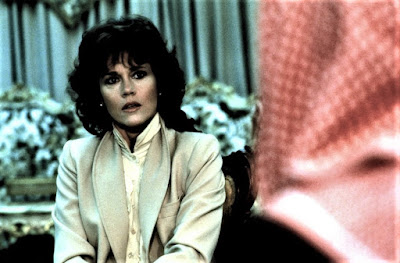
Jane Fonda seeks Arab money, Rollover

        When it comes to depictions of political paranoia, it’s hard to see past Alan J. Pakula’s The Parallax View. As the investigative journalist sucked into a whirlpool of suspicion and delusion when he uncovers a system for recruiting assassins, Warren Beatty gives one of his better performances. Add All the President’s Men and Klute to the Pakula balance sheet and the 1981 Rollover scarcely tips the scales. In lesser company its reputation would be higher but the panicky parable of The Parallax View is a hard act to follow.

         What’s worse, this is a thriller about high finance, a traditionally unhappy form that has only recently been redeemed by Margin Call and the series Billions. (“Rollover” doesn’t refer to the bedroom activities of its leads, incidentally, but to the process of renewing expired investments.)  All films about money field a strong team of unreliables and this is no exception.  The well-cut suits of Hume Cronyn, playing the Grand Old Man of Wall Street, belie his duplicity, while Josef Sommer is customarily shifty as a genially incompetent bank president.

         Bob Gunton’s middle man gives new meaning to the label “oily Levantine”. The slur has added force on this occasion, since the oil is real, the menace provided by those popular villains of the ‘eighties, the Arabs. Their presenceplacesRollover in the same ghetto of bad guesses as those celebrations of Japanese corporate supremacy such as Gung Ho!  and Other People’s Money.  Spare a thought for all those executives who studied the language, now useful only for ordering sushi. 

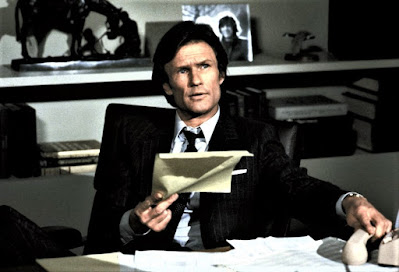
Kris Kristofferson as baby-faced financier

         Fonda, whose company made Rollover, plays, with scant originality, a film star who marries an industrialist. When he’s murdered, she takes over his empire, helped by Kris Kristofferson, a hired financial gun. He lures her into bed but also into the less welcoming arms of the Saudis as a source of new money.

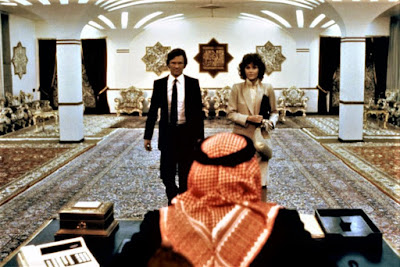
         To this end, they must go hat in hand to the Gulf, crossing the desert by limo to convene with some falcon-loving sheiks before repairing to a large black tent where, as Fonda sits meekly behind the men, they demolish most of a roasted sheep. It’s not clear who gets the eyeballs but after this episode there can be no doubt that Fonda has cojones  to spare

Kristofferson, Fonda go begging`

         Although the Arabs fund her expansion plans, their price proves catastrophic, igniting a world-wide slump. The film’s final image shows the couple huddled over a bottle amid the shrouded desks of a darkened bank, metaphor for an economy in ruins.  

         Paul Newman and Jeff Bridges were both approached for Rollover but  Kristofferson took the job, subject to retaining his Heaven’s Gate  beard. Pakula acquiesced – if he could produce even one real-life banker with comparable facial foliage. A somewhat baby-faced clean shaven appearance attests to his failure. 

         Fonda models a succession of gowns and furs that help soften a body grown muscular and bony in the maintenance of her exercise franchise. As Kristofferson lounges around her Architectural Digest  mansion, one expects Jane to pop out at any moment in a leotard and lead a session of jumping jacks and knee bends.

         Pakula’s regular production designer George Jenkins and cinematographer Giuseppe Rotunno dominate a film that is mainly about the high life and the price one pays for living it. Anyone looking for evidence of Scott Fitzgerald’s suggestion that the rich are very different will find it here in abundance. Even the assassins wear Armani.

         A dark palette of murky blues and greens, typical of Pakula, imbues the film with a painterly quality redolent of opera decor. Love scenes take place against a background of vast canvases by Rothko and Diebenkorn, and financial chicanery is debated during black-tie receptions in Lincoln Centre and the Museum of Natural History, the latter the setting for Fonda hearing of her husband’s demise. As Kristofferson reflects on “the illusion of safety,”  the camera, in a characteristic Pakula flourish, leaves the glitterati to crane up to a life-sized model of a whale suspended above their heads,  and a sad liquid eye that has seen mankind at its worst. 

         A superior copy of Rollover is streaming if you click here.