The first of the four phases of Rossellini’s evolving fusion of fiction and non-fiction,1941-75, was initially populist and nationalist in tone. His first features as director, La nave bianca/The White Ship (1941), then Un Pilota Ritorna/The Pilot Returns (1942) and L’uomo croce/ The Man with a Cross (1942) are now recognised as the first steps on Rossellini’s path to neorealism’s internationally acclaimed breakthroughs.
 |
| The Pilot Returns |
Rossellini denied he was part of any ‘movement’, finding it difficult to understand the claim since for him each film “possesses its own realism” which he saw as nothing more (or less) than a moral position. Asking the question ‘where is liberty? for Rossellini is “a central theme which lies in recognising the nature of one’s imprisonment. Each ideology has good and bad but limits your liberty… perfect in conformity there is no heroism.” (interview Cahiers du Cinema no. 183 October 1966).
Pierre Leprohon in summarising the postwar period suggests that neorealism was prefigured by Alessandro Blassetti in the mid thirties with his historical feature, 1860, and brought into existence by Visconti with Ossessione. “But it was Rossellini who thrust it into the limelight, thus giving it the magnificent impetus that was to carry it on for several years” (93).
Michelangelo Antonioni, writing in the leftist journal Cinema, noted a choral (coralità) quality/theme i.e. preference given to portraying the group collective over the individual, grounded in history. It is present in some films in the Fascist period, including Rossellini’s first features, lending a documentary quality that is also evident in Open City and Paisà. After disintegration of community in the aftermath of war shown in Germany Year Zero (1947), coralità is welcomed back by Rossellini in Francesco giullare di Dio (1950). In the first of the Bergman cycle, Stromboli (1949), it is necessarily rendered unavailable by the overriding commitment to melodrama after being brought briefly to the fore in the famous tuna fishing sequence in documentary mode, the abstract beauty of the rhythms in the fishing community’s earning of their livelihood. Any potential for coralità is negated by the shocked revulsion shown by Karen (Bergman), in cut-in close-ups, at the reality of the killing.
 |
| Anna Magnani, Aldo Fabrizi, Rome Open City |
The religiosity controversially apparent in Stromboli, The Miracle and Francesco giullare di Dio, is linked to Rossellini’s passionately humanistic concern with notions of liberty which escapes easy definition and has often placed him ahead of his critics. His commitment in his narratives, to observing (the urge to document) rather than telling (the urge to closure) was initially almost universally dismissed other than on the pages of ‘Cahiers du Cinema’.
Gilberto Perez in ‘Eloquent Screen’ identifies Rossellini’s film realism as “not a realism of meaning but of reticence, of deference to reality, of refusal to manipulate it into sense.” Perez continues, “meaning is an idea, a generality attached to things. If a novelist’s realism moves from the particular to the general in pursuit of meaning, Rossellini’s deference to things in their particularity is a photographer’s realism. It’s not that Rossellini lets things speak for themselves - things never do - but he lets them be silent.” (224).
 |
| Rome Open City |
The challenge of establishing overall coherence in Rossellini’s career starts with the first film of his ‘breakthrough’ war trilogy, Rome Open City (1946). It is regarded, not inappropriately, as one the most important films in Italian cinema history, based on “a whole mythology of originality and difference,” to quote Peter Brunette (41), making it as he admits, “an extremely difficult film to write about.” Rather than being seen, as it was initially, as “a direct challenge to the conventional cinema of the time…it is,’ as Brunette identifies, “in fact one of Rossellini’s least typical, most conventional films,” which is not to deny its power as a founding text of neo-realism. Brunette found that “when it is looked at more closely, what is striking is its overwhelming similarity to previous cinema (imbued with ‘Hollywood realism’), at least in terms of its narrative and dramatic structures. Unlike his earlier ‘fascist war trilogy’ beginning with La nave bianca (1941) in which Brunette notes that the use of documentary elements breaks up the narrative flow, in Rome Open City “all the elements of mise-en-scene…and everything else, however “realistic,” are rigorously enlisted in the service of the linear narrative.” It is the change to something radically different in Paisà and in turn in Germany Year Zero that is more characteristic of Rossellini’s oeuvre placing Rome Open City in this context “as the enigma” (43).*
Peter Bondanella sees the contrasting modes in Open City as “working the melodramatic plot to overwhelm the viewer with a sense of tragedy [moving] freely from moments of documentary realism to others of dramatic intensity.” Paisà for Bondanella “reflects to a far greater extent, the conventions of the newsreel documentary even though it goes beyond the mere statement of facts or depiction of events.” Its episodic six part structure presents a step-by-step narrative of the American invasion of Sicily.
 |
| Rome Open City |
Paisà/paisan is a colloquial form of paesano - countryman, neighbour, even friend, which was typically used by Italians and American soldiers as a friendly greeting. “The Implications of its deeper meanings provide the basis for Rossellini’s exploration of Italian-American encounters” (42).
In Rome Open City Rossellini offered a tight, suspenseful narrative using parallel montage to affirm the ‘national’ vision of the Resistance and the suffering of the Italian people. Paisà while retaining the latter and its attribution to the war, assumes the difficult task of dealing with the Allied invasion with the Allies as both invaders and liberators and the Italians both passive victims and active participants; in Open City the Germans are unambiguously the ‘unexplained evil’ cause of the suffering. Rossellini and Fellini (co-scriptwriter with Sergio Amedei on both films), spent six months travelling the length and breadth of Italy in preparation for the filming of Paisà. Archived early treatments reveal how the dramaturgy changed during the course of filming in response to more ambiguous found realities (see Christopher Wagstaff’s essay “Rossellini and Neo-Realism” in David Forgacs et al eds.).
Peter Brunette sees Paisà returning to the non-classical experimental elements (long takes, non-narrative, purposely temps mort (dead time), and the aleatory in general) already existing in the unconventional narratives of Rossellini’s three features he directed during the Fascist period.
Paisà “embodies a cinematic practice that can be seen as the model for the vast majority of his later films” (essay in ‘The Cinematic Text’ ed. R Barton Palmer 119). Brunette explores Rossellini’s search in Paisà, on both thematic and formal levels, for discontinuous elements to move against this search for ‘wholeness’ in the narrative that was realised in Rome Open City. Brunette concludes that “it is the presence of these ‘experimental’ features in this and later films, in fact, which assured that Rossellini was never again, after Rome Open City to have a popular [cinema] audience” (ibid). The contrast is confirmed in his late 50s ‘return to cinema’ with General Della Rovere. To gain financial backing for a return to the themes of Rome Open City and Paisà, after a series of box office failures, he was obliged to make a constructed, professional film in a studio, something he was not comfortable in doing although it garnered a rare box office success.
 |
| Germany Year Zero |
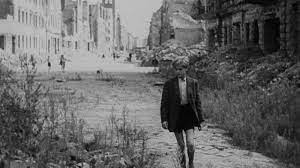
Rossellini’s restless search for “a different kind of cinematic language that would depart from programmatic neo-realism demanded by some Italian and French critics” (Bondanella ‘Films of Rossellini’ 15), is evident in Germany Year Zero (1947). Made little more than a year after the tragic, untimely death of Rossellini’s favourite son, Romano, to whom it is dedicated, features a traumatised young boy filmed amidst the rubble of bombed out Berlin. The theme of the post-war loss of faith is described by Bondanella as “hovering between objective documentary and the depiction of a moralistic horror story” (ibid 51). Rossellini began filming Germany Year Zero with the story unfinished. Like Godard he rejected working with a finished script most often starting with an outline supplemented with notes written (sometimes on a matchbox)
The filming of Germany Year Zero was interrupted to make two shorter films placed together for release as L’amore (1948), showcases for Anna Magnani. One is adapted from a one-act Cocteau play, La Voix humaine, in an experiment with psychological introspection (foreshadowing the Bergman series) in long takes and The Miracle scripted by Fellini - a confused and somewhat disturbed goatherd claiming the Virgin Birth after being impregnated by a passing tramp (played by Fellini) who persuades her he is Saint Joseph. Although condemned by the Church for blasphemy Rossellini subsequently described The Miracle as “an absolutely Catholic work…filmed during a time of the absolute loss of faith,” a faith that Rossellini seeks to re-discover in Stromboli.
 |
| Germany Year Zero |
Another film, in Italy mostly misunderstood and maligned in equal measure by critics and the public, in the making, offered for Rossellini ‘a clear and precise model’ of self- sustaining spirituality in Francesco giullare di Dio/ Francis God’s Jester (1950), Stromboli (1949), Europe 51 (1952) and Voyage to Italy (1953), the latter two both now widely recognised as the peak achievements of the then highly controversial five films made with Ingrid Bergman.
 |
| Francesco giullare di Dio |
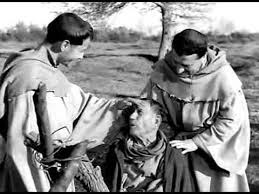
Anecdotal and often broadly comic, Francesco, based on a surviving 14th century manuscript, The Little Flowers of Saint Francis of Assisi, epitomises Rossellini’s anti-formalist style well described by Fred Camper as seeming “open and innocent” (“The Little Black Book of the Movies’). Camper notes that Rossellini’s compositions are always constructed to point to the space beyond the borders [of the frame] with a world-embracing hugeness shared by some of his key characters,” here foreshadowing his later deployment of the zoom shot.
As Bondanella notes, Rossellini was never a practicing Catholic, but he was inspired by the ethical teachings of the church and was fascinated by religious sentiment which he viewed as too often ignored in the materialistic world he inhabited (ibid 17) and in which, it should be said, he participated, eg in his love of fast cars.
 |
| Francesco giullare di Dio |
While Rossellini has often been identified among the precursors of modern cinema by virtue of neo-realism being recognised as one of its primary sources, Kovács makes the important point that despite becoming an example for many modern directors he never became a modernist filmmaker himself (261). Rossellini dismissed modern art as “superficial, unjust and inconsequential” in its generalising of a negative attitude towards the world while life, he said, is much more diverse than this attitude suggests (ibid). Yet, as Kovács further suggests there is ambiguity in his fervent rejection of modernism which has the same root as realism in the shared “essentially moralistic, even religious approach to art.” In the four films linked together in the previous paragraph Rossellini “created a form that showed a certain way of transcending neorealism” (ibid). Yet he never took the further step.
As Kovács explains, Rossellini was first of all concerned with the morality of art rather than style or narration. However at the beginning of the 1950s he started to make films focusing on personal relationships or on moral questions separated from history and society. His neorealist style became quite ambiguous as was already evident in Germany Year Zero where he used the rubble of bombed out Berlin to act as a psychological expression of the critically conflicted young boy’s state of mind. What Rossellini sought to do was “transcend neorealism as a political project and arrive at something like spiritual neorealism.” (ibid 262). The introduction of an abstract expressionist effect in this way, in principle is in contradiction with the neorealist ethos apparent in the obvious clash between the exteriors of the actual bombed city and the expressive stylisation of interiors filmed in studio sets.
The war did, however, provide a stable moral standpoint. “Morality, so to speak, was encoded in the environment. Outside the realm of war, embedding of the character in the environment did not invoke unequivocal associations anymore” (264). In social or other terms, an environment had to be shown that would incite the positive moral reactions that Rossellini sought, requiring him “to develop a certain psychological characterisation of the landscape. By the early 50s the neorealist landscape “became withdrawn into the background, or it became a projection or metaphor of the personal situation of the characters” (Gian Piero Brunetta quoted by Kovács ibid). Kovács points out that “Rossellini’s essentialist and moral approach” in his ‘trilogy of loneliness’ 1949-53 - stories depicting the lonely individual’s consolation and reintegration into her environment - did not allow him to take the phenomenological approach of recognising a lack of moral contact between environment and characters that was Antonioni’s starting point.
 |
| Voyage to Italy |
Voyage to Italy is centred on the estranged relationship between an English couple that is both seemingly confirmed and challenged through their contact with the foreign environment of Naples. Kovács concludes “it was in Voyage that [Rossellini] went the farthest into the phenomenological description of estrangement so the last minute step back from the brink was quite shocking. This film provoked argument and embarrassment with its “miracle” ending “ (ibid), that with the passing of time has received wide critical endorsement.
Brunette is in broad agreement with Wood’s assessment that Rossellini’s work is “strongly personal without ever being introspective … acts of exploration outwards from a defined centre of identity” (898). Brunette finds Wood’s drawing of exact analogies between the situations of characters in these films with Ingrid Bergman’s personal life, including the breakdown of their marriage and the depictions in Voyage to Italy and La Paura/Fear (1954), as “too conjectural and reductive.” However, given Rossellini’s “very personal but influential blending of fiction and documentary,” Brunette finds Wood’s description of “the autobiographical dynamic in Voyage to Italy suggestive.” The description of tensions between the couple (Bergman and George Sanders) in Voyage can be related to the interplay between realism (in the way it’s played out on the screen) and reality (the off screen tensions between Bergman and Rossellini). That interplay Brunette suggests, can also can be traced in other Rossellini films, especially with Anna Magnani in Una voce mana (1947-8) (ibid 156).
In comparison with the essay-like style of Journey to Italy, the last film of the cycle with Bergman, Fear, also centred on the theme of the couple, is transposed into an expressionist style “reminiscent of Lang and Hitchcock” (Adriano Aprà, Forgacs ed. 126).
Rossellini hit rock bottom financially in the mid 50s with the box office failure and critical rejection of the Bergman series. The significant exception was Andre Bazin and the then incipient New Wave: filmmakers writing in Cahiers du Cinema who were then alone in recognising the thematic and stylistic consistency of the series with Rossellini’s initially acclaimed neo-realism. In 1958 Cahiers voted Voyage to Italy among the 12 greatest films ever made’. Nowell-Smith suggests that their rescue operation led to the creation of “an apolitical Rossellini.”
 |
| The Miracle |
In the context of the extensive critical reappraisal beginning (in English) in the 80s of Rossellini’s complete oeuvre, from the second and third phases (the first being the films in the Fascist period), I suggest the key defining films in the second (1946-54) are Paisá, Francesco, Stromboli (Rossellini’s original cut), and Voyage to Italy, the ‘second line’ of this phase being Rome Open City, Germany Year Zero, L’amore Due Storie/Two Love Stories (The Miracle plus The Human Voice), and Europe 51. The defining, also transitional, films of the third phase - Rossellini’s ‘return to commercial cinema’ (1958-62) - are the documentary feature India, and Viva Italia. The ‘second line’ of this phase are, Era notte a Roma, General della Rovere and Vanina Vanini. At various times Rossellini’s own nomination as ‘important’ for him: Paisá, Voyage to Italy and Louis XIV, with Francesco guillare di Dio, and Viva l’Italia added as ‘personal favourites’ made clear from the accounts of their making in Tag Gallagher’s biography.
* On its initial release in Italy, Open City was a flop. The critics disliked it and the public stayed away. The same thing happened on its initial release in the US. It was not successful as the Italian entry in the Cannes Film Festival. The breakthrough was two months later when its release in Paris was greeted with rave reviews and equally strong box office returns opening the path to re-release in the US and Italy and international success (Brunette 51).
A second part on Rossellini will follow
Previous entries in this series can be found if you click the following links
Sixty Years of International Art Cinema: 1960-2020 - Tables and Directors Lists to Accompany Bruce Hodsdon's Series
Notes on canons, methods, national cinemas and more
Part One - Introduction
Part Two - Defining Art Cinema
Part Three - From Classicism to Modernism
Part Four - Authorship and Narrative
Part Five - International Film Guide Directors of the Year, The Sight and Sound World Poll, Art-Horror
Part Six (1) - The Sixties, the United States and Orson Welles
Part Six (2) - Hitchcock, Romero and Art Horror
Part Six (3) - New York Film-makers - Elia Kazan & Shirley Clarke
Part Six (4) - New York Film-makers - Stanley Kubrick Creator of Forms
Part Six (5) ‘New Hollywood’ (1) - Arthur Penn, Warren Beatty, Pauline Kael and BONNIE AND CLYDE
Part Six (6) Francis Ford Coppola: Standing at the crossroads of art and industry
Part 6(7) Altman
6(8) Great Britain - Joseph Losey, Lindsay Anderson, Karel Reisz, Richard Lester, Peter Watkins, Barney Platts-Mills
6(9) France - Part One The New Wave and The Cahiers du Cinema Group
6(10) France - Part Two - The Left Bank/Rive Gauche Group and an Independent
6(11) France - Part Three - Young Godard
6(12) France - Part Four - Godard:Visionary and Rebel
6 (13) France Part 5 Godard with Gorin, Miéville : Searching for an activist voice
6(14) France Part 6 - Creator of Forms - Bresson
6 (15) France Part 6 - Creator of Forms - Jacques Tati
6 (16) - Part 6 - Creator of Forms - Carl Th Dreyer
6 (17) - Italy and Luchino Visconti


