Editor’s Note: This is the third part of a series by Bruce Hodsdon in which he analyses the history and impact of Art Cinema. Part One appeared on March 10 and can be found IF YOU CLICK HERE. Part Two appeared on 16 May and can be found IF YOU CLICK HERE
**********************
 |
| Howard Hawks |
Part 3: From Classicism to Modernism
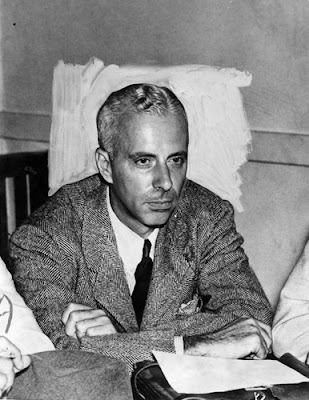
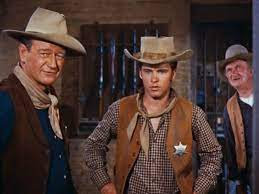
Although Howard Hawks (1896-1977) was active through the decade directing two of his best and most representative dramas, Rio Bravo (1959) and El Dorado (1966), Hawks was never recognised as a director of the year by IFG's selection panel on a par with their selection of four other great directors from the studio system: Cukor, Hitchcock, Minnelli and Huston. Neither was John Ford ever selected by the IFG panel despite directing two major 'testaments' in the 60s : The Man Who Shot LibertyValance (1962) and Seven Women (1966). The editors provided little clarity as to what the 'Five Directors of the Year' selections were intended to represent other than their personal choices and that the format was modelled on the Wisden Cricketers' Alamanac's '5 Cricketers of the Year', IFG's editor, Peter Cowie, being a cricket tragic.
 |
| John Wayne, Ricky Nelson, Walter Brennan, Rio Bravo |
In Sight & Sound's 2012 decennial World Poll Hawks is not voted with Hitchcock, Ford and Fritz Lang, amongst the top 25 directors of all time; Rio Bravo is voted equal 63rd with 24 votes in the “100 top films.” As to be expected, the minds of the great majority of 1200 critics and filmmakers “were variously and more dutifully most often opting for rating the milestone movies and turning points in the art of film.”
Hawks is reinforced as a paradigm of the Hollywood professional by his most committed defenders when they claim that he directed the 'timeless' best film in every major classic Hollywood genre. The doubters are held to account by David Thomson in his 'Biographical Dictionary' for their dismissal of Hawks's work as being “subject to the limitations of the entertainment film, prone to a romantic view of men in action; in short, a moviemaker for boys who have never quite grown up.” Thomson goes on to add that “because he is so unassuming as an innovator, so natural as an entertainer, his work has not been surpassed.” In comparison with John Ford, Thomson argues “that while Hawks's West is equally romantic in Red River and Rio Bravo it is only a background for character studies that are profound, humane and touched by sadness.” In comparison, in a judgement that most would consider excessively harsh, for Thomson, “Ford was so often bigoted, grandiloquent and maudlin.”
Thomson proceeds to argue his case in his 'Biographical Dictionary'. Like Hawks, Ford's work, as voted for in the World Poll, has only one film in the top 100 but it is ranked seventh. Thomson concedes that The Searchers,for him a film apart in Ford's oeuvre, is “very moving and mysterious...it does not cheat on a serious subject, and beautifully relates the landscape to its theme.” Ford would have directed more great scenes than any other classical American director and, as Thomson concedes, “he had an eye,” more so than ever after Ford lost the sight in one when he was wounded while filming a documentary of the Battle of Midway. Ford's indulgences do provide plenty of material for the unsympathetic critic in his extensive oeuvre of Irish-Americana which stands in contrast to Hawks's understated consistency in the playing of the dramas against the comedies, placing in relief the high points that seem to emerge organically in his best films.
 |
| John Ford |
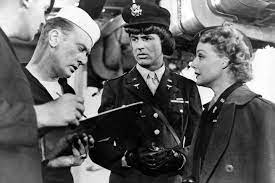
Sam Rohdie in his exploratory book 'Film Modernism' devotes his entry on 'Classicism' exclusively to Hawks. Referring to the dramas, Rohdie locates the secret of Hawksian laconicism in his self-acknowledged interest in “characters rather than actors,” choosing actors with 'character' (e.g. Bogart, Bacall, Wayne, Clift, Walter Brennan, Angie Dickinson, Jean Arthur, Cary Grant, John Ireland), a journey or itinerary providing a simple and straightforward structure with readymade continuity in which the characters resolve their differences. “Hawks is the perfect classicist. It is as if his films objectively imitate nature and invent nothing, going along with what occurs and what is met on the way exactly as his characters do” (ibid). The comedies often made almost systematically in relation to the dramas, reveal a darker Hawksian reversal – coarseness of humour involving slapstick and gender role reversals successfully replacing the subtlety of the dramas by Hawks' genius in retaining full control in the pacing and timing of the comedy. As John Belton points out, the action films and the comedies complement each other: while the male characters in the former resist change, those in the comedies learn to adapt to it as the female characters oversee the 'feminisation' of their man.
 |
"gender role reversals"
Cary Grant, Ann Sheridan, I Was A Male War Bride
(Howard Hawks, 1949) |
What Rohdie outlines is how the work of a classical American director was assimilated into the modernism of 'la nouvelle vague' [in a way that Ford's wide ranging traditionalism was not]. He notes how the New Wave had enthusiastic appreciation of Hawks's qualities and classicism. “By naming and revealing its self effacement (objectivity, power and grace), Hawks's style was made evident. As a consequence his images (means) were recognised as both integrated with, but separate from, their original narrative ends.” By rupturing Hawks's continuity “they rescued American cinema by highlighting its classicism giving it new life by making it part of the forms of the New Wave's modernism” while also undermining its classicism by making it visible, that it was no longer merely serving the narrative. This left what was learned from Hawks's skills, and their potential for use, “as primarily formal and cinematic.” When cited in a Godard film they were as fragments excised from classical cinema “given a home in the new forms and awareness of modernism” (ibid). In other words they had their your cake while eating it too.
Barrett Hodsdon quotes Hawks's biographer Todd McCarthy's conclusion “that his oeuvre did not represent an autobiography; rather it constitutes a massive self-projection, a portrait of his fantasy of himself” (The Grey Fox p.6) Hodsdon adds that “as with Ford, Hawks's career was still a remarkable projection for a hard-nosed mainstream filmmaker who believed in and worked under a commercial rubric. However, unlike Ford, Hawks never deconstructed himself [and his 'world view'] but retreated into his personal mythos in his last films.” (The Elusive Auteur 129-30)
Hawks's last 6 films were released 1959-70: Rio Bravo, Hatari!, Man's Favorite Sport, Red Line 7000, El Dorado, and Rio Lobo. Ford's last six,1961-66, were : Sergeant Rutledge,Two Rode Together, The Man Who Shot Liberty Valance, Donovan's Reef, Cheyenne Autumn, and Seven Women.
Transformation of Film Style “There is little doubt that a classical aesthetics looks for and favours films that can be constructed as organic, coherent, meaningful controlled art” (Adrian Martin 22).
For classical cinema, rooted in the popular novel, short story and
well-made drama of the nineteenth century, “reality” is assumed
to be a tacit coherence among events, a consistency and clarity
of individual identity. Realistic motivation corroborates the com-
positional motivation achieved through cause and effect. Art-cin-
ema narration, taking its cue from literary modernism, questions
this notion of the real rooted in the nineteenth century popular
novel and well-made drama: the world's laws may not be know-
able, personal psychology may be indeterminate.
(Bordwell 'Narration' 206)
Bordwell acknowledges Marcel Martin's summing up of new aesthetic conventions which recognise these new 'other realities'. Neorealism sought to depict the vagaries of life as lived to “de-dramatise”the narrative by showing both climaxes and trivial moments. “Specific sorts of realism motivate a loosening of cause and effect, an episodic construction of the syuzhet (plot), and an enhancement of the film's symbolic dimension through an emphasis on the fluctuations of character psychology” Bordwell goes on to illustrate how art film's reality is multifaceted in dealing with “real” subject matter such as contemporary alienation and non-communication (ibid).
 |
| Jerzy Skolimowski in his film Walkover |
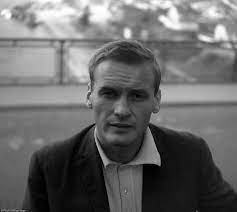
The sixties became the decade of transformation in the history of film style in which classical mise en scène could be “rejected wholesale but also referenced, cited, and thereby bracketed, problematised and merrily interfered with.” Godard in Le Mèpris (1963), as Adrian Martin further describes, “both mi-micks the classical system for expressive purposes while poking holes in its surface in a myriad of in-scene distances” (Mise en Scène 80). Jerzy Skolimowski, not long out of film school, in the midst of the Polish new wave, made a critical experiment in the way he deployed the extended long take in his second feature, Walkover(1965), one of the first films to do so, remarkably as Martin describes it in the opening single shot of 11 mins and throughout the film of only 29 shots in 72 mins. Skolimowski, inventively places traditional mise-en-scène (with its deference to montage) within potentially subjective scenes 'in crisis', as Martin recognises, by maintaining distance through total objectivity in lateral movement, fresco-like across sudden shifts of viewpoint. Although Skolimowski claimed not to have seen any of Godard's films before making Walkover,Martin notes his work on cinematic style “as having evident, transnational affinities with what Godard and others were doing in this period and throughout the remainder of the decade.” (ibid 75-6)
“The competing claims of realism and modernism was one of the sustaining debates through the last century from the late fifties to seventies that “produced many of the conceptual models of the cine- matic image, from André Bazin's realism to Screenjournal's modernist Marxism,” as G&S note (15). Historical and ahistorical impulses, being integral to their flexible appeal “are held in creative tension by art cinema, it is further suggested (G&S 14-15). Its flexibility lies in this combination of the ahistorical (its refusal of traditional historicism potentially avoiding ethnocentrism) and the historical (e.g. in the importance for it of movements and national film waves). In the end, any defining of international art cinema returns simply to a nostrum that potentially it encompasses narrative film that is “not Hollywood.”
As already referred in part 2, the local has played a key role in the evolution of “art” in international art cinema. In outlining its history Geoffrey Nowell-Smith emphases its heterogeneity across national cinemas through the sixties in western and eastern European cinemas. He is dismissive of the attempts that were made to give definition in art cinema to distinct generic properties analogous to Hollywood cinema and other mainstream film genres. While Nowell-Smith acknowledged an identifiable sharing of structural and stylistic breaking of the rules of classical construction and characterisation in many of the art films of this period, he saw this as continuing to move in many directions.
The apparent diversity of key New Wave directors from common ground, contributed to their international film festival and art house notoriety accompanied by the engagement of critics and a growing public interested in the variety offered by art cinema. Its opposition to Hollywood rests on the international variety of its films from austerity to spectacle, neo-realism to Felliniesque fantasy, radical narrative experimentation to relatively conventional storytelling, and Marxist inflected narrative to romantic humanism. As the scope for divergences between individual filmmakers outside the mainstream increased so also did the dependence on the commitment of producers prepared to back originality. The 60s also saw the increase in new forms of state aid in France in the 60s, and from television in Italy (RAI) and Germany (ZDF) in the 70s.
Against institutionalisation
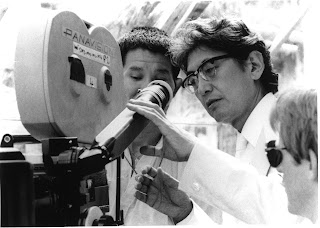
The radical events of May 68 generated an international climate for new cinemas as well as sharp differences in formal strategies for dealing with overt political content independent of the mainstream, in Europe, Africa, India, Japan, and North and South America (1).
 |
"...overt political content independent of the mainstream"
Nagisa Oshima |
In 1981 Steve Neale referred to the containment of the variety of art cinema by its economic infrastructure with “its basis in commodity-dominated modes of production, distribution and exhibition [within] a general institutional framework of discourses on high art and culture, and by the repetitions that tend to mark such discourses (15)” (2). In the new millennium the uneasy relationship between high art and low (cult) art was highlighted by David Andrew's polemic for new ground. He argues against what he sees as the outmoded containment of art film in the distinct generic terms identified by Neale as an institutional practice closely associating with designation and stratification of films according to the 'quality and artfulness' of modernism. Against this actual, or at least potentially reactionary institutionalisation as 'high art' cinema, Andrew proposes an “egalitarian,value-neutral path” which would admit disenfranchised areas such as 'soft-core porn'. Soft core art film emerged with the progressive relaxation of censorship in the late sixties to the mid seventies (3). What Andrew is specifically referring to in this context is a 'feminised' soft core genre first established as a cultural industry in America in the 1980s which remained unacknowledged for serious study. His main goal has been to develop a framework whereby untraditional scholars could “justify their exploration of cinema's most disenfranchised areas” using an art cinema approach (4).
************************************************
Notes
(1)The emergence of the concept of a Third Cinema in the late 60s initially in Latin America, did not simply refer to so-called Third World countries but to any films confronting political and social issues that challenged entrenched modes of mainstream action genres or individually expressive narrative: the First Cinema being the mainstream Hollywood model , the Second Cinema being the auteur-based Art Cinema centred in Europe. This will be further discussed in Latin American cinemas in part 4.
(2) It may be that art cinema is best defined not through a certain historical period, nor a directorial canon, or a set of distinctive subjects and styles but as an institution in whichcertain films are 'assigned' a position within the general film culture and are defined in terms of a particular mode of consumption. Film festivals are a key component of this institution. The institutional context is critical to the stabilisation of the 'genre' and the films' separate status as cultural objects. This circulatory network may be the key unifying aspect serving to distinguish its minority audience from the mass audience of the commercial mainstream cinema. ( from Tom Ryall “Art House, smart house Movie no. 90 1981 quoted Cook & Bernink eds. 108)
(3) Steve Neale notes (33) that the gradual postwar opening of anglophone film exhibition to European films increasingly provided commercial stability for 'adult art' on the screen beginning with films like La Ronde(1950), One Summer of Happiness(1954), And God Created Woman(1956), Les Amants(1958), La Dolce Vita(1960), Antonioni's 'trilogy' beginning with L'avventura(1959-62), The Silence (1963), Une Femme Mariée(1964), and Belle de Jour (1967) to art films with a reputation for explicit representation of sexuality such as I Am Curious Yellow(1967), Pasolini's 'trilogy of life' beginning with The Decameron(1970-4), Robbe-Grillet's Eden and After(1970) et al, Last Tango in Paris(1972), The Night Porter (1973), and Jancsó's Private Vices, Public Virtues (1976).
(4) David Andrews is a specialist in American literature, and art film including soft core porn. In 2006 Ohio State University Press published his book, 'Soft in the Middle', described as a nuanced study of the devalued soft core film and TV industry which occupies an ambiguous “female friendly” middle ground between hard core porn and Hollywood
*************************************************************
Geoffrey Nowell-Smith “Art Cinema” Oxford History of World Cinema 1996
John Belton “Howard Hawks” in Nowell-Smith op cit
Steve Neale “Art Cinema as Institution” Screen v.22/1 1981
Rosalind Galt & Karl Schoonover “Introduction: The Impurity of Art Cinema” Global Art Cinema 2010
Stephen Crofts “Concepts of National Cinema” Oxford Guide to Film studies Hill & Gibson eds.
Murray Smith “Modernism and the avant gardes” Oxford Guide ibid
David Andrews“Towards an Inclusive, Exclusive Approach to Art Cinema” Global Art Cinema ibid
Sam Rohdie Film Modernism 2015
Adrian Martin Mise en Scène and Film Style 2014
Julian Petley “Art Cinema” The Cinema Book 2nded. Pam Cook& Mieke Bernink eds. BFI 1999 p.106
David Bordwell Narration in the Fiction Film 1985
David Bordwell ”The Art Cinema as a Mode of Film Practice” reprinted with afterword in Poetics of Cinema 2008


