 |
| Claudia Cardinale as seen in Federico Fellini's 8 1/2 |
| |||||||
|
| Claudia Cardinale as seen in Federico Fellini's 8 1/2 |
| |||||||

Along with the celebrations for the centenary of his birth and, specifically, the retrospective dedicated to him to be held at the Cinema Ritz in Randwick, the Italian Cultural Institute in Sydney (co-organizer of the aforementioned retrospective) is pleased to invite you to a round table entitled The Cinema of Pier Paolo Pasolini: poetry, politics, provocation. The event is organized in collaboration with Cinema Reborn.
We have invited the following speakers from a range of filmic and cultural interests, all passionate about Pasolini’s art, to share their thoughts and ideas about his films, politics and poetry:
 Susanna has written on a range of film and cultural topics with a focus on Italian and women’s cinema. She is Professor and Pro Vice-Chancellor (Student Life) at the University of Sydney.
Chair: With a production background in journalism, television and documentary, Jane Mills has written and broadcast widely on cinema, screen literacy, censorship and feminism. She is Hon. A/Professor (UNSW), Sydney Film Festival Advisory Panel member and a programmer for Antenna Documentary Festival.
Free entry. Limited seats.
Booking essential: www.eventbrite.com.au
It will be also possible to follow the roundtable at the following Zoom link:
https://us06web.zoom.us/j/87182311227?pwd=YjV1WHhtODZWdjBLZFBMMEdiekt6dz09
Date: Friday, November 04, 2022
Time: At 6:00 pm
Organized by : Istituto Italiano di Cultura
In collaboration with : Cinema Reborn
Entrance : Free
Location:
Istituto Italiano di Cultura, Level 4, 125 York Str
AND.... there's still more Pasolini at the Randwick Ritz. This week his masterpiece THE GOSPEL ACCORDING TO MATTHEW. Details if you click here

Wertmuller was a living force of nature and her films have endured. Cinema Reborn was a partner with the Italian Cultural Institute in a seriously good and very well received season of Wertmuller's films at the Randwick Ritz earlier this year. Critics, scholars and cinephiles Jane Mills and Blythe Worthy did a whole host of work to get the show on the road, including arranging for speakers at each of the seven sessions.
A number of the introductions were also published on the Film Alert blog and you can find them if you click on these links below
Jane Mills introduces the season
Blythe Worthy introduces THE SEDUCTION OF MIMI
Critics applaud C'EREVAMO TANTO AMATI (Ettore Scola, 1974) screening at a special one-off homage to celebrate the 100th birthday of the the great comic actor Nino Manfredi, a much admired and loved Italian classic, screening in a beautifully restored new copy at the Ritz Cinemas Randwick Monday 29 November at 6.30 pm. To Book Tickets CLICK HERE
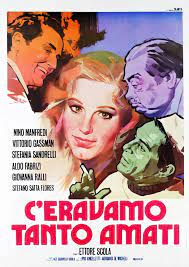
DAVID STRATTON
“…smart and entertaining …one of director Ettore Scola’s most engaging movies.” (after viewing the film at its world premiere at the 1975 Locarno Film Festival
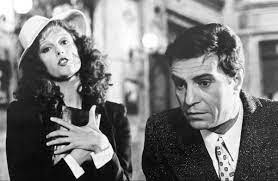 |
| Stefania Sandrelli, Nino Manfredi |
ROB HARRIS
With the possible exception of the more recent body of work by China's Jia Zhangke, no film has summed up a nation's political, social and cultural history with such clarity and humanity as We All Loved Each Other So Much/C'eravamo tanto amati(1974), the first international success of a director known primarily for comedies.
Ettore Scola (1931-2016) began his career as a screenwriter of broad farces, many of them for Dino Risi, credited as one of the maestros of the Italian film comedy style to emerge in the 1950s and 1960s. After a dozen years scripting such hits as Risi's classic Il Sorpasso(1962), Scola directed his first feature, Let's Talk About Women(1964), an episodic comedy of romance and relationships starring the actor who would become his most frequent star, Vittorio Gassman. It's a mistake, however, to think of Scola's work as mere comic entertainment. Like Risi, his pictures, funny as they are, derive much of their humor from satirizing the class disparities of everyday Italian life and the high-level corruption that has frequently characterized the country's government.
Scola's stands out by incorporating into its saga a detailed and passionate consideration of Italy's greatest artistic movement of modern times, neorealism, the cinematic style that emerged in the 1940s. Its early proponents, among them Roberto Rossellini and Vittorio De Sica (to whom We All Loved Each Other So Much is dedicated), focused on stories about the poor and working class, filmed on location and often with non-professional actors, depicting the difficult conditions of Italian life….
To drive home his point, Scola incorporates excerpts and evocations of films by De Sica, Rossellini, Federico Fellini and Michelangelo Antonioni. Fellini and Marcello Mastroianni appear as themselves in a funny recreation of the filming of the famous Trevi Fountain scene in Fellini's La Dolce Vita (1960), and De Sica is seen in archival footage talking about Bicycle Thieves. There are snippets of other movies and a seduction played out as one character attempts to instruct another in the wonders of Eisensteinian montage on Rome's Spanish Steps. …(Announcing the films recent premiere on Turner Classic Movies on TCM.com)
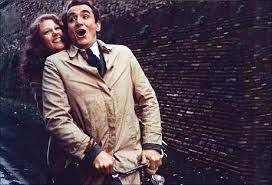 |
| Stefania Sandrelli, Vittorio Gassman |
VINCENT CANBY
Here is a quote from Canby in The New York Times, in 1977 when the film first opened in the US. (It has never screened at all in Australia as far as is known.)
"We All Loved Each Other So Much," which opened yesterday at the Beekman, is full of fondness, rue, outrage and high spirits. It is also—surprising for an Italian film—packed with the kind of movie references that French filmmakers like, and it is dedicated to the late Vittorio DeSica, whose "Bicycle Thief" plays a prominent part in the picture.
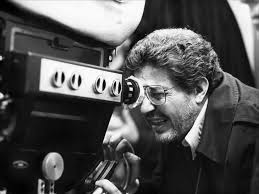 |
| Ettore Scola |

************************
Le amiche might come as a surprise to audiences aware only of Antonioni's celebrated films of the 1970s expecting his trademark extremely long takes, large empty spaces, massive architectural structures and long, deep focus shots in which characters, forever thwarted in their search for emotional and spiritual sustenance are dwarfed and alienated in soulless urban and rural landscapes. At first sight, apart from the main character, Clelia, (Eleonora Rossi Drago) who provides a moral centre and central viewpoint, what we see in Le amiche is a gaggle of wealthy, bourgeois, mostly mean, gossipy, amoral women, their husbands and lovers, whose concept of friendship is severely limited and whose interests and chatter rotate around love, sex, money, status and the latest fashion in couturier ball gowns. The film most certainly has melodrama and in recent years has been compared with the American romantic comedy television series Sex and the City. Which might sound like an almighty cultural put-down. But in fact, purveys precisely one of the films delights.
Plot
The lovely, thirty something Clelia (Eleonora Rossi Drago), newly arrived from Rome to set up the local branch of a couture house in Turin where she was born. Preparing to take a bath in her hotel room, she is interrupted by a screaming maid who has discovered Rosetta (Madeleine Fischer) almost dead from a suicide attempt in the next room. This triggers a chain of events that will ultimately end in a successful suicide and Clelia’s decision to return to Rome. But first, Clelia is swept into the social swirl of restaurants and casinos, artists’ studios and parties of four wealthy and vapid, mean and gossipy women, the supposed friends of the unhappy Rosetta: Momina (Yvonne Furneaux), a wonderfully performed whirlwind of worldly cynicism; Nene, a talented but masochistic ceramicist; and Mariella (Anna Maria Pancani), a delightful boy-crazy airhead.
Why did Rosetta attempt suicide? What links her to her friends? This is not, as one might expect, a simple case of melodramatic cherchez l’homme, although Nene’s partner, the faithless, not very talented painter Lorenzo (Gabriele Ferzetti) certainlyplays a key role in bringing about the denouement. (Ferzetti will play a similar role in L’avventura). Rosetta’s unhappy affair (cynically encouraged by Momina, despite supposedly a good friend of Nene) and its aftermath, all anticipate L’avventura.
The film’s other significant male character, Carlo (Ettore Manni), is the handsome, working class assistant to the head architect, Cesare (Franco Fabrizi). Cesare is designing Clelia’s couturier salon - when, that is, he has time to spare from his affair with the married Momina whose husband we never meet and is the sort of woman who doesn’t mind whom she seduces as long - as they are wealthy and not working class. Apart from Clelia, Carlo is the only character with any integrity. It doesn’t do him any good.
Style
For Penelope Houston, this was his outstanding film of the 1950s and in it she finds many elements of Antonioni's visual grammar: “Already the elements of this fastidious craftsman's style were locked in place: the awareness of landscapes, usually melancholy, the sense of people drifting through time and space, but held always under the tightest control, the persistence of vision.” Antonioni himself explained: “I need to follow my characters beyond the moments conventionally considered important, to show them even when everything appears to have been said.” According to Houston, this was partly what so annoyed the Cannes audience who booed when L’avventura was awarded the Critics Prize, along with that moral lethargy which seems to overpower his characters, blocking even the possibility of decisive action.
The neorealist strategy of using actual locations are lovingly filmed by Gianni Di Venanzo whose future credits would include La notte and L'eclisse for Antonioni, La sfida (The Challenge) for Francesco Rosi, and 8½ and Giulietta degli spiriti (Juliet of the Spirits) for Federico Fellini.
Screenplay
Adapted from Cesare Pavese’s prize-winning novella, Tra donne sole (Among Women Only, 1949), suicide frames the film’s narrative: suicide had a significance for both writer and director. In 1953, Antonioni contributed a segment, Tentato suicidio (Attempted Suicide), to an anthology film, L’amore in città (Love in the City). The significance for Pavese was more devastating: a year after publication of this novella, he committed suicide, reportedly because of an unhappy love affair. This may explain why the screenwriters, Antonioni with Suso Cecchi D'Amico and Alba De Cespedes, decided to link Rosetta’s suicide to an unhappy affair rather than leave her motives unclear, as in the novel. Pavese’s suicide would undoubtedly affected Antonioni.
The relationship between the three screenplay writers is intriguing. De Cespedes (who gets a ‘collaboration’ credit) was a best-selling novelist and newspaper agony aunt whose only screenplay credit is for Le amiche. D’Amico was an experienced screenwriter whose credits include films for Franco Zeffirelli, Luchino Visconti, Vittorio de Sica and Francesco Rosi. The writing process was not a happy one. When D’Amico’s script was accused of sentimentalising Pavese’s novella, Antonioni retorted: “I wouldn’t say that D’Amico wrote the script. The script came out of a cooperation between me and [the] two women. D’Amico is not a great writer, but she’s a good writer, She knows the feminine mentality very well, But they hated each other, Suso and Alba, so they never talked together, I picked up some material from one and some more material from the other and then I did the script… the emotional and existential crises of the characters are the same kinds of crises you find in my other films.”
On an unpleasantly ironic note in light of the four women friends’ constant immoral and amoral gossip and innuendo, the Pavese’s suicide note read: “I forgive everyone and ask everyone's forgiveness. OK? Don't gossip too much."


Introduction by Associate Professor Jane Mills, UNSW
I acknowledge the Bidgigal people of the Eora nation, the traditional owners of the land on which the Ritz Cinema is on and pay by respects to their Elders, past, present and emerging. Their lands were never ceded. Always was, always will be, Aboriginal land.
On a personal note, my thanks to Blythe Worthy who worked with me to wrangle the speakers.
Lina Wertmüller’s films were hugely popular in the 1970s. Especially in America although also in Italy where her ‘commedia all’italiana, a film comedy style deriving its name from the title of Pietro Germi's film, Divorzio all'italiana (Divorce Italian Style, 1961), gave her a big following.
In 1975, she was the first woman ever nominated for an Oscar for best director for her film Seven Beauties.And then “pouf!” She seemed to disappear although, in fact, she continued making films until 2014.
Wertmüller re-emerged triumphantly in 2019 when – at last - she was awarded an honorary Oscar (below). At the ceremony, at which Greta Gerwig and Jane Campion declared they were huge fans, rather than humbly thanking the Academy, Wertmüller boldly reprimanded it for its sexism , insisting that Oscar should be renamed Anna. How very Wertmüller!

A brief portrait.
She was born in Rome to a devoutly Catholic middle class family. Her full name, incidentally, is Arcangela Felice Assunta Wertmüller von Elgg Spañol von Braueich. This might explain Wertmüller’s penchant for absurdly long film titles: she once made it into the Guinness Book of Records for a film’s longest title. But as she said: "It is not so terrible to be ridiculous - I am living proof of this point!"
Her provocative, rebellious character made itself apparent early: as a teenager, she was expelled from at least 11 schools, the last for challenging Christian dogma that she objected to being taught as “the Truth.”. Doubtless, the nuns didn't much like her teenage passion for comic books, especially the Flash Gordon comic strip. She later cited this as an influence, explaining she found the framing “rather cinematic, more cinematic than most films.” (We'll see a character in this afternoon’s film, I basilischi, reading a Flash Gordon comic.) Upon leaving school at 17, she began working in the theatre and directing avant-garde puppet theatre – two more influences that can be seen in several of her films.
Wertmüller was like her films: over-the-top, in-your-face, emotional (often exhaustingly so), provocative and defiantly incorrect long before the term “politically correct” had been invented. She and her films were also perverse, funny and political. However, not everyone got or enjoyed her jokes: her satirical approach to gender and class politics often angered feminists and Marxists. Leaving the Communist Party in 1959 and becoming an ardent, although never uncritical, socialist, Wertmüller was a socialist-feminist who could take a joke. She could dish them out too.There was probably no nose she didn't enjoy getting up. And no-one of any political persuasion she didn't enjoy sticking up her middle finger at. Which might make her and her films sound rather vulgar. As, gloriously, they often were.
Films in this retrospective
 |
| I Basilischi/The Lizards |
 |
| The Seduction of Mimi |
On Sunday 4 April,in The Seduction of Mimi (Mimi’ metallurgico ferito nell’onore1972) you’ll meet the devilishly handsome Giancarlo Giannini (who I think of as Wertmuller’s muse) playing a Sicilian dockworker fighting Mafia corruption and the wiles of a beautiful young Communist organiser - with lack of success in both cases. This ferocious farce that won Wertmuller best-director award at Cannes will be introduced by Dr Blythe Worthy,researcher and adjunct academic at the University of Sydney and Film Reviews Editor for the Australian Journal of American Studies.
 |
| Love and Anarchy |
On Sunday 11 April,we have Love and Anarchy (long title coming up: Film d'amore e d'anarchia, ovvero: stamattina alle 10, in via dei Fiori, nella nota casa di tolleranza…1973). Set in fascist Italy just before the outbreak of World War II, Giannini plays a farmer turned anarchist who stays in a brothel while planning to kill Mussolini and, inevitably, falls in love with one of the whores. As you do - if, that is, you’re in a Wertmüller satire. It will be introduced by Associate Professor Bruce Isaacswho teaches Film Studies at the University of Sydney; read his ‘Great Movie Scenes’ column in The Conversation https://theconversation.com/au/topics/the-great-movie-scenes-61548). I confess I asked Bruce – also another male colleague – partly because I wanted their response to what has been described at times as Wertmüller’s man-hating, knee-jerk feminism.
 |
| All Screwed Up |
Next, on Sunday Sunday 18 April, ABC Radio entertainment reporter/ producer and critic specialising in music, film and TV Danielle McGrane introduces All Screwed Up (Tutto a posto e niente in ordine, 1974). In this, a group of immigrants try to adjust to city life but quickly find that everything is in its place, but nothing is in order. Rape, unwanted pregnancy, prostitution, poverty, and gender politics are all subject to Wertmüller’s own anarchic sense of humour: “Man(kind) in disorder” is a theme that Wertmüller has often said sums up her films. One of the reasons I asked Danielle is because I’m fascinated to know what a younger feminist today thinks of Wertmüller’s provocative brand of feminism.
 |
| Swept Away |
On Sunday 25 April, Swept Away (Travolti da un insolito destino nell'azzurro mare d'agosto, 1974) will be introduced by Associate Professor Francesco Borghesi who chairs the Department of Italian Studies, University of Sydney and whose teaching includes “Passions in Italian Culture.” This film gives us a mischievous contest of wills between a beautiful, rich, bourgeois woman and a smelly (according to her) communist sailor (who find themselves shipwrecked on a deserted beach. One of Wertmüller’s better known films in Australia, it has stunning performances from the two leads, Giannini again (in a Cannes Festival Best Actor award winning role) and also the delicious Mariangela Melato.
 |
| Seven Beauties |
The last two films of this retrospective on the first two Sundays in May areboth introduced by Associate Professor Giorgia Alù who teaches Italian Studies at the University of Sydney and whose research interests include Italian cultural history and visual studies. On Sunday 2 May, there is Seven Beauties (Pasqualino, Settebellezze, 1975), the film for which Wertmüller was nominated for an Oscar and Giannini was nominated for best actor. This is undoubtedly her most outrageous film. Most audiences find it confronting: when Wertmuller decides to explore not only gender and class but also the sexual politics of a Nazi concentration camp … words fail me…but they didn't fail Wertmüller, that’s for sure!
 |
| Ciao Professore |
On Sunday Sunday 9 May, Giorgia farewells Wertmüller with her last film, Ciao, Professore! (1992). Critic Roger Ebert called this film about a strict teacher and his (much smarter) young students “a sweet movie.” But Wertmuller doesn't hesitate to expose the Italian political system which fails to address (let alone redress) the imbalance between wealthy northern Italy and poverty-stricken south.
So that’s the season. Leaving me with just a a small space in which to introduce her very first film:
I BASILISCHI ( The Lizards, 1963)
I’ll start by saying something about some members of her crew which would be any debut director’s dream. Actually, any experienced director’s dream too.
Cinematographer Gianni Di Venanzo shot Fellini’s 8½ and Juliet of the Spirits, and several films for Antonioni – including, incidentally, Antonioni’s Le Amiche (The Girlfriends, 1955) which screens at the Ritz on Friday 30 April at 6:30 in Cinema Reborn’s festival of restored films over the last weekend in April, see https://cinemareborn.org.au/2021-Program
The editor was Ruggero Mastroianni, Marcello’s younger brother, a prolific editor with 189 films to his credit including Fellini’s Amarcord,Juliet of the Spirits and Ginger and Fred.
Music:this was an early film of a little-known composer who the following year wrote the music forA Fistful of Dollars: Ennio Morricone! (The Morricone whistle starts here!)

I believe the title has been poorly translated as The Lizards and lazily compared (sometimes unfavourably) to Fellini’s Vitelloni(1953). It’s true that both films portray a small group of aimless young men who loaf around in a rural Italian town all day, eyeing the young women and achieving nothing. But whereas vitellonitranslates as “calves” and Fellini portrays rather lovable, even frolicsome young bulls, Wertmüller deliberately calls her film basilischi meaning ‘basilisks’ rather than lucertola meaning ‘lizards’: a basilisk is a legendary deadly poisonous serpent. There is a sharper political edge to how Wertmüller depicts her young men: she shows that the poisonous ineffectual lethargy has seeped into their souls from the societal, cultural and political order from which they cannot escape. The people in her sleepy southern town (Fellini’s film was shot in central Italy) simply don't have what it takes to challenge a society that encourages them to take a pride in “putting up with their lot.” As the commentary – the detached voice of the place – puts it: “their history and surroundings makes them so.” Wertmüller captures the devastating effects of the economic imbalance between the wealthy north and the poverty-stricken south in ways that Fellini doesn't.
Critics love pointing out the influences on directors and in Wertmuller’s case, Fellini, neorealism and Pietro Germi’s comedy Italian-style are often cited. Fellini was undoubtedly an influence. Describing him, Wertmüller once said: “Meeting Fellini is like discovering a wonderful unknown panorama. He opened my mind when he said something that I will never forget: 'If you are not a good storyteller, all the techniques in the world will never save you.'”
And certainly, her films display a strong love for her locations – prosperous northern cities and also the poor southern villages and countryside – and at time, a neorealist documentary style. You’d be forgiven for thinking I basilischi’s wonderful opening sequence as the camera slowly pans round the ritual of family lunch followed by a siesta was pure documentary. But elements of stage theatre and comedy are too strong in this and i all her films for her to be considered a neorealist. As for comedy, this was one of her great strengths – it may also explain why she fell out of favour as comedy is notoriously subject to time and place.
I’ll end by sharing my favourite sequence in I basilischi, one that I think combines realism, location, sly comedy and something of the tone of puppet theatre. When Francesco (one of the basilisks) is making furtive advances on a young woman, we see her parading through the town streets, her bottom swaying – provocatively, it must be said - this way and that (she’s too bony to be jello on springs - but she’s trying), the pleats in her skirt swinging - alluringly - in and out, and her high heels going click, click click. For me it’s – I was going to say: “pure Jacques Tati”. Actually, it’s pure Wertmüller.
Enjoy the film!
Jane Mills.
This is an extended version of her introduction to the Lina Wertmüller retrospective at the Ritz, Cinema, NSW on 28 March 2021.


