Showing posts with label Cinema history. Show all posts

Monday, 3 March 2025

Sixty Years of Art Cinema 1960-2020 : Bruce Hodsdon continues his series - East Central Europe - 6 (40) Yugoslavia


Graphic for a Dusan Makavejev retrospective in Moscow, January 2024

Vatroslav Mimica b.23 (Croatia)   
Aleksander Petrović b.29 (Serbia)   Dusân Makavejev  (An IFG Director of the Year, 1973) b.32 (Serbia)    Živojin/Zika Pavloviƈ (Serbia) b.33    Purikša Djordjeviƈ (Serbia), Matjaž Klopčić (Slovenia)

Multiculturalism, autonomy and the counteroffensive

In 1961 in contrast to the other Eastern European countries, in multinational Yugoslavia “liberalising of cultural policy and a weakening of control over the film companies resulted in a surge in film production as well as a decrease in the number of “ideologically safe” films. “The basic prerequisites for the birth of autonomous film art and of socially critical films was created.” (M & A Liehm 412) This brought the first of a new generation of filmmakers into the studios. It also resulted in politically motivated critical attacks and prohibitions directed at films with social content and aesthetic ambition breaking new ground. These conflicts were part of the struggle over the political future termed the “second Yugoslav revolution,” the first being the uprising in Serbia against German occupation in 1941 led by the Communist party.

The ultimate result for film, as the Liehms point out, “was the strengthening of creative autonomy, and, contrary to the other Eastern European countries, the gradual legalisation of new forms of film production.” This enabled “independent groups of film-makers to obtain means to make films outside the framework of existing film enterprises.” Not only did this increase the scope for new talent but also increased the opportunity for those pursuing profit in mainstream production.”

Political liberalisation of the arts in the early sixties also resulted in a clearer determination of the character of the national film industries . Serbia had the largest film industry with the greatest number of film artists including directors attracting international attention. Croatian film showed the influence of animated (the Zagreb studio) and amateur experimental film based on the high visual level of Croatian culture as opposed to the Belgrade school. Slovenian film was founded primarily by France Stiglic in the forties and fifties. The sixties opened the door to a new sensitivity - exemplified by Matjaz Klopčić and Bostjan Hladnik “that changed Slovenian film lyricism into a tool of pure film thought and a romantic approach to life.” Bosnian film was a smaller industry establishing a unique position, producing such original film artists as Boro Drašković and Bata Čengić. The documentary studio at Sarajevo established a reputation as being the most daring and committed (ibid 413-4). This was the background for “Novi (new) Film,”a period of personal films, films that claimed the right to subjective interpretations of the lives of individuals and society, the right to “open metaphors,” leaving room for viewers to think and feel for themselves” ( 417).  


Vatroslav Mimica 
(1923-2020, above), the leading Croatian writer-director, one of the founders of the Zagreb school of animation who made many notable animated shorts in the 50s-early 60s including Venice Festival Grand Prix winner in 1958, The Loner (Samac), turning to feature films with Prometej sa took Vilsevice / Prometheus for Vishevica Island (1964). A successful company manager returns to his native island to attend a ceremony commemorating the heroics of the partisans, of which he was one, in the mountains during the war. The narrative assumes the form of his memories infused with bitterness and melancholy. Mimica successfully continued this innovative storytelling in Yugoslav cinema in Pondeljak ili utorak/Monday or Tuesday (1966), visual stylisation of the narrative growing out of the premises set up by the plot involving the daydreaming of an ordinary journalist breaking the monotony of his days. Mimica continued this fusion of plot and form in Kaja unit cu te/I’ll Kill You (1967) in which the terror plot grows out of the atmosphere created by the visualisation of a Dalmatian town. “It is as if tragedy in all Mimica’s films was simply the derailment of an aesthetic structure created by the camera” (Liehm 419). In Hranjenik/Nourishee (1971) the narrative is a metaphor in which a concentration camp , created by various shades of colour, becomes a world in which helpless people, left to their own devices, try over and over again to achieve a glimpse of freedom (ibid).


Purisa Djordjević 
(1924-2022, above) takes a retrospectively poetic view of the partisan war and the postwar period in a tetrology : Devojka / Girl  (1965) a tragic wartime tale; San / Dream (1966), a poetic meditation about partisan warfare ; Jutro / Morning(1967) a sombre study of a peacetime dawn;  Podne / Noon (1968) is a poetic meditation about partisan warfare, a sombre dawn of peace and a reflection in full midday light, on the break with Moscow. Djordjevic captures the tragic reality of partisan warfare by unifying in a single style the most direct almost documentary approach and the most dreamlike metaphors, as if to frame the same question to Yugoslavs: “are free people able to sing about freedom the same way they did when they were dreaming about it during the war?” (Liehm 420).


Aleksandar Petrović
 (1929-94, above) was “a central figure of New Film” in multiple roles including journalist, head of the Belgrade film studio, professor of the Film School and film director. His debut film Djove / Two (1961) broke new ground in portraying a romantic relationship in a form synonymous with modern film both thematically and in the exploration of new film language, as Bostan Hladnik attempted with the visualisation of stream of consciousness in Ples v dezju / Dancing in the Rain (1961).  Djorjievic’s Three (1965) is a multi-episode film based on short stories about three encounters with death that leaves an open question: to kill or to forgive? Skupljaci perja / I Even Met Happy Gypsies (1967) was an international success in portraying the tragic lot of the Vojvodina gypsies living on the borderline between reality and grotesque projection in a world of imagination, Petrović drawing metaphors for contemporary life and the world.


Zivojin Pavolović
 (1933-98, above) was “the instigator of conflicts that accompanied the birth and the successful advance of “New Film,” the Liehms inform that, “his style is a poetic naturalism; his goal is to debunk all myths about reality; and his 'heroes' are generally people from Dostoyevsky's Yugoslavia” ( 421), the inspiration for his second feature Sovraznik /The Double(1965). Zaseda/The Ambush (1969) is a bitter view of the period immediately following the war “when  Stalin was God,” the hero killing in the name of the revolution is then himself killed.


Matjaz Klopcić
 (1934-2007, above) “followed Slovenian cinema’s founder France Stiglic’s lyricism and Bostian Hladnik’s sense of stylistic experimentation with his own narrative style which emerged from his sense of form and his love for his native city of Ljubljana, “the true hero” of his films”. The poetically perceived city in the present is the setting for his first two features, Zgodba ki je ni /A Nonexistent Story (1966), and particularly, Na papirnatih avionih /On the Wings of  Paper (1967) - and in the past - his film about wartime youth, Sedmina/Funeral Feast (1968) a.k.a as Pozdravi Mariju/Greetings to Maria. “Klopcicfinally turned away from Ljubljana in his abstract anti-ideological metaphor about the contemporary world, Oxygen (1971)” (Liehm 427).


Dusan
 Makavejev (1932-2019, above), New Film's most original and infamous international figure, is linked by Kovács to Godard, Buñuel, and Straub-Huillet, as the most politicised and provocative artists of Europe's late modern cinema (32). The anti-psychological structure of Makavejev’s first feature, Covek nije tica/Man is not a Bird (1965), very similar in structure to Switchboard Operator, is a freewheeling collage of social commentary, labour and sexual politics and other seemingly unrelated topics. Bird culminates in the synchronising of a sexual climax with the end of Beethoven’s Ninth Symphony being performed in a cavernous foundry, to the ironic juxtaposition of Nazi newsreels with Yugoslavia's first film the subject of Makavejev’s third, Innocence Unprotected (1968), itself a kind of primitive prefiguring of the the collage mix of fact and fiction taken up by Makavejev with the surrealistic collage of WR Mysteries of the Organism (1971), his first three films forming a kind of continuum.

In Makavejev’s standout second feature, Ljubavni slucaj ili tragedija sluzbenice PTT/ Love Dossier or The Tragedy of the Switchboard Operator (1967) is a tragi-comic love affair between a switchboard operator and a corporation rat-catcher which turns sour after an idyllic beginning and in the course of which Makavejev takes the opportunity to make some ironic comments on Yugoslav society and its taboos. The loose narrative is “tied to social reality only by a thin thread.” Time is fragmented by flashes forward and other ‘extraneous’ factual and archival material but fused perfectly with the couple’s story “to create a picture of human activity in all its contradictions’’ ( Armes 202).  “The disjunctions and contradictions yield a lot of ideas about personal freedom and oppression (especially within a socialist state) and the profusion of images, is well enough organised to make the movie continuously provocative and suggestive.” (Tony Rayns Time Out). Their erotic relationship... ends up “consuming the man and the woman in the middle of a cool, indifferent world.” Makavejev “did not accuse or condemn, he simply made a statement” (Liehm 424).

Robin Wood identifies Makavejev’s first three features as ‘poem-films’, of which Switchboard Operator is the most developed, revealing him as “an artistic personality of great originality and consistence.” The poem-film is distinguished by Wood from the much more commonly deployed ‘novel-film’, a narrative form in which characters and themes are developed through a linear progression of events. A poem seems rather to exist in space, like a statue, “its meaning can be grasped only when the interaction of the parts can be experienced as a whole.” In Switchboard Operator the narrative of plot-and-characters is only one-if dominant-element  in a poetically organised whole of juxtaposed images and ideas broken down by Wood into 40 sequences of which 14 have no or only a tenuous connection with the central couple, the rest “forming a highly complex network of cross-references calling into question or modifying the others” (7).

Rejecting any pretence at anything approaching a conventional unifying structure peaking in extremity with his Sweet Movie (1974). In WR, Mysteries of the Organism (1971) a play upon Wilhelm Reich’s mission to reconcile Marx and Freud, Makavejev goes further than any other Eastern European filmmaker in denigrating the October Revolution while foregrounding Reich’s belief in the global need for better orgasms.

“Novi (New) Film”, the Liehms’ claim as “the art of democratic socialism, an art that has no duties and obligations, but rather the freedom to be a conscience - often an unavoidably sombre one - of the land, the nation, the society, and the individuals that comprise it” (430). Conflicts inevitably arose as a result of the process of radical democratisation of a system that had previously been a more closed and centralised one. The disputes between the advanced and more backward sections of such a diverse spread of nationalities [across Yugoslavia] provided the opportunity for “centrist” attack to be targeted in nationalistic terms. At first it was against so-called Croatian nationalists which turned into a broad campaign in 1972 “with purges, arrests, and even trials aimed against the liberal wing of the Yugoslav CP, intellectuals, representatives of the radical students,etc” (ibid).

Film was probably hit hardest by this counteroffensive. The attack had actually been foreshadowed at the national film festival at Pula in 1969 when the Yugoslav Communist Party published an article entitled “The Black Wave in our Films.” As the Liehms relate, in 1972 “Makavejev and Pavlović were expelled from the Party and Petrović had to leave his position as head of the film academy. Mica Popović, a well known Belgrade painter whose debut feature was twice banned then reedited, was vociferously attacked; work was stopped on a number of films in 1973, and heroic partisan themes came to the forefront again.”   

The demise of ‘novi film’ brought to an end a glorious period in the history of cinema in Eastern Europe, in which most countries took part. Makavejev joined Forman and Janscó in seeking at least temporary refuge in the west. But it was not the end of everything. Slovakia, which had played a very minor role in the nominally Czechoslovak New Wave, escaped the worst of the repression and produced interesting films in the 1970s. Polish cinema revived. Some at least of the émigrés returned to their homelands. But the sense of the cinema as a vanguard in the struggle to enable the peoples of Eastern Europe to ‘live in truth’ in Václav Havel’s phrase, disappeared and did not return.                                                                            

                                                                     -Geoffrey Nowell-Smith ‘Making Waves'

***********************************

Mira and Antonin J. Liehm  The Most Important Art: East European Film Art After 1945  1977                

Roy Armes  The Ambiguous Image  1976   

Andràs Bàlint Kovàcs  Screening Modernism : European Art Cinema 1950-80  2007   

Robin Wood   “Dusan Makavejev  in Second Wave  ed. Ian Cameron 

***********************************

Previous entries in this series can be found if you click the following links


Sixty Years of International Art Cinema: 1960-2020 - Tables and Directors Lists to Accompany Bruce Hodsdon's Series


Notes on canons, methods, national cinemas and more


Part One - Introduction

Part Two - Defining Art Cinema

Part Three - From Classicism to Modernism

Part Four - Authorship and Narrative

Part Five - International Film Guide Directors of the Year, The Sight and Sound World Poll, Art-Horror

Part Six (1) - The Sixties, the United States and Orson Welles

Part Six (2) - Hitchcock, Romero and Art Horror

Part Six (3) - New York Film-makers - Elia Kazan & Shirley Clarke  

Part Six (4) - New York Film-makers - Stanley Kubrick Creator of Forms

Part Six (5) ‘New Hollywood’ (1) - Arthur Penn, Warren Beatty, Pauline Kael and BONNIE AND CLYDE

Part Six (6) Francis Ford Coppola: Standing at the crossroads of art and industry

Part 6(7) Altman

6(8) Great Britain - Joseph Losey, Lindsay Anderson, Karel Reisz, Richard Lester, Peter Watkins, Barney Platts-Mills

6(9) France - Part One The New Wave and The Cahiers du Cinema Group

6(10) France - Part Two - The Left Bank/Rive Gauche Group and an Independent

6(11) France - Part Three - Young Godard

6(12) France - Part Four - Godard:Visionary and Rebel

6 (13) France Part 5 Godard with Gorin, Miéville : Searching for an activist voice

6(14) France Part 6 - Creator of Forms - Bresson 

6 (15) France Part 6 - Creator of Forms - Jacques Tati

6 (16) - Part 6 - Creator of Forms - Carl Th Dreyer

6 (17) - Italy and Luchino Visconti

6(18 - Italy and Roberto Rossellini - Part One

6(19) - Rossellini, INDIA and the new Historical realism

6(20) - Rossellini in Australia

6 (21) - Italy - Michelangelo Antonioni

6 (22) - Italy - Federico Fellini, Ermanno Olmi

6 (23) - Italy - Pasolini, Rosi

6 (24) - Interregnum - Director/Auteur/Autoren

6 (25) West Germany

6 (26) - Alexander Kluge Part One

6 (27) - Alexander Kluge Part Two

6 (28) - The Young German Cinema: Reitz, Schlondorff, von Trotta

6(29 ) West German Cinema - Fassbinder

6 (30) West German Cinema - Straub & Huillet

6(31) - New Spanish Cinema

6 (32) - Bunuel in the 60s

6 (33) Nordic Cinemas - Bergman and Widerberg

6 (34) - Scandinavia - Sjoman, Zetterling, Troell

6 (35) - East Germany - Konrad Wolf, Frank Beyer

6 (36) - East Central Europe - Poland

6(37) - East Central Europe - Hungary Part One

6 (38) East Central Europe - Miklos Jancso

Thursday, 13 July 2023

Sixty Years of International Art Cinema 1960-2020 the Sixties part 6 (15), France: Creator of Forms (ii) Tati - Bruce Hodsdon's series continues


6(15)  France :  Creator of Forms  (ii) Tati

Jacques Tati (1907-82) performed pantomime parodies of sports stars in the French music hall in the 30s. Some were made into short films. After the war the only short that he had also directed was expanded into his first feature Jour de fete (1947), filmed on location. Tati plays the village postman who makes a short lived attempt to introduce modern American efficiency systems, as viewed in a mobile cinema at the village fair. 

This introduces what became Tati’s on-going satire of the ‘coldness’ of modern technology and architecture. More significantly he developed his own method of staging and filming gags. In addition to mastering the essential art of comic timing, rather than using slapstick staging and editing methods in driving the gags home, Tati uses framing and the placement of objects in the foreground to subdue the gags and let them develop leaving the spectator to intuit and even ‘invent’ an understated joke.  

He took four years to develop this form of comedy before filming Les Vacances de Monsieur Hulot/ Mr Hulot’s Holiday (1953). The introduction of the warm understated character of M. Hulot, and the often uniquely inventive subtleties of the sight gags, lifted Hulot/Tati, the comic outsider and disruptor of everyday life, to international success. What drove Tati was his dissatisfaction with the traditional idea of the comic star. As Dave Kehr explains, “Hulot is not a comedian, in the sense of being the source and focus of the humour; he is, rather, an attitude, a signpost, a perspective that reveals the humour in the world around him.”


At first viewing, Les Vacances might seem to be simply a loosely assembled series of individual comic incidents strung together, rather than a tightly constructed comedy like those of say Keaton and Harold Lloyd, or more broadly a Hollywood style film with a typical narrative development. Les Vacances, Kristin Thompson suggests, is “as tightly constructed and rigorous as the best work of Dreyer, Bresson, Ozu, or Eisenstein” (Wide Angle, 23)*. She describes how Tati developed a carefully arranged variety of images in settings with meanings that are not causally connected: shots of empty beaches, streets and seascapes inserted between humorous action. These are not placed as continuity shots in a typical narrative referred to above but are an integral part of what Thompson refers to as forming a dominant  structure in which a series of cues/seeming discontinuities are placed as an indication that the film is moving outside the norms of comedy film construction in the way social themes are evoked.  A source of humour can be one boring (traditional) action or unpopulated image (examples nominated above) can be defamiliarised by being followed with a bizarre one (109).


Thompson further elaborates that “one of the most distinctive aspects of Les Vacances is that the concept of a pared down, banal environment is a convention usually associated with modern dramatic and tragic themes.” She notes that the art film “has adapted the device of the sterile environment and banal routine to create symbolic commentary on modern life. Tati is a flip side to Antonioni in his trilogy […] Instead of asking us to interpret the banality, Tati makes it funny” (ibid ).

Tati spent much of ten years (three intensively) in the planning and execution of Playtime (1967). He sold the rights to all his previous films to raise the funds to build a huge glass and steel structure to epitomise his vision of modern Paris, given the nickname “Tativille,” which can be seen as misplaced ambition or one of the great achievements of set design.  His stated ambition was “to make a film without the character of Hulot, with nothing but the people whom I see, whom I observe, whom I pass in the street, and to prove to them, that in spite of everything, every week or month something happens to them and that the comic effect belongs to everyone“ (quoted by Roy  Armes 151). So in the finished film Hulot is reduced to the level of the rest of the people and the effects come not from comic contrivance of a sequence of farcical incidents but from “observation of life reproduced with as great a fidelity as possible.” Under the director’s control stylisation is replaced with realistic effect. Tati himself was realistic about his film: “either it comes off [on the big screen] or it doesn’t.” Bellos  writes that “Playtime is not fundamentally or essentially a satire of high-rise architecture […] Tativille was the future of the city-a future that has now arrived” (248-250).


What is already to some extent apparent in Les Vacances, in Playtime Tati is opening a window on the world by clearing a space free of plot-line tyranny, forced identification with star actors (there are no conventionally placed central characters in Playtime ) and manipulation of emotions through rhetorical tricks of mise en scene and montage, as Kehr notes, leaving the audience to invent their own movie from the material offered. In this sense his next film after Les Vacances, Mon Oncle (1958) is only transitional.

Tati had a liking for Dutch documentarist Bert Haanstra’s film Zoo (1962) in which a hidden camera inside the animal cage provides the means for a montage of faces constructed to form a gallery of unconscious and untutored comic acts (Bellos 236). The stylistic reliance on observation and lack of intervention is greatly elaborated upon in Playtime, described by Kristin Thompson as “a comedy on the edge of perception” governed by its (parametric) form as a guiding principle in which “artistic motivation becomes systematic and foregrounded across the entire film” also in films by Bresson, Godard, Mizoguchi and Jancso. This means that the film is perceptually not fully graspable on a single viewing, not as a result of opaque plot and story, but because “the stylistic devices are allowed independence from narrative functioning and motivation,” and even allowed precedence over plot. Deflecting attention outwards from a simple cause and effect chain, Thompson points out “has ideological implications […] - the shift from the literal to the metaphorical” in Tati’s representation of the uniformity of modern urban life.”


The subject of a typical shot in Playtime is everything that appears on the screen - often dozens of individually active human figures in long shot - as Rosenbaum notes, requires continual scanning by the viewer something the parametric form encourages. Tati uses restricted technology in systematic ways in a dense mise-en-scene involving both disorienting cuts combined with long takes in his strong preference away from exaggeration towards comic understatement. “Tati’s use of gadgetry and innovation is remarkable for its ambiguity, especially in Playtime, but also to some degree in his earlier films, he exploits the new almost equally for its comic potential and for its aesthetic pleasure” (Bellos 253).

Tati’s use of the wide screen is designed to challenge the audience’s comfortable viewing habits. The camera does not lead the eye to where the action is since it is no longer a single narrative event but is to be found in a multiplicity of details and movements whose significance is not always obvious straight away. “Tati believed that it was the wide-film format that gave him this liberty” (ibid 260).  As noted elsewhere, Robert Altman took his mise en scene in a similar direction in films like Nashville and A Wedding.

After premiere openings on 70mm with stereophonic sound, Playtime subsequently circulated on 35mm widescreen and monaural sound prints. It was cut several times by Tati, (who had encumbered himself with an impossibly heavy debt load), from 185 mins to 103mins. I have found it available on a dvd 119 min version. 

Tati had no control over the shortened 35mm version being shown and had to give up showings of the complete 70mm versions when the rights to all his films were auctioned off (Rosenbaum 168).  Rosenbaum, who spent time working for Tati, writes that he instinctively said to him in an interview that  “Playtime is nobody.”  It became clear that “the birth of Tati the director had been ransomed by the death of Tati the performer.” This became “an existential crisis of the first order“. 


Tati devised Hulot only for Les Vacances but the public refused to let him be abandoned and, Rosenbaum says, Tati “became sick and tired of him.” In a sense then the radical ‘excesses’ of Playtime were a direct response to the popularity of Les Vacancies combined with Tati’s feeling, referred to by David Bellos, that Mon Oncle (above) was not the kind of film he wanted to make (229).    

* Noel Burch identified Playtime as the first truly ‘open’ film by which he meant the formal parameters of the film are no longer subservient to the narrative but take on an equal or greater importance in determining the structure of the whole film. This contrasts with the ‘closed’ film in which the style is determined solely by how it serves the narrative (the ‘zero point’ of style to be found in classical narrative). Thompson finds the early marks of the open film was already in Les Vacances in what Burch identifies as the “beginning of modern cinema around 1950 along with Antonioni’s Cronaca di un amore and Bresson’s Diary of a Country Priest.”  See also Part 4, parametric form in ‘Forms of Narration’.


********************************

Kristin Thompson  Breaking the Glass Armor 1988  

Kristin Thompson - “Parameters of the Open Film Les vacances de M. Hulot ” Wide Angle v2/1 1977                                                                 

David Bedos  Jacques Tati, pb ed. 2001.                                                                              

Jonathan Rosenbaum  “The Death of Hulot’  essay in Placing Movies 1995                                       


Dave Kehr  “Playtime”  in The International Dictionary of Films Vol 1 Films  ed. C. Lyon 1984         


Roy Armes “Jacques Tati: The Open Window of Comedy” in The Ambiguous Image 1976               


Noel Burch Theory of Film Practice 1973


*********************************************

Previous entries in this series can be found if you click the following links


Sixty Years of International Art Cinema: 1960-2020 - Tables and Directors Lists to Accompany Bruce Hodsdon's Series


Notes on canons, methods, national cinemas and more


Part One - Introduction

Part Two - Defining Art Cinema

Part Three - From Classicism to Modernism

Part Four - Authorship and Narrative

Part Five - International Film Guide Directors of the Year, The Sight and Sound World Poll, Art-Horror

Part Six (1) - The Sixties, the United States and Orson Welles

Part Six (2) - Hitchcock, Romero and Art Horror

Part Six (3) - New York Film-makers - Elia Kazan & Shirley Clarke  

Part Six (4) - New York Film-makers - Stanley Kubrick Creator of Forms

Part Six (5) ‘New Hollywood’ (1) - Arthur Penn, Warren Beatty, Pauline Kael and BONNIE AND CLYDE

Part Six (6) Francis Ford Coppola: Standing at the crossroads of art and industry

Part 6(7) Altman

6(8) Great Britain - Joseph Losey, Lindsay Anderson, Karel Reisz, Richard Lester, Peter Watkins, Barney Platts-Mills

6(9) France - Part One The New Wave and The Cahiers du Cinema Group

6(10) France - Part Two - The Left Bank/Rive Gauche Group and an Independent

6(11) France - Part Three - Young Godard

6(12) France - Part Four - Godard:Visionary and Rebel

6 (13) France Part 5 Godard with Gorin, Miéville : Searching for an activist voice

6(14) France Part 6 - Creator of Forms - Bresson


Thursday, 16 December 2021

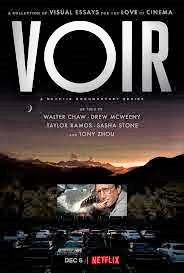
Streaming on Netflix - John Baxter draws attention to a new series devoted to analysing the movies - VOIR (Executive Producers David Fincher and David Prior, USA 2021)


VOIR OU NE PAS VOIR,

            What is one to make of Voir, the new Netflix series on what was called “film appreciation” and subsequently “film studies” but should now perhaps be re-branded “media aesthetics.” ?

             Serious discourse on film and television has taken a battering of late. Not in its quality, since the level has never been higher,  not even in the golden days of Cahiers du Cinéma. The deficiency is in the audience.  Those choristers to whom film aestheticians customarily preach are all tucked up warm in front of the TV. That just leaves the vicar, and he’s probably asleep.  

            With film journals largely moribund and publishing on film having retreated almost entirely to the academic press, the best discussion is on line, where Tony Zhou and Taylor Ramos, with their late lamented site Every Frame a Painting, cut a benchmark . Closely argued and illustrated with creatively chosen film extracts, their essays, generally in less than ten minutes, addressed with imagination, insight and wit such topics as Akira Kurosawa’s use of weather, the visual and, particularly, musical bankruptcy of the Marvel franchise, and Steven Spielberg’s mastery of those omnium gatherum shots known as “oners”. 


Tony Zhou

            David Fincher was a favourite of the duo –  check, for example, the admirably concise analysis of his style in And the Other Way is Wrong-  so it’s perhaps no wonder that Fincher has godfathered the entry of the series into the mainstream.

            Netflix enjoyed mixed success with previous exercises in the form. The Movies That Made Us  offered facetious behind-the-scenes accounts of making such hits as Home Alone, Ghostbusters  and Dirty Dancing, whileAttack of the Hollywood Clichés, fronted by an insultingly off-hand Rob Lowe, managed to qualify for inclusion among the shopworn tropes it purported to scorn. More adventurously, Life After Porn invited former stars of adult films to reflect on their careers and the industrial and social changes that ended them. None of these shows displayed a love of movies. Rather, any amusement or revelation was at their expense. 

            Zhou and Ramos have widened the focus of Every Frame a Painting  and lowered their sights. Of the six essays in the first series, two cater to a largely cine-illiterate audience by addressing general questions of perception, one on how animators create a character, the other on the fundamental differences in how we view film and television. 


Peter OToole as Lawrence

            The remaining four concentrate on individual films - Walter Hill’s 48 Hrs., Steven Spielberg’s Jaws, Park Chan-wook’s Lady Vengeance and David Lean’s Lawrence of Arabia – but all from the standpoint of sociology. 48 Hrs. is presented as a pioneer attack on racism, Lady Vengeance  as a meditation on the morality of retribution,  and the character of T.E. Lawrence as a paradigm of the “anti-hero”. Only Sasha Stone’s Summer of the Shark, the series’ curtain-raiser and – perhaps significantly, at 17 minutes, the shortest of the six – relaxes sufficiently to celebrate the innocence of 1975 and Jaws.

            Voir benefits from a new industry policy on the use of clips. Largely due to the persistent activism of Kevin Brownlow and other film scholars, copyright authorities now accept that publishing’s so-called “fair dealing” provisions also cover cinema. Clips may be used without permission or payment, providing they illustrate a specific point and the film gives immediate screen credit to title and copyright holder. This rule, more honoured in the breach by YouTube users, who  relegate such information to a final crawl, is enforced by Netflix,  often with deleterious effects. A montage of scenes from different films, for example, demands a screen credit for each, unleashing a blizzard of text as unreadable as it is distracting.

            While there’s little in Voir to surprise any graduate of Cinema 101, stimulation and even revelation sometimes reside in restating the obvious. 

            The Duality of Appeal invites animator Glen Keane (Beauty and the Beast)  to eschew the curve-based shapes that render a character “appealing” and design one based on straight lines. 


The unappealing character

The anonymous female he creates mimics the shape of a wine bottle, long and straight from hip to feet; also straight but narrower and shorter from hips to hairdo. Interesting, even attractive, but appealing? No.


Brigitte Helm - "Unappealing"

            Yet there was something about her that looked familiar. It took a moment to realise that her leggy body and long, sceptical face replicated characters from scores of films. She was the imperious countess, the no-nonsense friend, business-like manager or omni-competent administrator played by Brigitte Helm, Eve Arden, Valerie Hobson, Charlotte Greenwood and a hundred other sisters of the straight line. Was their casting – perhaps all casting - less a matter of acting and more of anatomy, even... architecture? With its capacity to offer such insights, Voir may yet aspire to Savoir.