Showing posts with label Charles Boyer. Show all posts

Tuesday, 5 July 2022

CANBERRA INTERNATIONAL FILM FESTIVAL 2022 - John Baxter remembers one of the highlights a restored copy of CLUNY BROWN (Ernst Lubitsch, USA, 1946)

Jennifer Jones, Cluny Brown

        In retrospect, 1946 was the wrong time to make Cluny Brown.  
In her 1944 novel, Margery Sharp gently satirized England’s pre-war landed gentry, a society of country-house weekends and cocktail parties, made possible only by an underclass of domestics and artisans, all eager to serve, and proud of “knowing their place” in an intricate hierarchy.  

Clover “Cluny” Brown is an orphan. Raised by her uncle, she lacks most social skills but is ambitious to follow him and become a plumber. His working-class accent makes it easy to “place” him socially, but Cluny, with no such signifier, is easily mistaken for a lady, with catastrophic results, as when some future upper-class employers think she’s “one of them” and invite her to tea. 

By chance, she meets Adam Belinski, a Czech intellectual and fugitive from Hitler, alone and friendless in London in the last few weeks of peace. The two outsiders forge an eccentric relationship that concludes with them travelling together to – *author’s message* - a classless America, where people reward Belinsky’s intellect and welcome Cluny’s working-class background as exotic and charming.

            Darryl Zanuck bought the novel as part of a deal with David Selznick aimed at widening the box-office appeal of Jennifer Jones, whom Selznick was about to marry. She had never played comedy and the role of Cluny looked suitable for a first attempt. John Cromwell was set to direct with Ernst Lubitsch as producer but when James Hilton’s script proved disappointing, Selznick moved on to his epic western Duel in the Sun, leaving Lubitsch and Samuel Hoffenstein to rewrite the story yet again, making it less a farce and more a comedy of manners with Belinsky rather than Cluny as its protagonist. Lubitsch also agreed to direct, ensuring a mittel Europeen treatment of the material.  


Jennifer Jones, Charles Boyer

Charles Boyer, who had proved his comedy skills in Tovarich, was an obvious choice to play Belinsky. At fifty, he had reached a difficult point in his career. For Clark Gable and Gary Cooper, grey hair and wrinkles enhanced their authenticity as men of action.  But for romantic leading men, particularly if they were foreign, the tendency was to cast them as priests, maitres d’ and the occasional head of state. Boyer would play all these in time, but for the moment he was ready to fight to keep his name above the title.

He already knew the novel. Sharp was a favorite writer of his British wife, and they had read it together when it ran as a magazine serial. Belinski was a character he had played before in Arch of Triumph andHold Back the Dawn. He and Lubitsch spent the war helping many such people find new homes in the United States. Men and women of heightened sensibility, they pined for a return to their former life, while knowing privately that it no longer existed. 

            Stranded in London with only one suit and no money, Belinsky seeks out an old friend in hopes of borrowing the rent, but finds his apartment occupied by a sub-tenant (Reginald Owen, resident silly-ass Englishman) whose sink is blocked on the very afternoon he’s hosting a cocktail party. An anguished call for a plumber produces, instead, the plumber’s resourceful niece, Cluny Brown. Thereafter, their fortunes entangle as she’s sent to work as a maid in the country house where he is, by chance, a house guest. Although Lubitsch mocks a society where having a dinner jacket is of greater importance than the activities of “that Hitler chappie,” he also applauds the generosity and good nature of the gentry, and their respect for the truly important things in life, in particular gardening and dogs. 

Jones showed little talent for comedy but Boyer took up the slack, helped by a strong supporting cast, mostly borrowed from MGM.  Peter Lawford plays a young engagé aristo and C.Aubrey Smith makes a token appearance, but Sara Allgood and Ernest Cossart steal the show as housekeeper and butler to Belinski’s hosts and Cluny’s employers. They deliver, straight-faced, quietly horrified autopsies on the two outsiders’ social blunders. “Her handling of the china has been sinister,” says Cossart, choosing from among Cluny’s numerous defects as a housemaid. 

Plumbing is only a minor theme in the novel but Lubitsch turns it into yet another means of mocking the class system. Cluny is eager to make plumbing her life, to the embarrassment of her uncle and others of her class, including the village pharmacist (a repeat by Richard Haydn of his strangulated-voice role in Ball of Fire), who sees her as a potential wife. The afternoon tea he arranges to introduce her to his censorious family ends in disaster when a blockage in the pipes tempts Cluny to demonstrate her skills in the toilet. 

The film’s release in June 1946 was a train wreck, beginning with a tepid reception in the United States. Audiences that wept for brave little Britain in Mrs. Miniver were puzzled to see the same society viewed obliquely from the perspective of Vienna, Berlin and Paris. 

Film-goers in the UK, still in an uproar over such Hollywood productions as Objective Burma!, which placed an Americanized Errol Flynn at the heart of the almost entirely British and Australian Burmese campaign, found the mocking tone particularly offensive.  One paper compared its view of class distinctions to “kippers fried in cream, an anchovy laid across a strawberry ice [or] any other simile that conveys complete and awful wrongness.” Another complained of “caricatured aristocrats and adenoidal chemists and self-conscious ‘characters’ and upper classes all seen as amiable half-wits, while the lower orders are smugly servile morons.” C. Aubrey Smith, doyen of Hollywood’s British contingent, published a formal apology for having taken part, and the film was pulled from cinemas after a week. 

Cluny Brown offers a snapshot of that moment in contemporary history when, having fought a war to preserve traditional values, the winners became increasingly doubtful that those values had any place in a post-war world. Within a few years, what the prologue to The Third Man would call “the old Vienna, with its Strauss waltzes and easy charm” – the world of Lubitsch, in fact – would be engulfed by the cynicism of that film and Billy Wilder’s black market Berlin in A Foreign Affair.Belinsky and Cluny might have been welcomed by a pre-war United States, as in the novel, but one fears for them in the wised-up world of 1946. 

SCREENS AT 1.30 PM ON SATURDAY 28 AUGUST 

To make a booking CLICK HERE

*************************

Editor's Note:John Baxter's most recent book is a biography of Charles Boyer  John is an Australian-born all-round writer, scholar, critic and film-maker who has lived in Paris since 1989 with his wife Marie-Dominque Montel and daughter Louise. His Wikipedia entry  details the many books he has written which include the first  ever critical volume devoted to the Australian cinema as well as studies of Ken Russell, Josef von Sternberg, Stanley Kubrick, Woody Allen, Federico Fellini, George Lucas, Robert De Niro and Luis Bunuel. His most recent book, one of a number of studies of Paris is A Year in Paris, described by the New York Times thus "In “A Year in Paris,” (Baxter) strings together the beautiful beads of the French everyday, all held together by the invisible act of imagination that makes a country cohere and endure." 

Saturday, 5 February 2022

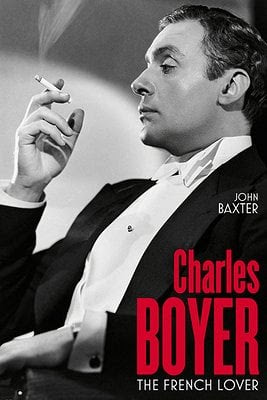
On Charles Boyer - John Baxter has written a lively biography of the French star - CHARLES BOYER:THE FRENCH LOVER


Early in Charles Boyer’s Hollywood career, director Gregory La Cava asked him “Do you think in English or French?” 

            Boyer replied that, though he was playing in an American film, he still thought in his native language.

            “There’s your problem,” said La Cava. “Until you learn to both think and act in English, you’ll never make it in pictures.”

            During a long career in which he won acting honours in both Europe and the United States on screen, stage and television, Boyer often quoted this story. For a time, he tried to follow La Cava’s advice, but finally came to believe that, in whatever language he acted (and Boyer was fluent in five of them), he would remain always, mentally and emotionally, French. 

            For generations of film and theatre audiences, Boyer was the archetypal Frenchman, cultivated, courteous, seductive, yet never quite at home in a culture not his own. The sense of loss conveyed in his murmuring baritone voice was the very essence of romance. Women longed to comfort him, men to become his friend.


John  Baxter (in Paris)

            One would not have been surprised to find that the real life Boyer was a playboy and serial seducer. In fact, he was intensely private, thoughtful, and both intellectually and political astute. Nominated four times for Academy Awards, he was honoured by the Academy only once, for his activities on behalf of France during World War II. Married to the same woman all his life, he was so devoted to her that, two days after her death, he killed himself, the dying fall of an often tragic life during which he lost his only son, also to suicide.

            It’s arguable that Boyer’s refusal to commit himself completely to any one language or medium was the secret of his remarkable success.

Having established himself as a jeune premier in the theatre and cinema of France, he sailed confidently through the transition from silent film to sound, made his name as a romantic leading man in Hollywood during the 1930s and 1940s, adapted to postwar character roles in both Europe and the United States, entered television in the 1950s as both producer and performer, and would, one feels, have gone on indefinitely had not personal tragedy intervened. 

Even after death, an aspect of his talent survived, in the form of his distinctive voice, which animator Chuck Jones co-opted for the character of Pepé le Pew, the seductive skunk of the Oscar-winning cartoon series.

Far from clinging to the performances that made him famous, Boyer showed a readiness to break the mould. After playing the doomed Continental lover in Algiers, he was a credible Napoleon in Conquest opposite Garbo, re-emerged in the sentimental comedy romance Love Affair, only to remake himself once more as the malevolent manipulator of Ingrid Bergman in Gaslight. 

His choice of roles during and after World War II shows a shrewd perception of his image. Realising his accent would always mark him as an outsider, he embraced that trope but also subverted it  In Hold Back the Dawn, he was a European gigolo loitering on the Mexican border, ready to seduce some tourist into marrying him, a role he reversed in Arch of Triumph as a principled Austrian doctor, stranded in Paris with little hope of evading the advancing Nazis.

At a time when actresses were expected to swoon into the arms of their male lovers, Boyer more often chose leading ladies who declined the submissive role in their relationship. Irene Dunne was his foil in Love Affair and Ingrid Bergman a worthy adversary in Arch of Triumph  and Gaslight, while in The Garden of Allah Boyer’s character is the plaything of women, first of Tilly Losch, who vamps him in a memorably erotic dance, then of the supremely confident Marlene Dietrich. 

Boyer appeared frequently on stage both in the United States and France, put his career on hold during World War II to become politically active on behalf of his occupied home country, and remade himself as a comedy performer in the 1960s, as much at home, it seemed, playing slapstick in I Love Lucy as in Neil Simon’s sophisticated Barefoot in the Park opposite Robert Redford and Jane Fonda.   

***************

Editor's Note:John Baxter is an Australian-born all-round writer, scholar, critic and film-maker who has lived in Paris since 1989 with his wife Marie-Dominque Montel and daughter Louise. His Wikipedia entry  details the many books he has written which include the first  ever critical volume devoted to the Australian cinema as well as studies of Ken Russell, Josef von Sternberg, Stanley Kubrick, Woody Allen, Federico Fellini, George Lucas, Robert De Niro and Luis Bunuel. His most recent book, one of a number of studies of Paris is A Year in Paris, described by the New York Times thus "In “A Year in Paris,” (Baxter) strings together the beautiful beads of the French everyday, all held together by the invisible act of imagination that makes a country cohere and endure." 
Saturday, 29 January 2022

On Blu-ray - David Hare rejoices at the rebirth of LOVE AFFAIR (Leo McCarey, USA, 1939)

Charles Boyer

The images above and below are from Leo McCarey's glorious and long lost 1939 Love Affair.

New 4K scan and restoration to Blu-ray from Lobster Films and MoMA.
While the release of this "lost" film, is extremely welcome, you shouldn't be expecting to see an image quality at the level of the best Warner Archive work under George Feltenstein and the MPI team there.
The new Lobster is clean, delicious and detailed enough to finally make out what's happening on the screen. The history of the film elements is typical but always interesting. Basically when Fox picked up the rights to remake it (virtually shot for shot) in 1957 as An Affair to Remember, they trashed the original RKO o-neg and prime elements which they inherited from the property deal and with RKO now legally deceased. Subsequently one could only see Love Affair in battered, faded 16mm prints of varying degrees of awfulness from TV syndication prints and worse. 

My own copy came from a Channel 7 midday movie screening taken from a 16mm kept in someone's garage. I haven't looked at it since I dubbed my VHS to DVD-R twenty plus years ago. 

Irene Dunne, Charles Boyer

The restorers here took on an all too similar situation to Sony/Columbia with it's recent restoration of Cukor's 1938 Holiday which Criterion released last year. Once again there Grover Crisp's team had a duplicate nitrate neg and various 35mm safety positives including a fine grain (a good quality reference but not projectable positive print variously known as a "lavender") from which the technicians can rework a new interpositive or something close. 

Sony delivered the results after 4K scanning with the decision to let through virtually un-mangled as much grain as possible from the new 4K master. It's a grain level that was not uncommon in the history of movies but nowadays it's a difficult sell to modern audience used to digital cleanup.
With Love Affair, Lobster and MoMA were faced with the decision to either go with the grain or massage the image back. They took the latter decision which is both cheaper (much lower bitrate and grading costs) and understandable and the result is a very serviceable and pleasing disc image and audio, with very light grain but considerable softening through the grain removal. 


Happily the DVNR never creates waxiness. It's up to you whether you like this or would have preferred a much grainier and still less than perfect first generation positive distribution print quality. Given the circumstances these days around sackings, studio Archival reductions, cost cutting and worse, I think Lobster has taken a sensible path. If money were no object, this might have come out of the works looking "better". As it is Love Affair looks "Good" and often "very good". And most importantly it gets the title back into the public eye, for which I salute the film, Lobster and MoMA without reservation.

Sunday, 24 January 2021

On Blu-ray - David Hare rejoices in the Lobster Films/MoMA restoration of Leo McCarey's LOVE AFFAIR (USA 1939)


The screens are of Charles Boyer and Irene Dunne in Leo McCarey's glorious and long lost 1939 Love Affair.

New 4K scan and restoration to Blu-ray from Lobster Films and MoMA.

While the release of this "lost" film, is extremely welcome, you shouldn't be expecting to see an image quality at the level of the best Warner Archive work under George Feltenstein and the MPI team there.

The new Lobster is clean, delicious and detailed enough to finally make out what's happening on the screen. 

The history of the film elements is typical but always interesting. Basically when Fox picked up the rights to remake it (virtually shot for shot) in 1957 as An Affair to Remember, they trashed the original RKO o-neg and prime elements which they inherited from the property deal, with RKO now legally deceased. Subsequently one could only see Love Affair in battered, faded 16mm prints of varying degrees of awfulness from TV syndication prints and worse. 


My own copy came from a Channel 7 midday movie screening taken from such a 16mm kept in someone's garage. I haven't looked at it since I dubbed my VHS to DVD-R twenty plus years ago.

The restorers here took on an all too similar situation to Sony/Columbia with it's recent restoration of Cukor's 1938 Holiday which Criterion released last year. Once again Grover Crisp's team there had a duplicate nitrate neg and various 35mm safety positives including a fine grain (a good quality reference but not projectable positive print variously known as a "lavender") from which the technicians can rework a new interpositive or something close. 

Sony delivered the results after 4K scanning with the decision to let through virtually un-mangled as much grain as possible from the new 4K master. It's a grain level that was not uncommon in the history of movies but nowadays it's a difficult sell to modern audience used to digital cleanup.  

With Love Affair, Lobster and MoMA were faced with the decision to either go with the grain or massage the image back. They took the latter decision which is both cheaper (much lower bitrate and grading costs) and understandable and the result is a very serviceable and pleasing disc image and audio, with very light grain but considerable softening through the grain removal. 


Happily the DVNR never creates waxiness. It's up to you whether you like this or would have preferred a much grainier and still less than perfect first generation positive distribution print quality.  

Given the circumstances these days around sackings, studio Archival reductions, cost cutting and worse, I think Lobster has taken a sensible path. If money were no object, this might have come out of the works looking "better". As it is Love Affair looks "Good" and often "very good". And most importantly it gets the title back into the public eye, for which I salute it without reservation.

Saturday, 13 June 2020

Nostalgia - Quiet Days in Hollywood


Jean Renoir,  André Daven, Robert Florey
& Charles Boyer
(Thanks John Baxter)