Showing posts with label Arthur Freed. Show all posts

Tuesday, 17 September 2024

On Blu-ray - David Hare looks over the 'staggering three strip restoration' of WORDS AND MUSIC (Norman Taurog, USA, 1948)


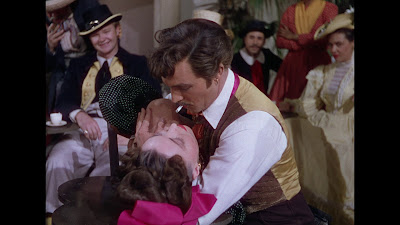
The screens are from Warner Archive's new Blu-ray of the Norman Taurog 1948 Words and Music.

ThIs is a very late entry in the Musical composer and lyricist bio pic sub genre from the Freed Unit although it has the impossible task of carrying as big a story as RIchard Rodgers and Larry Hart.
While Mickey Rooney's drunk scenes (above) give us a pretty blunt feel for Hart's alcoholism, the screenplay can do no more than barely blink at Larry's deeply closeted queerness, thanks to the Breen Office. And the momma's boy presentation is frankly confounded by too sympathetic an Oedipal figure in the form of Jeanette Nolan, fresh from her Lady Macbeth for Orson Welles, but now niced-up for la Hart mére..
So Taurog, ever the faithful Metro hack delivers relatively static and proscenium based iterations of some of the great Rogers and Hart numbers, even a knockout Lena Horne in "Lady is a Tramp" in which he actually resorts to a crane shot to give the number some basic animation. But the movie is a slog, for all that and for the many, many artists paraded through it


Finally, the movie is rescued by two completely unexpected and extraordinary sequences which knock your socks off: One the staging of "Slaughter on Tenth Avenue" with Gene Kelly and Vera Ellen (above) which rocks with Kelly's very obviously self-imposed staging and mise-en-scene. Not to mention the big brass arrangements by orchestrator Conrad Salinger.
And the second, most intriguing of all is a sequence after a big party has ended and Larry, now drunk and morose, asks Mel Torme (below) to sing him "Blue Moon.". I don't know how the gods of intervention suddenly stepped in on behalf of the ever-turgid Taurog but the sequence fixes itself into two setups, one tight CU of Torme, apparently singing the number to Hart, and a reverse medium with a track into medium close to a completely floored Hart who seems to be lapping up the moment at the most intense personal level. The number plays like a breakthrough scene for putting Harts homosexuality out there, and I for one lapped it up, like who knows how many young queer kids in the audience sitting in the dark when the movie first played who felt the same way. 


There we were, Mickey Rooney of all people playing Larry Hart, of all people, and staging the sequence to play as a love song from one man to the other. God only knows this could not in a million years have come out of the mind of Norman Taurog, but somehow it did.
If you need another reason to check it out, the three strip restoration is, once again staggering.

Wednesday, 10 March 2021

SLIGHTLY OUT OF TUNE. - John Baxter sends in his thoughts regarding THE GREATEST MUSICAL SEQUENCE.

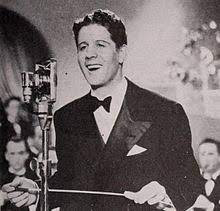
            London’s film scene in the seventies was enlivened by programmes assembled by the critic Philip Jenkinson (pictured above) from his collection of clips from antique musicals.  They gave many of us a first look on film at such legends as Ruth Etting and Jane Froman, the young Rudy Vallee and Bing Crosby, as well as a chance to relish those early filmed revues in which chorus lines stamped out heavy-footed routines with the precision (and tread) of infantry on the march,  not to mention bandleader Paul Whiteman, “the king of jazz”,  illustrating its roots by emptying into a giant melting pot a succession of national musical styles – Irish, Spanish, Italian – without a single black face to be seen. 

Rudy Vallee

            Sometimes Phil included clips from Europe: Tino Rossi, in costumes ranging from gypsy to bullfighter, but always the same reedy tenor;  husky German stars such as Zarah Leander with near-baritone voices to match; Jack Buchanan’s tailor’s dummy presence and the West End tremolo and art deco dancing of Jessie Matthews. And of course Marlene, showing how much could be achieved with two notes – and, naturlich, two legs. 


Zarah Leander

            But such clips only proved that musicals were something the Americans did best. Most European performers made their money on stage or with records. Cinema was a sideline. Not so the Americans, who, with the growing output of Hollywood, could afford to specialise.  The greatest artists of the American musical were triple threats in acting, song and dance. Add what James Mason called in A Star is Born “that little something extra” and you had a Garland, a Kelly or an Astaire. 


Ann Miller, Bobby Van, Kiss Me Kate

            But there were gifted performers too in the group whose “something extra” didn’t quite measure up. Bobby Van danced with the best – look at his rooftop duel with Bob Fosse in Kiss Me, Kate – and possesed an engagingly larrikin acting persona. Fantasising about Betty Garrett’s sister Eileen, a gorgeous young Janet Leigh, creamy and luscious as an eclair, he murmurs, in a line tumescent with implication, “I’ve been turning her over in my mind all afternoon.” But he arrived a decade too late for the golden days of the musical.

            Lucille Bremer came closer than many to the pantheon, her red-headed haughtiness the perfect foil to Garland in Meet Me In St. Louis. She and Astaire played off one another sublimely in This Heart of Mine, from the wartime anthology Ziegfeld Follies, as suave jewel thief and his quarry, waltzing through an absurd Harper’s Bazaar set of magenta walls, decorated with white-painted tree limbs and plaster statues with masks.


Lucille Bremer, Fred Astaire, Yolanda and the Thief

            Her big chance, again with Astaire, came  - and went - in the ill-starred Yolanda and the Thief.  Surrealist dream imagery collided with South American baroque in this catastrophic stylistic pile-up, after which not even the “little something extra” of being the mistress of producer Arthur Freed could save her career. She lacked, her lover decreed coldly, the ability “to carry a film,” and was exiled to the Siberia of the second feature. 

            A few gems from Yolanda survived the wreck. In one, Bremer’s heiress, convinced swindler Astaire is her guardian angel (I did warn you), tries to make him feel at home by providing a huge gilded harp. Astaire, unfazed  (was any performer less fazable?) sits down at the instrument to pluck and strum out a serenade with an amused arrogance that never fails to charm.  

            With perfection the norm in musicals, the flawed became perversely attractive. Hoagy Carmichael’s melancholy croak made Johnny Mercer’s words to his own Skylark sound as if they’d been marinated in Jim Beam and hung up to dry in the smoke from a thousand Lucky Strikes, while a gangling Buddy Ebsen’s calculatedly awkward soft shoe in Born to Dance just made the grace of Eleanor Powell appear that much more effortless. One could even enjoy watching Joan Fontaine apologetically faking her way through a sort-of-dance opposite Astaire in A Damsel in Distress.  Such was the alchemy of Hollywood that the feeblest performance did not just shine but caught fire. 

Joan Fontaine not dancing with Fred Astaire
A Damsel in Distress

            Of course we all loved the great setpieces. As the camera craned slowly from long shot into a medium close-up of the stars, meticulously groomed and coifed, and their high-priced throats opened to reveal each tonsil chromed to a gleam, all else receded as we luxuriated in their expertise. But at such times, the writer in me often fidgeted.  In narrative theory,  recourse to song and dance is justified only if the characters can express themselves in no other way. And the problem with show-stoppers is they often also stop the story stone dead. 

            I treasure those moments in film where, without an appreciable shifting of gears, the performers pick up in song and dance what they can no longer convey in words. In such a moment from New York New York, Robert DeNiro’s jazzman auditions for club owner Dick Miller.  As the men nearly come to blows, wife Liza Minnelli steps in with an a capella You Brought a New Kind of Love to Me and, dancing around De Niro, coaxes him, in a bar or two, into an accompaniment, then a duet. Brief and satisfying, it’s a sequence worth it just for Minnelli’s crazy pie-crust hat. (There is a copy on YouTube )

            Then there’s Peter Bogdanovich’s What’s Up Doc?  Ryan O’Neal emerges from a hotel elevator at a floor under renovation. Sitting down at a fortuitous piano, he pulls a sheet off the instrument to reveal a recumbent Barbra Streisand. “C minor seventh,” she says conversationally and, as he, bemused, plays that chord, she eases into As Time Goes By, while, in the picture window behind them, San Francisco disports itself in the Californian sunshine. That the same director could make the overblown live-recorded At Long Last Love is yet another demonstration of the hubris that can destroy the most gifted.  But isn’t it by the reflected light of its failures that the musicals’ diamonds shine?  

Editor’s Note: John Baxter’s note above is, in part, a response to a piece by David Hare in which proposed that "the greatest number ever written for a musical or a movie!" is 'Make Believe' from SHOWBOAT (George Sidney, USA, 1951). 

You can read David’s thoughts if you click here

Contributions and reactions are welcome. Send them to filmalert101@gmail.com

Friday, 29 January 2021

On Blu-ray - David Hare welcomes the new edition of Vincente Minnelli's masterpiece THE PIRATE (MGM, USA, 1948)

Gene Kelly, The Pirate

Minnelli's The Pirate was released in May 1948 after two years of gestation, and a history book's worth of gossip, trouble, tantrums, changes, disagreements, censorship, Garland’s latest breakdown, her divorce from the director and a cost overrun that left the picture floundering with more than 2 million (then a fortune) of debt for MGM. It’s never made its money back to this day.


Despite this, the movie is I am sure the most elegantly conceived, formally extended, most sophisticated and whimsical musical ever to come out of the Freed Unit. It’s perhaps the very greatest work of the highest imaginable aestheticism and design, casting, dance, performance, color and self-reflection, all carried by a minor narrative whimsy in the "once upon a time" mode from a very slight 1942 S.N. Behrman stage work, to a complete re-write which inverts the character impersonation theme totally by Goodrich and Hackett and a fully commissioned new score by Cole Porter, with the battery of the Freed Unit's peerless team of artists and crew, not least, Roger Edens, Robert Alton, Kay Thompson and, for the first time at Metro, costume designer Tom Keogh. His wardrobe broke the bank and every expectation for a conventional “period look” but instead complements the films seductively narcotic color design. If ever a film was made for the three strip negative, dye transfer positive printing process in 40s Technicolor, it’s The Pirate.
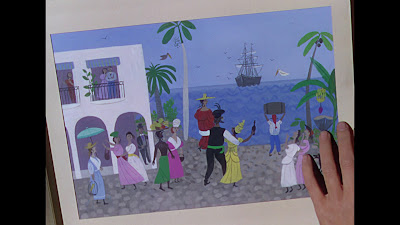


The picture begins after the credits with a red leather bound title cover page, followed without a cut by a series of exquisite water colored faux naif "storybook” illustrations (above) of the movie’s materials concerning the pirate, Mack the Black Macoco, and his fabulous exploits of pillage, swashbuckling and expressively direct masculinity, all read by a breathless Garland over the turning pages. Then without a cut, Minnelli pulls the camera slightly back from these gorgeous pictures (by Metro studio artist Doris Lee) and the amber tanned hand of Judy’s arm, playing Manuela (below) comes into shot, and then we track further back to group shot with even more hallucinatory imagery in three strip dye transfer Technicolor of the tale teller with her cohorts, as the driver of this great erotic fantasy. 
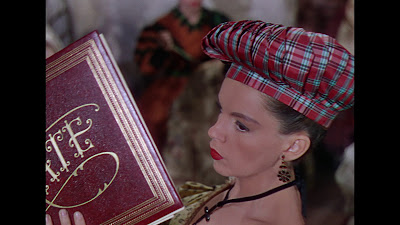


The film never leaves this hallucinatory realm of color, design, movement , costume and music. Each sequence to run the narrative opens with a reveal of the next persona in close or medium and the camera which by now has established its identity as another character, one of us, the audience adopts a life of activity with the most brilliant tracks, cranes and dollies seen in the forties. 


Kelly uses the film to pioneer his own ideas about male dance extending the three minute routines to ballets of solo male with chorus. The first musical number in the film comes just fifteen minutes in and introduces Kelly, and his travelling group of players. The sequence is set in what looks like an immense open air portside scene, and it certainly appears to be the film’s only exterior shot, but it’s simply the Metro backlot with a crane that stays with Kelly  for the first two minutes of the sequence from ground level to way on high 
(above) to the town and then a cut which begins the first verse of Cole Porter’s dazzling “Nina”. 
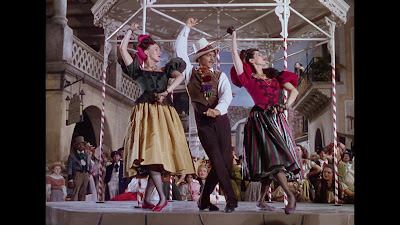


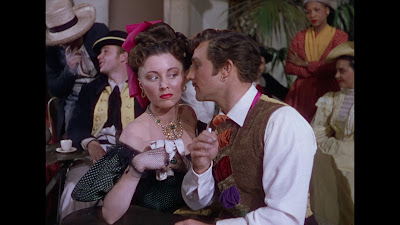
Kelly stages the song, an emblem of Porter’s wit and sophistication if ever there was one, with winks to the audience about psychiatry and unresolved passion. “Nina” all up is brief and funny but Kelly then stages a ballet up down through and over every corner of the set ending the first part of this six minute marathon with a completely debauched open mouth kiss with one girl (below), with the cigarette with whom he plays a tongue trick taking the cigarette into his own mouth and then swinging her over to kiss her, opens his mouth with the cigarette intact. This outrageously carnal gesture announces the second three minutes of this gob smacking sequence in which Freed’s and Metro’s greatest individual music arranger, Conrad Salinger now takes over Cole’s song and the score and orchestrates the next three minutes without lyrics totally for Kelly’s ballet as a solo with chorus into a tour de force of Bolero rhythm, complete with a blistering trumpet solo, all of which take the number into the stratosphere. 


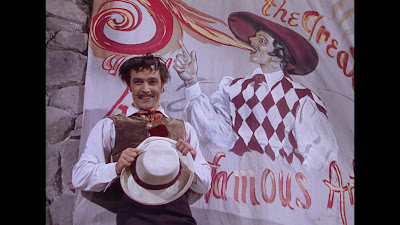
I think “Nina” is my favorite musical number in Freed musicals. The camera becomes in effect Kelly’s dancing partner, moving through and back, away and forward, to observe the dance, which climaxes, literally with woman after woman after woman throwing themselves at Kelly on the town square “stage”, to be “used” with a quick footed spiral step and then spun off the stage as discarded bounty. The number ends with Kelly racing from the town square which has just hosted this past six minutes of pure sex, and travels with him up and into a close-up against his own image painted onto a poster for their travelling circus’ show (below). 


It’s one of those devastating bravura Minnelli sequences that fully embeds all the strands of the film into the imagery – performance, desire, impersonation, lust, rejection and theatre as performance of someone else’s “reality”. It clearly sets the page for Kelly’ big dance expansions into the ballet mode which were embedded into his and Minnelli’s An American in Paris  five years later. But I now find Nina superior formally to the relatively literal Gershwin ballet and even its fine choreography and ace DP John Alton’s Oscar winning Noir-esque color filtered photography on that picture.Thus a basic Porter number meets Salinger and Kelly and the full resources of the Freed unit and extends into a titanic major sequence to end the first act.


The movie lost at least two of Cole’s original songs during production, including one cut by the appalling Louis B Mayer as too “depraved”, “Voodoo”, which would have followed the first rendition of Mack the Black by Garland under hypnosis and chorus in the show tent. Other items were changed or shortened – the “Light of my Life” number survived only one verse, but its presentation as it stands now is flawless, preserved in a single one minute take with Garland singing to Kelly.


Indeed even Garland’s now visible amphetamine addiction is put to use in two sequences which Minnelli apparently directed again with a minimum of takes. Interestingly enough, although Judy was absent for over 100 days of shooting time, thanks to Mayer’s criminal regime of prescription addiction that was finally bringing her again to breakdown, she has never given a better performance in my opinion either physically or vocally. She can throw a tantrum and a room full of furniture at Kelly in the exposé sequence, but her vocal range keeps her performance bedded in control. And like Judy, Kelly, too has never been better nor more beautiful, never sexier, never more self-aware or more exhilarating. Certainly his part in the second “Mack the Black” routine in which he does the ballet wearing leather hot pants and a tea towel, with the body of a prime athlete in devastating peak condition, ends as always with the image of his face bursting with the sheer excitement of completing his number. 


There’s not a trace in The Pirate  of the overbearing egotism that cruels so many of the final closeups in Kelly’s numbers from Singin’ in the Rain. The material for The Pirateis so sharp, so sophisticated, so far ahead of its time, even for Freed, one of the joys of watching the movie is simply seeing the satisfaction the leads are taking in their parts, including I must add Walter Slezak, to whom Minnelli gives some of the most affecting and moving close-ups in the picture as Garland renounces him. Never has desire looked so bleak, even in this glorious phantasmagoria.


It’s very difficult to pin this movie down, either as a Freed canon work, an avant-garde musical avant-la-lettre, a Minnelli masterpiece of the purest formal beauty and mise-en-sceneI think it’s simply all three. There’s no more dazzling musical formally in the Hollywood pantheon, even Minnelli’s earlier 1944 Yolanda and the Thief which has several similar tropes, and a bobby dazzler of a central six minute choreographed sequence with Astaire and yet another bevy of menacing women in prime Technicolor wardrobe, “Will you Marry Me.’ 


At this point Yolanda is likely a personal expression of Minnelli’s own terror and/or ambivalence as a basically gay man about to marry Garland. The sheer panic of that dance and the movie’s very thin plot is very readily wiped out at the end of Yolanda with the superbly composed “Coffee Time”, choreographed by Astaire and Eugene Loring which runs the dancers in five/four time against a score written in four/four time. The number effectively overwhelms Yolanda’s narrative thread, and resolves the matter with such a perfectly refined musical trick for the end.


For the Finale of The Pirate  Freed and Minnelli obviously needed something that was both still hip but able to bring down the temperature from the astonishing 95 minutes that preceded it. So Cole wrote “Be A Clown” and that great number, itself a dedication to the world of show business, brings the two leads, and the Freed team of artists to a close of a perfect movie.


Warner Archive’s new Blu-ray of The Pirate was taken from new 4K scans of the original Tech nitrate three strip negatives. The image and sound (12 bit uncompressed mono) are in perfect service to the movie they restore. It looks and sounds, if it’s possible, better than it did in 1948.