 |
| Michael Winterbottom |
The funniest moment in Michael Winterbottom’s 24 Hour Party People (2002) has impresario Tony Wilson (played by British comedian Steve Coogan) being caught with his pants down, literally. He’s sitting inside an OB van, a prostitute exuberantly fellating him, when his wife (Shirley Henderson) flings open the door and catches him red-handed, as it were. Usually quick on his feet, this time he’s very much on the back one. And all he can come up with is a vehement but totally unconvincing “This is not how it looks”.Winterbottom might have adopted the same line in regard to the sex scenes that turned 9 Songs into tabloid fodder, but it wouldn’t have been any more persuasive than Wilson’s desperate blurting. It’s clear that it’s exactly how it looks: the actors, Kieran O’Brien (who’d previously had a small part in 24 Hour Party People and worked with Winterbottom on Cracker) and first-timer Margo Stilley are having sex.
Most of the commentary about the film suggested that this is all they do, and that it’s all the film is about. But while it’s true that Winterbottom has said that he wanted to depict in explicit detail the side of relationships that is routinely elided with a cut or a tasteful dissolve, or simulated, 9 Songs creates a context for the interactions between his lovers that makes the suggestion extremely misleading.
As the film begins, the relationship is over, Matt musing about it in voice-over as he flies over the Antarctic in his new assignment as a geologist. He also ponders the vast white mystery of the landscape beneath, noting that it’s a place where “you can suffer claustrophobia and agrophobia at the same time, like two people in a bed”. The Antarctic remains a key reference point throughout the film.
The title alludes to the number of concerts Matt and Lisa attend, together or separately, after they first meet at a Black Rebel Motorcycle Club gig at the Brixton Academy. As the film tracks the course of their relationship, sex scenes and musical performances (including Michael Nyman’s for his 60th birthday) make up most of the brief running-time.
They’re an ordinary-looking couple, unglamorous, anonymous, like people you might pass in the street and forget an instant later. Which is part of the point: this is not a glossy Hollywood delve into the disreputable, nor does it invite the kind of voyeuristic engagement or titillation that one might encounter with porn. Shot digitally, it’s intentionally grungy, the camera spending at least as much time gazing at the characters’ faces as they register ecstasy, amusement or displeasure as it does watching their sexual couplings. Rather than simply sight-seeing, it seems to be grappling with the mysterious links between action and response, pointing, like Jonathan Glazer’s camera in Birth (2004) to the unfathomable that lies within.
The exploration of unknown terrain is central to the film. It’s not by chance that Winterbottom has Lisa give Matt a book about the Antarctic for his birthday, reading from it a passage about how icebergs are like a microcosm of the Antarctic as a whole, doomed to disintegration. Central to the film is a reminder of the transience of things: sexual arousal, the excitement of a concert, the pleasure of a relationship. If the icebergs and Antarctica melt to nothing, then what chance do Matt and Lisa have?
The use of Michael Nyman’s score, borrowed from Winterbottom’s earlier Wonderland (1999), leaves traces of melancholy on everything that happens. And they’re there from the start, just as they are whenever Nyman’s music turns up in Winterbottom’s work (as, for example, in the various versions of his films and TV series developed from The Trip).
The above is a slightly revised version of my review of 9 Songs originally written for The Sunday Age. I interviewed Winterbottom about it in May, 2005, in a public Q&A at ACMI immediately following the film’s Melbourne’s premiere.
*****************************
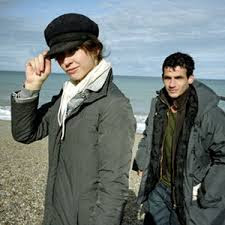 |
| Margo Stilley, Kieran O'Brien, 9 Songs |
Tom Ryan: Are you disappointed at the way that the critical response to 9 Songs has dealt only with the sex scenes and not the context that you’ve created for them?
Michael Winterbottom: Critical response is always very varied. You get good reviews and bad reviews and interesting reviews and boring reviews. To be fair, the starting point for that strand of the story was: why can’t you show two people making love in the cinema? If you’re going to make a love story, why isn’t it possible to try to deal with the most intimate physical aspects? Not that that’s the whole love story at all, but that’s part of it. So why is it excluded? So I wasn’t really surprised that that was picked up on by the press.
OK. But, to explore the context a bit, why the Antarctic as the point from which William narrates the story?
At the most basic level, it was just a place for him to look back from. When we began the story, we didn’t know exactly what the boundaries between the different strands would be. I didn’t know that there were going to be nine songs, I wasn’t sure how much would be Matt looking back on the love affair in the Antarctic and how much would be the love affair itself. So, to be honest, that’s always been somewhere that’s interested me as a place and I’ve always wanted to go down there. And it just seemed that it would be an interesting context for him.
When we started making the film, we started with the things between the two of them at the concerts and I thought the Antarctic was going to be for a different film. But it became the bookends, the starting point for the film, although I still hope to make a proper film in the Antarctic at some point. This was just a warm-up.
But you do make extensive use of it in the film. You keep coming back to it.
Well, I think the idea of the film was to try to look at the love affair more in the way a song or a poem might do rather than a normal film. And not to worry too much about the detailed life of the people outside of their making love. To not worry about the story or the plot, but to try to have a more lyrical approach. So, yeah, in a sense there are elements of the Antarctic that kind of correspond in some sort of way to the affair. But it sounds a bit pretentious to be stuck here talking about that. So really it was just a starting point…
How did you decide on these particular character types?
Really it was the casting, which is always obviously very important, but especially for this film. If you’re working with actors who’re improvising, it’s bound to be more important because there’s going to be more of them in the characters. So it was really just a question of finding two people who wanted to do the film and two people I thought would be interesting to film. So once I chose them, it was a question of two people making love and seeing what would come from that.
But you weren’t looking for George Clooney and Nicole Kidman. You were looking for particular character types here, weren’t you?
Well, two particular individuals. If we’d found two different people, obviously it would have been a different film. Really, there was very little prescribed before we chose them.
What about the structure that you decided on: the scenes between the couple punctuated by the songs? At what point in the process did that emerge?
Well, ever since 24 Hour Party People I’ve wanted to do a concert movie. Because when we did that film we spent a lot of time recreating bands’ concerts and it just seemed like it would be very simple and enjoyable to get the real bands and film them. So I think we did about four or five days with just the two of them in the flat and then we went to see… I think the first couple of concerts we went to see were Super Furry Animals and Black Rebel Motorcycle Club, and it just seemed actually that that rhythm for the filming was very good.
We went from the two of them alone together to this big crowd and the energy and the music. And so really it was probably through us filming like this that it became the shape of the film as well. It developed as we were making it. It wasn’t a sort of blueprint before we started. It was more a case of let’s start and see what happens.
To what extent then is the film an exploration for you of what might result from providing actors with general directions, switching on the camera and seeing what happens?
For me it’s always enjoyable when you’re filming if you’re looking for something to happen that day. For me, it’s not as if you’ve got four pages of the script to get through and then you’re finished. You have a situation and you have characters and you hope that something might happen.
What’s been your response to the hostility that’s been directed at you because of the film’s sexual explicitness?
When we started making the film, everyone said it was pointless making it because it wouldn’t be allowed to be shown in the cinemas. It would be classed as pornography, and so why bother making it? The good thing is that when we finally finished the film and showed it to the censors in Britain, they passed it without any cuts at all. So it’s been interesting…
In some quarters, the actress’s retrospective regrets about doing the sex scenes, or at least about not being able to remain anonymous, has turned into an ethical challenge against your use of her? That is, that you’re more experienced and should have known how she’d feel… Is this fair criticism, do you think?
Well, I think you should talk to Margo Stilley. On the basis of all the times I’ve met her since shooting the film, she doesn’t regret doing the film at all. What happened was: when we first showed the film, it was at the market in Cannes to try to get the money to finish it. She decided at the last minute not to come down, that she didn’t want to do press. As soon as the British press found out that she didn’t want to be interviewed by newspapers, they immediately sent journalists half way around the world to talk to her mother and her grandmother, and ran endless stories about her. But it wasn’t a big decision on her part that she didn’t want to do press at that point.
She’s done a lot since and she doesn’t regret being in the film at all.
On the subject, what’s interesting is that a lot of journalists, in Britain anyway, have assumed somehow that Kieran must be very happy to have been in the film. Because he’s a man, therefore he must be very pleased to be having sex in the film, whereas Margo, the woman, must be being exploited. Actually, having worked with them over the whole period, I think it’s a very intimate thing to do, a difficult thing in some ways, but something they wanted to do. And it was a very similar experience, I think, for both of them. Just because one is a man and one is a woman doesn’t mean to say it was completely different experience for them.
I have to ask this question: why was it necessary for them to have real sex as distinct from simulated sex?
Well that was the whole starting point for the film, in a way. I was trying to create a situation that’s as natural and relaxed and as real as possible, and then when you get to a sex scene in a normal context, it’s very awkward. It’s not as if actors don’t have to do intimate things on film: they might be in bed together, they might be kissing, they might be stroking each other’s bodies, they might be naked. There’s a whole set of rules, and boundaries, about how to do it. So it’s very hard to get any feeling of honesty or feel like you’re capturing anything that could be equivalent to the intimacy involved in making love to someone you love.
Obviously there are thousands of films and love stories that succeed in making you feel that way, but I thought it was interesting to try to capture the intimacy of having them really making love in bed rather than pretending to do it. And when we made the film, when we started I didn’t know whether I would like it or whether the actors would like it, or whether the crew would like it. But actually, after a few days, it became very normal and actually more relaxed than it would have been on a set where they were actually faking it.
Question from audience: Do you feel a camaraderie with other directors, say Catherine Breillat, who perhaps have something daring or original to say and who’ve made films about sex in recent years?
I’m not sure I’d call it camaraderie. Obviously a lot of films deal with sex in some form or other, but, in starting this, the idea was really very simple: not to use sex as a metaphor for anything, not to try to make a film about sex as a problem. But just to make a very, very simple film about two people in bed together, one person remembering the woman he’s had a relationship with and just trying to capture something of what his memories of this woman might be.
Other films that do sex are interesting. I’m just trying to deal with it very naturally and very simply. Of course, they happen to make love, but as part of a love affair, it seems to me that it’s very natural. I think that it’s not really such a big issue that there’s sex in it. I don’t really get what the problem is, of seeing two people making love. It’s what most people want to have as part of their lives. And it’s sort of odd that there’s some taboo about it.
Question from audience: Everybody seems to be focused on the sex in the film, but if the sex is real what about the drug use? Was that also real?
I think no comment is my response to that. I’ve got enough problems as it is.
Question from audience: How do you get the money to make the films you want to make?
We really only make one film a year and you probably only need two or three people to finance it. Some films take a long time, or never happen, other films happen straight away. It’s a bit like a lottery…
Question from audience: Why did you choose that muddy brown film stock?
We shot the film digitally, on DV. It’s more lightweight, which means you can film for about 40 minutes. So it lets you get the camera right up close to people, and it’s very quiet as well. When you get that close and hand-held, it’s always a bit of an issue with sound… just trying to capture fragments of memories…
From my point of view, it’s enjoyable not to always make the same kind of film.
 |
| Michael Nyman |
TR: I can’t interview Michael Winterbottom and not ask how important to you is Michael Nyman’s music?
I love Michael Nyman’s music... In fact, we’re just working on the score for Tristam Shandy [released as A Cock and Bull Story]. He’s re-recorded some of The Draughtsman’s Contract music for us and also other pieces as well. For 9 Songs, I’d been using the Wonderland score to play with in the editing and I liked the way it combined with some of the scenes, so I called him up to ask him if we could use the Wonderland music in the film and he said he was doing his 60th birthday concert and playing the Wonderland music. It was the very last thing we shot for the film. One of the great things about Mike is that he loved the idea of being with people like Black Rebel Motorcycle Club and Primal Scream.