A SELF PRESERVATION SOCIETY.
One pleasure of those periodic lists of the 100 Best British Films is watching worthy pieces of kitchen-sink realism fall behind while one’s guilty favourites rise. Time was when the 1969 version of The Italian Job would not have made the list at all. Last time I looked, it was at 36.
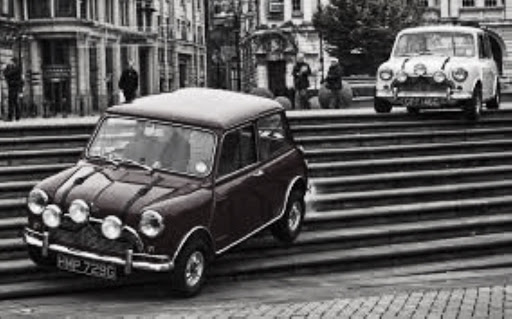 |
| THE REAL STARS |
I have many and varied memories of The Italian Job. The sweetest must be climaxing a talk on stunt people at the National Film Theatre in London with a screening of the film’s wild Mini Cooper drive through Turin, the first time the sequence had been seen in full Panavision and stereo for over a decade.
The second can be condensed in a single image; sitting in a taxi at 4am on a warm Los Angeles night and seeing the film’s screenwriter Troy Kennedy-Martin nailed in its headlights, naked, pink and steaming as a shrimp just out of the boiler.
But more of that later.
Three Mini Coopers, painted red, white and blue, and loaded with stolen Chinese gold, rocket down a Turin sewer while the thieves, led by Michael Caine, bawl an exultant song in Cockney rhyming slang. Could there be a more apt metaphor for the Britain of Mary Quant, the Beatles, Joe Orton and David Hockney?
A little loose around the morality? Don’t worry, sir; we can have that altered in no time. Clothes, in fact, are one motif of the film. After a two-year prison stretch, the first stop for Charlie Croker, Michael Caine’s character, is Carnaby Street, at that time the navel of the fashion universe. After one look at his old outfits, catastrophically vieux jeux, his short-maker sneers, ‘What were you serving, Charles – life?”
 |
SIMON DEE AS SHIRTMAKER AND MICHAEL CAINE
|
By all the rules, the film should never have happened, and almost didn’t. It originated with soft-spoken, reticent and politically principled Troy Kennedy-Martin, best known for his 1986 anti-nuclear TV mini-series Edge of Darkness. But driving between London and Italy, where his sister Maureen then lived, he conceived a lean Eurocaper film with a steely edge. The crime would be dangerous, the thugs real, the ending ironic.
Michael Caine made a splash as a working-class smart-arse in Alfie and The Ipcress File, only to lose momentum with Hurry Sundown, a failed 1967 Hollywood debut. This inaugurated a series of duds, including a John Fowles adaptation so awful that Peter Sellers, asked what he’d change if he could live his life over, said, “I’d do everything exactly the same, except I wouldn’t seeThe Magus”
The script of The Italian Job kicked about until - in Caine’s version: there are others - he happened to ask his neighbour at a showbiz lunch what he did for a living. “I just bought Paramount studios for $152 million”, Charles Bludhorn said. “Have you got any scripts that you want to make?”
Michael Deeley was the logical choice to produce, since he had just made Robbery,about that other triumph of British criminal free enterprise, the Great Train Robbery. He wanted the same director, Peter Yates, who later directed the innovative car-chase movie Bullitt. Instead, the job went to little-known Peter Collinson - because, if gossip can be believed, he had friends in the corridors of power.
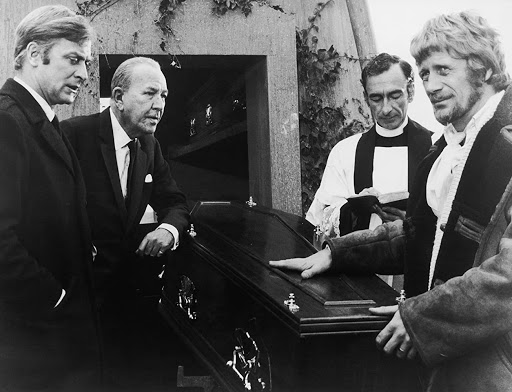 |
MICHAEL CAINE, NOEL COWARD, DAVID KELLY (PRIEST)
and PETER COLLINSON |
Raised in an orphanage, Collinson over-compensated obsessively for low self-esteem. This film was his passport to the big time, and he wanted nobody to forget it. Arriving each day in a white Rolls Royce, he’d periodically slip outside to make sure nobody was leaning on it. The working-class tone of the script irritated him. Kennedy-Martin imagined the film’s computer whizz as a donnish recluse who collects toy trains, but Collinson preferred a giggling Benny Hill, who can’t keep his hands off fat women. Bridger, the gang boss who finances the raid, was to have been Nicol Williamson - 30, arrogant, and aggressively male. Instead, Collinson cast his own godfather, Noel Coward - 69, languid, gay - and, at Collinson’s orders, never addressed on the set by his name but always as “Master”.At the end of the first script, the gang stashes the gold in a numbered Swiss account, then loses the number. It ends with Caine’s girlfriend randomly sticking a pin in a list, hoping to hit the right one. In the novelisation of the script, the gang gets the gold back to England, only to be told by Bridger to take it back.Of the ending used on the film, Kennedy-Martin was scornful. "I didn't even write it. Michael Deeley added it after they'd run out of money. Peter Collinson hated it so much he wouldn't film it and made the assistant director do it instead." Today it’s one of the most familiar – and most loved - scenes in all British cinema.
The film needed 16 Mini Coopers, which Deeley assumed British Leyland would volunteer. Not so. “Their attitude,” wrote Caine acidly, “was that they did not need us to sell their cars.” Contrast the attitude of Fiat. Not only did Gianni Agnelli allow Collinson to shoot on the Fiat testing track that runs across the rooftops of Turin. If they replaced the Minis with Fiat 500s, he’d give them all the cars they could wreck. Deeley gritted his teeth, thought of England, and paid retail for the Minis he needed.
English character actors filled the film, from Benny Hill as kinky Professor Peach, disappointed he won’t need to wear a stocking over his face, to Tony Beckley as Bridger’s fastidious lieutenant, Camp Freddy – one of the film’s many jokes based on London slang.
 |
| DEREK WARE (LEFT) WITH DRIVERS |
Derek Ware, a cocky Londoner whose Havoc agency supplied stunting talent for many British films of the time, counselled Collinson on the preferred weapon of smash-and-grab raiders – pick-axe handles – and choreographed the fights and falls. Given an unexpectedly free hand, Ware, who has a mute role as gang member Rozzer, scattered his men through the film in small roles. Some got to deliver their first lines in long but anonymous careers. For the escape through restaurants, churches, over the tops of buildings, across a weir and finally down a sewer, Deeley hired L’equipe Rémy Julienne, the best drivers in Europe. Notwithstanding irate café owners who soaped their marble floors to make the cars skid and an attrition rate on Minis that had the production accountant biting his nails, they achieved an effect of seamless expertise.
Though The Italian Job did well on first release, critics and distributors alike viewed this as a Kleenex film, to be used and thrown away. In the US, it flopped. “When I arrived in Los Angeles to promote the picture,” wrote Caine, “I was stunned to open a newspaper and see an image of a naked woman sitting on the lap of a gangster who was holding a machine gun.” He caught the next plane home.
Within a year, all CinemaScope prints were worn out. TV versions retained only the central third of the image. Caine, Deeley and Rémy Julienne went on to better things, but Collinson’s career stuttered along until 1980. His last film, The Earthling, was shot, coincidentally, in Australia.
 |
| TROY KENNEDY MARTIN |
When I went to live in Los Angeles in 1987, I became reacquainted with Maureen Kennedy-Martin and her husband, former National Film Theatre director Ken Wlaschin (who collaborated with Troy on novelising the film.) I also met Troy, who was getting ready to leave California. I needed a car and offered to buy his. We agreed I’d collect him from his producer’s house, where he was staying, and drive with him to the airport. In the darkest hour before dawn, my cab pulled up the foot of his producer’s wide gravelled drive just as Troy, having taken a shower in the main house, was returning to the guest house to dress. The image of him steaming in the headlights is one neither I nor the cab driver will ever forget.
Half a century after it was made, The Italian Job seems more than ever a film for its times. Not Swinging London, however, but Brexit Britain, with its go-it-alone bravado and insistence that this is once again a self-preservation society. The film begins with the Mafia almost stopping the heist before it even gets going. Maybe this time it won’t be plucky little England but canny old Europe that wins.


