Friday, 6 March 2026

CINEMA REBORN - March Newsletter #1 - Program Release dates - Charitable Donations - New Publications - RED MATILDAS Restoration

 Hello Everyone

Just an early note to let you know that the full Cinema Reborn program will be released on 15 March. On that day you can drop in to the Ritz or Lido and pick up a copy of our splendid brochure listing all the films, session times and presenters. You will be able to log on to our website for all the information and links to bookings. We’ll be sending out another email closer to the date but if you would like to receive our brochure emailed to you as a downloadable Pdf document then you can order it in advance by emailing cinemareborn2025@gmail.com and just put “Receive Brochure” in the subject line.

In the meantime we have announced seven programs and you can read short notes and make a booking if you go to the Ritz Cinemas or the Lido Cinemas pages. On those pages you will find a link to purchase a 5 film ($80) or 10 film ($140) pass that will allow you to purchase a single ticket to any of our programs including our opening, closing and Saturday centrepiece sessions.

Charitable Donations

Cinema Reborn is grateful for the financial support of our donors. If your donation is received before 9 March you will be listed in the 2026 printed catalogue. Donations received after that date will be listed in 2027. Donations are used pay the screening fees to the archives and producers who supply our films and to keep our admission charges to regular Ritz and Lido prices (with the lowest student concessions of any similar film-related event).

We have once again set up a page via the Australian Cultural Fund to receive donations of any size, large or small. You can find it IF YOU CLICK ON THIS LINK

Justin “Jisoe” Hughes holding a photo of one of his galves

‘Katies’ — the new magazine publication of KinoTopia set to launch at ACMI

Fellow Cinema Reborn Organising Committee Member Digby Houghton has organised — with the help of KinoTopia — a screening of Eddie Martin’s 2005 documentary Jisoe at ACMI on March 24 to coincide with the publication of KinoTopia’s new print magazine Katies. More information and tickets available here.

KinoTopia is a weekly newsletter based in Melbourne and founded in 2023 as a means to promote underground and repertory screenings in the city and its surroundings. More information and how to subscribe can be found here.
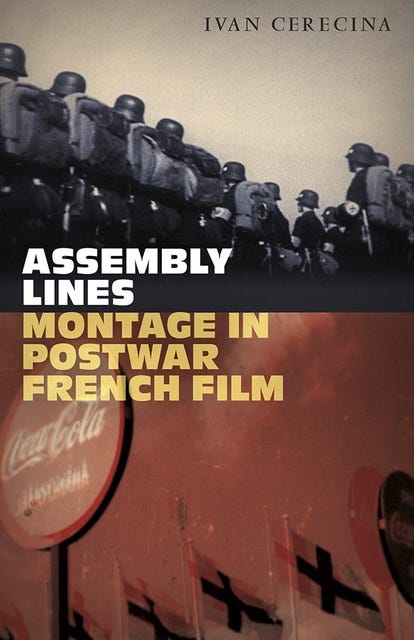
A New Book by Cinema Reborn Supporter and Presenter Ivan Cerecina

We are pleased to announce the publication of Assembly Lines: Montage in Postwar French Film, written by one of our Cinema Reborn presenters, Ivan Cerecina (The University of Sydney / Ivan’s website ). The book examines the re-emergence of montage as an aesthetic figure and historiographical principle post-1945, via a study of the early films of three important filmmakers of that postwar generation: Nicole Vedrès, Alain Resnais, and Chris Marker. It is published by the prestigious University of Minnesota Press.

The book is available for pre-order in Australia until the end of February for the reduced price of $40 AUD, via The Nile Bookstore

Readers outside of Australia on your list, but they can purchase the book via the University of Minnesota Press’s website
Red Matildas – A Restoration Project of a Major Australian Documentary

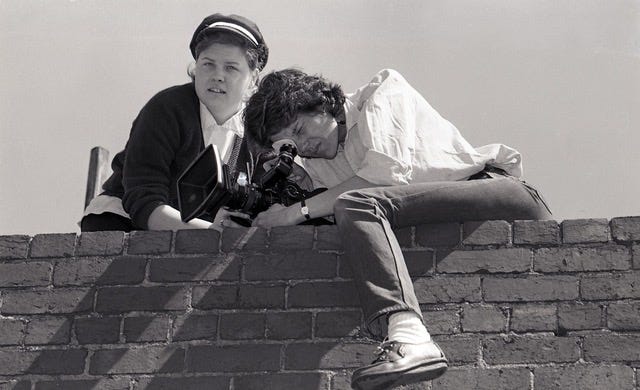
Trevor Graham writes: In the picture is some significant Australian film history: Mandy Walker (DOP now 48th President of the American Society of Cinematographers, DOP on Elvis, Return Home, Mulan, Snow White, Jane Got a Gun, amongst many others) and Laurie McInnes (Broken Highway, Palisades, On Guard amongst many others) shooting Red Matildas, in Fitzroy (Melbourne) 1984.

FRIENDS OF HISTORY, AUSTRALIAN CINEMA & DOCUMENTARY – WE NEED YOUR HELP.

RED MATILDAS returns to screens big and small in a stunning 4K digital restoration, forty years after its original 16mm national cinema release across Australia. This award-winning 1985 documentary, to be preserved for streaming, community and educational audiences, captures the spirit of three remarkable women who challenged inequality and militarism during one of the most turbulent periods in modern history.

Through the stories of May Pennefather, Joan Goodwin and Audrey Blake, Red Matildas explores Australia during the Great Depression: a time of mass unemployment, hunger, and the rise of fascism at home and abroad. It was a period that stirred many into political action, and these women placed themselves at the front lines of global struggles for peace and justice.

Red Matildas is more than a historical record. It is a powerful reminder of the enduring struggles for peace, justice and women’s rights, and of the courage it takes to stand against war, poverty and inequality. Resonating deeply with today’s world of social upheaval, economic hardship and conflicts in Europe and the Middle East, the film invites new generations to rediscover the passion and conviction of women who refused to remain silent.

Already 50% of the $25,000 needed to restore the film has been raised. Those interested in donating to support the restoration of this award winning and irreplaceable film can learn more here:

Tax Deductible Donations through Documentary Australia

We hope you can support the ongoing life of this significant Australian documentary.

We look forward to seeing you at Cinema Reborn 2026.

Tuesday, 3 March 2026

At the French Film Film Festival - Tom Ryan reviews the 'Quietly compelling, exquisitely gentle, ...perfectly judged' - OUT OF LOVE (Nathan Ambrosioni, 2025)


Unexpected events can change people’s lives. For Jeanne (Camille Cottin) in Nathan Ambrosioni’s superb Out of Love – the original title, Les enfants vont bien literally translates as “The Children are Alright” – it’s the arrival on her suburban Paris doorstep of her sister Suzanne (Juliette Armanet) with her nine-year-old son, Gaspard (
Manoã Varvat), and his little sister, Margaux (Nina Birman). 


Anybody who’s ever found themselves fortunate enough to take on parenting obligations will recognise Jeanne’s sense of panic when Suzanne disappears overnight, leaving her children behind. Jeanne is single and child-free by choice. Both sisters’ lives have been scarred by loss and each is, in her own way, still grieving about it. 

Beautifully shot by Victor Sequin and tenderly enfolded by Alexandre de La Baume’s unobtrusive score, the 26-year-old Ambrosioni’s emotionally potent family drama transforms Jeanne’s uneasy attempts to adjust to the changes thrust upon her into a journey of self-discovery. At the same time, it empathetically evokes the children’s confusion at what’s happened to them and the frightening fear of forever-abandonment that has fuelled so many fairytales over the years and has now found them cast adrift in the world. 

For Jeanne, the crisis becomes both personal and professional. Nicole (Monia Chokri), her former partner, shows her by example that it’s possible to deal with the needs of the children she’s been forced to take under her wing. And so, juggling her work as an insurance claims assessor with the demands of mothering these two lost souls, as well as with trying to make sense of her sister’s disappearance, Jeanne gradually comes to recognise parts of herself that she never knew were there.

Out of Love’s visual style tells us about the sisters’ lives even before we’re properly introduced to either of them. The restlessness of the opening scenes – as Suzanne drives the children to Jeanne’s – is in sharp contrast to the orderliness that characterises the initial sequences in Jeanne’s home. But then, as Jeanne comes face-to-face with her unexpected event, the stillness with which she had surrounded herself is not only disrupted but comes to seem like it’s been a prison all along. Nothing in the film is simple, every scene charged with a sense that things could change again in an instant. 

Ambrosioni’s approach throughout is measured and compassionate, rigorously drained of melodrama and neatly balancing Jeanne’s needs against the children’s confusion and distress. And the film’s glorious final sequence offers no easy solutions for any of the characters, setting imagery evoking lost childhoods against Gaspard and Margaux’s essential decency and resilience and guiding us towards an appreciation of how Jeanne’s commitments speak of a well-earned sense of renewal.
Quietly compelling, exquisitely gentle, delicately nuanced and graced by superb performances all round, this is a perfectly judged film.


Monday, 2 March 2026

Jane Mills announces a CALL FOR PAPERS for SISTERHOOD - A symposium hosted by the Sydney Literature and Cinema Network

Genevieve Lemon, Karen Colston, Sweetie

Sisterhood

A symposium hosted by the Sydney Literature and Cinema Network

17 July 2026

The University of Sydney

Symposium Overview

From the ancient tales of Psyche and her sisters to contemporary feminist novels and films, from the Brontë sisters’ literary explorations to cinematic adaptations of Austen and Alcott, sisterhood has been central to women’s writing and filmmaking. This symposium asks: How do literary and cinematic texts represent the complexities of sister relationships? What narrative strategies do writers and filmmakers employ to explore sisterly love, rivalry, and ambivalence? How do representations of sisterhood intersect with questions of gender, sexuality, race, class, and national identity? And how have depictions of sisterhood evolved from nineteenth-century novels through classical Hollywood to contemporary screen media? 

This symposium invites scholars of literature and cinema to explore representations of sisterhood across literary and screen texts. From novels and poetry to film and television, sisterhood has been a rich site for examining questions of female identity, desire, rivalry, and solidarity.  

Joan Crawford, Bette Davis, Whatever Happened to Baby Jane?

Topics and Themes

The symposium will feature a keynote address by Associate Professor Jane Mills examining cinematic representations of female sibling relationships. Drawing on decades of scholarship and personal reflection, the keynote will explore the paradoxes of screen sisterhood, from the tender collaborations of the McDonagh sisters and Lillian and Dorothy Gish to the sororophobia of Whatever Happened to Baby Jane?, from the psychological complexity of Sweetie and Georgia to the alternative possibilities offered by Love Serenade and Greta Gerwig’s Little Women. Mills’ address will take us through questions such as are there films that withhold moral judgment while representing sisters with disparate attributes? Has the #metoo movement impacted how sisterhood is portrayed on screen? And how can cinema help us understand the desire to be both the same as and different from another woman, which at times makes sisterhood seem impossibly difficult?

Rebecca Frith, Miranda Otto, Love Serenade

We welcome proposals that will expand on these themes for 20-minute papers addressing representations of sisterhood in literature, film, television, and other screen media. Topics may include but are not limited to:

-       Sororophobia and female rivalry in classical and contemporary cinema

-       Sisters in specific national cinemas, film movements, or genres (horror, noir,      melodrama)

-       Sisters in documentary and non-fiction film

-       Female filmmaking siblings (McDonagh sisters, Wachowski sisters, etc.)

-       Historical evolution of sister representations from silent cinema to the present

-       Sisterhood in animation and children’s cinema

-       Lost sisters, absent sisters, and ghostly presences in fiction and film

-       Transmedia storytelling and sisterhood

-       Critical and Theoretical Frameworks

-       Psychoanalytic approaches to sister relationships

-       Queer theory and sisterhood

-       Narrative theory and sister relationships

We welcome submissions from scholars at all career stages, including graduate students, early career researchers, and established academics. 

Submission Guidelines

Please submit you abstract to sisterhoodsymposium@gmail.com by 6 April 2026. 

Abstract Requirements:

-       300 words maximum

-       Include your name, institutional affiliation, email address, and paper title

-       Include a brief biographical statement (100 words maximum)

Selected papers may be considered for publication in an edited collection or special journal issue following the symposium.

For questions about the symposium or submission process, please contact the Sydney Literature and Cinema Network: literatureandcinemanetwork@gmail.com

Sunday, 1 March 2026

On Chris Blackwell and Island Records - Rod Bishop reviews a recent autobiography - THE ISLANDER My Life in Music and Beyond, by Chris Blackwell (Nine Eight Books, UK, 2022)


In 1972, the founder of Island Records, Chris Blackwell, served as executive producer on Perry Henzell’s ground-breaking Jamaican film The Harder They Come. 
A vibrant, eye-popping, reggae-pounding, rude-boy film, Blackwell had suggested Jimmy Cliff for the main role and included some of his songs on the soundtrack. After the film became a hit, Cliff walked away from any deal with Island Records and signed with EMI. 
Blackwell was disappointed: “I was upset about that because I knew the way to break him was through the rebel character he portrayed in the film. But when the three Wailers walked into the office, here was the real thing.”
Chris Blackwell today with his Blackwell Rum

In 1973, Blackwell advanced £4000 to Bob Marley and The Wailers for their first album Catch a Fire. Never had a reggae band recorded an album as a unified statement; previously they were albums made from a collection of singles.
Seeking a wider audience, Blackwell took the eight-track tapes and with The Wailers approval, added steel guitar, synthesizer, organ and clavinet for “more of a drifting, hypnotic-type feel than a reggae rhythm.” He was intent on making Marley a rock star, rather than a black musician restricted to black radio stations.
After The Harder They Come, Catch a Fire was his second Jamaican cross-over in two years. A film and an album that transported the energy of reggae, and its Rastafarian religious culture, to an unsuspecting world.
This double-hit from Jamaica was hugely successful and with Marley in his portfolio, nothing would ever be the same for Blackwell. Variety was later to call him: “indisputably one of the greatest record executives in history.”
Blackwell was brought up in Jamaica by wealthy parents: his mother was a Costa Rican born Jamaican heiress and his father came from Anglo-Irish roots. They were wealthy enough to provide him with rent, living expenses and start-up financing well into his adult life. And send him to Harrow in the UK for his public-school education.
Catch Fire Album Cover

Back in Jamaica during the 1950s, Blackwell immersed himself in the mento and calypso music of Kingston, laboriously selling records from the boot of his car to jukeboxes and the growing “sound system” dancehalls across the island.  His expertise at choosing hit tracks and working the room with Kingston’s music production industry put him in prime position to select musicians when new sounds emerged – ska, rock-steady, reggae and dub. 
At the age of 22, joined by Leslie Kong and Graeme Goodall (an Australian), with start-up funding from his parents (as you do), he established Island Records in 1959.
A record executive who still boasts of wearing shorts and “flipflops”, he relocated Island Records to London in the early 1960s where his inhouse operating style was generally regarded as “organized chaos”.
Above all, Blackwell believed in discovering virtually unknown talent who promised to have long careers, as he had done with Jimmy Cliff and Bob Marley. The “underdogs, misfits and rejects” he was prepared to support even when album after album failed, stemmed from his conviction in the integrity of their musical talent, and the likelihood of that talent becoming future household names.
Island signings included the Spencer Davis Group, Nick Drake, John Martyn, Fairport Convention, Free, Sparks, King Crimson, Traffic, Toots and the Maytals, Roxy Music, Cat Stevens, Bob Marley and The Wailers, Steve Winwood, Mott the Hopple, The B-52s, Jethro Tull, Grace Jones, Nico, Marianne Faithfull, Tom Waits, John Cale, Eno, King Sunny Adé, Angéligue Kidjo, Robert Palmer and U2. 
He passed on Pink Floyd (“too boring, the worst thing I’ve ever heard in my life”); and Procol Harum’s Whiter Shade of Pale (“unmarketable”); and punk (“not enough bass and rhythm”); and Elton John (“too shy and even staid”). The Rocketman didn’t speak to him for another 15 years.
Island grew into what was regarded as the greatest independent record company in the world with 100 employees in the UK and 120 in the USA.
In 1989, Blackwell sold Island to Polygram for $300 million. U2 had negotiated 10% ownership in Island in return for a delayed $10 million in royalty payments for their album The Joshua Tree, payments delayed by one of Island’s many revenue crises. U2 collected $30 million from the sale of the company.
After the success of The Harder They Come and the follow-up Jamaican film Countryman, Blackwell set up an Island film company, with a distribution division that included Kiss of the Spider Woman, Koyaanisqatsi, The Hit, El Norte, and Stop Making Sense. He has 19 producer credits listed on IMDB.
Blackwell’s autobiography is heavily detailed, poorly indexed and lacking in personality insights. I lost count of the number of “my wife at the time…” without learning anything about them.
Blanche Blackwell, "constantly pursued" by Errol Flynn

His time with Errol Flynn, who he regarded as having “helped popularize Jamaican music” during the 1950s, is an exception. Flynn, who constantly pursued Blackwell’s mother, was a role model for the young entrepreneur and his only role model in this autobiography. 
Among many Flynn anecdotes, the Tasmanian actor recommended a “crack” Australian group called The Caribs to Blackwell. A house band playing mento and calypso in a tourist hotel in Surfers Paradise in the 1950s, Flynn helped them move permanently to Jamaica where they played residences in clubs and formed the backing band for Blackwell’s early studio recordings.
Ever a pragmatist, Blackwell had unique ideas on album covers:
“I really believe if people see something that looks good, subconsciously they’ll think maybe there’s something going on inside, on the record. There were times when someone came out with a cover which was better than the record itself, so I’d have to send them back to remake the record.” 

Saturday, 28 February 2026

On 4K UHD - David Hare recommends "the 4K of the year" - BEN HUR (William Wyler, USA, 1959)


Another recent release is Warner's huge and vastly gorgeous, manifestly detailed new 4K two disc (Plus third BD extras disc) steelbook set of 1959's Ben Hur, directed by the great William Wyler with a superb score (some think his best) from Miklos Rosza, second unit direction by the great Yakima Canutt for the Chariot Race and a cast of thousands including grand muscle and toga work from Chuck Heston and Stephen Boyd.

On those two let's remind ourselves of second string writer Gore Vidal (one of at least four more) on outlining the motivation for the two old adolescent friends, Judah (Heston) and Messala (Boyd) now reuniting after a youthful love affair only to be ripped apart by Judah's monotheistic zealotry. The first embrace has Heston literally slathering and drooling over Messala's neck. This barely concealed queerness gets another huge workout in the late Act 1 galley slave sequence when Jack Hawkins, fresh from The Bridge on the River Kwai takes to adopting Chuck as his "son" (one word for it) , fortuitously indeed as this grace and favour ultimately leads the "hero" into getting the rounds of a lifespan to shadow his near invisible contemporary, Jesus Christ. The movie darts around the religiosity very nicely but that's Wyler for you. A total expert at extracting the essences of narrative from the acres of flowery prose in the original novel.

Whatever else you want to make of it the show is genuinely epic with absolutely expert, tight direction from Wyler who stuck with the seemingly unwieldy 2.65 Aspect Ratio of the new Metro65 anamorphic 70mm format which manages to set everything up basically from (rarely) full wide to medium wide to occupy the focal depth with detail of importance while the script blocks and stages the players with long takes and very great, limpid technique. Wyler has a very attractive tic, not noticed by me previously, of doing edits from wider to closer shots of the same actor while speaking or listening to animate what Gore Vidal and the other credited and uncredited writers kept of the original thousand pages Lew Wallace nightmare.
The movie, I must confess has the very grand status of having introduced me to my first stirrings of homosexuality as a boy child, in particular the raft scene with Chuck and Jack Hawkins cut loose from the wreckage on the Roman barge. Hawkins and me both could not get enough of Chuck's very fine figure at this stage of his career (the year after he got Welles the gig to make Touch of Evil at Universal.) If anyone could ever be said to have tamed a performance of range and sublety out of Chuck, it was Wyler.
All the cast members are right, and fine, even Dame Frank Thring, late of Melbourne, playing Balthasar as a screaming dinner party queen. It works. He works, and everyone around him works with it. Even in his first shot and dialogue Thring manages to eyeball-undress Chuck and lick him remotely from top to toe in five seconds of screen time.
Movies like this don't get made any more. They're actually too sophisticated and the audiences are no longer there to really "get" them.
I recommend this as 4K of the year so far.