Tuesday, 7 January 2020

SYDNEY FILM COLLECTIVE STATIC VISION ANNOUNCE INTERNET-FOCUSED FILM FESTIVAL IN MARRICKVILLE


Hyperlinks (February 21-23) is the first festival from Static Vision, a local collective who have been presenting Australian and NSW premiere screenings of important international films (Long Day’s Journey Into Night and the Academy Award nominated Hale County This Morning, This Evening among them) since October 2018.

Hyperlinks will screen 12 feature films and 8 short films, most of which will be Australian premieres, at Pink Flamingo Cinema in Marrickville. Tickets and festival passes are now on sale at hyperlinks.sydney.

The Opening Night Party will be a retrospective screening of Personal Shopperdirector Olivier Assayas’ 2002 cyber thriller Demonlover, followed by a set from Atro (Slim Set) and Static Vision Sound System.

Demonlover tackled data hoarding, the dark web and the excesses of late capitalism way before they became major areas of concern in the cultural consciousness,” says co-programmer Felix Hubble. “It sets the tone for the festival as well, right down to our underground screening space’s ad-hoc aesthetic.”

Leading the festival's documentary line-up are the provocative Searching Eva, a Vice-funded feature which gives a young model and sex worker navigating their way through Europe the opportunity to think through their identity online and on camera, Sakawa, a window into the world of Ghanaian scammers who build their computers from scrap parts and catfish Americans to escape a life of poverty, and Lynch: A History, a YouTube collage film about former NFL star Marshawn Lynch and the racism embedded in the American media machine.

Digital connection isn’t only limited to the screen. Hyperlinksalso boasts a handful of films about global exploration: Leave the Bus by the Broken Window, a gonzo documentary about the Hong Kong art market from Moonlightproducer Andrew Hevia, Tourism, a gentle comedy of travel misfortune from Japanese director Daisuke Miyazaki, and Sophie Bédard Marcotte’s L.A. Tea Time, about a Quebec-Los Angeles road trip in search of filmmaker Miranda July.

There will be a late night double feature on Saturday 22nd February of two microbudget American indies, the proto-desktop comedy 0s &1s, from Wobble Palace director Eugene Kotlyarenko (whose latest film Spreeis premiering this month at Sundance), and Jobe’z World, the slacker film answer to Josh and Benny Safdie’s Good Time (shot by their regular collaborator Sean Price Williams).
page1image21000page1image21160

The Closing Night film is Swedish documentarian Lina Maria Mannheimer’s Mating, which began its life as a social experiment about online dating, before morphing into an intimate and sharp look at modern love as two of the film’s subjects started dating one another. The film received a Special Mention in competition at CPH:DOX in 2019.

Hyperlinks will also showcase two feature-length gallery works during the festival. AIDOL , from German artist and musician Lawrence Lek, is a film built in a video game engine that depicts a world where war between man and machine plays out through e-sports championships and pop idol hits are used to placate the human masses. The Task, from American artist and photographer Leigh Ledare, is a documentary experiment that follows a multi-day group discussion about power structures that descends swiftly into internet comments section-style debates and fissures.
“Part of the reason we went with the theme of digital progress and culture is that we knew it would push us outside of the usual festival cinema fare and into gallery works,” says co-programmer Conor Bateman. “We often talk about how many great films can’t fit into our local festivals, but we also can’t ignore the brilliant work being done for non-traditional cinema spaces.”
The short film programme in Hyperlinks reflects this sentiment, bringing in work from video artists from around the world. It includes the award-winning Thai short A Room with a Coconut View, Australian artist Tiyan Baker’s Reddit-focused The Witness, a desktop essay by French filmmaker and academic Chloé Galibert-Laîné, and Sunstone, an ingenious work of documentary from artists Louis Henderson and Filipa César.
Hyperlinks runs from 21-23 February 2020 at Pink Flamingo Cinema in Marrickville.
Individual tickets and passes are now on sale at hyperlinks.sydney
Contact press@staticvision.com.au for any press enquiries.


Sunday, 5 January 2020

The Current Cinema - Barrie Pattison tracks down new Chinese cinema in the multiplexes WILD GOOSE LAKE (Yinan Diao), TWO TIGERS (Fei Li) and ONLY CLOUD KNOWS (Feng Xiaogang)

CHINA SYNDROMES.

There’s something happening in Chinese movies that we don’t know about. China is opening 20,000 new cinemas a year, now filling in the distant rural areas which is supposed to create a wider, less sophisticated audience.

Hard to relate that to Nan Fang Che Zhan De Ju Hui/Wild Goose Lake the new Wuhan dialect movie from director Yi'nan Diao and stars Ge Hu & Lun-Mei Kwei who were responsible for the intriguing China noir Bai ri yan huo/Black Coal, Thin Ice. If anything Wild Goose Lake is more sophisticated - though not as involving, a crime piece mainly notable for an elaborate texture in saturated colour that we are not used to in Chinese films. The acknowledged influence of Wong Kar- wai is obvious and the work has also been compared to the Michael Mann thrillers. This one is actually closer to Odd Man Out or Thieves Like Us and not to its advantage.

We start as Ex-con Ge makes his way through the corridors of the hotel that the bike stealing gangs have taken over for their conference. In the basement garage an instructor is giving a master class, to largely male spectators, on battery theft - the
most valuable part of the machine. A turf war over who will get the prized pre-development streets breaks out with rapid edited close shots of gangsters grimacing as they struggle together. A zip gun shot rings out. This is a film of unexpected loud noises.

Ge becomes involved in the competition to decide the allocation and rides out at night on a LED light decked bike through road tunnels but a wire has been strung there which decapitates his associate. Ge survives but faces a road block where he shoots it out, not realising it is manned by police one of whom he kills.

At this point the shape of the film becomes clear. Ge has no prospect of escape (better in 21 Bridges) and his efforts are directed toward making sure that the thirty thousand dollars cop killer reward that has been posted for him goes to his epileptic ex-wife and their son.

A complicated flashback structure introduces Lun-Mei Kwei, the chain smoking not really pretty star of Black Ice at a nocturnal meeting, with his flashback explanation to her taking up the first section of the film. She has been sent by his associates who themselves have designs on the reward and are being tracked by police, at one stage conducting their investigation in light up shoes like the ones used by the line dancers that Lun-Mei Kwei briefly joins. The cops take a group photo with the body of a gang biker they have killed.

Kwei is one of the “Bathing Beauties”, the whores who hang around Wild Goose Lake to ply their trade, making it impossible for the cops to pick them from the other fun seekers - suspense from whether she is partnering with Ge in his efforts to keeps the reward money or acting as an agent for the gang bosses. She seeks out the wife, found inside a wardrobe at a furniture market, and it’s Kwei who keeps the appointment with Ge at the Rail Station concession. They have a make out after which she spits a mouthful of cum - is this a first?

Despite the amount of punishment Ge takes and his heavy-man skills, like stripping the automatic pistol at speed or stabbing an opponent with an umbrella which he opens inside him, he is totally up staged by Kwei. Her appearance in the white linen hat is one of the most striking images in a visuals dominated movie - arresting insets like a bullet in a dish, the light switch, close ups of zoo animals or the white hat floating in the lake. One meeting takes place in a store of distorting mirrors out of which they fail to get the full Lady From Shanghai impact.

The finale in the crowded slum courtyard, with curious residents and their block representative mixed in with the shoot-out, makes an addition to the grubby settings. The final audience show presentation, where the reward is handed over to a masked informer, resolves our speculation.

The film is uneven, less focused than Black Ice and it drags in places but its best scenes do register. 

It’s better value than Fei Li’s Liang zhi lao hu/Two Tigers  also recently shown here. In that one, business man You Ge, whose celebrity actor career extends back past Chen Kaige’s 1993 Ba wang bie ji/Farewell My Concubine, is kidnapped by comic Shan Quiao thumping him with a golf club and chaining him up in a derelict swimming pool. The abductor is hopeless, asking a mere million yuan, so You Ge has to take over and run the operation for him - OK it was funny in Ruthless People.

Unfortunately, they give up on this and the piece slides into an implausible buddy movie/Scrooge fable where the victim demands that his captor make three inquiries for him. Things are already off the rails in the first one where period costume movie star Wei Zhao (Shaolin Soccer)is having trouble bringing conviction to her film within the film character. After her meeting with Shan Quiao, recalling her failed pairing with the businessman, has given her a life experience to draw on, she aces the scene on a new attempt. Darned if I can see any improvement.

Another outing requires You Ge to pose as the chauffeur on a visit to his now blind former friend as part of an attempt to repair his failure there. This goes down when the friend blows off the attempt at check book generosity.

There’s some more but we’d dropped past my threshold of attention by then. This is a polished production with more of the new full contrast colour lab work and clearly talented players who are spinning their wheels. It takes a while to realise that the track’s full orchestration of “Frere Jacques” is actually celebrating its use as the Chinese “Two Tigers” Song. 

Which brings us to the big disappointment. A new film by Feng Xiaogang is an event. He’s both China’s biggest earning film maker and possibly their society’s most probing commentator. Pieces like Tangshan dadizhen/Aftershock (2010) and Wo bu shi Pan Jin Lian/I Am Not Madam Bovary (2016) have real substance – think somewhere between Sidney Lumet and Cecil B. de Mille.

So pencil in hand I trooped out to Burwood for his current Zhi You Yun Zhi Dao/Only Cloud Knows. This is an ambitious contemporary romance set in New Zealand. It also pivots somewhat soggily on a piece of re-worded Western music, “You Belong to Me” no less.

It is a total change of pace for its director, a damp hankie account of the allegedly true life romance of an associate, set in scenic New Zealand.

In a tortuous flashback structure we see young Chinese couple Xuan Huang & Caiyu Yang buy an isolated rural property where only the cows can hear you scream and set up the district’s only Asian restaurant next to the 1874 Masonic Hall in picturesque little Otago town Clyde. They are joined by cheery local Lydia Peckham working long hours and facing the hazard of a local junky with a firearm under the jacket. A lost dog is added to the mix.

Only Cloud Knows’ most substantial theme, the contrast of their years of hard work and long hours with Peckham’s globetrotting gets buried here. Of course all this sweetness can’t last the film’s two hours plus and just when we think fire and funerals have brought matters to a close, the piece starts all over again with a giant flashback accounting for the pair’s courtship while boarding with veteran landlady Fan Xu (Railroad Tigers) recounted to a flask sucking charter boat captain out looking for the blue whales which are a motif in the production. The whales actually do register, hard to tell how much is CGI. 

It all does look great with wide, impeccably picturesque images from the cameraman of House of Flying Daggers and Shadow, foliage framing lush green fields, cloud banks shrouding the peaks next to the highway or the camera lifting to show the tall buildings of Auckland behind the leads. I’m sure it was greeted rapturously by the New Zealand Tourist authority. 

Unfortunately, as it works out, this one joins the rash of new movies made by foreigners working (largely) in English on their home turf, possibly with an eye on the opportunities presented by the new streaming services - Curtiz and Paris Song maybe but here the cast are clearly struggling to animate their lines under a director not working in his first language. The film is an hour shorter than The Irishman and seems twice that one’s length.

Peckham’s hard working friend is particularly strained in trying to register as spontaneous. Curiously some of the local bit players are more at ease - the kid who gives the couple the lovable dog or the whale boat captain.

Things are not helped by our mind set demanding from serious Chinese cinema and Feng Xiaogang in particular what message we are meant to be taking away from all this. Does it double as a cautionary tale about leaving the mother land? Is it a plea for overseas investment? Is it meant to be something innocuous after the stop start release troubles met by I Am Not Madam Bovary

We may never know it’s back story but the new film is the weakest entry in its director’s filmography, a considerable let down and something of a strain to sit through.

I wouldn’t want to go all Harvey Weinstein on their ass but it’s tempting to mentally construct a pacy seventy-minute film out of this slog. Start with the whale scene. Ditch the courting, the attempts at adventurous form (Xuan Huang driving past himself in his old car as a time shift or the spectator seen only in silhouette sympathising in the vet’s waiting room) along with Peckam, the dog, our hero’s flute playing and as much of the leads as can go and still leave something coherent.  

To tell the truth I don’t hold out all that much hope for my thinks version either. It's all rather sad.

Saturday, 4 January 2020

Robynne Murphy gives ScoMo an earful - Martha Ansara asks us to take note.

Dear Friends,
Just take a look just below at our amazing director speaking her mind from the Nelligen RFS brigade on the fireground! (And please pass any of this information that you want to — the tilm is almost funded but more is needed for archival footage costs. Even in these terrible times, we need films to inspire us — WOMEN OF STEEL is one that definitely does that.)

https://www.youtube.com/watch?v=OGKNtP2MmAM&f=

To those I haven’t contacted yet, please click on the leaflet at the bottom of this email for more information on the WOMEN OF STEEL documemtary.  (promo:  https://vimeo.com/344035067)

Robynne has been on the fireground in 12 hour shifts since November 26. For the past 43 days she has been unable to do anything except fight the fires and then try to sleep and recover so she can go out and do it again. The clip from Channel 7 speaks volumes about what the RFS volunteers are going through. Communication with the South Coast is now sporadic and Robynne has almost no time to speak to us but editor Rowena Crowe and I are carrying on with the film as best we can.When you see the spirit Robynne shows in the Channel 7 clip, I hope you will understand why. That same strength animates WOMEN OF STEEL and is very much needed in a devastated country.

I know that most of you, especially those impacted directly by the fires, will have many pressing priorities at this time, Nevertheless I'm reaching out to you to give Robynne the emotional support of making just a small (additional) donation -- even a token amount would be a boost. It has always given Robynne so much happiness to see each name appear on the donations list.

Tax deductible donations  can be sent to https://documentaryaustralia.com.au/project/jobs-for-women-film-project

Martha Ansara (consulting producer)

Friday, 3 January 2020

Defending Cinephilia (4) - Asian film specialist John Snadden looks across the region

Burning (Lee Chang-dong, South Korea)
It was a good year for film in 2019, one in which American studio releases finally showed they had the right stuff to keep audiences in theatres and away from their big screen TVs and streaming services...at least temporarily.

Internationally, there were some worrying developments for Chinese commercial cinema in the Middle Kingdom. 

Of the new releases I watched this year, three stood head and shoulders above the rest. Lee Chang-dong's Burning was a powerful drama about obsession and retribution, which also saw the remarkable screen debut of South Korean actress Jun Jong seo. There wasn't a minute I didn't enjoy of Once Upon a Time in Hollywood, which was Quentin Tarantino's dog-eared love letter to a city and an industry he knows only too well. Another was Joker, a grotesque take on the Hero Myth and, arguably, a career defining performance from Joaquin Phoenix as a brutalised young man who finally discovers his calling in life.

Dragged Across Concrete (S Craig Mahler, USA)
Other titles which I really liked were Dragged Across Concrete andThe Mule, first-rate films from veteran film-maker Clint Eastwood and up and coming talent S Craig Zahler. Aquaman was a genuine surprise and the most under-rated movie I watched this year. Hotel Mumbai was easily the best Australian feature and miles ahead of the turgid The Nightingale. Director Asghar Farhadi's Everybody Knows was a vast improvement on his recent The Salesman, and certainly helped along by stars Javier Bardem and Penelope Cruz.

The two worst films I sat through this year were true cinema sinkholes: the appalling misfire (and that's being particularly kind...) Holmes and Watson, and US, pretension on steroids from Get Out director Jordan Peele.

Asian Film
Extreme Job (Lee Byeong-heon, South Korea)
This year again saw South Korean cinema on a high, where both ends of the genre spectrum were covered by excellent films. Extreme Job  was a LOL culinary/crime themed comedy with a final twenty minutes that was a hoot for fans of Asian cinema. 

Parasite turned out to be a seriously likeable urban satire where a family of have-nots grab the chance to become upwardly mobile. The darker underlying elements eventually making this one of the year's most memorable movies.

From mainland China, the animated feature Ne Zha found large, enthusiastic audiences world-wide  - and no wonder considering what an entertaining and devilish little film this was.

The Crossing (Bai Xue, China)
Otherwise, in Oz, commercial mainland films were thin on the ground which led local exhibitors to screen a number of Chinese art-house releases. The Crossing, an across borders, coming-of-age crime flick, and the highly acclaimed An Elephant Sitting Still were quality films which found appreciative audiences.

Cantonese cinema was highlighted by two crime-action movies which set the bar for action cinema very much higher - something which used to happen on a regular basis over twenty years ago.

White Storm 2: Drug Lords is a tough crime thriller with a car chase sequence where a sedan poleaxes a bus and is then pursued into an Underground rail station where people on escalators and trains all become collateral damage. Mind blowing stuff!

Line Walker 2, a Mission Impossible-style spy-action flick finishes in Spain with a gob smacking foot-car chase through the crowded streets of Pamplona where bovine vs auto in a tremendous sequence - which has to be seen to be believed!

Both these passages of visceral cinema were great examples of high concept and inspired execution.

The Secret (Ann Hui, Hong Kong) Blu-ray cover
Of the HK Blu-ray discs which I viewed this year, the Special Edition restoration of Ann Hui's  The Secret (1979) was something to treasure, and is a must purchase for anyone interested in Cantonese cinema.

If you follow the dinosaur media, none (or maybe one?) of these major regional releases would be at all familiar as they were ignored by their arts scribblers.

Prevention
In recent times, President Xi Jinping's demands of "moral purity" and "adherence to Communist Party philosophy" have had a major effect on Sino movie-makers and artists in general throughout China.

*  Cell Phone 2  (Feng Xiaogang)
*  One Second  (Zhang Yimou)
*  The Hidden Sword (Xu Haofeng)
*  The Last Wish  (Tian Yusheng)
*   Summer of Chang Sha  (Zu Feng)
*   The Eight Hundred  (Guan Hu) 
*    Liberation (Chang Xiaoyang/Li Shaohong)

The circumstances surrounding Zhang Yimou's film, One Second, are particularly galling, as it was withdrawn from the Berlin Film Festival when it looked to be in serious contention for the top prize. The last thing the CCP wanted was a feature about the Cultural Revolution receiving international acclaim and the associated publicity.

Instead, this year filmgoers worldwide have been served up fatuous CCP propaganda in movies such as The Wandering Earth and The Bravest, plus terrible 1950s-style teenage romances and expensive looking but bland crime movies.

The ultimate irony of the above list of suppressed films is that the final two titles are hard line propaganda pictures about China's wartime successes last century, but which had the temerity to present Taiwanese troops in an heroic light. (They won't do that next time!)

I have a feeling next year's file of Verboten titles will be even thicker.

As the year closes, please spare more than a few thoughts for the pro-democracy protesters in Hong Kong who are now engaged in the fight of their lives and, quite possibly, preparing for the worst of outcomes.

On that sunny note, I'd like to wish all the best to Geoff and the Film Alert crew for 2020. 

Thursday, 2 January 2020

A New Film a Day in 2020 (2) - SÉRIE NOIRE (Alain Corneau, France, 1971)

There have been at least ten film-makers who have had a crack at adapting Jim Thompson. Stephen Frears did The Grifters  from a script by Donald Westlake. Bertrand Tavernier did Coup de Torchon. The two versions of The Getaway figure prominently. And there is Alain Corneau’s Série Noire an attempt to give a generic title to Thompson material. George Simenon’s novels were apparently self-classified into Maigrets and ‘romans durs’ and I often wonder whether the impulse to classify Thompson material as modern noir, seemingly as Corneau does, does the author a disservice. Maybe ‘romans durs’ and the ‘films durs” that they generate is more apt. Not that important anyway. Just a badge…

Série Noire  is a showcase for the flamboyant Patrick Dewaere. He is never off the screen or out of a scene. Dewaere began acting as a four year old and had 50 film and TV credits before his untimely death at the age of thirty five. Dewaere was 26 when he appeared in Bertrand Blier’s Going Places and 29 when he appeared in Claude Miller’s The Best Way to Walk. After making Série Noire  in 1979 Dewaere made nine more films in three years, including for Claude Sautet, André Techiné, Luc Beraud and Blier again. 

Série Noire opens with Dewaere as Franck Poupart, a sleazy door to door salesman driving his car onto a wasteland and miming a series of actions, most of them derived from movies we know ("Are you talking to me?") involving some form of violence. He heads off to make a collection, searching for a miscreant who owes him money, and comes across an old lady who offers her fifteen year old niece for sex in exchange for some cheap goods. We are in seriously sleazy territory here, added to shortly thereafter in a scene between Franck and his slovenly wife in their unkempt apartment. The action in Franck’s life takes off but notwithstanding the later acquisition of a pile of money he is heading downward fast towards an ironic ending where his complete self-delusion has taken over.

Patrick Dewaere, Série Noire
Without Dewaere’s preparedness to perform all this in a totally hyperactive and uninhibited fashion, a performance of great technical agility, it could fall apart – the subversive comedy would be wildly wrong, the coincidences all the more improbable. Cornea, a post-New Wave craftsman,  director of some 21 films which weaved in and out of the genres and whose biggest hit was the mediaeval musical Tous les Matins du Monde  clearly enjoyed playing with the stereotypes. With Dewaere he used an actor prepared to go far beyond the enigmatic poker faces of the crime genre. An interesting movie but maybe not much more.

MONSIEUR MAYONNAISE - A Screening presented by Rod and Lesley Freedman of Trevor Graham's documentary about Philippe Mora's father's life in the French Resistance

Dear Friends and Colleagues,

You’re invited to our 5th Meet The Director Documentary Screening. See the synopsis below.

Due to limited seat numbers and likely high demand,

Tickets are listed as Free, but we ask you please to donate $5-10 at the door.
If you book but find you can’;t come, please cancel your booking so we can fit others in.

We look forward to seeing you at this intriguing and funny film,
Rod and Lesley Freedman
--------------------------------------------------------------------------
MONSIEUR MAYONNAISE, 95mins + Q&A with Director TREVOR GRAHAM
Presented by Rod Freedman
- Wednesday 5 February 6.15 - 9.15
- Darling St Church, 668 Darling St, Rozelle
- Entry by donation $5-10
BYO FINGER FOOD + DRINKS TO SHARE
6.15  Meet & Eat
6.45  Screening
8.20 Q&A
8.45 Meet & Eat

MONSIEUR MAYONNAISE is an artist's epic adventure into his family's secret past. Australian artist and film-maker, Philippe Mora, investigates his father George's clandestine role in the French Résistance in WW2 and his mother Mirka's miraculous escape enroute to Auschwitz.
Philippe, a Hollywood cult-horror movie director and pop-artist, adopts a Film Noir persona to tell his family's story. He also packs his paints and easel, as he embarks on a journey to create an audacious comic book about his parents, their survival and the Holocaust. From LA to Berlin, Paris to Melbourne, Monsieur Mayonnaise is a richly layered road movie starring artists, real life heroes, Nazi villains ... and baguettes with lashings of tasty French mayonnaise!

Director Trevor Graham is one of Australia's leading documentary filmmakers, a former Commissioning Editor at SBS and Head of Documentary at AFTRS and winner of two AFI Best Documentary Awards.
Some of Trevor's films are - Mabo: Life of an Island Man, Red Matildas, Painting the Town, Land Bilong Islanders, Dancing in the Moonlight, Paper Trail, Sugar Slaves, Aeroplane Dance, Mystique of the Pearl, Tosca - A Tale of Love and Torture, From Little Things Big Things Grow, Small Island Big Fight, The Pilot's Funeral, Keen As Mustard, Before Death Us Do Part, Make Hummus Not War.


MEET THE DIRECTOR is a bimonthly series of documentary Q&A screenings presented by filmmakers Rod and Lesley Freedman, The AGEncy Hub and Darling St Church.

Rod and Lesley Freedman are Change Focus Media -  https://changefocusmedia.com.      
The Agency Hub is part of The AGEncy Project - https://the-agency-project.com/     
Screenings hosted by Darling St Church and Rector Mark Leach - http://www.darlingst.org.au/

Wednesday, 1 January 2020

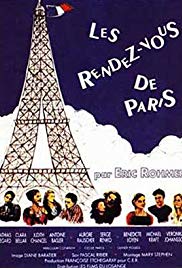
A New Film a Day in 2020 (1) - LES RENDEZ-VOUS DE PARIS (Eric Rohmer, France, 1995)

New Years Day viewing when the power came on after 30 hours of candle-lit darkness, a slowly warming freezer and a day where the sand was too hot to walk on at Gannet Beach Bawley Point.

A film to take you back to 1959 when the New Wave told us what it was like to be young and carefree and worried about love. In order, JULES AND JIM, LES COUSINS, SHOOT THE PIANIST, ADIEU PHILIPPINE, LOLA and those early little comedies by Philippe De Broca which we confused for New Wave movies.

Three stories which may or may not have been shot with the idea of turning them into a feature. The five young women in the three stories are all drop dead gorgeous, the young men mostly so though you would never say the lead in the second story Serge Renko was an oil painting. He plays opposite Aurore Rauscher and the only question remaining after viewing this one is "Whatever happened to Aurore Rauscher?" Luminosity leaps from the screen, an aura of future stardom emerges. Yet IMDb says this was her only film

Aurore Rauscher
As usual the Rohmer tropes of trick endings and bizarre comeuppances are to the fore, none more so in the first story about the lost wallet and the complications it causes. You feel very sorry for the young man who has turned up for his date full of hope. But life has moved on... Of course the second story when a young wife is liberated from both her errant husband and the near puppy like boyfriend in one fell swoop is similarly brilliant.

Among the least known of Rohmer's films, the Blu-ray transfer is superb and the film a gem which literally transports you back 36 years to the days when the French cinema briefly liberated itself from the studio and the literary.