Wednesday, 7 October 2015

The Duvivier Dossier (24) - Max Berghouse reviews La Fete a Henriette

La Fete à Henriette ( English Holiday for Henrietta) Director: Julien Duvivier,  Script by Duvivier and Henri Jeanson, Cast: Dany Robin (Henriette) Michel Auclair (Marcel), Louis Seigner (Script Writer 1), Henri Cremieux (Script Writer 2), Michel Roux (Robert) and Micheline Francey ( Script Girl). France, 1952, 118 minutes.
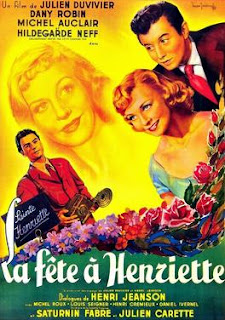

This film is generally reviewed as a comedy, and I suppose it is, but in a very intellectual and French – rational way. It is not a film of laugh out loud moments, except perhaps for cinephiles who recognise deliberate references to other then contemporary film directors and films.

The "real" story concerns two unnamed scriptwriters, one businesslike and down-to-earth (Seigner) and the other volatile to the point of irrationality (Cremieux) who try to brainstorm a new script following the rejection of the immediately prior one, rejected on the perfectly understandable grounds of obscenity (at least as it was understood at the time!). The two are ensconced in some sort of weekender next to a river and this bears a striking resemblance to the main set in the director's earlier film, La Belle Equipe (France, 1935) which is set on the River Marne outside Paris. The weekender, apparently studio based, is one of those typical Duvivier sets with an open mezzanine over the ground floor. This construction with open stairways leading into rooms or apartments is very common in the director's work. It seems to me to display his desire for control and regularity. Maybe on the other hand it's just accident!

The two writers verbalise various scenarios, ably assisted by their script girl – very admirably played like Micheline Francey, whom it is not hard to see is quite the brightest of the three. Anyone who has been involved in "the business" would recognise the various plots that any script writer would employ, not in the interests of "credibility" or "truth" but just so they can find someone to produce the film, make money, and hopefully put bums on seats. To a very considerable extent, despite some comic head notes, this is the "real" movie. The balance is the playing out of the various scenarios as they are discussed, worked through and frequently discarded. The consequence of this is that these various alternatives played out by Henriette, Maurice/Marcel and Robert are clearly "constructs" which have intellectual but little emotional depth.

That seems to me to be the essence of the film. The director takes a very rational look at his cast and moves them around as does a puppetmaster, according to his immediate requirements. Because the actors are moving at the direction of the puppetmaster, there can be no question of free will and thus the film fits in with the general pessimism and misanthropy which characterises Duvivier.

These various differing scenarios are in effect examples of the multiple storylines which also characterise Duvivier's work. Probably because it was made in Hollywood and therefore more accessible to English speakers, Tales of Manhattan (USA, 1942) would be the best example of this. For reasons apparently pertaining only to myself, I have never liked this film and took it that the director only engaged with the work out of necessity. Yet I must concede that multiple storylines are a feature of his work and he does it with exceptional panache. Perhaps therefore it was a matter of choice.

A third aspect I consider worthy of comment is that since the action takes place on Henriette's name day (after St Henriette) which occurs on Bastille Day (July 14) there is great play on the holiday atmosphere within Paris itself. There is for example a montage of public buildings draped in the Tricolour which I thought went on for rather too long but there is also a well conceived and played out background of the military celebrations and marching troops with traditional French marches in the background. This characterises and contrasts with the individual celebratory mood of the city in which Henriette, Marcel and Robert play out their various roles. It is as if the director suggests that multiple things occur and that the fate of individuals is of little importance.


The original film score by Georges Auric is exemplary. Perfect for the period and he, the composer, is like the director, rather undervalued these days.

The pre-film credits are a treat. It features question marks as to who is responsible for what and this is only revealed by the end credits which are thus very interesting.

Several scenes refer to the work of other of the director's "competition" and one scene featuring an apparently blind but "all seeing" filmmaker, referencing Marcel Carne, is as lovely as it is brief. Because the only storyline relates to the scriptwriters, some of the interspersed playings out of their scenarios are interesting while not in any way moving the drama along. A chase through a cinema/theatre, art deco in style with pursuer and pursued running across the stage as the theatre organ is raising, and then continues on to the roof, is extremely noir. That the director knew what to do to capture a fully noir ambience is even more strongly shown by a chase inside an industrial park, including pursuit and death on a gas storage unit.

No one could begrudge the capacity of the director to show off his prowess by really emptying his bag of tricks. However fundamentally, that is exactly what they are: tricks which will have manifold appeal to cinephiles, without being more than tolerably amusing to less interested folk. That said, I had loads of fun.

The Current Cinema - Talvar - Adrienne McKibbins reviews a major new Hindi movie

TALVAR (GUILTY) Director: Meghna Gulzar, Writer and Co-producer: Vishal Bhardwaj, India, 2015, 131 mins)

Many in the west may not be familiar with the actual case that the new Hindi film, Talvar is based upon, though most Indians would be.  It has been much discussed in the Indian press and by the public over a long period of time. The case took years before a conviction was recorded.

Known as the Noida Double Murder case, the events took place in 2008.  A 14 year old girl was found in her bedroom with her throat cut. Her parents were in the apartment/flat at the time and there appeared to be no forced entry. Suspicion immediately fell on the family servant who seemed to be missing.  The following day the servant was found on the roof of the apartment building, his throat cut in a similar manner to the girl.  Suspicion then fell on the parents.

It is clear in retrospect that the police did a very poor job initially. The crime scene was compromised, forensics were not done properly or at all, and it appears some evidence was corrupted or lost. The case dragged on for years. There were several investigations. Eventually the case was taken away from the police and handed over to the Criminal Investigation Bureau.

Talvar (Guilty) is Meghna Gulzar's third feature after an eight year gap away from filmmaking. It is her most ambitious and easily her best film, intelligently written by Vishal Bharadwaj (writer/director of the critically acclaimed Haider). The film presents various scenarios (in a vaguely Rashomon style) as to what may have happened, deftly cutting back and forward between what may have actually have happened and what the inspector deduced may have happened. It becomes clear by the conclusion of the film that the filmmakers have strong sympathy for only one of the possibilities presented.

Because it’s a "true" story some audiences would be aware of the outcome of the case, however the film is constantly engrossing, but obviously more so to those unfamiliar with the case or the Indian police and legal system. Without being heavy handed this film is an indictment of the legal system, the press, and the sloppy indifferent attitude to the original police investigation. Notwithstanding the grim subject matter, the screenplay is not without wry humour which mostly comes at the expense of the police and their ineptitude.

Although there may be one too many close-ups for emphasis, Pankaj Kumar's cinematography realistically captures the atmosphere of the streets of suburbia. Noida is about 25 kilometers southeast of New Delhi, a planned city that came into being with the urbanization thrust during the controversial Emergency period of 1975–1977. Direction and cinematography create an accurate picture of the time and place.

Talvar is presented as part police procedural, part crime thriller, part docu-drama investigation, and is absorbing from start to finish. It's not a perfect film but its flaws are diminished by what it has achieved in the presentation of a partly unknowable story. Above all the film has strength in its performances. While all the supporting roles are well cast and essayed, exceeding all is Irrfan Khan's totally unforced acting. As the CID investigator brought to the case reluctantly, and with visible skepticism, he is the driving force and most memorable aspect of the film.  His performance is flawless. Irrfan Khan has had a series of excellent roles in India recently for which he has been acclaimed, The Lunchbox, Qissa, Pan Singh Tomar, Piku etc., he has also established a career outside Hindi films, Slumdog Millionaire, The Namesake, Life of Pi, Spiderman, Jurassic World, In Treatment etc... He has another film releasing this week, Jazbaa, but his performance here will undoubtedly be acknowledged at Award season.

Deservedly the film has received unanimous praise from the Indian media, (there are a whole host of positive Indian reviews on the net). Talvar is easily one of the best Hindi films this year, and not to be missed. It is unquestionably a first-rate example of the diversity and quality cinema currently coming out of India, a perfect illustration that Hindi cinema (Bollywood) is not all predictably the same.

The screening of the film in India has provoked further interest in the case with the original investigating officer (played by Irrfan Khan in film), making a statement in the last few days as to who he believes to be guilty.  Here is an example

For those interested in looking at the facts of the case Wikipedia gives a good basic overview  Pankaj Kumar Pankaj Kumar Pankaj Kumar


Talvar is currently screening nationally.

Tuesday, 6 October 2015

Chantal Akerman - Mary Stephen remembers....

Chantal Akerman was very special to me. My very first film in Paris (that I saw) was "Je, tu, il, elle" … later on, when I was looking for a producer for my 3rd film (after Justocoeur), the one who committed to me was supposed to be "the producer who produces all these women directors, like Chantal Akerman" , his name was Alain Dahan (he's passed away now). 

So I always felt a special bond to her, since we shared the same producer.  And he really tried to push for my work but we didn't get CNC funding for that project and in those days didn't have all the other connected funds.  I was also very young and not very strong to withstand this kind of financing and producing nightmares as well as creative pressure.  

....And CA's passing makes me reflect on all these things because her work was singular and unique.  

I gave a talk 2 days ago on editing called "outside-the-box thinking" going against broadcasters and standardised funding practices which makes filmmakers lazy and i urged them to think outside-the-box.  CA's passing is a reminder of how outside-the-box she was and the price of pain to pay for it.  (Are filmmakers today ready to pay for this outside-the-box thinking?  Are filmmakers today exploring enough boundaries?)


voilà my thoughts… 

Vale Chantal Akerman

I just learned of the death of Chantal Akerman, director, at the age of 24 of the masterpiece Jeanne Dielman, 23 Quai du commerce, 1080 Bruxelles and many other wonderful films. I've had a look around the net and found tributes in The Guardian and from Jim Hoberman and  Richard Brody. A major film-maker sadly passes.  

Sunday, 4 October 2015

Vale John Guillermin

Noel Bjorndahl wrote this appreciation on his Facebook Page. Thanks for permission to reproduce. 

RIP John Guillermin. Born in London of French parents. His career began in documentary films after WW2 service. He made a number of competent but inconsequential movies like The Crowded Day (1954). His breakthrough film was I was Monty's Double (1958) based on a true WW2 story. His following film Tarzan's Greatest Adventure (1959) was probably just that. Gordon Scott had become identified with the role following Lex Barker's stint as the ape man. The greatest adventure was shot on some rugged locations and, provided Tarzan with two beautiful women (Sara Shane and Scilla Gabel) as well as some posh support in Anthony Quayle and Niall MacGinnis. A strong crime melodrama, Never Let Go (1960) benefited from the off-beat casting of Peter Sellers as a sadistic rackerteer and car thief terrorising Richard Todd. Waltz of the Toreadors followed in 1962, this time with Sellers on more familiar ground, leering his way through an open sex romp. After more Tarzan, Guillermin made a string of larger budgeted films beginning with Guns at Batasi (1964), an adventure film set in then contemporary Africa with military types Richard Attenborough and Jack Hawkins along with the young Mia Farrow. Rapture (1965) was something of an arthouse film, and followed a difficult relationship between Patricia Gozzi and Dean Stockwell (as a troubled fugitive in hiding). Melvyn Douglas and Gunnel Lindblom brought a measure of class to the strong material. The Blue Max (1966) and The Towering Inferno (1974) found Guillermin right at home on big budgeted material-they were both strong commercial hits Guillermin continued with futher safe blockbusters the best of which were a decent updating of King Kong (1976) with gorgeous Jessica Lange and ever reliable Jeff Bridges; and Death on the Nile, another sumptuous piece of eye candy adapted from Agatha Christie material with Peter Ustinov as Hercule Poirot and an all star cast headed by then usual suspects Bette Davis, David Niven, and Angela Lansbury, All up, the movie industry has been the richer for reliable commercial craftsmen the likes of Mr Guillermin.

Noel's mention of Never Let Go reminds me that this film was the subject of some controversy in its day and it is believed to have initially been banned by the Australian censor. Back in the 50s and 60s, the censor had no accountability and frequently banned and cut films. Nobody knew. There was no gazetting or other public recording of what censors got up to and the wily one-armed war veteran Richard Prowse (dubbed "One-Armed Dick" by the film trade who ran the show liked it that way). After I finally saw Never Let Go, on the ABC late at night as part of the then endless J Arthur Rank rotation, I wrote this note for the earlier iteration of Film Alert when there were a lot more rarities and classics shown ad and watermark free in obscure times on both the ABC and SBS. Out of sheer nostalgia here's the note.

Never Let Go ((John Guillermin, UK 1960, 90 minutes)
The last time this one came round was late night on the ABC just a few months ago and I confessed then that I hadn’t seen it but had recently had drawn to my attention that it had been banned in Australia when its first release was planned. I’ve now seen it and it is indeed a horrid piece of work. Chief among its mysteries is why Peter Sellers should have chosen to make the film, between two successful comedies Two Way Stretch and The Millionairess. Sellers plays an unctuously revolting spiv, a repulsive character. He runs an operation re-birthing stolen cars. He rules his gang members with a violent hand. He keeps as a mistress a seventeen year old who has fled from a girls’ reformatory and can’t escape his clutches. (She’s played by Carol White who went on to fame in Ken Loach’s Poor Cow.) Sellers happens to steal Richard Todd’s new car and spends most of the film inflicting ever more grievous bodily harm on Todd to dissuade him from pursuing repossession of the vehicle. It’s badly directed without any feel for the nightmare noir characteristics of the plot and it’s badly photographed, or at least so hurriedly photographed that you get little sense that the whole thing isn’t being thrown together in some studio. But by God it is a vicious piece of work and you can see why our fuddy duddy censorship authorities of the day would have blanched at its ‘low moral tone’. 

Friday, 2 October 2015

Talvar - Opening of a major new Hindi movie

Cinephile and Hindi cinema aficionado Adrienne McKibbins has sent in this short note about this week’s Indian film release. A longer review might follow. Check back.

DON'T MISS TALVAR ( DIRECTED BY MEGNA GULZAR)
ONE OF THE BEST INDIAN FILMS OF 2015 STARS IRRFAN KHAN (SLUMDOG MILLIONAIRE, LIFE OF PI, JURRASIC WORLD) IS EXCEPTIONALLY GOOD.

BASED ON A FAMOUS INDIAN MURDER CASE - THE NOIDA DOUBLE MURDERS  Check this review from The Hindustan Times


Details of where and when its screening around Australia are here


Thursday, 1 October 2015

From the Archive (2) - A Short History of Magic from about 1979 to 2008

I saw Ross Skiffington once at a dive up in King’s Cross. He was playing to about twenty people and I was called up to assist with a card trick. At a given moment I heard a slight engine whirr and the designated card popped up. Not much of a trick, I thought, from my vantage point. But he is a brilliant prestidigitator who can confound with all sorts of dazzling exercises. His name keeps popping up as a technical advisor in theatre pieces calling on one of the cast to display a magician’s skills. This year alone he has advised Pamela Rabe in the STC’s production of The Cherry Orchard and Paula Arundell and Socratis Otto in the Ensemble’s production of Are You There?

More alarming was a call up on a boat doing a desultory trip down to the mouth of the Yangtze from Shanghai. The return journey featured a cabaret show and the inevitable magician. Chinese magicians are quite brilliant and an incident/hommage in Christopher Nolan’s The Prestige shows one at his best. The magician on the boat was working very close to the crowd and he produced a small guillotine and promptly sliced a carrot in half. Then I was instructed to stick my finger in the gap and the crowd eagerly awaited the moment when it might be hacked off. I didn’t. Just as the magician was about to slip the mechanism I heard a click but still pulled my finger out before the blade did or didn’t come down. This caused hoots of laughter. We tried again. By this time I’m contorting my face in fear. Again I heard the click and pulled my finger out. The crowd is reduced to hysterics. Finally click, finger, blade falls, finger intact. Triumph. Buckets of applause. Back at the hotel a stranger accosts me in the foyer and calls my ‘act’, deliciously extending the suspense of the moment, the funniest thing he has ever seen on a stage.

In Las Vegas I went to see Siegfried and Roy. Buying my ticket only a few hours before the show ($99, price includes two drinks) I get put on the side. “Where are you from? says the attractive usherette. “Australia’. ‘Gee that’s a long way to come. Maybe we could find you a better seat’. At that moment, I learned later I was supposed to say ‘Gee, could you?’ and slip her ten bucks. I didn’t, so she didn’t. But the show was astonishing right down to one elaborate sequence where they claim they are going to show you a trick from behind so that you can see how it’s done. They don’t of course, just dazzle you even more. I learned later that one woman who got called up for a trick and, for a seeming eternity,  then doesn’t notice a white tiger about a foot away from her is all part of the show. Most people never pay the $99 (includes two drinks) so they don’t realize the whole show is a clockwork apparatus and things like calling up random strangers from the audience is a definite no-no. That’s an aspect of magic acts that is discussed in The Prestige as well. Magicians practicing the catching the bullet in their teeth act will never forgive the film-makers.

The movie spends quite some time explaining much of the magician’s armory of distracting devices, especially bits and pieces about concealed bottoms, trap doors and fake locks. The fanciful element of the story is in the involvement of the genius Nicola Tesla, Edison’s rival in developing uses for electricity, and his invention of a means of de-materialising matter and transporting it elsewhere. That was the gravamen of the quite thrilling narrative written by Christopher Priest, a novelist who trades in the mysterious and the unsettling.


The central plot trick itself stares at you and it seemed to me that I picked it up too early. Earlier than the film-maker intended anyway. That doesn’t distract that much from the story. What does distract is that you don’t get the full sense of Danton’s obsession. It becomes a by the numbers retelling and the bland face and even blander accent of Hugh Jackman doesn’t serve it well. Strange too that Jackman doesn’t even attempt any sort of English accent and you cant quite work out the origins of his character. Christian Bale is called on to do Cockney and mostly succeeds but you have to wonder why these two actors had to be chosen over other Brit stars. Robert Carlyle might have been astounding in the Danton part and someone uglier and more menacing would have done better than Bale. That would have given the film a darker edge, a meaner tone, something that reacts better with Michael Caine’s role as a master manipulator. And I have to wish that people would stop casting Scarlett Johansson in unsuitable roles as well. After this one and The Black Dahlia she’s in danger of getting herself lost in so-called prestige (oops) productions which cause her to lose credibility. Lana Turner would never have taken this role. Still the story itself remains great. Nolan’s rendering of it is mediocre. He seems like the boy who got called up from the audience and flubbed the trick, much to the real magician’s consternation.