Panique - Dir: Julien Duvivier, Sc: Charles Spaak,
Julien Duvivier based on a novel by Georges Simenon, With: Viviane Romance/Alice, Michel Simon/M. Hire, Max Dalban/Capoulade, Emile Drain/M.
Breteuil, Guy Faviere/M. Sauvage, 91
minutes, France, 1946.
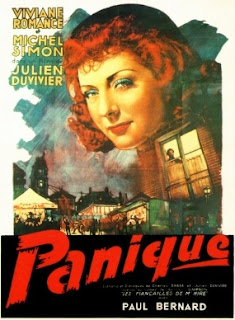
Panique is Julien Duvivier’s
first film on his return to France, following the Second World War. The Master
had worked for almost a decade in America, but not, one would think, terribly
successfully. It should be noted that I use the word "Master" quite
deliberately, not in the sense of "Maestro" or chief, but as a true
cinema giant – so if that view does not accord with yours, there is little
point reading on. I choose this film because it was manifestly unsuccessful
with critics and audiences on first release but has subsequently acquired a
much more significant reputation.
Quite without formal evidence, I would like to suggest some background issues
relating to both creation of the film and its reception which only historical
insight can give. Why, after all, would an adaptation of Georges Simenon novel,
be unsuccessful when that author was probably the most adapted to cinema in
Europe, if not the world? One would infer that the director chose an
understandably commercial plot with strong expectations of acceptance and the
failure of such acceptance should be attributed to his particular methodology
and style. Duvivier returned to France immediately after the war, having been
quite vilified in taking work in Hollywood when he left in 1937. He returned to
a country deeply divided between right and left. The left was dominated by, as we now know, the record in France during
the occupation of scarcely unblemished, indeed quite rampant collaboration.
Except
for the most egregious cases of collaboration, it was in the interest of both
right and left to play down the extent of this want of patriotism. Even those
who did not actively collaborate could be said to have simply "sat at
home" and watched passively. How much easier it must have been to criticise
someone like Duvivier who had left the country altogether and only returned
"when the coast was clear". And he came back with many of the
finishing touches of expert production values and efficiency which only
Hollywood at that time could have given. He was thus a very easy target.
In a film in which there is no absolutely clear protagonist (this is discussed
later), we first encounter the apparent male protagonist seated in the back of
the bus which has come to its destination. The bus conductor changes the destination
signal from "VilleJuif" (translation "Jewtown" to
"Gare de L’Este" (translation "Rail Station East") so it is
clearly set in Paris. At that time the Jewish area of Paris was the Marais
(which is now the gay area of the city). But it is an imaginary,
"poetic" version of that arrondissement, more semi-suburban, than
urban. Mr Hire, all long, unkempt, black beard and large fedora, is clearly to
be imagined Jewish. One of those central European Hasidic Jews who flocked to
France in the inter-war period and unlike totally assimilated "secular
Jews" were the ones most immediately and brutally treated. Of course this
is not stated. Mr Hire has a French first name "Desire" and as events
unfold seems quite tolerably assimilated: he takes the female protagonist to
his unoccupied family mansion on the river and acknowledges that he has been a
lawyer but given up practice.
Thus we are confronted immediately with the "outsider", who because
of his racial and religious background, audiences would recognise as a representative
of people who had been exceptionally badly treated, certainly by the occupiers,
but additionally by French people – only a relatively few months earlier. His
behaviour is odd and considering his background as it is revealed, one of
considerable privilege, is eccentric indeed. The plotline is essentially that
of an outsider wrongly victimised by "insiders" because they are self
protective and seize upon the outsider for what are quite superficial reasons.
Mr Hire is played with exceptional finesse by the noted French actor Michael
Simon who makes no apologies in playing him as in many ways unattractive
because of his lack of sociability. We learn that under another identity he is
a practising astrologer something that would not have pleased the Catholic
General De Gaulle, for some part of the time of production of the film, the
ruler of France. His tragedy is that as he begins to come out of his
reclusiveness, drawn to an attractive woman, Alice (Vivian Romance), who is in
fact the "moll" of a petty gangster. Hire is sacrificed by her in
preference to her gangster man and she is shown as being completely
unscrupulous. She learns that it is her boyfriend who is the murderer of an
elderly local spinster where the locals prefer to blame Mr Hire.
It is her behaviour that defines this film as "noir". She is truly
evil. She recognises the nature of good, but consciously fails to do it. This
seems to be some commentary on the behaviour of Frenchman during the war: no
wonder they found it uncomfortable. While she makes a few pathetic attempts to
ensure Hire's safety, she is fundamentally concerned with herself, her gangster
boyfriend and enjoying the loot that the boyfriend stole from the deceased
spinster. She tries to convey the impression that she acts out of necessity,
whereas it is clearly a matter of choice. At around this time in France Sartre
was writing about this very issue which he called "mauvais fois"
(translation "bad faith"), behaving as if there is no choice, whereas
in fact there is. Again this is a commentary on French behaviour during the
Occupation.
While much of the action takes place in a very claustrophobic environment of
cheap rooms in cheap hotels and one room bedsits, there is also a particularly
captivating background in the exterior sets of a carnival arriving at the
central square. The lightheartedness of the carnival atmosphere, or at least
its presence within the township, as well as putting me in mind of exterior shots
in Les Enfants du Paradis (Marcel Carne, France, 1945) also seems to be a commentary or at least
application of the French concept of "laicite" in the sense that free
public discussion should be capable of taking place in public areas, divorced,
for example from restraints of religion etc. Numbers of commentators have
indicated that in the period 1945-1950, many directors transposed the ugly
recent past of occupation, collaboration and death onto a different milieu. In Panique I believe the director is doing
this quite consciously and the unease this caused audiences, I think accounts
for its initial failure.
Like many if not most significant films, it enables us to view characters
"in the round", as truly human with all the idiosyncrasies and
foibles. Mr Hire, who seems to spend his days in the city taking photographs
illicitly (a 35mm camera and strap and carry case are always around his portly
frame), is quite possibly a voyeur but he is not without sympathy because of
this. Alice is truly evil, because she is self-aware, but is not uninteresting
to us solely because of that.
Lastly I wish to comment on "Jansenism". Jansen was a Catholic bishop
whose writings had very considerable effect on French Catholicism. His writings
emphasised what theologians refer to as "the Fall" thus emphasising
the inherent evil in humankind. An evil that had to be restrained and
consciously controlled. I have no idea whether Duvivier was a believer but he
certainly came of a normal Catholic background and I think his inherent
pessimism dovetails perfectly with Jansenist theology. Certainly I think the
parallel would be made by audiences.
Beethoven said in relation to one of his later and more complex piano sonatas
that it was not written for the present but for future generations who would
understand it. I think the same would apply to Panique.


