Showing posts with label Margaret Qualley. Show all posts

Tuesday, 2 September 2025

The Current Cinema - Barrie Pattison enjoys HONEY DON'T! (Ethan Coen, USA, 2025)

Margaret Qualley

I rate 
Honey Don't! Pretty much the most enjoyable movie since - well - Drive Away Dolls, the first part of Ethan Coen's proposed trilogy with Margaret Qualley in her P.I. Honey O'Donahue character. The new instalment offers all the things that make these enjoyable - raunchy sex, ultra-violence, bad taste, smart film craft and substantial borrowings from some of the best crime films that pre-date it - The Big Sleep, The Naked City, Chinatown - Hitchcock represented by lots of Psycho,  along with Torn Curtain & Topaz. Throw in Jessica Jones and add the parched Bakersfield L.A. settings they absorbed from Fat City.  

David Z. Obadiah’s attention-getting titles have the camera rolling through that scorched desert suburb and locking onto local business names painted on walls, proving to be the film’s credits. The most conspicuous streetscape feature is  coach stop benches.  These get to be significant. Lera Abova, the Russian lady from Luc Besson’s Anna, shows up on her moped at a remote highway car smash, where the wreck has rolled into an isolated ravine. The suspended body of the girl driver is still bleeding.  Abova prizes the “Four Way Temple” ring off a dead hand before going off to float naked in an abandoned mine pond.


Some time later Margaret Qualley drives her classic turquoise Chevy SS up to what has now become plainclothes cop Charlie Day’s crime scene and there’s this exchange about what either one is doing at a traffic accident.  Day keeps on coming on for Qualley, tall in her loose fitting outfit and heels, despite her telling him “I like girls.” She gets better information out of records storage-cage  officer Aubrey Plaza.


Turns out the dead girl had hired Qualley before they had a chance to meet. Her working an already closed case is the most Chandler element. The piece is closer to Mickey Spillane. Think of Honey Don’t! as the Kiss Me Deadly of our time. 


Chris Evans

Investigations keep on indicating charismatic 
Reverend  Chris Evans, who pounces on the chance to come on as something other than Captain America with a beard. As with Drive Away Dolls’ Congressman Mat Damon, also promoted with family values bill boards, Rev. Evans is a sleazy populist leader. His shadowy Russian connections, add to  the character’s contemporary resonance.


The service he gives to a congregation of marginals in their best clothes, about God’s demands and noodle, is a super-charged highlight. The Preacher also has other interests including Motel Parking Lot dope deals and threesomes with bondage gear girls in the Sacristy. These get to involve vengeful henchman Jacnier, who we were just getting to like. Qualley/O'Donahue finds a choir smock and fetishist leather and chains under the bed in her late client’s family home. 


There’s maybe related complications in the chaotic domestic situation of the investigator’s sister Kristen Connolly and punk niece, diner waitress Talia Ryder, who shows up roughed up by a trailer-trash boy friend. The scene where Qualley sorts him out (smashing his sawn-off proves harder than it looks) is another of the film’s surprise highlights.


With her secretary Gabby Beans giving Qualley a hard time when her boss picks up the ‘phone calls that are her job, it’s all a bit much for her and she finds release with Plaza in material more explicit than we’ve seen either do before. The downwards take of the pair of them, naked, smoking in bed, is done in a single run of the camera. Critics who seem to miss everything else in the film pick up on the shot of dildos (also pivotal in Drive Away Dolls) soaking in the sink next morning. Think the ripped papers flushed in Pyscho’s toilet bowl for a similar disruption of movie taboos that hadn’t occurred to us before.


Along with the shock value material and the nostalgia content, Honey Don’t! keeps on fielding walk-ons that could have classed up earlier Coen Brothers efforts - Patrick Swayze’s brother as the piano bar man who makes his line about smiling register by a menacing leer, Michael Gmur’s brief, unmotivated monologue about the bus he’s driving or homeless man Kale Browne who proves to be more than he seems. In any other film they would stand out. 


Aubrey Plaza, Margaret Qualley

It takes a while to establish that there’s something going on here than we never got in 
Drive Away Dolls but wait. One of the film’s core purposes is to set Qualley’s star status but it’s more remarkable to see Aubrey Plaza, conspicuous for a decade, abruptly finding her character. Think Gloria Grahame in The Big Heat.

We’ve now got IMDB and Rotten Tomatoes (both U.S. but incorporating some foreign language sources) and an alarming thing is that reviewers all seem to be queuing up to say the same thing  - like the bogus consensus of that Sight & Sound poll. They all home in on the dildos. However the Mickey Spillane thing totally passes them by. They can’t all be too young for that. One element that puts writers off is apparently unmotivated content. In a scheme where information is planted with such precision (the retrieved ring, a Rolodex that doesn’t have Plaza’s address, green lipstick on the tea cup) it seems hard to believe that we are not going to get more clues. I’m still wondering about who offed the car smash client but my guess is that all is to be revealed in Go Beavers, the proposed third film. No word yet on how that one is going. Personally, I've had such a kick out of the first pair I can’t wait.

Monday, 4 March 2024

The Current Cinema - Barrie Pattison reports falling about watching DRIVE-AWAY DOLLS (Ethan Coen, USA, 2023)

Margaret Qualley, Geraldine Viswanathan, Drive-Away Dolls


I’ve been wondering about Drive-Away Dolls, the movie from the Coen brother who didn’t want to make a black and white Macbeth with Denzel Washington. I noticed a reference to it quite a while back (its credits say 2023) but pretty much the only promotion I’ve seen for its local run is a teaser on the front of a trailer for another movie. That all worked up my curiosity.

What I got was the kind of ferocious bad taste movie you’d expect if someone hired Oliver Stone to re-make The Rocky Horror Picture Show. After an uneasy start, I found myself falling about.

This one is kind of a family affair, one Coen brother writing with his editor wife and directing Andie McDowell’s daughter and Jonah Hill’s sister, to showcase a young woman from Newcastle, New South Wales, called Geraldine Viswanathan who makes a memorably straight faced contribution to all the anarchic stuff. Think Aubrey Plaza without the attitude. She is the required contrast to hard charging Margaret Qualley, teetering on the edge of her stardom. Qualley would have fit right in as a Howard Hawks woman.


It starts off uneasily with Pedro Pascal meeting a grotesque fate in an alley. Attention shifts to girl buddies Qualley and Viswanathan finding themselves at a loose end. Qualley has broken up with her police officer lover Beanie Feldstein, complete with an argument about who gets their wall dildo, while Viswanathan, fresh from her job with Ralph Nader, isn’t all that interested in the Sapphic club scene and plans on joining a birding expedition in Tallahassee, reading her Henry James novels along the way. 

Matt Damon

The ideal mode of transport would be a Driveaway where they take a car to its owner in another city. Turns out that grouchy Bill Camp’s office has a vehicle waiting to be shifted just there – exercise in comic probability. Nobody checks the boot, which turns out to have two suspicious items where the spare tire should be. Eyes widen when that’s unlocked.

Things liven up for Margaret when they stay at the motel where a lesbian soccer team are relaxing with the captain blowing a change partners whistle at half time. Turning down a threesome, Geraldine finds herself spending the night sitting in the office.

Geraldine Viswanathan

Meanwhile comic goons Joey Slotnick and C.J. Wilson discover that their car has been mistakenly dispatched because how likely is it that two sets of customers would want to go to Tallahassee? This sends those rightful owners off in pursuit, which gets one beaten up by Feldstein because he’s old school and doesn’t want to hit a woman and his mate is blindsided when the address the soccer girls he’s charming gives them turns out to be a rough black music barn.

The girls meanwhile are coasting on a suspect credit card and the luxury El Conquistador hotel’s policy of inclusivity - steamy shower scene. Of course paths converge.

Not the least of the delights is the film’s maliciously misapplied film form. Scene transitions come up as the Henry James pages fluttering, contrasting to a psychedelic montage of fluoro coloured pizza fillings. Miley Cyrus gets a psychedelic number and there’s a glimpse of Senator Matt Damon’s mis-spent college days.

Beanie Feldstein

Drive-Away Dolls
 keeps on playing off audience expectation. It’s an exploitatively sexy film (“at least take off your shirt”) where the only full frontal is a sunbathing bit player. It comes with my all time favourite McGuffin (include monologue about the possibility of an E-Bay sales promotion). They telegraph the introduction of ego-free star Matt Damon with a hoarding of him as the local family values politician. Boy is he going to get it! When the girls confront him, they announce themselves as Democrats.

The pace never slacks with the lesbian frame of reference twisting the familiar situations into something grotesquely fresh. Everyone comes out of it well though it’s not a big budget offering.

I’m sorry they didn’t get about to making this in the nineties the way they planned, when it could conveniently have slid in with the drive-In fare that it burlesques. I would have re-visited it at intervals quite a few times by now. That I would have enjoyed. It’s the highlight of my current viewing.

Sunday, 14 November 2021

Streaming - John Baxter gives attention to a film that slipped under the Covid radar - MY SALINGER YEAR (Philippe Falardeau, USA, 2021)

Margaret Qualley and that portrait

MY NEW YORK YEAR. 

            My first American literary agency was a three- or four-person operation occupying a cluster of rooms on the twenty-somethingth floor of a ‘thirties building in mid-town Manhattan.  It subsisted almost entirely on tending the estates of past clients, now long-dead, whose portraits decorated its walls. 

            The proprietor, then in his eighties, had known all of them as friends, and could be amusing about their eccentricities. He was not without a few himself. Outside his window, Astroturf covered a terrace the size of a golf green. On quiet days, he would step out with the Ben Hogan driver he kept in the corner of his office and, indifferent to where they landed, whack a few Titleists into the smog of East 24thStreet. 

            His assistant, une dame d’un certain age  who had been, and perhaps still was, his lover, satisfied my curiosity by taking me down into the sub-sub-basement where a room was crammed with steamer trunks, each stencilled with an illustrious name. Within them was the accumulated correspondence and memorabilia of that particular literary great.

            A treasure trove for the biographer, I suggested. She glared.

            “Those vultures? Never. They know nothing about these....”  She ushered me out,  slamming and double-locking the door. “....and they never will, as long as I’m alive.” 

            I thought of her while watching My Salinger Year (aka My New York Year), the latest film by Quebecois director Philippe Falardeau.

Director and co-writer Philippe Falardeau

            As the walking wounded movies of the pandemic begin to limp into the light, it’s become more interesting, at least in France, to monitor broadcast video and streaming outside Netflix and the other major sites. The 2021 My New York Year/My Salinger Year had some kind of release, even, apparently, in Australia, early this year,  but otherwise sank without trace. It deserved better, if only on the basis of Falardeau’s  tragi-comic The Good Lie, (2014) about a well-meaning Reese Witherspoon trying to integrate the remnants of a tribal Sudanese family into white middle-class Canada.

            Mike Nichols’ 1988 Working Girl set the bar high for stories of modern young women striving for business success. Sigourney Weaver dominated that film as the manipulative boss who is also a role model for upwardly mobile Melanie Griffiths. Weaver appears again in My New York Year  as the literary agent, blessed (or cursed?) with reclusive author J.D. “Jerry” Salinger as a client.  In a manner which, probably not by accident, echoes Anne Hathaway as the neo-fashionista in The Devil Wears Prada, Weaver’s naive assistant Joanna Rakoff (Margaret Qualley) must stifle her own creative ambitions to help insulate Salinger from his intrusive public. 

            The story has its basis in fact. In the mid-nineties Rakoff left California to work at Harold Ober Associates, a revered New York literary agency. Sigourney Weaver is a thinly-disguised portrait of senior partner Phyllis Westberg. 

Sigourney Weaver as Phyllis Westberg

            Falardeau, who co-wrote the script with Rakoff, wisely declines to concentrate on Salinger. Tim Post plays him in a couple of near-anonymous appearances but he’s mainly present as a husky telephone voice and that familiar portrait from his Catcher in the Rye days, prints of which dominate the Ober office like a religious ikon.

            The film focuses instead on Joanna’s struggles to reconcile real life with the fantasy of literary success.  In typical bildungsroman fashion, she learns that, when life and legend conflict, printing the legend is only a short-term solution. 

            She tries anyway, dumping her well-meaning Californian lover for an edgy New Yorker, only to impair that relationship by exercising her new-found critical abilities on the manuscript of his novel. At the office, she tries to second-guess her boss about a new book from young-adult author Judy Blume, pleading the cause of art against money. Most disastrously of all, she’s tempted, a la Miss Lonelyhearts, into replying personally to one of the weekly harvest of letters to Salinger which it is part of her job to shred. 

            At the end of her year, Joanna must decide whether to join Margaret on the battlements, defending commerce from the attacks of art, or take arms with the hungry generations battering at the gates. No prizes for guessing which way she jumps.

             My New York Year, uncertain with whom to sympathise and anxious to show every facet of Joanna’s dilemma,  bites off more than it can chew. As in The Devil Wears Prada, the late introduction of a back-story for her boss, revealing a complex private life, forces us hurriedly to reassess the character of Margaret, something done more deftly by Aline Brosh McKenna in the earlier film. 

            Nor does Margaret Qualley’s Joanna convince as someone who might, in time, succeed as an  author. Her total published work, two poems in The Paris Review, doesn’t suggest it acts on Salinger’s advice to write every day, while her near-reverence for The New Yorker, a visit to the offices of which is staged like the pilgrimage to some sacred site, argues against the independence of spirit that might earn success. She’s first and last a fan, and long before she sees it, we accept that Salinger is right to isolate himself from such people. The love of one’s admirers, even those as sincere as she, can be toxic.  Look what happened to Orpheus. 

***************** 

MY SALINGER YEAR was released in Australian cinemas nationally by Palace Films in January 2021. It came out on DVD and Home Entertainment (iTunes, Fetch, Amazon etc) through Madman Entertainment on 21 April.

It is presently also available to stream on Binge and Foxtel Now.


Saturday, 9 October 2021

Streaming on Netflix - Rod Bishop recommends MAID (Molly Smith Metzler, USA, 2021)

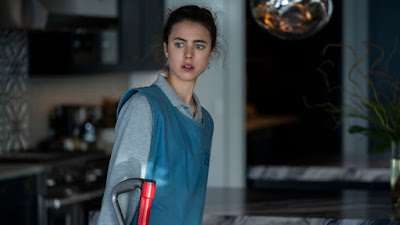
Margaret Qualley, Maid 

Set in Washington State - although filmed in Canada – this 10-part adaptation of Stephanie Land’s memoir Maid: Hard Work, Low Pay and a Mother’s Will to Survive, may be the year’s biggest surprise.

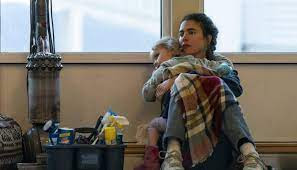
It opens as Alex (Margaret Qualley) and her two-and-a-half-year-old daughter Maddy (Rylea Nevaeh Whittet) do a night-time runner from their trailer park home. 

They are escaping Alex’s husband, the “emotionally abusive” bartender Sean (Nick Robinson). After sleeping in their car and being betrayed by well-meaning friends, Alex and Maddy’s next stop in their spiral towards poverty and welfare support is a domestic violence shelter.

If this is starting to sound like a piece of miserable social realism brilliantly directed by Ken Loach…well, it isn’t.  


Rylea Nevaeh Whittet, Margaret Qualley, Maid
                                         

Alex doesn’t believe she should qualify for such support, that emotional abuse is less deserving than physical abuse. It’s one of many wrong-foot moments for the audience as Maid takes you to places you have seldom seen.

Like the domestic violence shelter run by the wonderful Denise (BJ Harrison) with its codes of protection and its abused mothers standing in clumps on the roadside, their heads down over the mobile phones they can only use blocks away from the shelter to stop their abusers tracing their location.

The issues raised in Maid are serious enough – a broken welfare system with Catch-22 demands; court appearances for custody where the verbal legalese makes proceedings incomprehensible; half-way houses; grinding cleaning work where you pay for your own cleaning products; and endemic family dysfunction – but Maid’s greatest quality and its blessing are a full range of empathetic, three-dimensional characters who humanize the world they inhabit.


Andie McDowell, Maid

Alex’s artistic mother Paula (played by Qualley’s real-life mother Andie MacDowell) is undiagnosed bi-polar and as well-meaning as she is, clearly needs therapeutic help. Alex feels she’s been caring for her mother since she was six-years-old. Paula, too, lives in a trailer with her gambling boyfriend Basil, whom Alex continually accuses of having a fake Australian accent.

Apart from his violence, Sean has alcohol problems, but instead of myopic denial he is forcefully self-aware of his issues and how he needs to prove himself to win Alex back. His alcoholism, however, is shared with Alex’s father Hank (Billy Burke), a former drink-abuser but now a born-again Christian. They bond at AA meetings and form a double-whammy for Alex who hates her father even more than her estranged husband.

Alex cleans a mansion for Regina (Anika Noni Rose), a lawyer whose husband leaves her just as she’s about to adopt a surrogate child – a child she never wanted in the first place and one she has no idea how to raise. As their strange relationship warms, we wonder just who is worse off here – single mum Alex in her struggling poverty or Regina, whose life and mind is disintegrating among the artifices of her opulence.

Despite the great supporting characters, the canvas belongs to Alex, and here Margaret Qualley is fully in command of her performance. An intelligent woman who copes admirably most of the time, Alex still makes many believable mistakes. It’s a lived-in performance from Qualley, packed with nuanced authenticity and eye-movement acting that conveys far more than the written dialogue. 

Although it may be hard to believe – given the subject matter – it also has great humour.

A privilege to watch…despite some awful songs on the soundtrack.