Showing posts with label Greek Cinema. Show all posts

Sunday, 27 September 2026

CINEMA REBORN NEWSLETTER - 4K Restoration of Greek film classic EVA (Maria Plyta, Greece, 1953) and the next UNKNOWN PLEASURES screening in Melbourne


CINEMA REBORN – SEPTEMBER NEWSLETTER #2

Recommendations for the forthcoming Greek film festival and for the Unknown Pleasures screening in Melbourne

GREEK FILM FESTIVAL

EVA (EVE) - Festival de Cannes

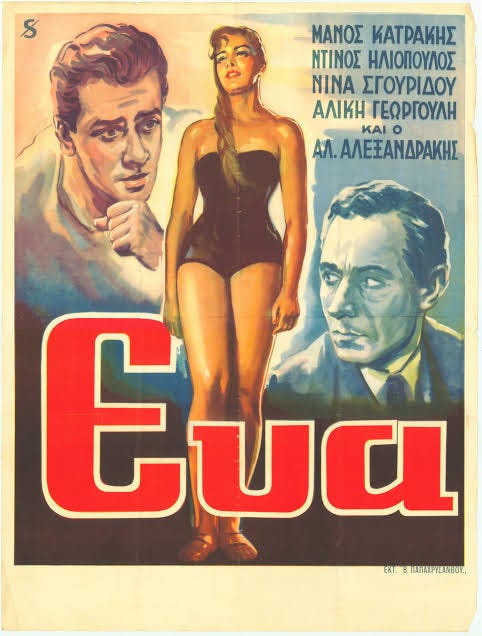
Stalwart Cinema Reborn supporter Helen Goritsas writes about a major new restoration of EVA (Maria Plyta), a cinema classic screening at the forthcoming Greek Film Festival in Sydney and Melbourne from 13-25 October

I’m part of the Festival committee, and this year we are presenting the Australian premiere of the new 4K restoration of Maria Plyta’s Eva (1953), with screenings in both Sydney and Melbourne.

The restoration premiered at Cannes Classics 2026, becoming the first Greek film to screen in Cannes Classics. EVA was directed by Maria Plyta, Greece’s first female feature film director, and its restoration has brought important renewed attention to her body of work.

The 4K restoration was undertaken by The Film Foundation’s World Cinema Project and Cineteca di Bologna at L’Immagine Ritrovata, in association with Alatas Films and Professor Betty-Despoina Kaklamanidou, and in cooperation with the Greek Film Archive.

Click Here for details of the Sydney screening

Click here for details of the Melbourne Screening

In Sydney, EVA screens at Palace Norton Street on Saturday 17 October, where I’ll be moderating the Q&A following the screening. Special guests acclaimed film director Ana Kokkinos and Professor Vrasidas Karalis.

We also have a special event the following day, Sunday 18 October, at the Chau Chak Wing Museum, University of Sydney:

Feminism and Cinema: The Legacy of Greece’s First Female Director, Maria Plyta.

I’ll be moderating the discussion between film director Ana Kokkinos, Professor Betty-Despoina Kaklamanidou, Professor Vrasidas Karalis and Dr Sophia Sakellis, exploring Plyta’s work and legacy, the restoration and rediscovery of EVA, and women in cinema.

Event details:
Click here for details of the panel discussion


UNKNOWN PLEASURES SCREENING IN MELBOURNE ON TUESDAY 6 OCTOBER

Cinema Reborn Organising Committee Members Grace Boschetti, Digby Houghton and Zac Tomé are the curators of Unknown Pleasures, a long running series of screenings which spot light the work of Australian independent filmmakers. 

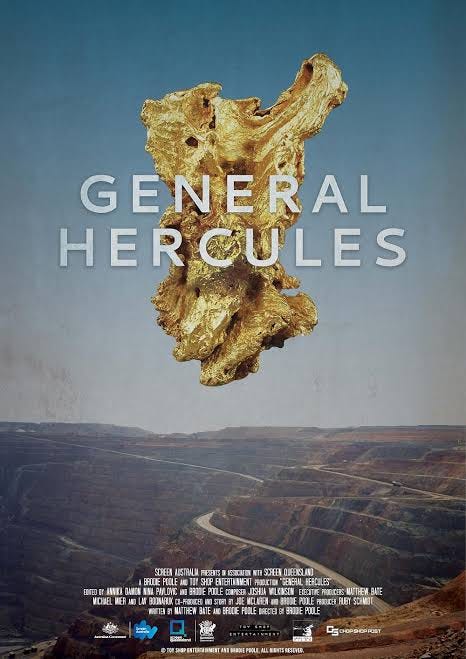
This October Unknown Pleasures screens the debut feature of cinematographer turned director Brodie Poole, ‘General Hercules’. In Kalgoorlie-Boulder, Western Australia, oddball independent prospector John 'General Hercules' Katahanas is running for mayor against the incumbent John Bowler, in an illuminating David vs. Goliath campaign. This engaging and keenly observed portrait lays bare the deep rot left in the wake of colonialism and exploitation.

Tix available here

General Hercules (2022) - IMDb

CINEMA REBORN DATES FOR 2027

Make a note in your diary for the Cinema Reborn 2027 season which will be presented at the Randwick Ritz Cinemas in Sydney from Friday 30 April to Sunday 9 May and at the Hawthorn Lido Cinemas in Melbourne from Friday 7 May to Sunday 16 May. We expect to be making program announcements of our initial titles sometime in December and the full program for both venues will be released on 13 March. If you would like a friend to be kept informed please pass on this email or send their address to cinemareborn2025@gmail.com


Thursday, 11 December 2025

At the Greek and Italian Film Festivals - Janice Tong embraces a Trilogy: Life's Labyrinths, Part 1 - ATHENS MIDNIGHT RADIO (Renos Haralambidis, Greece, 2024)

The voyage back from the far side of a metaphoric world had taken almost a year through a fogged maze of days and hours undone. Throughout, I have been an impersonator of the small-spirited and bumbling adventurer Phileas Fogg (courtesy of a recent viewing of the comic and alarming meteoric talent of one David Tennant), and suffice to say, it was not only in name that we were equals. This year of quiet unassuming mourning where films were watched unnoticed, passed me by with a meandering haze of interceding narratives that neither yielded joy nor nostalgia. In fact, I had not noticed much but for a lack of appetite. 

 The Italian Film Festival changed all that. Maybe it was time, too. I had selected more than seven films to be watched (managing only three in the end), I did, however, include the great Visconti’s Death in Venice in the same season – this other film, newly restored, was screening at the Ritz in Randwick and nicely complemented the three films. And ending this period of weekend film-going with a poetic, lyrical and infinitely beautiful film from the Greek Film Festival (first time attendee to this one), Athens Midnight Radio. And it is with this film – and the end of my chapter of disquiet – where I shall begin. 

Renos Haralambidis, Athens Midnight Radio


Nyhterinos ekfonitis | Athens Midnight Radio 
Written and directed by Renos Haralambidis, who also plays the main protagonist in the film, a lovelorn late night radio announcer who is about to celebrate his fiftieth birthday on air. This film is pretty much a one-hander and Haralambidis carries it off magnificently. Part recollection, part reflection, on the unrelenting onset of time; this is the announcer’s call into the darkness – for a return to love, to youth, and perhaps to the better days already missed, those long gone years. With this, he has cast a message in a bottle, and set it adrift in a vast ocean of the unknown. His one wish – to be reunited, on air, off air, into the distance of the night – with a love he’d let go a long time ago. He has given her the duration of his session to get back in contact, to call in if she happens to be listening. 

So this night is a story crafted in memories of his youth, where the city’s glorious ancient monuments, tokens of his lover’s meeting spots, and the music, a nostalgic signalling of lost days – many beautiful pieces, especially the repeated aria from The Pearl Fishers, Je Crois Entendre Encore (I Think I Hear Again), differently rendered each time. And at each hour, passed-time was marked through its announcement by an analogue tape recording (a hark back to ancient Hellenistic days where the hours of the night were announced via water clocks). 

Contributing to this film’s hypnotic quality is Haralambidis’ sonorous midnight voice, like a confessional, this internal monologue is sometimes punctuated by music, sometimes by callers into the radio station, and sometimes, most memorably, by the recordings of messages left by his lover on his answer phone. In this way, Haralambidis invites us into not only his personal history and desires but also identifies to us his current mood: as a man of nostalgia; we immediately understand that he is a collector of songs, for the messages have a musicality of their own. 


The characters, although unnamed (and probably because they are unnamed) made their love story infinitely relatable. The anonymity a city like Athens offers is depicted none more clearly than in the scenes of the midnight marathon runners preparing for their race, the warm up exercises were shown in close-ups: the back of heads (one with headphones in place), fragments of limbs, arms, hands, feet – as though preparing the viewer for those other fragments, sculptures of Greek gods, and monumental ruins like the ever-watchful Acropolis, that featured prominently throughout the film. Kostas Gikas’ cinematography paints the city in slow motion, the quiet city released from tourists and workers commands our eyes, paired with a soundtrack (provided by the radio announcer) demands our ears’ attention too. Even a remembered ‘performance’ from an isolated phone booth brought out a sense of yearning, nostalgic for a youth long gone, for a simpler way of life. 

This film is also Haralambidis’ love story to Athens. As the night paints its stars across the sky, the narrative illuminates and awakens the secrets long buried there. In what seems to be another life, the announcer was once an Evzone, part of a light infantry that stands guard at monuments. In recalling its elaborate handover parade, which for me at least, has always been a curious mix of choreography, solemnity and discipline. This sentiment and tone matches perfectly the magnificent, but silent monuments standing sentinels across the city in sleep, where the vanished lover of his youth, a dancer, leaps and twirls across these landscapes. The most touching scenes were those where she had danced in front of him. First at Syntagma Square in front of the Tomb of the Unknown Soldier where he was stationed. At the time, even her beautiful grand jetés were unable to stir his heart, marking the place where their love story began to unravel. And now, in a dreamscape, and Haralambidis with eyes closed, reclined against the sublime fragments from the East Pediment of the Parthenon, were of Demeter (whose skirts he leant against) and Persephone, and Dionysus nearby, all in a kind of limbo and frozen in action. 


These replica sculptures located at the Acropolis metro station in Athens are mute, as though their stories, currently voiceless, are asking to be discovered – slow mirage-like sequences where everyday workers pass by these works, and the sleeping Haralambidis, unseen. Whilst his lover, a ballet dancer, portrayed wonderfully by Eleftheria Stamou, a dancer herself with Greek National Opera Ballet, is as alluring and mysterious as these ancient gods, and as graceful as Athens, her city, especially when dawn breaks. 

Does he get to reunite with her? This dream lover? You’ll have to watch the film to find out. Perhaps the mood and meaning of this film is best described by Haralambidis in his own words: “I always appreciate Athens as a city where you can be in the arms of eternity as trains go by and also amongst the crowds, which come and go, as if indifferent to these surroundings. And it is in the underground of the city's metro, at the Acropolis metro station where the exhibit of the replicas of the statues of the eastern gable end of the Parthenon, that I discovered the stars for my new film Athens Midnight Radio.” 


This quote is from a beautiful short article on the website of the British Committee for the Reunification of the Parthenon Marbles where Haralambidis speaks eloquently about his film and Athens. 

 The Greek Film Festival ran in October in Australia this year. 

The Italian Film Festival ran in September and October in Australia this year. 

**************************

 Look out for the next instalments coming soon, on La Grazia by director Paolo Sorrentino and Il tempo che ci vuole | The Time it Takes by Francesca Comencini 

Saturday, 2 October 2021

Streaming on MUBI - Janice Tong welcomes DOGTOOTH/KYNODONTAS (Yorgos Lanthimos, Greece, 2009) and KAL AZAR (Janis Rafa, Greece, 2020)

Family antics, Dogtooth

Yorgos Lanthimos 
must be one of the most original directors of his generation; I thought his film The Killing of a Sacred Deer (2017) was a perfectly executed modern-day Greek tragedy (if you would excuse the pun); and so what if critics or viewers thought it wasn’t an exact adaptation of Iphigenia, it didn’t need to be, such is the freedom of invention for a director. Whilst I didn’t like The Favourite (2019) or the more recent short Nimic(2019) that is showing on Mubi, I did enjoy The Lobster (2015) which reminded me of another, the Japanese film After Life (1998) which I’ve discussed in conjunction with Vif-Argent recently. 

It’s not possible for a film to exactly conform to our idea of a play or another film, to do that would be extremely boring for both director and audience. Dogtooth, an earlier film of Lanthimos is along that same vein as that of The Lobster.The absurdist humour and absence of sentiment in the film’s main characters meant that pathos is excised from the audience. We cannot help but be drawn in to the unfolding lives of those disaffected characters. 


The fragmentary nature of the film and the seeming lack of a cohesive narrative drive the audience to invest in the characters’ every action. We derive meaning (and this may vary from person to person) from what we see, based on our own experiences of cinema or histories. Lanthimos extracts much meaning out of predominantly action images. 


The game of 'seek', Dogtooth

The almost stoic presence of the characters, their lack of emotion, their resolute falling in with what is required of them: that the father drives Christina, a security guard from his work place, to provide sexual services to his grown up son is just an everyday episode, of the family members going about their banal existences. Another time, the three grown-up children engage in a family game where all three are blind-folded and having to ‘seek’ their mother, locatable by the sound of her voice counting up the minutes. It’s a reverse ‘hide and seek’ - and seek they must. Remembering what Baudrillard wrote: that the worst thing for a child when playing the game of hide and seek is to not be found; if you’re too well hidden, they give up and they forget you instead of finding you. The game is nullified because the rule dictates that there needs to be a ‘hide’ and a ‘seek’, without one of these elements, it is not possible to conduct the game. Here in Dogtooth, the rules of the game are understood simply to be just that and the father (none of the characters except for Christina are named) goes to all extents to ensure that the game remains in play, as does the eldest daughter. 


The plane. The plane!, Dogtooth

All the cast members, especially that of the eldest daughter Angeliki Papoulia, who has worked with Lanthimos for three of his films, including The Lobster, are completely believable. And Christos Stergioglou as the father is also notable, as the oddball dictator-like patriarch; setting up rules of the house that may seem totally absurd, but are totally convincing for the family; the dynamic between all the family members is also nicely tuned with the off-kilter sibling jealousy at its finest. 


There is something of an absurdist humour in most Lanthimos’ films, and Dogtooth holds its ground as one of his best. Its pared-back nature, stripped of the type of artifice that The Favourite was propped up on, means that this film will continue to feel modern and challenge perspectives and expectations of cinema audiences.


Kala azar is also the name of a potentially fatal immune system disease, Leishmaniasis or Black Fever, that is caused by the bites of female sandflies that carry the leishmania parasite. If you look at the Médecins Sans Frontières website, you’ll find that the statistics are staggering, with between 200,000 to 400,000 new cases each year. It is the second largest parasitic disease in the world - and yet, not many people would have heard of it.


No boundary between the human and the
animal, Kala azar


This largely silent film offers a permeable border between the human and the animal: that line where the human ends and the animal begins,  is continuously being blurred. An unnamed couple played by Pinelopi Tsilika and Dimitris Lalos are lovers and business partners; they run a kind of crematorial services for bereft pet owners. Travelling through a landscape that looks to be the bordering on deserted, I would not necessarily say post-apocalyptic as the highway seem to be jammed with lorries and trucks. The theme that runs through the heart of this film is the perseverance of nature, and you can see the wildering process in the deserted landscape, although some scenes showed rundown fenced-off areas that may indicate refugee camps, not the mention the rifle gallery next to where they work. 


As part of their job, the couple go to meet with these pet owners in all sorts of rundown and out of the way houses and farms. They caretake the deceased animals by collecting their bodies and small containers from the owners, (some of these are just plain bottles or jars, others are more like fancy trinkets, and sometimes the animals are wrapped in a beloved scarf) and take them back to their ‘crematorium’ before returning their ashes to their owners (in the jars and holding vessels). The idea that all the animals are cremated together, so that the ashes return to the owners would be mixed in with a collection of other beloved animals that have also perished and have been cremated alongside, is a lovely one; but would no doubt offend the ‘me’ culture these days. I like this collective way much more the sycophantic antics of providers who now claim to be able to ‘freeze-dry’ your pets (as if taxidermied pets are not weird enough - I do like taxidermy, just not of my own pets), this kind of practice is bordering on the ghastly.


Giving the chickens a fine sendoff. Kala azar 

The idea of preservation in this film reminds me of another - a wonderful film called The Ring Finger or L'annulaire (2005) directed by Diane Bertrand (sadly I don’t think she’s active anymore). And in this film, which stars the beautiful Olga Kurylenko (she suited this role perfectly), her character works at a ‘laboratory’ or ‘museum’ of sorts, one where people are able to come to preserve a beloved possession; be it a pet that has passed away, music score, or even a memory. If you haven’t seen this film, please take the time to do so as it’s showing on Stan at the moment.  


Avant-garde director Janis Rafa has made a very fine debut feature in Kala azar; crossing over the abyss, if only the arc of what remains of civilisation can be summarised by the chicken factory scene, where a philharmonic orchestra provides a live concert for the thousands of chickens the night before they are to depart for their final destination. Elgar’s Nimrod from the Enigma Variations is an adpt finale for the chickens and a tribute to our historical past, (Nimrod was the great hunter in the book of Genesis; and now, we are no longer the great hunter, but instead, we are live animal factory owners). This dedication to our very distant past is an interesting one, especially since Sir David Attenborough’s latest documentary tells us that currently 70% of the mass of birds on this planet are domesticated, and the majority of them are chickens. 


This ‘special treat’ for the chickens was organised by the father of the woman; her parents are the silent older couple, who are perhaps even more primal in their behaviour then the younger couple. The mother is fantastically portrayed by Michele Valley, (who was also in the role of the mother in Dogtooth), and she lives in a house that is festooned with dogs; she baths with them, eats off the same plate as them; treats the bites on the dogs (as well as her daughter) with this homemade gloopy potion from a prickly pear-like cactus. 


A beautiful finch to be cremated with an equally 
lovely embroidered handkerchief, Kala azar

To tease out the animal and the human is to draw a line between the feral and the civilised, and yet, the practice of game hunting, or the way people turn away from roadkills with disdain, and the treatment of animals for slaughter, show that there can be little difference between man and animal. How do we find a space within this kind of landscape that allows us to be apart from this herd? Rafa’s pervasive narrative attempts to provide an answer in this exceptional film.


Kala Azar is currently showing on Mubi, as is Dogtooth.


#filmfestivaleveryday #filmoftheday#jandnfilmfestival