Editors's Note: This is the second of the introductions to films screened in Cinema Reborn 2023. Jane Mills gave the introduction to Claudia von Alemann's landmark feminist film, Die Reise nach Lyon/Blind Spot at the Ritz Cinema, Randwick, NSW on Sunday 30 April 2023. It was screened with another landmark feminist film, Helen Grace's Serious Undertakings (1983) Jane Mills is Hon Associate Professor, UNSW.
***********************************.
We're about to see two remarkable films by two remarkable women.
I'll start by saying a little about Claudia von Alemann's Blind Spot which tells the tale of 2 more remarkable women. I want to explore the links between this and our other film, Serious Undertakings, made by another remarkable woman,Helen Grace. Helen will then takeover to introduce her film. We'll end by dedicating this screening to yet another remarkable woman, Tina Kaufman.
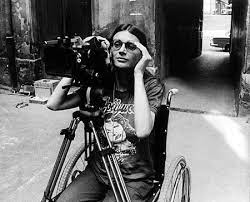 |
| Claudia von Alemann on location in Lyon for Blind Spot |
In all, that's five remarkable women. At least five: we can't forget all the remarkable women who worked on thesefilms. Several of whom are with us here this afternoon. And we mustn't forget the men who worked alongside them.Both films warn of the dangers of forgetting and of the importance of remembering.
The German title of 'Blind Spot' is "Die Reise nach Lyon" which means "Journey to Lyon." The English title, "Blind Spot," initially puzzled me because it's very much a film about sound. It uses sound to trace the past. It listens for echoes. It hears pre-echoes. As the critic Paul Willemen wrote, it is "one of the few real sound films ever made." I'll return to that "blind spot".
��
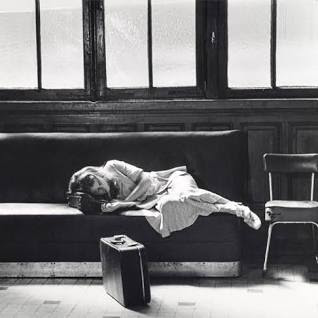 |
| Elizabeth (Rebecca Pauly) arrives in Lyon |
The film is, in fact, about two journeys to Lyon. First, we meet the contemporary young German woman, Elisabeth (Rebecca Pauly) as she arrives in the French city of Lyon. She has quit her profession as an historian and left behind her husband and young daughter.
Elisabeth travels to Lyon to seek evidence of Flora Tristan, the French-Peruvian, socialist and feminist writer whohad also visited Lyon alone, without her husband or child, over a hundred years earlier.
Flora Tristan qualifies as "remarkable" for many reasons. Before Marx, she argued that working class emancipationwould come from the working class. Before Engels, she insisted that the liberation of women was a prerequisite for aworkers' revolution, famously declaring: "The most oppressed man finds a being to oppress, his wife: she is theproletarian of the proletarian." Before the Communist Manifesto, she published a treatise on the need for aninternational Worker's Union.
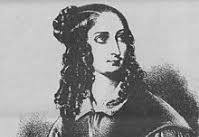 |
| Flora Tristan |
Travelling around France on her own, she visited Lyon to find traces of the silk workers (canuts) who had staged majorprotests for better working conditions and pay. Tristan wrote in her diary:
with my union project in my hand, I go from town to town, […] I talk to the workers. I find them in their workshops; in their garrets and even, if needed, in their taverns. …face-to-face with their poverty, I will compel them […] to escape from this frightful poverty which is degrading and killing them.
With Tristan's only recently published diary in her hand, Elisabeth visits Lyon, to find traces of this revolutionary feminist. Elisabeth is also searching for herself, seeking a unity between the past (Tristan) and present (herself). But Elisabeth can find no trace of Tristan (whose diary wasn’t published until more than a hundred years after she wrote it).Holding Elisabeth back are the historian's traditional methods perpetuating patriarchal hierarchies and orthodoxies.Dismayed by the forgetting, Elisabeth seeks alternative, feminist ways of remembering and recording history.
There is, of course, another traveller to Lyon: that's our filmmaker, Claudia von Alemann who seeks alternative feministfilmmaking ways of remembering and recording history. Elisabeth intrudes on the patriarchal terrain of traditionalhistoriography. Von Alemann intrudes on the patriarchal terrain of traditional cinema.Visually, Blind Spot is an extraordinarily evocative film. The images offer a palimpsest – images of the present through which the past can't—mustn't—be forgotten. The film's images evoke sound as one voice appears imprinted within another. No surprise that cinematographer Hille Sagel was also a painter. The beautifully composed and textured shots of cobbled streets, slum dwellings, stone steps… evoke echoes allowing us to remember, imagine, and even hear Tristan's famous rallying cry: "Workers, without women, you are nothing!"
Von Alemann said of her film: "Remembering is largely effected acoustically. I use many sound elements to transmit different ways of hearing. One speaks of the “subjective camera,” I want to speak of the “subjective microphone.”
So, back to the English title: Blind Spot.
The term denotes that area in our retinas which cross the optic nerve. The absence of light receptors (rods and cones) generates the absence of an image of something that actually exists. Metaphorically, we talk of a 'blind spot' when driving to refer to the place beyond the reflection in our wing mirror, the place where we can't see what is actually there.
Finally, I get it: the blind spot in this film is our blind spot. It’s the point where society can't see what existed, but which actually exists, is still there. As it can't be seen, it has to be remembered —or re-remembered.
Remembering and retrieving Tristan —and by association, other women like her—from our "blind spot", von Alemann puts them in the spotlight, so that their achievements might be rescued from forgetting and might, in the process, change other women’s lives. This is feminist activist cinema.
And, as I say this, I realise I could just as well be talking about our other remarkable film: Serious Undertakings. It's my huge pleasure to ask Helen Grace to introduce it.
In her introduction, Helen acknowledged all those who worked on the film, those who helped her get the funding to complete it, and those who recently restored it. For further information about Serious Undertakings, see https://aso.gov.au/titles/documentaries/serious-undertakings/notes/
For more about both Blind Spot and Serious Undertakings see: https://cinemareborn.com.au/Blind-Spot ]
This Cinema Reborn screening was dedicated to Tina Kaufman about whom her good friend, the film writer Adrian Martin, wrote:
Memories of Tina Kaufman
Another loss: Tina Kaufman. It’s impossible to overstate the importance of the wonderful tabloid Filmnews, which she edited over the long haul, in Australian film culture and history. While Cinema Papers focused essentially on mainstream feature releases, Filmnews was the voice of independence: in cinema, ideas, politics, writing style, the lot. Tina had indispensable collaborators (including Hall Greenland) all throughout, but she was that publication’s heart and soul – and she kept it on track through every tight monthly deadline, every funding crisis, every rocking of the boat.
Tina was, in so many ways, an extraordinary person. Only she could have held together the extremely diverse set of people and interests that fed into Filmnews: everything from the most old-fashioned cinephilia to the most progressive politics, and every hybrid position in-between.
 |
| The Film News Editorial Board, Tina Kaufman front centre |
Tina had a brilliant, in-depth, on-the-ground understanding of industrial matters in the film world (she became a kind of regular ‘industry reporter’ in Metro and other places post-Filmnews) – stuff I was never able to follow until Tina laid it out so lucidly in her articles.
She had a gregarious side: she loved to laugh, gossip and network. No ideological position was sacrosanct for her, and she took a wicked pleasure in hurling people’s arguments against other in the often-contested pages of Filmnews. Even – or especially – if they had once been intimate partners! (I could tell you a story or two…)
A unique thing about Tina: she was the only non-academic person I ever knew who could happily attend every session of numerous university conferences on film and media: apart from the socialising side, she always found something interesting in every discussion she heard.
Something else I recall: her absolute devotion to attending every new Hong Kong release in Sydney’s Chinatown cinemas, at the time when that tranche of filmmaking was so exciting and revelatory. That was just one shade of her encyclopaedic, absolutely committed cinephilia. She saw everything that she could! At film festivals (she was deeply involved with the Sydney Film Festival), special event screenings, in bunkers and back rooms …
Tina eventually got to write a book: on Wake In Fright for Jane Mills’ Currency series of Australian Classics. It provides a fascinating perspective on how she saw that film in the context of 1960s social and lifestyle changes in Australia – changes which she had lived to the hilt.
She was an essential person in my life, particularly during the 1980s. I wrote for Filmnews from 1981 to 1993, often in a somewhat wild, experimental style, trying to find my voice – including a long critique of the magazine’s own film-crit contents! Tina did not flinch at publishing that; in fact, she encouraged it from me, and waited for the bullets to fly once it appeared. A good show, of the kind she savoured!
Perhaps the last communication I had with Tina was in late 2017, after my website launched. She liked it but had quite specific two complaints about what I had not yet included: a. my 2010 launch speech for her book; and b. a conference paper I had given on the classic 1930s film Peter Ibbetson back in 1985, of which she retained a crystal-clear memory!
In 1986, when I moved from Melbourne to Sydney for a while, I virtually lived in the Filmnews office at the Chauvel cinema. I was broke, out of work, displaced from all my routines, and fairly depressed; Tina gave me things to do on the magazine, and would always help me out with another $20 bill so that I didn’t starve.
Once, when I was especially sad after some interpersonal incident, I went moping to Tina at her desk there. She listened attentively, thought for a moment, then proclaimed: “Well, look, it’s good to shake life up once in a while!” What wise advice! Vale Tina. (© Adrian Martin, April/May 2023.)
References:
Robert Acker, “The Major Directions of German Feminist Cinema”, Literature/Film Quarterly 13, no. 4, (1985).
Ben Andac, 'Margarethe von Trotta', Senses of Cinema 23 (December 2002), https://www.sensesofcinema.com/2002/great-directors/von_trotta/
Maelle Arnaud, "Le Voyage à Lyon (Claudia von Alemann, 1981)" Plateforme des collections films de la Cinémathèque Française,(2021), https://www.cinematheque.fr/henri/film/107456-le-voyage-a- lyon-claudia-von-alemann-1981/.
Erika Balsom, "Remembering Women: Claudia von Aleman's Blind Spot," Cinema Scope, (June 16, 2021).
Melanie Bell, Shelley Cobb, Christine Gledhill, Debashree Mukherjee, Laraine Porter, Rashmi Sawhney, Ulrike Sieglohr, "ResearchingWomen’s Film History", Columbia Academic Commons, https://academiccommons.columbia.edu/doi/10.7916/d8-as7q-5051
Richard Brody, "Blind Spot", New Yorker, https://www.newyorker.com/goings-on-about- town/movies/blind-spot
Barton Byg, “German History and Cinematic Convention Harmonized in Margarethe von Trotta’s Marianne and Juliane” in Sandra Frieden (ed.) Gender and German Cinema: Feminist
Interventions. Vol II: German Film History/ German History on Film, (Oxford, Berg, 1993), pp. 259- 71.
Erica Carter and Claudia Sandberg, "Feminism and Women’s Cinema" The German Cinema Book, (2020),https://www.academia.edu/41655333/Feminism_and_Womens_Cinema
Theresa Castro, "Hidden Figures," Sight and Sound, (March 2022), https://www.academia.edu/ 95812020/Hidden_Figures_Claudia_von_Alemann
Thomas Elsaesser and Michael Wedel, The BFI Companion to German Cinema, (London, BFI Publishing, 1999).
Julia Knight, New German Cinema: Images of a Generation, (London: Wallflower Press, 2004).
Barbara Kosta, Recasting Autobiography: Women’s Counterfictions in Contemporary German Literature and Film, (Ithaca,Cornell University Press, 1994).
Raquel Morais, "Bring Back, Bring Back", Six Plus One 13, Bring%20Back,%20Bring%20Back%20% E2%80%94%20LIFE%20WAY.html
Flora Tristan, "Le tour de France. État actuel de la class ouvrière sous l'aspect moral, intellectuel, materiel." (Paris: Editions Têtede feuilles,1973), https://gallica.bnf.fr/ark:/12148/bpt6k82507w/f6.double.
Klaus Phillips (ed.), New German Filmmakers: From Oberhausen Through the 1970s, (New York, Frederick Ungar, 1984).
Paul Willemen, Edinburgh Film Festival Catalogue, 1981, quoted in Goethe Institute, UK, (8 April 2022),https://www.goethe.de/ins/gb/en/ver.cfm?event_id=22765723


