Showing posts with label Alba Rohrwacher. Show all posts

Sunday, 31 October 2021

Janice Tong's 🎥 First Filmic Postcard from the 2021 Italian Film Festival in Sydney - LACCI/THE TIES (Daniele Luchetti, 2020)

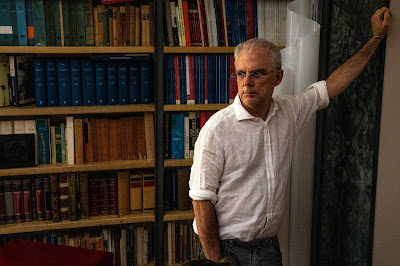
Director Daniele Luchetti on the set of The Ties
note the word-mural behind him

Family. That single word with a power to bring comfort and joy and also immense cruelty and destruction. Labyrinthine and pharmakonic (in the sense of
 Derrida - as both “poison” and “cure”), rarely can you escape your genealogical Eden. The invisible thread that stitches and patterns its roots in a history not of your own choosing. This topiary garden is by design and by the time you’re 5 or 6 years old, it’s formal structure is ingrained to inform your growth and shape your future form.  
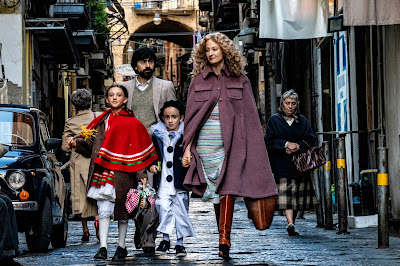
Luigi Lo Cascio and Alba Rohrwacher as Aldo and Vanda,
parents of Anna and Sandro – Giulia De Luca and
Joshua Cerciello respectively
.

In Luchetti’s Lacci, timelines and half remembered episodes are woven like remnants of cloth stitched by the thread of time. Sewn together, this tapestry narrates a fragmented story, dense and sprawling, where the viewers are treated with glimpses of an ordinary family’s domestic life and its unravelling. 


Vanda and Aldo with their two children Anna and Sandro appear to be the kind of close-knit family one desires. The film starts out in Naples where they were attending a family party, before returning home for bathtime, TV and supper, followed by a story before bedtime. But any familial bliss ends there, because before the end of the night, Aldo (Luigi Lo Cascio) confesses to his wife, Vanda, of having been unfaithful to her, that he is in fact having an affair with another woman and may be in love. Vanda is played by the talented Alba Rohrwacher, (last reviewed here in the 2018 film Lucia’s Grace) whose performance is both vulnerable and cruel. The camera clearly loves her face as it often captures her in close-up. When framed by her curly locks in profile, her classical features make her look as though she has just stepped out of a Botticelli painting. But that aside, Vanda clearly loses it and asks Aldo to leave. Ever so obediently he does, but defiantly, he also does not return home that night, or for many years after that. From here, time is no longer linear, cohesive or rational, and needs to fold back on itself to make sense of what’s happened. 


Vanda continues to struggle to keep her emotions in check. Over time she no longer behaves in the manner of a dignified and bereft mother; she has not borne her betrayal well at all. Being jilted has made her bitter and vindictive. She tries to confront him, then she tries to kill herself. But in her every action, her children bear the brunt of the outcomes, silently molding and shaping them. The needle pierces as it stitches all of these episodes together. In a later scene, it is suggested that maybe what Vanda fought so hard to successfully gain, is exactly the opposite of what she wanted; the ties that she made have bound her to a life that was false and unhappy.


-
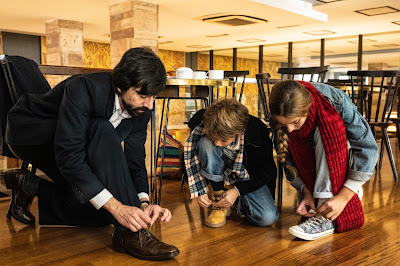
The tying of the shoelace


Some of the scenes with the children were incredibly touching. The young Anna and Sandro were played very well by Giulia De Luca and Joshua Francesco Louis Cerciello respectively. The eyes tell their story, flitting from delight at seeing their father, to incomprehensible hurt at the actions of their mother. The bookstore where as teenagers they finally reconnect with their father, was a mnemonic token. Apparently an idiosyncratic way of tying shoelaces was shared between father and son (the daughter missed out), and that metaphor of the shoe lace acts as the tie between the children and father, pulling Aldo back into the noose of the family again. But wounds never really heal, especially with Anna, who as an adult (played by Giovanna Mezzogiorno, last reviewed here in the film Naples in Veils (2017)) has been estranged from her parents for many years. At forty, she bears no resemblance in both physique or sensitivity to her younger self, instead, she bears a closer resemblance to her mother, in both bitterness and entitlement, than she realises. 


As for Aldo the word-smith, he has locked his other life inside the chequered box that “can’t be opened”. This, of course, is a metaphor for his heart-box of which the key is also locked within its depths, swallowed up by a web of words. Just like Glenn Gould’s brilliant interpretation of the Goldberg Variations that is played throughout the film, folded within its exterior beauty lies a complex web of form and structure; one can appreciate its charm and delight in its neat unison of notes without having to understand what is hidden within. When I listened earlier this year to Gould’s treatment of the variations during his famous 1955 recording session, with five hours worth of outtakes, it becomes clear that what we have come to know and love is already a distilled version of the truth. The truth, in fact, lies elsewhere.


Aldo wove a protective wall around the apartment with his many bookshelves. These are not necessary books of wisdom, they are instead a kind of word-mural that binds him to this interiority, where truth exists. These are not words that can release him out into the world. Take note of what he has named his cat; it is a word in Latin, so that every time they call to it, they are in fact calling out loud the words “shame”, “the fallen”, “landslide”, “ruined” to the world. As well, the name is the phonetically equivalent of “the beast”, echoing to that which lived inside of him once upon a time, the side that has been tamed, and the name is perhaps a reminder (as the title The Ties does as well) of the collar which chains him to his chosen path.
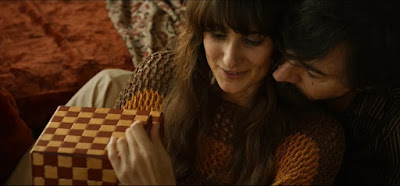

The box that does not open, Lidia (Linda Caridi) and Aldo


We will find that what is filled with love and light are but memories, most notably the loving and touching scenes where Aldo was taking nude photographs of his lover, Lidia (Linda Caridi). Their bodies bathed in a golden radiance - the sunlight in Rome is like no other that shines - as though bestowing its citizens with a kind of sacredness. The body is sanctified through this golden lens. And later his precious memory of Lidia is rediscovered in the polaroids taken that golden afternoon. Her image is laid out in the form of a cross on the coffee table, fragmented, a Polaroid-jigsaw, symbolic of the crucifixion of a nude Madonna - when of course she is the other Mary, the whore who has torn apart the family - this other woman is now laid bare, and the magic of that afternoon cannot be restored, (nor her good name), and, just like the destroyed apartment, all is broken, torn, shattered, and left in ruins.
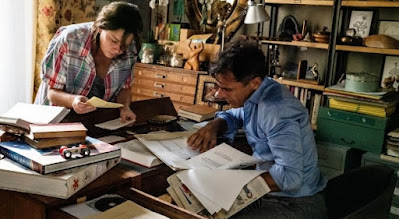

Anna and Sandro as adults, in search of a past


Having said all that, this film is a lot lighter than what this review has made it out to be. The acting, cinematography, pace, and the intertwining of timelines of these four main characters - they multiply, 4 into 6, into 8 and finally into 10 “different” people - bind the viewers to their lace-like story. Premiered as the opening night at last year’s Venice Film Festival, it is an absolute delight to be able to see it on the big screen in Sydney; especially as my first film at the cinema post-lockdown.


The #ItalianFilmFestival is showing nationally, from the 20th October to the 12th December. (Note that some states finish earlier).

#Italianfilms

Tuesday, 17 August 2021

Lockdown Life - Janice Tong looks for signs of life from Italy - A QUIET LIFE (Claudio Cupellini, 2010), LUCIA'S GRACE (Gianni Zanasi, 2018), PASOLINI (Abel Ferrara, 2014) and A ROOM WITH A VIEW (James Ivory, 1985)

Toni Servillo, A Quiet Life

Lockdown life in Sydney has made the days of the week lose all meaning. I’ve worked long hours during this time and the only salvation at the end of the day are my books and of course, films and a couple of well-chosen TV series. Of the latter two, I’ve taken to watching quite a few Italian films as well as television shows and found them delightfully sentimental without the soap. The set design, narrative, direction and acting are, in fact, impeccable. Whilst I won’t be reviewing the TV shows here, but if you’re looking for a good detective series that is story-driven, one that is not running on adrenalin alone and certainly not filling your screen with blood and gore then I would highly recommend you take a look at one of these: Rocco Schiavone: Ice Cold Murders on Stan, Maltese: The Mafia Detective (Foxtel); and Masantonio on SBS on Demand.

The name Toni Servillo needs no introduction even to those who have only a passing interest in Italian cinema. I first saw this brilliant Neapolitan actor in Paolo Sorrentino’s film The Great Beauty (2013) and more recently I’ve had the pleasure to see his incredible performance in Il Divo (2010) playing the politician Giulio Andreotti. In that film, Servillo’s face was transformed to such an extent that it was an immobile mask, putty-like and unyielding, a shield where nothing can get through nor escape. Deep is the corrupted state of affairs, so much so that it has penetrated the soul of a man, and a nation state. But I like Servillo best when he is playing more sensitive and thoughtful character roles,  the detective in The Girl in the Fog (2017), recently shown on SBS on demand, and similar by name, but totally unrelated, The Girl by the Lake (2007) also on SBS a few years ago. 


Here, in Una vita tranquilla, Servillo is Rosario Russo, a skilled chef who is running a small restaurant-hotel in the German countryside. And he is indeed leading a quiet life, but for the way that Italians gesticulate so passionately, (and this element is not lost in this sleepy Alpine-like town. Russo does a fine job of arguing just so in the kitchen with his Venetian chef, Claudio), all seemed to be well with his little family; a young son, he is well respected in the community, the restaurant is shared in partnership with his German wife, Renate, played by the wonderful Juliane Köhler, whom I’ve not seen since Downfall (2004). The multilingual nature of this bonded family unit lends an air of both sophistication and familiarity at the same time.


Juliane Köhler, Toni Servillo, A Quiet Life

But all is not well when two young ruffians show up, Edoardo (Francesco Di Leva) and Diego (Marco D'Amore). You can immediately see that there’s a shared history between Rosario and Diego, and more than that, their roots lie deeper than that of family, but in Rosario’s hidden past. The two young men turn out to be Camorra hitmen who have come under orders to clean up. The mood in the film changes; although still quiet, danger now permeates its mise-en-scène. We know well in advance that it will not end well. Diego’s naivety almost matches that of Rosario’s young son; it seems that the bloodline of an assassin has not bonded his family in a calculable way and Rosario’s sacrifice is far greater than the escape from his past life. Claudio Cupellini’s direction gives this film a slow burn and Filippo Gravina’s script is precise. It reveals Rosario’s nature to us in a single scene, with him systematically tapping copper nails in a ring around clusters of Alpine trees; in order to kill them.


I first caught the luminous Alba Rohrwacher in Luca Guadagnino’s gorgeous and memorable film I Am Love (2009) at the Sydney Film Festival, reviewed here. Since then, she has appeared in no less than 40 films, but sadly, I’ve only managed to see a handful of them; including Perfect Strangers (2016) with the wonderful Marco Giallini who plays Rocco in the film (just like his alter-ego Rocco Schiavone in one of the Italian TV series recommended in this post). She was also in Arnaud Desplechin’s Ismael's Ghosts(2017) at the French Film Festival and more recently at this year’s French Film Festival she was in Chloe Mazlo’s Sous le ciel d'Alice (2019) reviewed here. I also saw her in her sister Alice Rohrwacher’s film Happy as Lazzaro (2018) currently available on SBS on Demand.


Alba Rohrwacher, Lucia's Grace

Let me say how much I enjoyed this film. Lucia’s Grace is one of those small films that leave you thinking feeling good long afterwards. As a professional surveyor and single mother, Lucia’s life came to crossroads when a woman, we realise almost immediately that she is the Madonna, appears to her when out surveying a field. Lucia was hired by a local businessman who wanted to build a showy function centre in the middle of a pristine Tuscan-like golden field; called inappropriately (and uglily), The Wave - this proves to be ironic later on. Lucia was asked to survey the land with her assistant Fabio (Daniele De Angelis) but was later asked to accept the old dodgy surveyor map rather than to provide her own professional opinion.


Director Zanasi cleverly understates the visions and make them grounded and believable as a parable of sorts, and cinematographer Vladan Radovic saturates the film in a golden hue that adds to this modern day fable. There are so many beautiful moments about family, Lucia’s teenage daughter who looks just like a version of herself; love and investing in things that have meaning. Branded as a comedy by its distributors, (yes, there are lots of comedic moments) I see it more to be a finely narrated film that sets out to ask fundamental questions about the human condition; about belief and self-worth. Do you have faith in your own convictions and belief in your own skills and abilities. And then how to use those abilities and gained knowledge to navigate authentically in the real world. 

Willem Dafoe, Pasolini
 

Abel Ferrara’s Pasolini is a wonderful retelling of the last days of this great director’s life. Willem Dafoe must be one of the luckiest actors alive to be able to embody, in a single lifetime, the spirit of Van Gogh, Jesus and now Pasolini. 


Perhaps the most sombre and least crazed of Ferrara’s work. wth some of the film’s dialogue drawn directly from the writings of Pasolini, and hence, thoughtful and full of poesis. I wrote extensively on Pasolini’s film Teorema (1968) years ago when I was doing my degree in Film Studies and one of my very treasured possessions is Pasolini’s novel of the same name. Love or hate his work, once read or seen, it is difficult for his writings or films to leave you. 


I was happy to see an aging Ninetto Davoli, one of Pasolini’s most beloved actors, and his one-time lover and longtime companion in the film. However, it was Pasolini’s final meeting with his destiny that really hit me hard. There was no new ending that can be ascribed; unlike that given to Sharon Tate in Tarantino’s Once Upon a Time in Hollywood (2019). This auteur, poet and intellectual was simply killed in what was more or less a chance encounter. His novel The Divine Mimesis, published posthumously (it was already in the hands of his publishers before his death) is a must-read for those interested in this director.


When I think of the romance of Italy, I also think of A Room with a View; yes, that is quite quaint of me, but this is a film from my childhood that I have deep nostalgia for, as I do with other Merchant Ivory co-productions, such as Maurice (1987), Howard’s End (1993) and The Remains of the Day (1994) but to name a few. I’ve always enjoyed these productions, as my love for the reserved natures of the characters in these films, is one of the shared joys of being a Sino-British child.


Julian Sands, Helene Bonham Carter,
Maggie Smith. A Room With A View

I’ve not seen A Room with a View since I first saw it on the big screen, so I decided to read the book as well as watch the film in tandem. How is this achieved you ask… well, in stages if you must know. I would race ahead and read some chapters before watching the film (broken into 3 or 4 long segments), the book on the other hand, is a slim volume. The effect is quite peculiar, but interesting, as the film does not follow the E. M. Forster’s novel exactly, and I reveled in these slight differences. 


I hadn’t realised how marvellous Helena Bonham Carter was as Lucy Honeychurch, she was only 19 years of age at the time and this was her first feature film. Both Julian Sands (as George Emerson) and Daniel Day Lewis(as Cecil Vyse) were ten years older than her at the time, and again, their performances though completely absorbing (you can already see the craft in Daniel Day Lewis’ as a bold character actor) just makes Helena’s Lucy shine all the more. The stellar cast with Dame Maggie Smith,Denholm ElliottSimon CallowDame Judi Dench andRupert Graves, with incredible vistas of Rome, beautiful costumes, the whimsical hairdos and the English countryside, as well as the easy-to-like narrative charms you throughout. But of course, in the heart of this story, hearts turn despite all the decorum that surrounds it.


The epiphany that occurs to both George and Lucy is via an act of transgression; and what better than place for this to happen, then in the holy city of Rome? If you don’t know the story, then, pray, read the book, or see the film; better still, do both, as I did.


A Quiet Life  on SBS on Demand. Lucia’s Grace on Stan. Pasolini on Mubi

A Room with a View from J+N’s private collection.