Friday, 8 January 2016

The Duvivier Dossier (41) - Barrie Pattison on (some of) Duvivier's silents

Julien Duvivier
One of my greatest regrets is missing Langlois’ major Duvivier Retrospective which the Paris Film Museum mounted after the director’s death in the sixties. They didn’t do live ones as a rule. That will teach me not to live in Australia.

This means that I get to the director’s work when he is already established and assured and miss the apprentice works.
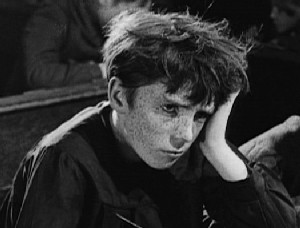


1925 Poil de carotte
The earliest accessible Duvivier film is a first pass at the Jules Romain short stories which will become something of a signature work for the director. It’s is not altogether characteristic, though we can see his misanthropy and his envelope pushing technique.  Bushy bearded Henri Krauss (a 1913 Jean Valjean) heads up the family with masculine looking shrewish mother Charlotte Barbier-Krauss, son Fabien Haziza (who cabaret tootsie Susanne Talba is vamping into stealing the family cash to take her to Paris), daughter Jean who barely figures and young freckle faced André Heuzé, called  Poil de Carotte/Carrot Top, who mum mistreats. Only maid Lydia  Zaréna whose heavy eye make up and lipstick don’t really jive with her simple peasant blouse and skirt, stands up for the boy despite her subservient place in the household.

The kid is delighted at the chance to go shot gun hunting with dad but mean mum forbids
it and he has to pretend disinterest to avoid her giving him a beating like the time when she’s laying into him (convincing) and sees Krauss coming to stop and ask him whether he
likes his mum or dad better. When the brother empties the cash box, mum puts suspicion
on Heuzé and it all gets to be too much. He decides the barn, the beam, the rope. 

However Krauss is holding a council meeting and the board members clue him in on his wife’s mistreatment of the boy. He rushes back to grab the kid’s feet just when he kicks the support away. Embrace and explanation that he was born too late and unwanted so, though Barbier-Krauss is still his mum, from then on they will be two. 

The Haute Savoie backgrounds - distant mountains, hay stacked in the fields, the fair with its merry go round, train trips, striking constructions and twenties rural community in peasant costumes, which elects Krauss as mayor, all contribute atmosphere and a few striking scenic wide shots like Heuzé’s vision of going hunting with dad Krauss in the cultivated fields.

The effects heavy style is equally conspicuous, occasionally to effect - the six Poil de Carotte’s doing the yard chores in long shot around Krauss - but the superimpositions, split screens and (curiously) shots into mirrors to produce divided image tend to distract. However I will pay the revolving  mirror, that comes to a halt reflecting the brother.

A creditable effort though Duvivier did better with sound, Bauer & Lynen. The film also relates to Feyder’s remarkable Visages d’enfants (France/Swtizerland, 1925), in its child - parent relations, and the marriage game young Heuzé and Yvette Langlais play to the indignation of the girl’s mum has a hint of Les Jeux Interdits (France, 1952). 

Le Tourbillon de Paris/ The Maelstrom of Paris,1928 
Trashy but accomplished Duvivier silent which anticipates Au Bonheur des dames (France, 1930), as it opens with the train bringing white haired Scottish Lord Gaston Jacquet to Tiges in the Swiss Alps (very Visages d’Enfants/Mother), reading the newspaper coverage of  the disappearance of  Paris star Marie Duval. Jaquet finds the house where elegant Duval / Lil Dagover (Caligari, Congress Dances) enters distant. Telling cuts closer anticipate The Great Waltz. Turns out Lil’s the wife who left him because he wouldn’t let her continue her stage career. 

The elderly housekeeper-mother explains she’s sick and he convinces her to go back to Scotland with him in the waiting sled. As they are about to leave, they confront her friend with black lipstick and brilliantine, Raymond Bary.

Back in London, Lil is again the toast, dancing with Bary at Claridges and feted by the diner suit critics.(“You should have left me at Tiges. There I would have been forgotten”) She resumes her stage career - scene of fittings for gowns and the necklace tried in front of one of those three face mirrors. At a reception, Bary moves on her but Jaquet has sent in his card and he comes out to tell the husband she won’t see him, only for the men to reconcile and Bary agrees to act in her interest.

Meanwhile sleazy critic René Lefèvre attempts to grope Lil and is repulsed, warning that he can turn the tide of opinion. (“I admired an artist but it was only a woman”) On opening night she imagines a well wisher accompanied by his see through derisive doppelganger - nice. 

Bary has organised a derisive claque for the second act and their response makes her slump on stage, with the curtain rung down and a swarm of investors, designers and director, complete with diagonal titles, declaiming about their losses. However an aged retainer says think about her public. Bary fesses up and she goes back on and wows them. Lefevre gets his hat knocked off in the rain and Lil goes back to her Scots husband - happy end.

The soapy plot drawn from an obscure novel limits the piece but Dagover’s glamorous presence and pacing and choice of camera angles (Armand Thirard among others) are to be admired. Design and costumes, partly the work of Christian-Jacques, are particularly accomplished.

Maman Colibri/ Mother Hummingbird 1929 
The team who put out Le Tourbillon de Paris had gained even more assurance when they got around to this Anna Karenina rip-off featuring the unjustly forgotten Maria Jacobini. She starred in Otzep’s The Living Corpse/Yelizaveta Andreyevna Protasova in the same year.

In the sun drenched Arab streets, Maria abandons aristocrat hunsband Jean Dax for the movies’ then-ubiquitous young lover Francis Lederer (The Wonderful Lie of Nina Petrovna, Pandora’s Box and later Midnight). Passion cools when Lederer encounters younger Lya Lys, leaving Jacobini alone. Her attempts to see the child she has been forbidden wring the hearts of the weepy audience, not to mention Court Dax.

Mounting and performance are imposing and deserve a more challenging story line. 
The Algerian opening anticipates the director’s frequent North African projects and
meshes with the Joinville interiors effectively. 

Au bonheur des dames 1930 
Duvivier’s last silent (it was sonorised) is one of the best films of 1930, with
him and his old associates again mounting an elaborate drama around an international glamour female star - here Dita (Grand Illusion, Mlle Docteur) Parlo who was better and more attractive in her German films but still registers, particularly in her screen filling close-ups. 

We kick off with a menacing shot of the smoke belching roof of a locomotive pulling into a Paris rail station disgorging Parlo in her cloche hat into churning pedestrians, complete with “Au Bonheur des Dames” sandwich board men and a line of one letter hoarding carriers, making up the name. Montage with Guido Seeber style composites and the trackings we will get through the film. 

Parlo’s finds her uncle, gray haired Armand Bour’s cellar shop-home among the
demolitions, a worn beam supporting its wall. Inside unsuccessfully demonstrating the strength of the cloth in the heavy bale, he is too busy to recognise his niece. In the six months since her father’s death, when he wrote her, the big store (doubled by the real Galleries Lafayette) over the road has engulfed the rest of the district, leaving him the last hold out, living with only ill daughter Nadia Sibirskaïa and her ethnic looking live-in shop assistant fiancé. Bour blames entrepreneur manager Pierre de Guingand (Aramis from the 1921 Three Musketeers), who is prepared to run a ruinous “vendre à perte” policy to wipe out competition. 

Determined to earn a living, Dita crosses the road,  tracking through the milling
customers dazzled by the luxury goods. A shop lifter is hauled in by the store cop. She waits in the Staff  overseer’s office and he selects her as a mannequin, taking her to thedressing room where the models laugh at Dita’s old fashioned underwear and she has to be shown how to swing her hips on the run way. At the window Dita spots model Ginette Maddie flirting with her uncle’s assistant below and tells the girl that he’s already engaged, creating tension.

The burly supervisor granny with the lorgnette is all for cutting Dita loose but manager de Guingand spots our heroine and has her hired. The mean overseer takes the credit. Both the gawky fellow employee and the boss wait for Dita after time. She looks through the window of the cellar home/shop and sees the word “bonheur” in lights opposite.

De Guingand has set himself up with the aid of powerful patroness Mme Germaine 
Rouer. She introduces him to financier Baron Hartman/ Adolphe Candé, who sees De Guingand flirting with women at the reception in her presence and warns him that the way he treats women will bring him down. 

On DVD and Blu-ray- David Hare runs through his recent acquisitions (2)

In a previous post which you can find here  I gathered up a series of Facebook posts by longtime scholar and cinephile David Hare discussing his latest Blu-ray  and DVD acquisitions. Below is another set. (Click on the images for a hopefully good capture.)

Twilight Time's new Blu-ray of The Detective (Gordon Douglas, USA, 1968), another flawless 60s DeLuxe Eastmancolor Scope transfer from Fox. In these grabs Sinatra extracts a confession from Tony Musante and with an incredibly open and physically played intimacy that director Gordon Douglas makes the high point of the film, in contradiction to the procession of faggy stereotyping elsewhere that surely comes direct from the pages of the trash novel by Roderick Thorp. The production lumbers the film with a painfully arch quasi Nouvelle Vague multi flashback structure to confusingly counterpoint Lee Remick's "nymphomania" to the more primary homosexual text. This and a literally unbelievably bad career worst performance from Jacqueline Bisset fail to completely dampen interest in this as a major pre-Gay Lib time piece and a Douglas project. The first of his three Tony Rome movies with the Blue eyed one, it remains fascinating as a pre Friedkin Boys in the Band (USA, 1970), pre- Stonewall direct presentation of gay material from a major studio picture. Rather than dwell on the fag baiting minutiae it's a better idea to take your cues from Frank the king of cool himself in the opening murder investigation, when someone says to him (stating the bleeding obvious given the Lydeckerian apartment) "He wuzza Homosexual". Frank slips out sotto voce without blinking, "yeah, the leader." Later in the picture, during a bar sequence the soundtrack features David Raksin's great theme for Laura (another Fox property of course) to signal another Waldo-esque gay dimension to the picture. Unreservedly recommended.

Twilight Time's flawless new Blu-ray of Devil in a Blue Dress (Carl Franklin, USA, 1995). Here's Denzel Washington at a career highpoint which sadly failed to make a dent in the Box Office. Also in the two shot Don Cheadle in his first big breakthrough role as Denzel's/ Easy's' id, Mouse. Carl Franklin's immaculate direction is supple, mobile and taut with Franklin's own screenplay tightly transferring the Walter Mosley late 1940s black noir novel. Prime atmosphere from composer Elmer Bernstein and DP Tak Fujimoto, Jonathon Demme's then favored DP, with Demme also producing. The picture's period recreation easily meets Chinatown but set a decade later, and the ambience here has the added punch of poisonous, suppurating racism, never needing more than a nudge to eat away at the glimpses of hope throughout Fujimotos' cloud and grain inflected pale blue LA skies, and the astonishing color palette, down to an amazing range of skin tones which take on unexpected new narrative meanings through the course of the plot with variations in light and focal length, all rendered in a consummate recreation of late 40s dye transfer Technicolor post war pastel palette. The picture badly needs rediscovery and if this gorgeous new transfer doesn't do it nothing will. Noir as black reality in which white people, starting with the cops are murderers and thugs, and the rest are corrupt perverts. Even Daphne's/Jennifer Beale''s "secret" doesn't save her from the racist quicksand.

Anton Walbrook reads Emeric Pressburger's fine speech denouncing German fascism to Eric Portman's Nazi in Powell's perfectly marvellous 49th Parallel from 1941, from the 2013 Carlotta Blu-ray. It's effectively part one of his (and Emeric's) later highly personal monologue as a pending refugee in the 1943 Blimp, in an even greater sequence. Both episodes are filmed by Powell in just two takes, MCU and close. Like much of the picture the speech is a fine element in itself, as is much of the movie, but the sum of its parts never quite reaches a perfect whole. Even Vaughan Williams' superb score seems to strike an outside key, just as the performances themselves seem so irascibly varied. Perhaps it was the fact that Powell still took sole director credit and Emeric took sole writing credit. Their perfect union would only come with the next picture. It would also be an understatement to describe Larry's performance as scenery chewing but there you go. Some equally if more restrainedly delicious refinement comes from suprising actors like Lesley Howard, Raymond Massey and even a juvenile Glynis Johns. As an ensemble cast the movie plays with more varied performance styles and personalities than a Robert Altman picture.

And for those who share my fascination with lingering shots of men in underpants or showering, and soaking wet crotch revealing trousers, frequent displays of very physical male camaraderie and hugging etc, you won't be disappointed. The banter is very, uhh Canadian Mounties. The disc is impeccable, especially given the absence of any O-neg or even a mint archival first gen 35mm NItrate. Carlotta seems one of the most reliable BD houses these days for fine quality transfers, and this is another. The only thing they might now have been able to conquer if they were doing it in 2016 rather than 2012 is a digital application to tame the gate weave that hits very infrequent rougher dupe looking passages. But a minor quibble. Removable French subs and the disc includes the 42 minute curiosity short docu-feature with Ralph Richardson in the navy, The Volunteer which is however a 25fps/50Hz source with the usual speeded up squeaky voice syndrome. This item is worth watching if only for the brief shots of the Denham 1936 Modernist post deco studio canteen which looks like it jumped out of a Maholy-Nagy short.

Yet another new Twilight Time Blu-ray, King Vidor's less than camp Solomon and Sheba (USA, 1959). Here's La Lollo tempting a parrot with some crumbs while her toenails are painted. A bit like the cast with the audience really. This sequence which apparently has no other purpose in the narrative runs over four minutes - who knows why. God knows De Mille did this sort of static pageantry-luxe so much better. This is also the movie that can claim one of the 50s most mysterious screen credits: "Gowns for Miss Lollobrigida executed by Schuberth of Rome." I want to know more, don't you? I struggle to see much relevance from it to Vidor's career, and the color palette seems to come from the mind of some demented queen on downers, even in this technically astute transfer from a presumably Eastman 35mm reduction print which has to wrestle with both the ugly cheap looking production design and the technical weaknesses of the source. Yul was substituted for Tyrone Power after the latter's fatal heart attack two thirds of the way through filming (and no bad jokes at this point, in the interests of good taste), and the movie also claims George Sanders impersonating the semi fictional "Adonijah". Yul wears a rug to do Solomon, and even more amazingly David Farrar plays Pharaoh in white cocktail gown with matching headpiece, and seems to slur repeatedly through his line readings while teetering on the verge of toppling off the throne. Despite all this the picture isn't big on laughs. Even the midpoint orgy sequence is fully clothed which says it all.


The very first CU in the whole of cinema of a very realistic procedural from Feuillade's fantasy masterpiece Fantomas. This is a grab from the third title on disc 1 from the new Kino Lorber/Gaumont Blu-ray 2-disc set. The quality is simply unbelievable - resolution, contrast, grain, fine detail, stability. It made me weep with joy. And the transfer literally knocked me off my seat. If anything at all comes along in 2016 to beat this for Blu-ray of the year I will be amazed. Run don't walk. Film Restoration, 4K mastering and Blu-ray transfers do not get any better than this.

Thursday, 7 January 2016

The Current Cinema - serious young cinephile Shaun Heenan's holiday diary

I spent a lot of time this week watching films on demand, using Vudu to catch up with a few recent smaller releases which had caught my eye. We’re right on the verge of Australia’s Oscar release season, with The Revenant (Alejandro González Iñárritu, USA, 2015) hitting theatres by the time this article goes live. While I didn’t see any awards heavyweights at the cinema this week, I did take my nephew to another new animated film, which we both enjoyed very much.

I started the week with the Austrian horror film Goodnight Mommy (Veronika Franz & Severin Fiala, Austria, 2015), which played at the Sydney Film Festival to some acclaim and even became Austria’s submission to the Foreign Language category at the Academy Awards. That was much ado about nothing, I’m afraid. The film comes from producer Ulrich Seidl, but contains none of the insight and very little of the social horror of his recent work as a director. Twin boys Elias and Lukas, played by identical brothers using their own names, move to an oversized new house with their mother, whose face is covered in bandages following an accident. After a series of perceived slights against them, the boys start to question the identity of the woman under the bandages. An exciting opening scene involving a chase through a cornfield places the best of the cinematography up front, but from there on the visuals become deliberately sterile. The film is either too careless with its secrets, or it deliberately gives one of its late-game reveals away very early. I’m not sure which it is, but secrecy is really all Goodnight Mommy has going for it, so this undermines the film badly. This is too shallow for the art-crowd and too tame for the horror fans. I can’t recommend it at all.


The best film I saw this week was Mississippi Grind (Anna Boden & Ryan Fleck, USA, 2015), which contains much gambling, but doesn’t quite fit into the tired mould of the Gambling Film. Ben Mendelsohn is quickly becoming my favourite Australian actor, and he is exactly the right person to play Gerry, the sad sack gambler who is drowning in debt, and has just about accepted his fate. That is, until he meets the chirpy, talkative Curtis (Ryan Reynolds), who seems like he doesn’t need the money, and just likes the conversation around a poker table. The pair team up for a casino-crawl through the American South, hoping to eventually make enough money to get Gerry out of trouble. Along the way, they take in the sights and sounds, with a particular focus on live music. They talk about their situation, their pasts and their aspirations for the future, and whatever else comes to mind. This friendly road trip element is enough to make the film worth your time, and I really enjoyed it. The plot briefly veers into the standard formula of desperation and failure, but then doesn’t so much resolve it as throw it out the window in a burst of gleeful fantasy. As the film keeps repeating, it’s all about the journey, not the destination.

The Look of Silence (Joshua Oppenheimer, Denmark, 2014) is a companion piece to Oppenheimer’s Oscar-nominated documentary The Act of Killing (2012), and like that film, it focuses on the government-sanctioned murder of almost a million Indonesians. Those killed were broadly and falsely labelled ‘communists’, as though that would excuse their extermination. The term basically applied to anybody the government wanted dead for any reason. Since this happened, those responsible have remained in positions of power for another fifty years, and as we saw in The Act of Killing, they still believe their actions were necessary and heroic. The 2012 film explored this history through the eyes of the killers themselves, but The Look of Silence shifts focus to a man whose brother was one of those murdered. He directly confronts those responsible for the killings, revealing his familial connection to the events, which remains to this day an incredibly dangerous thing to do. The man is never identified by name, and many of the film’s credits are listed anonymously. It’s a strong film, and a frightening one, made only slightly less so through our familiarity with the previous film. The shock of the situation has passed, and all that remains is a crushing sadness.

I followed this sobering film with something much, much less substantial. Halo: The Fall of Reach (Ian Kirby, USA, 2015) is (stick with me here) an hour-long animated film based on the first half of a novel which itself serves as the prequel to a 2001 video game. My love for the Halo games runs deep, and I have read and enjoyed the novel The Fall of Reach (Eric Nylund, 2001). This cartoon is junk. The story is sci-fi, and focuses on a group of children, kidnapped by Earth’s united government to be physically modified and trained as super-soldiers. Their planned use is to fight insurrectionists, but they are thrown into the middle of an intergalactic war when humanity is attacked by a group of militant alien religious zealots. The voice work here is droning and emotionless, and the animation is poor. The film takes the format of a motion-comic, consisting largely of barely-animated still frames. This looks particularly bad during the action scenes. I’ve already written more than this film deserves. I am exactly the target audience for this thing, and I hated it.


My only cinema trip this week was a local screening of The Peanuts Movie, the unwieldy Australian title card of which actually reads Snoopy and Charlie Brown: The Peanuts Movie by Schulz (Steve Martino, USA, 2015). Jokes about branding-gone-mad aside, this movie serves as an excellent tribute to a cast of characters I’ve followed since childhood, and it’s a good entry point for a new generation. The animation, while visibly three-dimensional, mostly takes place on a flat plane, exactly mimicking specific iconic poses from the original comic strip. In fact, I recognised almost every frame of this film from the original artwork. The story also feels like it could have come directly from the source material. It’s all about Charlie Brown’s lack of self-confidence, and about his good nature in spite of this. Specifically, he falls in love with a girl who moves in next door, and spends the whole movie trying to make himself talk to her. The film hits all of the nostalgia beats, using every common scenario from the comics. Snoopy is both an aspiring novelist and an imaginary fighter pilot, Lucy runs a 5-cent psychiatry booth and so on. It’s all very familiar. It is, perhaps, too familiar to really strike out on its own as something new, but there’s something to be said for just sticking to what works.

Wednesday, 6 January 2016

The Current Cinema - Ben Gibson recommends 45 Years

Spoiler alert  (details revealed)...Somehow we only just caught up with 45 YEARS  (Andrew Haigh, UK, 2015) -- completely engrossing, moving, articulate and I think also a great teaching film: The first dialogue scene with the over-respectful postman full of compacted and subtle exposition-in-character; the camera calmly and carefully framing looks and states, with deliberately expressive angles and shadows shaping point-of-view, shorter-than-usual lenses and some interior space for once, no pointless and randomly close two-shots, confidently locked off for once, so not roaming in search of some empty emphasis or the vacuous and inert photographing of some actors working, when it moved following HER LOOK rather than roaming about looking just for HER, for instance, when she views the party venue; everyday sounds telling their own stories sharply; the ex-girlfriend attic slide show in alternating blackness framing HER SIGHT of these facts and not just the empty facts themselves for whoever-can-see; the plotting meager and sharp and the information owned, driven by the characters' growing knowledge rather than only the writer's generalised curiosity, and with careful and telling elipsis; the characters themselves daring and original, with an ex-factory manager who's also ranting at right-wingers and trying to master German philosophy (ever see such a person on British telly?); every look and line of performance considered, intimate and delicately small; the dialogue full of intended and telling ambiguity; the ending triumphantly early, total and simple. 

In summary: if some more UK films about ordinary contemporary characters could be made with this precision, with such respect for the exactitudes of film craft, like say the very best of French family dramas, we'd no longer recoil in horror and disgust at the preposterous question: "D'you wanna see a flick about some aged middle class marrieds in Norfolk preparing for their anniversary party?". We'd just ask, like a bunch of French cinephiles I suppose, "Who made it?" and "Does it matter at all?" and then maybe get along to some of our own pictures all about us....i.e. We enjoyed it.

45 Years opens around Australia on 18 February

Tuesday, 5 January 2016

Vale Mary Callaghan

Film-maker and activist Mary Callaghan died this week. I'm trying to locate someone who might write an obit. In the meantime this website is devoted to her life and career. Hopefully more soon.

Monday, 4 January 2016

The Film Institutions in 2016 – (2) Screen Australia

It took two seriously good hits to do it.  However, building on Mad Max Fury Road,  and The Water Diviner as early as September 15 industry guru Don Groves was already calling it in Inside Film “It might be a stretch but 2015 could come close to the all-time for Australian films  of $63.4 million set in 2001, the year of Moulin Rouge!, Lantana, The Man Who Sued God and Crocodile Dundee in LA. After a strong start to the year from Mad Max: Fury Road, The Water Diviner, Paper Planes and That Sugar Film, Aussie films already have eclipsed 2014’s lowly $26.1 million (a market share of 2.43 per cent) and 2013's $38.5 million.”

Within a couple of weeks the CEO of Screen Australia Graeme Mason couldn’t help himself and was signing off on a press release trumpeting the new 'record'  . You had to follow the asterisk to the bottom of the page to find the note*Note - figures are actuals i.e. not adjusted for inflation. Using the ABS’s calculator to obtain approximate inflation-adjusted figures, 2015 is already the best box office result for Australian film since 2001. - Here's the full story

The truer story still lay somewhat buried and needless to say you have to wonder whether it’s in anybody’s interest for such things to be told when we are trying to get the nation once again used to the idea of going out to a local picture. Keep it simple and you’ll believe that this past year, 2015, has set the bar for the highest cinema takings ever for Oz movies. But we know the claim is based entirely on inflation.  And there’s more to agonise over, to which I’ll return.

So let’s start from the start. The biggest years for Australian cinema are those where two things, or one or other of them, might have happened. The first is where the greatest number of Australians actually plonked down their money and bought a ticket to an Oz movie. What that year is, remains unknown or if it is known is a closely guarded secret known only to a few. So where can I go. I can investigate by suspicion to start with and my suspicion immediately told me that the ‘BIGGEST’ ever Australian film was “Crocodile” Dundee and the second biggest “Crocodile” Dundee 2. That’s the assumption I started proceeding on until I came upon a splendid piece of analysis commissioned by Film Victoria which you can find here.

In brief This report analyses box office takings of Australian theatrical
releases from 1964 onwards, adjusted for inflation. The analysis allows for an accurate comparison of the performance of Australian films at the Australian box office over time.
The report was issued in 2010 so further adjustments for another half decade of inflation would be warranted but I wont attempt them myself.

Here’s the report’s table of the top twenty and the inflation adjusted dollars
Title
Year
Recorded Box Office
Box office Equivalent 2009
CROCODILE DUNDEE
1986
$47,707,045
$104,001,358
BABE: THE GALLANT PIG
1995
$36,776,544
$52,958,223
THE MAN FROM SNOWY RIVER
1982
$17,228,160
$50,133,946
CROCODILE DUNDEE 2

1988
$24,916,805
$46,843,593
AUSTRALIA

2008
$37,555,757
$38,306,872
GALLIPOLI
1981
$11,740,000
$38,037,600
ALVIN PURPLE
1973
$4,720,000
$36,721,600
MAD MAX 2
1981
$10,847,491
$35,145,871
MOULIN ROUGE
2001
$27,734,406
$34,668,008
HAPPY FEET
2006
$31,786,164
$34,646,919
STRICTLY BALLROOM
1992
$21,760,400
$33,946,224
PICNIC AT HANGING ROCK
1975
$5,120,000
$30,003,200
THEY’RE A WEIRD MOB
1966
$2,417,000
$26,127,770
YOUNG EINSTEIN
1988
$13,383,377
$25,160,749
THE ADVENTURES OF PRISCILLA QUEEN OF THE DESERT
1994
$16,459,245
$24,688,868
PHAR LAP
1983
$9,258884
$24,443,454
MURIEL’S WEDDING
1994
$15,765571
$23,648,357
THE DISH
2000
$17,999,473
$23,579,310
MAD MAX
1979
$5,355,490
$20,939,966
THE PIANO
1993
$11,240,484
$17,197,941


(By the way I thought The Castle would be in this list. Acccording to Wikipedia the film was released in 1997 and grossed $10,326,428. Not enough apparently.)

So, just a couple of observations.

The highest grossing film of 2015, Mad Max Fury Road might just, depending on the inflation rate for the last five years, scrape in at number 20 in the biggest box office films of all time. The film also had the additional benefit of increased ticket prices for those prepared to pay for 3D.
2.    
     More than half of the films above were made without any recourse to or assistance from the national screen agency of the day for such things as script development, workshopping, labbing, mentoring, or further drafting.

The latter of which is as it should be. Film-makers able to work with the majors should not be the beneficiaries of modest handouts from the state, though they will of course always benefit from whatever tax advantageous laws are available to support film production.

The national screen agency should have a bias towards promoting excellence and quality film production. Your taxes may go to work via rebates and offsets to support the industry but direct grants should be aimed at the top end of the market. Those will be the films which compete for prizes and international acclaim even if they click with only small audiences. We should be prouder that direct government funding assisted the production of The Piano, Samson and Delilah, Love Serenade, Charlie’s Country, Toomelah, Sweetie, The Navigator, Heatwave, and Breaker Morant than of tax breaks that produced many popular successes and increased the profits therefrom.

A few years ago, somebody at the then new Screen Australia dreamed up an interesting hurdle. It was called something like “Six out of six” and referred to a year in which Oz films were accepted for what were designated as the six major film events/competitions of the year. It may even have included the Oscars but that detail is lost in time. Doesn’t matter. While it seemed a bit fanciful at the time, the all too familiar PR boasting being at full stretch, I think that the achievement may not have been replicated. There are still too few films made here selected for those major competitions and that’s a significant failing of the way by which Screen Australia goes about its work. If films from Thailand, Taiwan and other countries with modest standards of living are regularly selected for the great competitions then we should be taking a long hard look at our mechanisms for funding our best film-makers. 

Part of the current failure derives from the fact that our best film-makers don’t get to work often enough. Having established reputations, there should be an express lane wherein bureaucrats are not niggling away about further drafts and sending people off into the sunset of endless tinkering.


So it’s on to 2016 and already the commentary is suggesting that the likelihood of repeat record business is small. Neither George nor Baz nor Russell has a local movie coming out. Get ready for the gloom and doom to return. Unless of course something gets into one of those Six and the world sits up in the way it did for The Piano  and all the rest.