Sunday, 19 July 2015

Adrienne McKibbins reports on the new Hindi movie BAJRANGI BHAIJAAN

Kabir Khan’s BAJRANGI BHAIJAAN, currently screening at Event Cinemas Burwood NSW complex and elsewhere through GU Cinemas, is about a 6 year old girl who is parted from her mother on a train journey close to the Indian Pakistan border. The girl ends up in India.... She links up with the hapless (but good hearted) hero played by Salman Khan. The girl does not speak, so there is much ado about what to do with her and how to find out where she comes from.

Eventually, our hero discovers she is a Muslim and from Pakistan, and decides he must take the girl back to find her parents. Unable to do so legally, he illegally enters Pakistan eventually linking up with a would-be Pakistani reporter, played by Nawazuddin Siddiqui in a charmingly comic avatar. He has been told our hero is an Indian spy.

Needless to say our hero eventually manages to get the little girl back to her home, and then must find a way to get back to India (he has no passport or visa).

This film released for the Indian festival EID is a real holiday blockbuster, the audience I was with (almost full house) cheered and clapped at various points, especially a speech about India and Pakistan being similar people who should not be hostile to each other.

The finale is very sentimental, taking place at the Indian/Pakistan border.

Kabir Khan has always had concerns in his films about the politics of India/ Pakistan, Hindu/ Muslim, and despite this film being a full on commercial Masala pic with requisite songs and a big dance number, it is also a plea for tolerance. Salman Khan is better than he has been in recent films, but this role is clearly designed for him.. and he does what is expected right down to his usual shirtless scene, when being beaten by Pakistan police.

Definitely designed as a family entertainer. Although it’s predictable, especially in the second half, it still manages to hold a certain amount of tension and Kabir's use of locations is excellent from the desert to the mountains.

It has opened big in India to mostly positive reviews.  Despite the story line being not that original (in generic terms) it is a likeable film, as its heart is in the right place and the "preaching" is genuine and heartfelt.

Currently screening Australia wide in Event cinemas

Here is Anupama Chopra's review ( She is one of the best most sensible reviewers in India). It really sum up the films faults and pluses..and I agree with her virtually 100%.

Bob Ellis announces he is seriously ill

Bob Ellis became known to me way back in 1969 when he sent in a brilliantly scathing letter to George Munster's Nation  about my review of Larry Peerce's Goodbye Columbus. Called me a dolt, and, given my naivete at the time, was probably right to do so. Not that I appreciated the intemperateness of the language though no doubt Munster and the readers of that wonderful near-iconic fortnightly thought it all very droll.

Ellis could indulge in some of the most oafish public behaviour ever exhibited in this fair land. Long ago, at a Canberra preview screening of Tom Jeffrey's Weekend of Shadows (Australia, 1978) he leapt to his feet when the Q&A started and launched a tirade about the film "This piece of fake Kodachrome Dostoyevsky"...was one of the phrases he uttered in attempting to slag he film unmercifully. When asked to desist or at least ask a question he roared "How dare you?" as if that was the end of the matter. Moments later he roared again when the information was gleaned that a certain script doctor had worked on the film. "Oh no!" he muttered very loudly and when asked sotto voce who that person was he pronounced her,in a loud voice as the woman who ruined Newsfront, a film  from which he famously had his name removed from the credits believing that the three hours or so he'd written had been savaged into mediocrity. Later he took out advertisements advising that he was now accepting credit for the film but as well that he was still sore at the butchery that had gone on.

Bob Ellis is a man with an asbestos hide and a supreme self-confidence. He directed several films of his own scripts and all were droll little experiences. He ceaselessly wrote books, plays, film scripts, articles, speeches for politicians, letters and pungent personal and political reportage about the day. That proved to be one of his occasional downfalls.  When reporting as fact a spicy but apparently untrue anecdote about Peter Costello and Tony Abbott, he lost a libel case and had a ridiculously huge sum of damages awarded against him by a vindictive, Labor-appointed judge. But who can forget his exchanges with David Williamson which mixed a holiday in Bali and the state of Ellis's bowels.

Nothing stopped him though and anybody who reads his rollicking blog of recent years would know he fears no man, no lawyer, no judge and especially no Liberal political opponent. It may be that some of his current subjects will be glad if in fact he's on the way out and will be gone soon. You imagine that Bronwyn Bishop, whom Ellis reduced to a laughable figure, mad as a hatter and berserk with her own self-importance, might be one of those. It was Ellis who took her on in the Mackellar by-election and gave the harridan a giant shock that showed she was nothing more than some Antipodean version of the Wizard of Oz, grinding and cackling away to ever-diminishing effect and finally exposed as a know nothing ratbag. She has never risen back above parody.

Ellis, you liven up our lives and the Australian polity.  If the news cotinues to be bad let me say while you are still alive, you, and your predictions of Labor victory, will be sadly missed

Saturday, 18 July 2015

Two Great Westerns on the ABC this week

Resuming an early Film Alert tradition...on the box two major westerns late night, ad free and hopefully in the case of the later one, the right ratio.
Shane (George Stevens, USA, 1953, 118 minutes)
“There never was a film like Shane”  said Paramount Pictures prior to the release of a movie which the scholars advise was shot in Jackson Hole Wyoming in the summer of 1951 and released in April 1953. It stars Alan Ladd, not typecasting at all, decked out in buckskin, plus Van Heflin and Jean Arthur as the farming family he defends. Jack Palance plays what David Thomson calls “the greatest mean, ornery arrogant gunfighter there ever was, or will be.” When Sergio Leone assembled his team of writers for his mythological valedictory to the American west, Once Upon a Time in the West (Italy, 1968) the brief was to cobble together and pay homage to elements of all the iconic westerns. Shane figured front and centre in the plot. ABC1 at 12.25 am on Tuesday 21 July


The Good, the Bad and the Ugly (Sergio Leone, Italy, 1966, 180 minutes perhaps)
So, speaking of Leone, we get the chance for some comparison as well as a chance to check out just what version of the movie the ABC might be showing and in what ratio. Will it be the full restored epic, seemingly endless, and will it be screened in Leone’s masterful Cinemascope or will the ABC do what Foxtel does and remove the letter box and give it some strange full screen 16:9 look. Time will tell. ABC1 at 11.30 pm on Sunday 26 July

Orry-Kelly leads to an evening viewing Oklahoma! on DVD

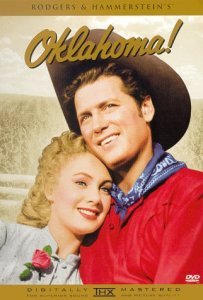
Gillian Armstrong's new doco, though nearly a biopic given there is so much enacted material and so many conspiratorial confessions to camera by Darren Gilshenan playing O-K, has already been widely praised here  by Barrie Pattison after a screening at the Sydney Film Festival. However it did provoke me to get out the disc, acquired long ago, of Oklahoma! for which O-K won an Oscar, just for starters to confirm what Orry did to liven the show up. It comes as a two disc set, one the Cinemascope version which would have been what I first saw at Hoyts Padua in Brunswick lo all those years ago, and on the second disc the less well-restored Todd A-O version. Without thinking I put on the 'Scope version. Big mistake. This is the one where Zinneman's framing cut off the dancers' feet rather too often. A check later of the Todd A-O version confirmed it is by far the better and the takes on some of the dances are better. Since the DVD release the film has  undergone a restoration and the new version was screened at Bologna in 2014. The eleven minute extra on Disc two explaining the differences between Scope and Todd A-O is most enlightening.

Friday, 17 July 2015

Reinventing the wheel - Digging for audiences for Oz films

The first sentence in Don Groves report on the Inside Film website  sounded good
“Screen Australia has started a scoping study to figure out new approaches to building pride in Australian films.”  Then, as your taxes went to work, things may have quickly run off the rails. “The workshopping of ideas is a tacit recognition that the Australian cinema ‘brand’ was tarnished last year by a string of films that underperformed at the B.O., reflected in the lowly market share of 2.43 per cent.”  Oh dear!  “The Australian cinema ‘brand’’!” Fear the worst. It’s another dodge by the bureaucrats currently in charge, always a moveable feast, to explain why all that direct Government investment in movies almost entirely supports both critical and box office duds that almost entirely sink without trace - and have for a very long time.

Don’s report went on “Screen Australia’s communications manager Imogen Corlette is working with the agency For the People to consult with a variety of industry stakeholders on ideas to develop a more engaged market for Australian films.” What a lucky agency. Though that somewhat neo-Maoist name suggests a certain capacity for radical thinking.  On the one hand the move sort of reminds you of that regular Bristow cartoon when an impoverished caterer suddenly gets an order advising of a Board meeting in the Chester-Perry building. Joy breaks out all round. Maybe you have to know about it to get it. On the other, the agency’s website proclaims:


We're for shaking things up.
Disrupting industries, creating new markets and new companies.
We're for culture that fuels creativity and innovation. We help build trust and get teams to work harder and be happier.

We're for new models, new theories, new ways of working for this century, not the last one. Our inspiration comes more from Silicon Valley than management and design textbooks.
We’re for the potential and realisation of technology. We’re for closing the gap between technology use in your personal life vs your work life.
We’re for common-sense and brutal honesty.

Cant  argue too much with any of that. Screen Oz went on “We are looking to reframe the ways people think and talk about Australian film – shifting perceptions of success away from a simplistic focus purely on box office performance, to encompass less visible achievements, and a deeper appreciation for the many impressive achievements in a global industry,”.
Oh my goodness!
“As a first step we’re looking at how and why attitudes to Australian film tend to form and how we might be able to encourage Australians to feel as proud of our achievements in this arena as we do in so many others. This is no small – or new – task, nor one we want to do in isolation.”
Well, that’s right that it’s not a new task but I digress. “The agency plans to draw up an action plan encompassing PR, events, digital/social and other initiatives designed to “create a culture of pride and passion amongst consumers.”
.........Hey here’s a solution. How about we make some good movies!  Like Mad Max Fury Road...that’s a real good movie though it didn’t need any funding from Screen Australia. Warner Brothers and the Australian tax man covered the bills.
Bruce Hodsdon and I addressed this question first close to a decade ago and in a stunningly brilliant submission to a Government inquiry we came up with the following recommendations:
·                     there should be a clear recognition that the comparative box office performance of Australian films has been unfairly denigrated by the use of inappropriate comparisons;
·                     the focus of assessment criteria to judge success should be shifted from percentage return on investment and market share to comparative subsidy per consumer. This shifts the conceptual emphasis from a film as a product to a film as a work with intrinsic cultural value with an enduring outreach across national boundaries;
·                     Australia’s film agencies need to radically rethink the attention given to the process of scriptwriting, the funding of writer/auteurs and the relationships that exist between writers, producers and directors in the Australian film industry; and
·                     there needs to be a strong, forthright and full commitment on behalf of all funding and investment bodies to ensure that our best film-makers, those whose work has been internationally or locally recognized and rewarded, and our best writers, are working more fruitfully and more often.
You can read the whole paper here .
Later Bruce addressed the question of measuring success in another paper he published which you can also find on the Film Alert website here  and more recently Deb Verhoven and two colleagues have devised another way of considering these matters. A discussion about these issues can be found here  and here .
Still your taxes are at work and the meter is ticking over towards the eventual moment of brutal honesty. Industry stakeholders (which  doesn’t include the likes of us) will be cutting and pasting their submissions as they tailor their advice to whatever way the questions are being put this time.

I’m still convinced that there is one simple step - get our best film-makers working more regularly and allow them and their producers far more latitude as to what they might make. The results will speak for themselves and the love affair with our movies might just rekindle and some serious regular money be made.

Wednesday, 15 July 2015

Hitler onscreen and I - Some thoughts following Oliver Hirschbiegel's 13 Minutes

The 1980 Melbourne Film Festival presented the Australian premiere of Hans-Jurgen Syberberg's Hitler:A Film From Germany. Made in 1977 it ran over four parts and totalled 442 minutes all up, that's just under seven and half hours. The theatre, the 800 seat National, just around the corner from the Palais, was near full when it started. Quickly the audience started to thin out as people realised that Syberberg's long, rambling, obscure poetic rendition of the tyrant's life was not quite what they expected. My old, and now departed friend and Festival Committee member, Pat Gordon explained to me at the time something I dont think had really ever struck me before. All sorts of what you might call 'normal' people are fascinated by Adolf Hitler and that's why the books and movies about him will never stop.

I think I've only come rather late again to this phenomena perhaps prodded by seeing a couple of films that I chanced upon almost by accident. And ever since Oliver Hirschbiegel's Downfall (Germany, 2004) there have been ever more reminders as well  - among the best are these - one that hit Kevin Rudd, from 2010 here   and to balance things up one from 2013 that gives Tony Abbbot a thumping here . Among the oddities is a summary of all the actors, or at least 65 of them, who have played Hitler in a movie that has been assembled by Olaf Moller in his Conference - Notes on Film 05. description here And the books continue. The latest edition of the New York Review has a piece about six new books devoted to the Nazi concentration camps, the Holocaust, the post-war trials and other issues.

At Bologna in 2014 a section was devoted to "The Cinema at war against Hitler" curated by the legendary late Peter von Bagh. The survey was small but broad and included Olaf's film as well as G W Pabst's The Last Act (Austria, 1955), basically the Downfall story, John Farrow's Hitler as gangster movie The Hitler Gang (USA, 1944)   and a genuine oddity, Frank Tuttle's The Magic Face  (USA,1951). In that film, posited as a true story, it is claimed that a lowly stage magician killed Hitler and took his place and made decisions, like the invasion of Russia, that destroyed the German war effort from within. Believe it or not...

So, I cant run through the sixty five, probably more, Hitlers on screen because I haven't seen them all by a long shot. The latest however comes with much prestige attached to it, largely because it is the second go-round the Hitler years material by Hirschbiegel, a follow up to Downfall and an attempt to shine a light on a near forgotten moment in German war history. Out of curiosity I looked up Alan Bullock's biography (published in 1952, and there would have been dozens more published based on later and greater research). and it lists Elser in the index and puts the word plot in inverted commas and covers the matter in just a couple of paras. Bullock's view of George Elser and the attempt to kill Hitler in November 1939 is that it was an event 'organised by the Gestapo as a means of raising the Fuhrer's popularity in the country’. That's not the view taken in Hirschbiegel's film.

Leftist in his politics, beset with family dysfunction and, somewhat improbably, very attractive to women, George Elser is a lone wolf who, with daring, skill and bravado, almost kills Adolf Hitler in 1939. The supposition is that it would have been a gamechanger and the war, then going gangbusters for Germany, may have petered out. But it fails and Elser spends the rest of the war explaining himself, first by being tortured, later by forced co-operation. He is kept alive because the Fuhrer believes he could have only have done what he did via conspiracy and thus wants to know the names of others. 

The film starts a way long time before this and we get a long exposition of Elser's tangled life and his involvement with another man's wife. Who knew all that I thought. But gripping in the telling, especially for all those normal people with a Hitler fascination.

13 Minutes opens on 23 July


16 July 2015

Sunday, 12 July 2015

A Rush of Zen - Chen Kaige's Monk Comes Down the Mountain

Watching Chen Kaige's new movie Monk Comes Down the Mountain just a week or so after seeing the restoration of King Hu's A Touch of Zen (Taiwan, 1971) you realise very quickly that much energy is going to be expended in pursuit of some fairly routine outcomes. The monk in question, "He Anxia", and there's a nice joke about his name I haven't recorded, cleans up the members of a mountain top monastery thinking this would advance his position and prestige only to be told that no, it means he is being exiled out of the place to learn about the world.

The world it turns out is a big city in the thirties with shiny cars and come on look babes and fat diners in restaurants. You dont get the impression that we should, unlike King Hu's film take this very seriously as a representation of historical reality. Its a fairground movie studio composite of a thirties big town. After some trick work he is taken in by a doctor who owns an elegant pharmacy who needs assistance and who has a wife who is fooling round behind his back with the doctor's very camp brother. All three come to sticky ends within a half hour or so leaving the monk in charge of the pharmacy and setting him off on a range of new adventures involving gangsters, monks, kung fu specialists, a corrupt police chief and fleetingly a girl friend. As played by Wang Baoqiang, He Anxia is the irrepressible smiling force though as the movie proceeds he starts to take second place to loner monk and fighting machine Zhou Xuyi (Aaron Kwok) who fights the final fight before the two of them retreat to the monastery (ooops, but you knew it was coming anyway.)

On the way through there are one or two well-choreographed fight sequences and several which are as boring as batshit. The sequence involving the fight on the tightrope is rather the best of them. Otherwise its mostly bloodless and notwithstanding some intimations of sexual behaviour quite sexless. Objects of desire are mostly missing.

It ends, again taking its cue from A Touch of Zen in a bombastic over-ripe depiction of Buddha's greatness and much smarmy rhetoric being spoken on the soundtrack.

The film is an international co-production of some sort. Columbia Pictures gets a credit as one of three producers. There is also a local connection to the film. The photography is directed by Geoffrey Simpson and he seems to have a specially chosen team with European names to assist him. The music is by by someone with a European name as well. Chen's reputation endures though there doesn't seem to be anything specially noteworthy in either Simpson's or the composer's efforts.
I assume its all been done according to the dictates of the day. We are indeed a long way from Yellow Earth (1984) and King of the Children (1987), and even from Farewell my Concubine (1993). The excellent English subtitles are by Linda Jaivin. I'm not sure whether Oz audiences were offered the the 3-D version that went out in China. It's 2-D only at Event in George St.