Wednesday, 2 January 2019

On Blu-ray - Scott Murray sets down his top ten Blu-rays of 2018


1. Au Hasard Balthazar (Robert Bresson, 1966). Criterion, Region A. I have only watched the first few shots, because when the girl strokes the donkey’s head I can’t go on. There is a brilliance, a perfection, a sad beauty, that is beyond my endurance. I would say it was the best film ever made if Bresson hadn’t made twelve others equally great.

2. Andrei Rublev (Andrei Tarkovsky, 1966). Criterion, Region A. Made the same year as Au Hasard Balthazar and further proof (to me) that 1963-67 was truly a Golden Age.

3.El Sur (Víctor Erice, 1983) Criterion, Region A. As sublime as a Bresson, precise and perfect in every way, the heartbreaking story of a girl wanting to visit her absent father in Spain’s south. No. 3 in my all-time Top Ten.

4. The Awful Truth (Leo McCarey, 1937) Criterion, Region A. My favourite screwball comedy and another McCarey classic. There was nothing McCarey could not do … and brilliantly. Truth now has the Blu-ray release it deserves.

5. The Farmer’s Daughter (H. C. Potter, 1947) Kino Lorber, Region A. Superb gender-role comedy that I think betters Adam’s Rib, which it predates by two years. The surface casualness hides the film’s intelligence and radicalism. The women are independent and powerful in noble and destructive ways. 

6. Merrily We Live (Norman Z. McLeod, 1938) Classic Flix, Region A. How can one not adore a film where the two dogs are named “Get Off the Rug” and “You Too”? A witty riff on My Man Godfrey (two years earlier) from the wonderful McLeod (Topper, Pennies from Heaven). 

7. Four Faces West (Alfred E. Green, 1948) Kino Lorber, Region A. The best Western release of the year and the most narratively surprising, because one never knows when goodness may appear. I don’t often cry in Westerns, but I do in this, Jacques Tourneur’s Stars in My Crown and, of course, John Ford.

8. The Bravados (Henry King, 1958) 20thCentury Fox, Region B. With Four Faces West, the Western gem of 2018. King’s work with Greg Peck (The Gunman, Twelve O’Clock High) is extraordinary. The Bravados is the best film I have seen about the seductions and dangers of presuming guilt.

9. L’Amour d’une Femme (The Love of a Woman, Jean Grémillon, 1954) Arrow, Region B. The early 1950s was a remarkable time for the exploration and celebration of the emerging modern woman. Ian Fleming was a key chronicler, with his independently minded women, uncowed by male power and control, seducing and abandoning men when it suited. Grémillon’s final film is precisely on note (a year after Casino Royale) with a female doctor (Micheline Presle) arriving on the Brittany island of Ouessant and treating her career, reputation and love life as hers alone. Serenely told.

10. Chappaquiddick (John Curran, 2018) Lion’s Gate, Region A. A balanced account of the 1969 death of Mary Jo Kopechne on Chappaquiddick Island in the car driven by Democratic Senator Ted Kennedy, a morality tale of how famous politicians and strategists so effortlessly sidestep morality, truth and compassion. 
 '''''''''''''
Plus:
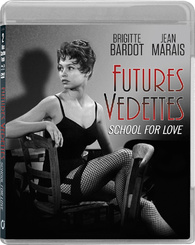
L’année dernière à Marienbad (Alain Resnais, 1961: dreary beyond endurance, but every frame is exquisite). Ingmar Bergman box set (worth it for the masterpieces). The Big Country (William Wyler, 1958: finally in the correct screen ratio). The Breakfast Club (John Hughes, 1985: I sat to briefly check this new 4K transfer and, of course, couldn’t leave). Futures Vedettes (Marc Allégret, 1955: Bardot in HiDef while awaiting La Verité). Heaven Can Wait (Ernst Lubitsch, 1943: the Blu-ray is a okay approximation of the exquisite nitrate print). Irma la Douce (Billy Wilder, 1963: Shirley MacLaine’s performance is the sweetest in cinema). Lolita (Adrian Lyne, 1997: superbly scripted by Stephen Schiff, directed by Lyne and acted by Jeremy Irons). My Man Godfrey (Gregory La Cava, 1936: a role-reversal gem that charms radiantly). Night of the Demon (Jacques Tourneur, 1957: wonderfully annotated release of a beguiling film). Separate Tables (Delbert Mann, 1958: the genius of Terence Rattigan, with a perfect cast).

And:
A special note of praise for the superb quality of many audio commentaries, whether by a frank director (Sidney Lumet admitting that he made Fail Safe, which lacerates the nuclear-deterrent concept, because he was certain Armageddon was just days away), and by those learned and informative advocate-scholars, including Adrian Martin (erudite and surprising on every Blu-ray he does, including Paris Nous Appartient,sometimes even convincing me to like films I have refused to like!), Sir Christopher Frayling (in fabulous and full flight on Night of the Demon) and Joseph McBride (calm and kind on The Magnificent Ambersons). 

Biggest disappointment: 
The Magnificent Ambersons (Criterion, Region A). It is time someone removed for eternity the scenes that Welles didn’t direct or approve, then used script extracts and extant frame enlargements of the missing scenes. 


The Current Cinema - Max Berghouse has a few contrarian thoughts about Orson Welles and THE OTHER SIDE OF THE WIND


Like most cinephiles I regarded viewing The Other Side of the Wind(Orson Welles, 2018) almost with a sense of religious obligation. The enormously long period of time from initial production to final release (for which we must be ever thankful to Netflix) is known to pretty much everyone. That long and convoluted history is readily available on Wikipedia and there are bountiful reviews. So I don't propose to deal with either of these issues further.

The storyline is so intensely autobiographical: a wellworn and previously ultra famous film director returns from Europe to America with an unfinished project "in the can" with the intention of finding backers. He fails in this and the culminating scene is his death by motor traffic accident. My interest in this subject was the extent to which Mr Welles had found some insight into his lifelong (at least as a director) difficulty, if not complete unwillingness, to complete projects. The film as shown certainly displays the director as factually being unable to complete at least this project, but it certainly doesn't seem to indicate to me any understanding of why this was such a continuing problem.

Some light on this I think can be found in an interesting article by former actor and long-time director Jonathan Lynn in the Times Literary Supplement, November 23, 2018, "Orson's bag". While this is a personal account of a middle-aged man when he was young and very much in awe of Mr Welles it describes certain stages in the project. Most relevant in my view is that throughout the production Mr Welles resided full-time at the Cipriani hotel in Venice or at the sister hotel the Villa Cipriani. For at least part of the time it would appear that the entire crew was also staying at the Villa Cipriani. These are among the most expensive hotels on earth and I feel that just Mr Welles'  residing there, much less his crew, might have been enough in and of itself to make a film. 

It certainly would have added an extra gloss to a film like Chimes at Midnight (Orson Welles, 1965) a film that whatever its other qualities always looks "cheap as chips". In this I think is the answer to the question I posed to myself. I don't think Welles had any intention of finishing most of his projects. A project shoot was theatre in itself and was the apparent vehicle to provide for his luxurious if peripatetic lifestyle.

John Huston as JJ Hannaford, The Other Side of the Wind
I wish to examine this in greater detail but I also accept, upfront, that the connections I draw may not be to everyone's satisfaction. I wish to dwell on the relationship between the director of the film within the film played by John Huston (JJ Hannaford) and his then protégé Brooks Otterlake (Peter Bogdanovich). The relationship in the film, as well as the film within the film reflect on the real-life relationship between Mr Welles and Mr Bogdanovich. At the very beginning of shooting, Mr Bogdanovich was amongst the most praised directors of his generation. I well remember as a very young person indeed going to see The Last Picture Show(Peter Bogdanovich, 1971) and it is still my view that although a "small" film, it is just about perfect, not only in purely cinematic terms but as a recreation of one of the finest American novels of the 20th century, "The Last Picture Show” by Larry McMurtry (1966). Yet like his hero Mr Welles, Bogdanovich began to fall seriously from favour quite soon. This has often been attributed to the breakup of his relationship with his creative partner and wife Polly Platt. As Mr Bogdanovich's production designer, her influence was extraordinarily significant and this can be judged by the falling away in quality of Mr Bogdanovich's films after their divorce.

Welles, Peter Bogdanovich, Joseph McBride during the shooting
of The Other Side of Wind
In the current film under review, he plays Brooks Otterlake which on momentary reflection is a watery connection taken too far. There is a character in the satirical novel by Evelyn Waugh "Vile Bodies" (1930), Lord Monomark. This character was originally intended to be Lord Ottecove and the name as well as the ebullient and extremely flashy character is clearly a reference to the famous Canadian- British industrialist and newspaper proprietor, Lord Beaverbrook. The name change came at the insistence of the publisher' s lawyers. I think there is more than a coincidence here. Otterlake, formerly a disciple of the director has now become a creative power in his own right with all the appearances of a prior wealth which Welles too enjoyed as a youth, but lost. And the references also to a foreign source of wealth: Canada. In the case of Mr Bogdanovich's background, his father was a Serbian pianist of very considerable repute and his mother an heiress to a very substantial Austrian Jewish enterprise. 

So far as I'm aware, although both parents arrived in America as refugees in 1939, they were persons of substantial means and this is evident in the education and early life of Mr Bogdanovich. It's well documented that he spent numbers of years looking at upwards of 400 films per year. So was their time for ‘work’; instead rely upon the family fortune.

Reviews of the film, as between director and Otterlake, as well as commentary on the relationship between Mr Welles and Mr Bogdanovich make note of the incipient jealousy between them. Mostly the comments are of an artistic kind: Mr Welles in decline having first had a "disciple" and Mr Bogdanovich very much in the ascendant. However, I see the relationship, while certainly of envy, as basically financial. Mr Welles continuously wanted to indulge himself. He wanted the high life (for a time in his youth he was a playmate of children of Prince Aly Khan) and this is evident in his change from svelte young man to gross middle age. 

In a previous review I wrote of my personal distress in relation to the collapse of the career of Erich von Stroheim. Here at least was someone who remained embittered to the very end because he was given no further chances. The loss to us as viewers is quite probably incalculable. Mr Welles was also a person of outrageous talent but at the end of the day, I don't think his desire to make films (I mean produce, edit and publish) was ever so strong. So to some extent the loss to us is less.

As to the film: it is certainly a must. I had originally thought that with 98 hours of shot footage, it would be well-nigh impossible to make a coherent whole of it, even with the reverential and extraordinary talents of those who subsequently put things together. I now think that it is highly likely that much of the footage was shot simply for the sake of shooting. I found the end product really quite moving and substantially coherent. There are some flat moments relating to inadequacies of the script and these have to be considered "errors". There are others which are deliberately so most particularly the footage of the film within a film. Once one is aware that this is Mr Welles as director casting aspersions on director Michelangelo Antonioni, the longeurs become more than tolerable.

Tuesday, 1 January 2019

Defending Cinephilia 2018 - Links to the contributions

My thanks once again to all the people who took some time to write down their thoughts as to what were the cinephile highlights of the year. Click on the names to go through to each person's post. 

Contributions are still welcome and should be sent to filmalert101@gmail.com

A free subscription to anyone who names the director of the above

A new avenue into Australian Independent Cinema - Bill Mousoulis sets up an online platform

Bill Mousoulis
Editor's Note: Stalwart campaigner for Australian independent film Bill Mousoulis has set up a wonderful new platform to help independent film-makers find an audience.

Bill writes:

How hard is it to see alternative Australian film? Does one have to fluke upon it? Is searching through You Tube like being in a tip looking for some coins?

For what it's worth, on this page I embed a number of indie Australian films, for easy access by the viewer, you!

As the cliche goes – enjoy!

Tip: because I highlight only one or two works from each filmmaker, you can most likely find more of their work by clicking further on the clip (into their channel, etc.)

To see what Bill has done start by Clicking here 

Vale Ringo Lam - John Snadden remembers a major figure in the modern Hong Kong Cinema

RIP Ringo Lam. 
Ringo Lam

One of the giants of modern Cantonese cinema, and a film-maker responsible for some of the best crime films of all time. 

Mainly known in the West for his HK pic CITY ON FIRE and the Van Damme movie MAXIMUM RISK. But for the fans, like myself, it was the visceral masterpieces such as SCHOOL ON FIRE and FULL CONTACT that he will be remembered for. 

Personally, my favourite Lam film is FULL ALERT, the HK crime pic he made after returning from Hollywood in '97. It's a giant of a film where the duality of law keeper and law breaker has never been better explored. 

He was one of the most uncompromising and single-minded directors who ever made films, and at his best was without peer.

Monday, 31 December 2018

Cine Latino Film Festival 2018 - Barrie Pattison contemplates what's on show from Colombia and Cuba

Editor's Note: This is the second instalment of a long report by Sydney's supercinephile Barrie Pattison about what was on show at the recent Cine Latino Film Festival in Sydney. The first post on the films from Argentina can be found  if you click on this link 

Films from other sources were on view. How many Colombian movies have you seen - more particularly, ones that were not about shooting it out with drug cartels? That alone made Andrés Burgos’ slight, engaging Amalia la secretaria a curiosity.

Here things are not going well at the office where dumpy Marcela Benjumea is first to arrive as the shutter is rolled up in the morning. The staff excursion has been cancelled in favor of “reflective pauses” which turn out to be yoga work outs conducted by boss Diego León Hoyos’ flashy red head daughter. An aggressive staff member wants his urgent file
attended to in front of the others and she lets him take a candy that she has already licked from the glass bowl on her table.  Hoyos is going off early and Benjumea finds a revolver on his desk which she discreetly unloads. 

Things aren’t that much better at the suburban home Benjumea commutes to on the red bus. Her silent, aged mum is in the hands of a carer to whom she talks a blue streak when her daughter isn’t around and the high point of family social interaction is Benjumea digging out diseased plants in their walled in garden.

Things pick up with the appearance of hired-in maintenance man, bald and disorganised Enrique Carriazo, for whom she cuts office wiring. They get on a treat. 

He finally invites her out, with Benjumea scissoring out cardboard footprints and doing the recorded learn-to-dance routine to her mother’s scorn. That nosedives when her dance instructor takes the class to the Bohemia night club where she sees Carriazo dancing with a younger woman. She sends him on his way about the time Hoyos calls her into the office and says the company is going under. When she suggests a reorganisation selling assets to meet debts, he instead asks her to help fiddle the books. She won’t be in it and he pours her a whisky and fires her.

Her plan to visit her grown daughter in the US is scuppered because she now has no certificate of employment so she turns over the ticket to the carer, giving her the clothes she has made for the girl, and sets out for the club.

This one is predictable. We know mum is going to speak and it’s not hard to guess that perpetually scowling Benjumea is finally going to smile - rather winningly. The payoff is too slight. 

The windowless interiors and no sky exteriors do complete the gloom and the characters become endearing even if the piece goes on too long for a deliberately one note exercise. 

Interesting performers. It would be nice to see director Burgos’ Carmen Maura movie. 

A small Cuban retrospective revived that once familiar concept - Third World Cinema.  Jorge Luis Sánchez & Abrahán Rodríguez  El Benny was a patchy biography of mambo star musician Benny Moré sketchily covering his 'Banda Gigante', affairs, antagonisms, alcoholism and witch man religion. There’s been some money spent on it and the cast are
a striking looking set of people - one passably raunchy sex scene. 

Set in troubled times (“The Cubans could have cut you to pieces with their machetes”) and offering a mix to colour from B&W, it takes us into the tribulations of Moré with his wife on about “Your nights and your mistresses.” He gets off-loaded from Ulyk Anello’s Duany Radio Progresso broadcast (“They’ve just kicked me out of the best orchestra in in Cuba”) after having turned up in a rapidly assembled outfit including the shoes of the taxi driver who he then takes on as manager. 

Moré tries Mexico, earning gangster Carlos Massola’s enmity when he spends time with the heavy’s voluptuous Caracas mistress and Moré spots the cabbie’s attractive teenage niece while rehearsing in the out of doors back yard shed, causing more friction.

There’s a green looking flashback seven years to our penniless hero being taken up by the middle aged cafe woman with rolls of notes and reefer cigarettes changing hands but alienating her when he pairs with his wife to be.

A colleague wants him to play at election rallies in his rural cinema and post-coup Batista troops take out student rioters and activists throwing leaflets off roof tops. They are followed by Castro speeches on TV and guys in beards and fatigues. 

Our hero’s success and popularity is contrasted with conservatorium trained Mario Guerra’s decline after Moré fires him from the band and the two meet again when Guerra has become a bad smelling drunk to whom El Benny gives money to get himself in shape for the piano player vacancy at a cabaret. Guerra says he will use it to go to the States instead. 

The life of excess catches up with Moré and the witch man and voodoo nurse magic him. He’s told he can’t ever touch alcohol but this restraint founders and he succumbs at 43, vomiting blood. There’s a news reel obituary playing in his friend’s movie house.

The staging of the numbers ranges from a juke box accompaniment to the elaborate TV program with lines of dancing girls. Occasionally the cascading musical items build up impetus. 

Lots of wannabe-sounding dialogue “A genius does what he can. A talent does what he wants.” “Some people want to kill him with joy. Now you want to kill him with sadness.” Whatever the message may be it’s lost on an audience who don’t know the background. 

Fernando Pérez' 1990 Hello Hemingway comes from Castro’s Cuba, its content as predictable as the poverty stricken family running out of rice and beans while living near the Papa Hemingway hacienda in 1950s La Vigía district. 

Young Laura De la Uz  in the first film of a long career (later Irene inEl Benny) is the girl who wants to fulfill the dreams her literature teacher fires up in her, with a scholarship to the U.S. of the movie stars whose pictures line the green painted timber walls of her room. Reading a second hand copy of “The Old Man and the Sea”, another tale of frustration, underlines this. At one point the presence of glimpsed Hemingway looks like it will represent her salvation but he goes off to Africa, hunting lions like the ones in the old man’s visions.

Our heroine struggles to meet the qualifications for the scholarship (baptism, confirmation, reference from a teacher, new dress) because she comes from a poor public school while the other candidates are drawn from more prestigious institutions. The girl having been given up by her birth mother weighs in here. Meanwhile her putative boyfriend is on about her drawing posters for the militant student union. 

The support characters are indistinct though the three generation family is supposed to be warm hearted and nourishing. The production values are tele novella (particularly the monotonous small instrumentation score) but there is impact in the final scenes of the sympathetic teacher being thrown into the police van along with her students when she tries to protect them and  when our heroine is found when the smart dressed scholarship administrator stops on seeing her at Xmas serving behind the counter in the cheap coffee bar which has become the alternative to her dream. Their exchange is “Do you want a coffee?” 

The final image of De la Uz on the beach with the old fisherman is a try to bring the elements together.
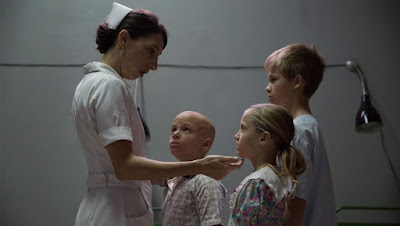
El Traductor/ A Translator
The event also provided Rodrigo & Sebastián Barriuso’s new El Traductor/A Translator, an earnest account of 1989 Havana professor of Russian literature Rodrigo Santoro (Westworld) who finds his course cancelled and himself shuffled off to translate for Chernobyl victim children for which Cuba’s believed exemplary health system has been offered.

The predictable arc is his resentment at the disruption of his ordered academic life being replaced by sympathy for the pale, shaven headed kids.  The film does get the expected moments of pathos out of the situation and works up some suspense from the power failure where he and Argentinian nurse Maricel Álvarez (Biutiful) who has a clearer view of situation, have to break the quarantine seal to deal the power failure shutting off equipment sustaining young Nikita Semenov.

Surprisingly however the film’s emphasis is not on this but on the strain his new work patterns put on Santoro’s marriage to an art dealer who is appalled when their unattended child wanders off and leaves open her home full of valuable works. This gives the film a curious imbalance until the final title reveals that it is made by the now grown sons of the family -  which oddly make the point of view recognisable.

Cuban films made thirty years apart recognisably field the same vision of a world with screwed priorities which the Castro era tried to address and a film industry that was aware of the bad reputation of propaganda works. Not much Cuban product from any period is shown so I guess we should be grateful but I had the same reaction to both these movies - that the needs of the narrative and the message hadn’t been effectively merged, despite the attention both received.

And like the man on the TV says, there is more. 

(To be continued)

Sunday, 30 December 2018

Defending Cinephilia 2018 (11) - David Hare runs through his highlights

My tribute to cinephilia this year is basically a madwoman's breakfast. 
Paul Schrader
A few more movies I liked very much in 2018, aside from the previously mentioned (and reviewed if you hit the links) First Reformed, Buster Scruggs and Cuaron's Roma.
There's the new Sophie Fiennes Bloodlight and Bami, a portrait of Grace Jones from someone who's doing the best imaginable documentary portraiture in the movies now, after her two great Slavoj Zizek movies. Watch a video if you click here
Sophie Fiennes and Grace Jones
Also the latest series of David Lynch's Twin Peaks, all of it disarming, provocative, moving, original, funny and compelling, and with an Episode (number 8) that must be the most stunning work of abstraction in American Cinema.
Claire Denis' addictively funny and wise Un Beau Soleil Intérieur  (Click here for my review) which introduces Alex Descas (left), her favorite male actor, to save the day and rescue the male species from a parade of inexcusably awful men. Denis then ends the movie, with credits rolling, while on the biggest louse of them all, Depardieu, who plays her "psychic therapist" reading to her and us the audience a litany of equally compelling total bullshit that even takes the wind out of Xavier Beauvois' odious banker with his craft whiskies and his vegan olives. 
Jean Gremillon
And a multitude of rediscoveries too long to list, largely prompted by mostly incredibly beautiful new 4K restorations. Just a few: Chikamatsu Monogatari, The Apartment and Some Like It Hot, new French discs from new 4K's of Gremillon's masterpiece Gueule d'Amour and Bresson's sublime treatment of Cocteau, Les Dames du Bois de Boulogne, both from TF1 (without English subs). The long awaited Criterion boxset of the Dietrich-Sternberg pictures. Sony’s dazzling new 4K for A Matter of Life and Death, finally after ten years of very compromised video releases. From Gaumont in France three late 30s Ophuls in lovely new 2Ks, all of them derived from OCN's or fine grain nitrates, Yoshiwara, De Mayerling à Sarajevo and Sans Lendemain. Again none of these are English subbed. 
Max Ophuls
Finally, even though I did not make the pilgrimage to Bologna this year, something even better came along. Geoff Gardner's brainchild and the product of very much sweat, love and passion from a small but dedicated band, Sydney's first Cinema Reborn season last May. That enterprise was hugely successful on every level, not least the personal, I think for everyone involved. but especially for Geoff who finally got to introduce his most beloved film in the history of Cinema, Renoir's great Le Crime de Monsieur Lange. The event went beyond the collegiate in the totally convivial way it pulled together associates, presenters, and audience into one larger entity, something which has been missing from Sydney for decades: a truly cinephilic occasion by and for people who can bring that back into the life of the city. 
Here's to next year!
The Crime of Monsieur Lange