JEAN-PIERRE MELVILLE: MASTER OF SHADOWS AND SILENCE,
a season of Melville’s restored films at the Ritz Cinema, Randwick. Screening Le Cercle Rouge (1970)
Sunday 4 October
Introduction by
Associate Professor Jane Mills,
School of the Arts & Media, University of New South Wales.
– I acknowledge the Bidjigal people of the Eora nation on whose land this cinema stands and pay my respects to their Elders past, present and emerging, and all Aboriginal people here today. Their land was stolen, never ceded. Always was, always will be, Aboriginal land.
– For giving us this opportunity to see these films, I wholeheartedly thank the Tamir family, Cinema Reborn, StudioCanal, Jessa Shields, Ashleigh McKenzie, the projectionists and front of house people and everyone at the Ritz.
***************************************************************************
Karl Marx once said : “All men are brothers and all brothers betray each other.” Well, no, Marx didn't say this. I’m just getting into “Melville-mode.” Melville, a believer in authenticity not realism, often invented the quotes he used at the start of his films – as he does in the film we’re seeing today.
My bogus quote introduces two crucial Melvillian themes: brotherhood and betrayal. And a third theme lurks: the blurred boundaries between solidarity and betrayal, criminality and justice, criminal and cop.
Starting with brotherhood: An Alsatian Jew, Jean-Pierre Grumbach (his actual family name) and his older brother Jacques grew up in Paris. As a teenager, Jean-Pierre fell in love with cinema - if he saw less than 5 films a day, the day was wasted. He became a communist; Jacques a socialist.
Jean-Pierre felt betrayed when Stalin signed the 1939 pact with Hitler. And betrayed again a year later, when the French government signed the armistice treaty with the Nazis. At this point, both brothers joined the French Resistance.
In 1942 Jean-Pierre crossed the Pyrenees, eventually reaching London to join the Free French Army. Taking the code-name ‘Melville’ after his favourite author, Herman Melville, author of Moby Dick, he served with the Free French until the war ended. Back in Paris, he embarked upon his career, making 13 films in 26 years.
As it happen, Brother Jacques also set out over the Pyrenees in 1942. He was carrying a huge sum of money for De Gaulle. Jacques never got across the frontier. The money disappeared. In 1953 his corpse was discovered. His Spanish Republican guide had shot him and buried his body. Arrested, the guide explained Jacques broke his ankle, leaving him (the guide) no choice: his orders from the Resistance were to kill the seriously wounded rather than abandon them to be found by Nazis and thereby compromise the security of the group.
The guide was acquitted and Melville did not appeal the judge’s decision. Or, perhaps he did – in his films. These challenge the Gaullist myth that all France supported the resistance, that the resistance comprised only trusted, faithful, loyal, that all men are brothers. They depict informers and collaborators to reveal that some freedom fighters were criminals who betrayed each other.
It’s foolish to insist that works of fiction are, or even mirror, reality. But in this true story about Melville’s bother, I detect the possible origins of his film’s blurred boundaries between brotherly solidarity and betrayal, between lawmaker and lawbreaker. In a Melville film about the Resistance (there are three), one sees gangsters at work; In a Melville crime film, one sees brotherhood amongst men seeking freedom.
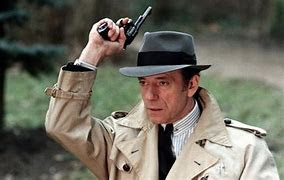 |
| Yves Montand, Le Cercle Rouge |
Le Cercle Rouge (1971)
Le Cercle Rouge, Melville’s penultimate film, is a crime film - although Melville claimed:
it's a transposed Western… the action’s in Paris not the West … cars replace horses. …I start with the traditional – almost obligatory – situation: the man just out of jail. He’s the equivalent of the cowboy riding behind the titles who pushes open the saloon doors once the credits are over.
It’s a film in which brotherhood and betrayal are at constant war and uneasy peace with each other. The three main criminals, Corey, Vogel and Jansen, played by Alain Delon, Gian-Maria Volonté and Yves Montand respectively, never betray each other but they have no qualms about betraying anyone else. The porous borders between crime and law are extremely leaky; the bonds of brotherhood are not strong:
· You’ll meet he bent prison officer who, by alerting the Delon character, Corey, to a possible heist in a high-class jewellers, betrays his brother, Rico.
· Rico, it turns out,was involved in the crime that sent Corey to jail for five years; Corey never informed on him but Rico never once visited him in prison.
· In a further betrayal of friendship, Rico is now sleeping with Corey’s former girlfriend. She too, of course, has betrayed Corey but the film does not swerve from its emphasis on male betrayal: Corey merely dumps her photo in the waste bin. Yves Montand’s Jansen, an alcoholic, ex-police officer who was once a member of the unit that investigated police corruption, betrays his former colleagues to join the two criminals, Corey and Vogel in the magnificently performed (and filmed) heist.
· The fence who originally agreed to receive the stolen jewellery betrays their trust when, at the behest of Rico, he refuses to accept the stolen goods. This sets in motion a chain of events that will eventually result in the three criminal’s deaths.
· Santi, a shady nightclub owner who runs a group of illegal call girls is both a criminal and a police informer. He betrays his old friend Vogel by informing on him to the police.
· Police Commissaire Mattei (an inspired piece of casting of the comedian and singer André Bourvil) constantly pushes the boundaries of legality, relying on and blackmailing his informers and one point even impersonating a criminal and his performance is all too believable.
· Also drawn into the ring of betrayers, when illegally arrested by Mattei in order to blackmail his father, Santi’s school-age son informs on all his marijuana-using classmates.
As the General Inspector of Police constantly intones throughout the film: “All men are guilty.”
The film’s emphasis on men – and my emphasis on brothers - is deliberate. Melville’s films are largely woman-free and woman-unfriendly zones. Le Cercle rougecertainly is. Are the films – was Melville misogynistic? Homophobic? Homophilic? It’s surely for you to decide. They're chilly, dark, and pessimistic about humankind and human relationships. But is there really no warmth, no glimmer of love as some critics suggest? If so, tell me why the hell, near the end of today’s film, when Alain Delon’s Corey walks out the door, left behind, Gian Maria Volonté’s Vogel clutches a red rose.
There’s much to say about Melville and this superb film - hugely admired by, among others, John Woo, Ringo Lam, Johnnie To, Takeshi Kitano, Aki Kaurismäki, Fassbinder, Michael Mann, Walter Hill, Quentin Tarantino, William Friedkin, Jim Jarmusch and Neil Jordan. Woo, in particular, says: “Melville is god to me.”
But I’ll focus on the justly celebrated heist scene that has earned these admiring critiques over the years:
· a staggering, audacious work of silent cinema;
· a brilliant heist scene without a sound and no montage;
· half an hour of real-time brilliance;
· 25 minutes of almost no editing, no music, not a single word;
· Melville forces us to listen to silence.
· a dazzling, single, static long-take.
The scene is so dazzling that it appears to have blinded and deafened some of our most acute critics. Is it half an hour? 25 mins? No, it’s 26 mins, 48 seconds. Is it silent? Most definitely not: there are at least 122 different sounds in a magical soundscape. Is there no music? At one moment, a door on the staircase above the criminals seems to open and the sounds of party music and laughter spill out. Don't miss the subtle, non-diegetic jazz percussion sequence with drums and cymbals as Corey and Vogel pad across the rooftops. And enjoy the jewel cabinet alarms clicking off in what sounds like a round of orchestrated applause after the virtuoso rifle marksman, Jansen, hits his target. As for no editing, Melville and editor Marie-Sophie Dubus would not have been able to attain such a high level of suspense without the cross-cuts, parallel edits and shot/counter-shots, between the criminals, between interior and the exterior and between the criminals and the overwhelmed, gagged and bound guard. This is most definitely not a single long shot. As for the supposedly static camera, cinematographer Henri Decaë uses a brilliant palette of pans, zooms and tracks that all synchronise in an image-soundscape to… …yes, to blind, deafen and dazzle us. Melville knew what he was doing because he makes a sly joke: the scene before the heist ends with the words: “Let’s hear it”; the first words after it are: “They're not very talkative.”
I conclude with another’s advice on how to get into “Melville mode”:
· Tell nobody what you’re doing: keep even your loved ones in the dark.
· When choosing between smoking and talking: smoke.
· Wear a raincoat, buttoned and belted, regardless if it’s raining.
· Keep your revolver, until you need it, in your coat pocket.
· Before leaving home, put your hat on.
· No hat? You can't go.
As none of you here are wearing hats, please ignore this advice. I know you’ll enjoy the film.
 |
Jane Mills with John McDonald at the Ritz
John will be introducing the third film
in the Melville season, Le Doulos
on 18 October
|
Advance Bookings the remaining five films in the Jean-Pierre Melville season at the Ritz Cinemas Randwick are available IF YOU CLICK THROUGH TO THE RITZ WEBSITE


