Showing posts with label Netflix. Show all posts

Tuesday, 14 July 2026

A Travel Hint and a recipe - Airline omelettes and a lesson from MIDNIGHT DINER

Kaoru Kobayashi as the chef in Midnight Diner

When travelling, at least when travelling in your old age when you can afford smart hotels with giant buffets, airline lounges, indeed airline travel, my advice is never choose or accept anything which is described as an omelette.

You will find something shaped like an omelette, even coloured like an omelette, basically yellow, but it never tastes like an omelette should - a slightly firm exterior and an interior that is slightly, just on the edge of liquid. 

Omelettes that have gone through the hell of preparation for a buffet or a heated (re-heated?) airline breakfast, taste nothing like that. They are hard and unyielding of any flavour to savour.

The best omelette I have tasted, and I dont profess to have tasted every possible method or combination, was first demonstrated at the end of an episode of Midnight Diner when the chef simply about an ounce of butter into a medium heat frying pan with a flat bottom about eight inches wide and steeply curved sides. When the butter had melted he simply broke two eggs onto the butter and stirred vigorously with a table fork for about twenty seconds before  turning one side over onto the other with a spatula and after about another twenty seconds flipping it over again. Some tiny shade of brown appeared on the ridge. it was ready. 

If you want add cheese, smoked salmon or diced chicken add it just before you use the spatula.


Tuesday, 26 May 2026

Streaming on Netflix - KYLIE (Dir: Michael Harte, Australia/UK, 2026, in three parts)


Charlie Schlatter, Kylie Minogue, The Delinquents

"Maybe I should go back to acting"....or something very similar is the absolutely only reference to the bits and pieces of film acting that Kylie Minogue has done over a forty year career in the three part three+ hour series currently screening on Netflix. 

It's not as if the series tries to avoid the many moments of mediocrity in her work. There's plenty of them in her singing career. So...mysterious. Did she not want to talk about her films or did the producers forget to ask the questions.

Her most notable appearance was in The Delinquents. There is an HD copy of the movie on YouTube if this has made you at all curious. Kylie Minogue utterly outshone bland imported Yank Charlie Schlatter and brought a lot of conviction to a role about teenage love, illegal abortion, police harassment, welfare harassment and true love winning out. Kylie doesn't sing though she appears to play the piano quite well. The real star of the production was the music supervisor, who no doubt on instruction, loaded the film up with a soundtrack of classic 50s rock and pop by the likes of Little Richard, The Platters and Gene Vincent. It's worth a look and when I watched it on YouTube it was uninterrupted by advertisements.

More recently the film's modest box office back in its day was used as the starting point of a piece by Brendan Swift published in Inside Film a couple of years ago about the vexed question of just how government intervention in the film industry should work. You can read the whole thing IF YOU CLICK HERE. I wont give any more away but my favourite paras in the story were these:

"Retired film distributor Alan Finney, who marketed many classic Australian films including Priscilla and Muriel’s Wedding, says the question of “who decides” which films receive government funding has always been a complicated question.

“One of the problems when you’ve got a small population and a small industry is the people who you appoint to make the decisions are either of two kinds,” he says.

“They’re either people who have never been in the industry and know nothing about it, and are therefore criticised for not being in touch with the key factors of decision-making, or they’re people that have been in the industry, and then the criticism is made that either they’ve got vested interests or they’re obviously failing in their job in the industry, which is why they’ve been appointed to the board of this state or federal funding body.” 


Sunday, 12 April 2026

Streaming on Netflix - Rod Bishop recommends - DETECTIVE HOLE aka Jo Nesbø’s Detective Hole (Jo Nesbø, Norway, 2026)


Any Norwegian serial killer, police-procedural that uses the German philosopher Martin Heidegger as a running joke, has got to be worth a look.

Tobias Santelmann plays Detective Harry Hole (pronounced Hurl-ah) as a self-loathing, destructive introvert, almost completely lacking in social skills and occasionally suicidal. An alcoholic with a taste for prescription meds, he’s brilliant with forensics and highly skilled at serial killer profiling. It’s the booze that keeps getting him into trouble, causing an on-and-off relationship with his current partner Rakel (Pia Tjelta). It also means he’s constantly in danger of suspension from the police force.

He gradually bonds with Rakel’s 14-year-old son Oleg (Maxime Baune Bochud) and scores big time with the teen by introducing him to the Ramones. Despite the threats of suspension, Harry’s serial killer expertise means the Oslo cops can’t do without him.

Tobias Santelmann as Jo Nesbø’s troubled cop in Detective Hole

His adversary is Tom Waaler (Joel Kinnerman), a seriously corrupt, narcissistic police colleague with a sociopathic idea of social justice. Tom also blames Harry for being drunk and killing Tom’s friend (possibly his lover) in a police car chase. Forced to work together, Tom and Harry have nothing but contempt and suspicion for each other. All this - and more - is revealed in the first episode. Another eight follow. 

Adapted for television by Jo Nesbø from his fifth Detective Hole novel (The Devil’s Star), Nick Cave and Warren Ellis add a brooding original score to the copious collection of songs. The ‘needle drops’ include Iggy Pop, Ramones, Los Lobos, Sex Pistols, Warren Zevon, Donovan, The Doors, Slayer, PJ Harvey, Leonard Cohen, The Falls, Muddy Waters, Elvis Costello, Otis Brown, Tammy Wynette and others.

Jo Nesbø 

At times graphically violent, this crime thriller is set in an often gritty and grimy Oslo. Although many of the tropes are familiar, the psychological character studies are interestingly heightened, and Nesbø has loaded the series with enough Nordic pickled herring plot twists to keep most viewers guessing and absorbed. 

Thursday, 23 October 2025

Streaming on Netflix - Rod Bishop recommends SHE WALKS IN DARKNESS (Agustín Díaz Yanes, Spain, 2025)

Susana Abaitua as Amelia

It’s the 1990s and the Basque separatist group ETA is in full swing. 

Operatives brazenly assassinate politicians, academics, police and high-ranking military by simply walking up and shooting them in the head. On busy streets, in cars, and crowded restaurants in broad daylight, location doesn’t seem to matter. Or they just blow things up.

ETA (Euskadi Ta Askatasuna or Basque Fatherland and Freedom) forms the backdrop for writer-director Agustín Díaz Yanes and his restrained, but always gripping and tense spy story.

Yanes inserts a fictional plot into this Spanish history with an undercover mole planted inside the ETA to discover the location of the group’s stash of weapons. 

(Andrés Getrúdix as the handler, Susana Abaitua as Amelia, She Walks in Darkness)

Recruited to infiltrate the group, Amelia (Susana Abaitua) is a member of the Spanish Civil Guard and a Basque language speaker. She stays undercover for many years.

Her new ‘legend’ includes a comatose ‘mother’ in a care facility; her handler is the Spanish cop Castro (Andrés Getrúdix); and her tradecraft involves communicating through Italian pop songs and switching garbage bags. She is planted as a teacher in a Basque high school, run by Begoña (Iraia Elias), a clandestine ETA leader whose husband is in jail on terrorist charges.

In its life span as a violent terrorist group (1968 to 2010), ETA killed over 800 including 340 civilians, and injured another 2,200. In more than 2000 attacks, the group carried out over 500 bombings, 456 shootings and 66 kidnappings (32 of whom were killed).

Yanes does seem more interested in espionage tradecraft than he is in ETA’s politics and we learn little about their motivations or why particular targets are picked. The copious use of newsreel footage from the time helps with authenticity, but it doesn’t provide much depth to our political comprehension.

And despite Amelia’s handler being accused of torturing ETA prisoners and being threatened with a trial, some commentators warn against being seduced by any film about the ETA seen from the point-of-view of the police.  

It’s an austere slow-burner and, despite its faults, should satisfy most le Carré admirers.


Friday, 20 September 2024

Streaming on Netflix - Rod Bishop is intrigued by THE SIGNAL (Sebastian Hilger, Philipp Leinemann, Germany, 2024)


Spoilers ahead:

In 1977, American astronomer Carl Sagan chaired a committee to choose 116 images and a variety of sounds for the “Golden Record” to be carried on the Voyager missions into the cosmos.

The hope was extraterrestrial intelligence would find the Voyagers and presumably sit down over a nice cup of tea to marvel at our Greetings from Earth in 55 languages and our documented sounds, including wild dogs, volcanoes, Morse Code and even Carl Sagan laughing.

More than twenty countries contributed to the music section including folk music from Peru; the Brandenberg Concerto from Germany; Mariachi from Mexico; and Yolngu songs from Australia.

Unsurprisingly, the USA chose four unique contributions – Navajo music; Louis Armstrong; Blind Willie Johnson; and Chuck Berry (“Johnny B. Goode”).

A year after the first Voyager launched, comedian Steve Martin claimed an alien civilization had already listened to the Golden Record:

They sent us a message that actually proves it. It may be just four simple words but it is the first positive proof that other intelligent beings inhabit the universe. The four words that came to us from outer space…are… Send More Chuck Berry.”

In The Signal, a four-part sci-fi series from Germany, the Golden Record produces more laughs, perhaps unintentionally, but perhaps not.


Astronaut Paula (Peri Baumeister, above) is on a space mission funded by Indian billionaire Benisha Mudhi (Sheeba Chaddha) when she hears “Hello”… “Hello”… “Hello” coming from outer space on a craft headed to Earth. Paula is not entirely well, however. She once took an acid trip in a fun park and had “full blown psychosis” from it for some time after. She also managed to hide it from Mission Control.

About the time she hears the repeated “Hello” in space, she starts finding little crawling bugs under her skin and has to spend time in her sleep-capsule recovering. Nevertheless, she manages to plot the trajectory of the sound and work out where the alien craft will land on Earth.

There’s much skullduggery on the ground however, and a consensus among some powers has decided Earth isn’t ready for contact with an alien intelligence. Seems what they fear most is getting sick and dying, like the Aztecs. Better then to just blow up the alien craft with a big atom bomb.

Problem is, Paula has craftily concealed the true co-ordinates. It’s left to her hubby and daughter to be in the right place at the right time. When the alien craft does arrive, it turns out to be one of the Voyagers.

The stylus has stuck on the Golden Record with a voice repeating “Hello” “Hello” “Hello”, providing us with yet another reason to not go back to vinyl.

Seems these aliens are indifferent to us and our civilization, and not even impressed with Chuck Berry.

They just sent our space junk back to us.

Friday, 23 August 2024

Streaming on Netflix - Rod Bishop analyses truth and fiction in TRANSATLANTIC (Anna Winger, Daniel Hendler, Germany/France, 2023)


Despairing of his country’s muted indifference to the war in Europe, 32-year-old Varian Fry left the USA in 1940 for Marseille with $3000 strapped to his leg. There, he led a volunteer team to assist more than 2000 refugees escape from Vichy France. 

The refugees included artists and intellectuals many of whom walked across the Pyrenees to Spain, or left by boat with forged documents to safe ports, en route the USA.

The refugees included film director Max Ophüls; writers Hannah Arendt, Arthur Koestler and Walter Benjamin; artists Marc Chagall, Max Ernst, Marcel Duchamp, André Breton and Jacqueline Lamba Breton; musicians Pablo Casals and Wanda Landowska; Nobel Prize winner Otto Meyerhof; and the philosopher and anthropologist Claude Lévi-Strauss. 

Known as “the American Schindler”, Varian Fry received the only official recognition of his work in 1967, five months before his death. André Malraux, then Minister of Cultural Affairs awarded Fry the croix de Chevalier of the French Legion d’Honneur. Malraux had visited Fry in Marseille in 1941, but had refused his offer to escape from France, instead entrusting Fry with the reels of his Spanish Civil War film L’espoir (1940). 

Varian Fry, Marseilles, 1941

The television series Transatlantic was ‘inspired’ by Julie Orringer’s The Flight Portfolio, a weighty novel that ‘fictionalizes’ the work of Varian Fry and his collaborators. In its closing titles, Transatlantic claims to be a “a work of fiction inspired by real people and real events”.

Factual history and historical fiction are really at issue here.

A lot happened during Fry’s fourteen months in Marseille and both Orringer and the television series creators Anna Winger and Daniel Hendler have a lot to choose from. Or maybe…just make-it-up…sorry, I mean create ‘historical fiction’.

Orringer, for instance, creates a major and entirely fictional character for her novel – Elliot Shiffman Grant. He is the second most important character after Fry, and also Fry’s past lover. Grant joins him in Marseille to renew their closeted relationship and provide the novel with its central emotional arc, even if none of it is actually true. 

Varian Fry, 1967

Winger and Hendler dispense with Grant entirely in their television series and, instead, use a Thomas Lovegrove as Fry’s gay lover. But he, too, is entirely invented for romantic interest. 

Fry’s son has confirmed to The New York Times that his father was gay, but the Orringer and the television series creators have gifted Fry lovers who never existed. 

In the novel, Orringer gives Hannah Arendt only a few pages. She comes to see Fry looking for help to escape Vichy France. He immediately tells her he will try to obtain visas to the US for her and her husband. In the television series, Arendt is a slightly more substantial character, but is forcefully told by Fry on several occasions he cannot provide her with a visa. Quite confusing.

In Transatlantic, the escape route over the Pyrenees is compromised by British Intelligence who want British POWs taken to Spain. Fry’s lover, the fictional Thomas Lovegrove, turns out to be working for the British. In the novel, the route is never compromised, nor are there any British POWs, nor British Intelligence operatives and certainly no Thomas Lovegrove. 

Alexander Fehling as Max Ernst, Johdi May as Peggy Guggenheim

Other sources do claim Fry worked for British Intelligence and did help British pilots escape, suggesting it was a source of income to keep his refugee operation afloat.  It was, after all, a murky war, where casualties include the truth.

The novel also details the Flight Portfolio project - drawings from the surrealist artists seeking Fry’s help to escape. The drawings were to be smuggled to New York for a sale designed to raise funds for more escapees. But the Vichy police confiscated the drawings in a raid. 

In fact, there was no such Flight Portfolio project until 30 years later. In 1971, four years after Fry’s death, the International Rescue Committee published a portfolio of lithographs, limited to 250, under the title FLIGHT. Fry, who started the project in New York in 1964, found it difficult to assemble the work. In The Rescuer (2012), Dara Horn notes that a reluctant Marc Chagall finally contributed, but refused to sign his work. Max Ernst refused numerous requests from Fry, only ‘capitulating’ when Fry travelled to France to beg him. André Breton just flatly refused. 

If these claims from Dara Horn are true, this reluctance to engage years later with the refugee cause and with the man who could legitimately claim to have saved their lives is very puzzling. Something is missing here.

Fictionalization, however, allows Orringer to take the idea of a ‘Flight Portfolio’ from 1971 and re-plant it to Marseille in 1941. It’s such a good idea for a book title, after all.

Historical fiction is still fiction.

One real character from the time, who didn’t make it into either the novel or the television series, was a volunteer Varian Fry called a ‘moral adventurer’ – the ex-pat American Charles Fernley Fawcett: a wrestler, Foreign Legionnaire, social butterfly, trumpet player, songwriter, composer, artist, B-film actor (more than 50 credits), and for Varian Fry in Marseille, a doorman-receptionist. Fawcett wore his ambulance corps uniform as he managed the queues of refugees lining up for interviews with Fry. 

Cory Michael Smith as Varian Fry

Fawcett engaged in six bigamous marriages in a three-month period during the war, marrying Jewish women from Nazi internment camps so they could leave on American visas. At one point, two “Mrs. Fawcetts” turned up in Lisbon at the same time. 

His exclusion from the novel and from Transatlantic only testifies to the wealth of real - and imaginary - characters available. 

Leaving aside the surrealist artists’ party (nude in the novel, clothed in the television series), ‘fictionalization’ can produce some imaginative moments.

In the television series, surrealist artists André Breton, Jacqueline Lamba Breton and Max Ernst loiter around a swimming pool improvising poetry:

Hug the dull. Prickly thorns are below.

In his slippers, a snail has lost his armor,

But he has found a mailbox.

The rain falls upside down.

It is blown by the currents, like ribbons.

The gray-black clouds are reflected on the skin of the sardines.

Swindled under the influence of their lumber pains!”


In Orringer’s book, when André Breton is escaping Marseille by boat, Breton says to Fry:

There is no purer embodiment of surrealism than the departure from land onto a borderless plane of water. One sails over the bodies of millions of creatures, many of them unknown to man – even over mountains uncharted, mountains higher than the highest peaks in Tibet – entirely without consciousness, without the slightest knowledge of their existence. One might, for example, while sitting in the ship’s dining room and eating iced pineapple, sail over a great underwater current propelling a fleet of leviathans and their children, thousands of tons of oily flesh moving invisibly and inaudibly along that unbound underwater river like giant corpuscles through the bloodstream of the world.

Tuesday, 21 May 2024

Streaming on Netflix and on SBS on Demand - Two takes on Irish crime - BODKIN (Jez Scharf showrunner) and BLUE LIGHTS (Series 2 - Declan


It seems a bit like the Irish crime producers are doing to the Brits  what the New Zealanders do with us more generally...make better films I mean... So is the sample too small and the fact that there's been no new series of The Line of Duty for awhile tipped the balance towards Ireland as the primary place for "Brit" TV crime. Hard to know. There was Boat  and Wolf of course but still, small though the contribution may be when you look over the the total output of Brit TV crime in 2023  the Irish seem to have a knack for the stuff. It's probably all traced back to the DNA whereby in the sinews of real Irish crime was the activity of the IRA in robbing banks to finance itself.  Maybe it dealt in drugs too. Whatever, all over Ireland, if you believe Blue Lights and to a lesser extent Bodkin, crime is rampant. In fact the Belfast of Blue Lights  is a hot bed of Loyalist gangs nowadays more interested in fighting for control of the drug trade than defending the Crown.  

All this of course just follows on from the work of Peter McKenna (Not the VFL footballer but I wont go into that again) which I breathlessly admired a year or so back when I  wrote about his series Hidden Assets and Kin. The latter especially had a sense of Shakespearean downfall about its gang leaders and their trusted offspring, their lieutenants and the powerful women who pulled their strings. It also had two of the most ferocious villains you'll ever come across - the successive heads of the Kinsella gang played by Ciaran Hinds and Francis Magee.

Blue Lights  created by Declan Lawn, Adam Patterson and Louise Gallagher, is much more a descendant of  Z Cars and The Bill. Series one tossed us into a police  station where a handful of rookie cops, all with a backstory that had to be explained, start policing the mean streets of Belfast. The lines between the old cops and the young were clear. The old cops knew much, in one case too much, and the young cops knew bugger all. Of the four young cops in series one, one has dropped out and become a lawyer with a cause that has to be the most slow burning element of series two. 

By series two, now on SBS on Demand if you can stand the ads for Chemist Warehouse, or elsewhere if you look around, the back stories are given and a couple of new cops are introduced, both of them appearing to be dodgy in ways that only get explained later. The new cops are there because drug crime and drug dealing has got out of control and two Loyalist gangs are at war with each other. Into this steps an ex-military man whose sister runs a bar which pays protection money to one of the gangs. The  veteran, who saw and did terrible things in Afghanistan, isn't going to take it anymore. ..Enough said...

Will Forte, Siobhan Cullen, Robyn Cara, Bodkin

Bodkin,
screening on Netflix is a much smarter bit of film-making, much less formulaic if you dont regard the crime,  the corrupt police, mysterious disappearances and cold case investigations as part of a formula I guess. A Guardian-type journalist is under the pump for a story she has written exposing crime in high places which has led to the death of her whistleblower. Her editor decides she needs to cool off so sends her back to her homeland Ireland to investigate a cold case involving mysterious disappearances. Somehow or other an American podcaster and his enthusiastic assistant  are also investigating the case and the contrast couldn't be clearer. 

The journo is abrupt, crash through or crash and the podcaster is full of handwringing political correctness about what he should and shouldn't be doing. It has a drollery to it that's irresistible. The credits may shock you. I know nothing about the writer/showrunner Jez Scharf but I have heard of two of the many Executive Producers, Barack and Michelle Obama and the director of the first two eps Nash Edgerton. How a boy from Sydney get picked up to direct two eps of an Irish TV series is a mystery but I guess that's how the worldwide network of agents and producers works these days. 


Monday, 7 August 2023

Streaming on Netflix - Rod Bishop is impressed by THE EDDY (Glen Ballard, Damien Chazelle, Randy Kerber, Alan Poul, Jack Thorne, UK, Germany, USA, France, 2020)


When Jack Thorne was given a writer’s brief for the The Eddy, the series was to be set in “a multi-cultural, multi-lingual, multi-faith Parisian jazz club”. 

Years before, however, the series had started life as a jazz club in the mind of the Grammy Award winning music producer Glen Ballard: “I have lived in Paris a long-time and have been to every jazz club multiple times”.

Ballard’s career includes recording and writing for Michael Jackson’s albums ThrillerBadand Dangerous, but his ultimate aim for The Eddy was a television series. By the time production started he’d written over 40 songs with his collaborator Randy Kerber whose own career includes piano work for a vast number of films and who has worked with an awe-inspiring list of artists from Frank Sinatra to Leonard Cohen.

Kerber also plays the brilliant pianist in The Eddy alongside the other musicians in the band. They were all chosen for their musical talents, not their acting skills.

With producer Alan Poul, Ballard and Kerber enlisted the help of French-American film director Damien Chazelle (below, before he directed Whiplash and La La Land) and also the prolific hit-and-miss British screenwriter Jack Thorne.


Thorne wrote what was asked: a struggling jazz club in a gritty part of Paris run by renowned former jazz pianist Elliot Udo (André Holland), an African-American from New York, who is in an on-again-off-again relationship with the band’s Polish singer Maja (Joanna Kulig), while also struggling with his wayward 16-year-old daughter Julie (Amandla Stenberg, below). 


Elliot’s partner in the jazz club is Farid (Tahar Rahim) and he has become secretly involved with violent local criminal gangs in an effort to keep The Eddy from going under.

Other band members are from Eastern Europe, Haiti, North Africa, Cuba and Croatia. There are also local Moroccan musicians fusing hip-hop with traditional Islamic music; and they’d also like time on The Eddy’s stage. 

There are many references to the history of Parisian jazz, home for a time to the likes of African-Americans Sidney Bechet, Dexter Gordon, Kenny Clarke and Miles Davis. Glen Ballard has said; “The mission for me was to connect young listeners and viewers to what jazz really could be…Paris never gave up on jazz.

Spoken in French, Arabic, English and Polish and shot on 16mm with camera movements inspired by John Cassavetes, it retains its uniqueness through all eight episodes.

And there’s lashings of jazz - all exemplary. 

Friday, 9 December 2022

Streaming on Netflix - Rod Bishop recommends SR. (Chris Smith, USA, 2022)

Robert Downey Sr & Jr

Anyone who employed the underrated film score musician Jack Nitzsche to work on the oddball, low-budget, underground feature
 Greaser’s Palace(1972) deserves some respect.

Particularly if the film is about a mysterious figure literally parachuting into an 18th Century Western and capable of resurrecting the dead. The reviews called it “witless”, “unwatchable” and an “embarrassment”.

But Nitzsche, bless him, was back for the director’s next effort, Sticks and Bones(1973), a TV movie about a Vietnam vet returning home blind - variously described as “bizarre”, “unsettling” “controversial” “ugly” and “abrasive”. Consigned to the CBS vaults after its first screening, but apparently stolen in 2012, Sticks and Bones can now be found on YouTube.

And who is this director? It’s Robert Downey Jr’s pop Robert Downey Sr. 

An underground, anarchist, anti-establishment director in the 60s, 70s and 80s, Downey Sr. had one major hit with Putney Swope(1969) and there are another 11 features that are hard to find (try YouTube).

Growing up, Downey Jr. was surrounded by his father’s counter-cultural world and claims he never encountered anything ‘mainstream’. His charismatic dad – who in this documentary freely admits to having been a drug addict – used to think introducing his kids to drugs was the right thing to do. Once, on a road trip from Santa Fe to Los Angeles, his son “was in charge of the hash pipe”. Downey Jr. believes it set off his own downward spiral into drugs and alcohol and he later claimed in court, he’d been taking drugs since he was 8 years old. 

As a Hollywood actor, after a concentrated five-year period of arrests and convictions for drug and other offenses, Downey Jr. found himself unable to work, as any production game enough to cast him could not get completion bond insurance with him in the cast.

This film is not about Downey Jr’s drug problems, but about his relationship with his father during the period his dad succumbs to Parkinson’s. With his family supporting his every effort, Jr. engages in a wild attempt to document Sr’s even wilder career. For his part, the father just insists on access to the footage so he can cut his own version of the film. He spends a lot of time on the set of his son’s film, unable to stop directing the scenes.

Both father and son seem as difficult to handle as a box full of monkeys. But, despite everything they have been through, and despite everything Jr. could legitimately throw at his father, they clearly, quite simply, love each other. And that ain’t nothing.


Sunday, 20 November 2022

Streaming on Netflix - THE MURMURING (Jennifer Kent, USA, 2022) - An episode in Guillermo del Toro's Cabinet of Curiosities

Guillermo del Toro

Thanks to David Hare who drew my attention to this little movie.

You go where the wind blows and for Jennifer Kent, who has made two highly regarded features The Babadook (2014)  and The Nightingale (2018)  but nothing else on the record since then, fate  has blown her into the arms of Guillermo del Toro for whom she has written and directed a one hour “teleplay” for the eight part series Guillermo del Toro's Cabinet of Curiosities now screening on Netflix. Del Toro's appearance introducing the show is the last of him though it did hit a memory trace that took me all the way back to his remarkable debut feature Cronos (1993)


The Murmuring  stars Essie Davis and Andrew Lincoln. Del Toro himself wrote the story which Kent has adapted into a near two hander.


Essie Davis, Andrew Lincoln, The Murmuring
 

It’s set on an island of Nova Scotia in 1951 and two ethnographers (?) Nancy and Edgar arrive to study the local population of a bird called a dunlin. These are famous for their ability  ("is it mental telepathy?") to form enormous swarms all flying in elaborate patterns. Things are a little tense between them and Nancy has lost interest in sex, indeed in just about any kind of emotional warmth. From a hint at the start we know there’s a deep dark secret that is going to come out. 


While you expect it to happen, the mechanics of it  don’t come out until we go through a series of incidents which suggest that the couple, otherwise alone on the island, are living in a haunted house. But only Nancy hears and sees the signs and…go no further. Not being an aficionado of this sort of material I cant say whether others might find this all too predictable. But for mine, as medium length modest movies go, this is very good indeed and helped immeasurably by the performances of Davis and Lincoln.


The series has eight stories, only one other of which is based on Del Toro’s story material. Sources are as varied as stories by H P Lovecraft, an original script and a web comic. Five ‘young’ male directors and three female directors do the hard yakka. Netflix has given the film (or maybe the series) its own “R” rating but that is way beyond the gentle and very clever storyline.

Friday, 7 October 2022

Streaming on NETFLIX - Barrie Pattison discovers ATHENA (Romain Gavras, France, 2022)

The barricades. Athena


"...its defenders as a human frieze
overlooking the urban battlefield..."

After the home ground success of Ladj Ly’s Les Miserables  account of riots in the
Paris housing projects, we were bound to get a follow up, so Netflix bank rolled the
2022 Athena, part scripted by Ly and directed by Romain Gavras, who has a walk on
in the earlier film.

The reported killing of an Arab boy triggers riots in the French ghettos There’s the
prospect of calling out the army and provocation by right wing elements? Right from
the start, there is no question about this one being a showy, attention getting piece of filmmaking. 

Gavras fils  is distancing himself from his pop clips and his escapist Isabelle
Adjani, Vincent Cassel Le Monde est á toi. This one has significance writ large upon it
and  Netflix are emphasising the connection with Les Miserables. 

We kick off in the middle of the action with the dead boy’s older brother, soldier Dali
Benssalah announcing the murder and calling for calm, when the immigrant population is blaming the police. His dreadlocked activist other brother Sami Slimane disrupts his press conference with a Molotov Cocktail, starting the fire which engulfs the police station they loot for a weapons safe and rockets seen being deployed in the background as the rioters start their continuing single take ride across the city to their base in housing project Athena, bannered biker and horse rider running parallel with their co-opted police wagon on the highway. Just organising and staging this eleven-minute single shot must have taken amazing effort, even allowing for its quota of  CG.  Only in the film’s final exploding high rise is the effects work
obvious.

The film has some more of these - the drone shot which continues over the parapet to
show its defenders as a human frieze overlooking the urban battlefield, the camera moving through the gaps in the walls smashed into the apartment block where the tenants are reluctant to leave their homes. We again see defenders using digital ‘phone spotters to decide where to dump refrigerators off the roof onto the forces of law below. “We’re done being seen as victims.” There’s a domestic TV still playing in the burning lounge room, showing the news. “The war has already started.” We hear about parallel riots in thirty French cities. “Dijon is in flames.”  

There follows the nighttime entry of see-through plastic shield, singing riot police who find themselves surrounded and petrol bombed. Family man soldier Antony Bajon is among the cops streaming over the wall, become separated and held with his life as a payback hostage (“let’s fuck him up”) and ending stripped of his military outfit, like the lead of  Soy Nero. 

There’s no denying the craft skill - the film makers  get their value out of editing, using  the odd fade and cutting between close-ups of Benssalah, Slimane and their half brother Narco Trafficker, Surkin’s music and the effects merging at the height of the riot, the clear images and sound in complex, difficult filming.

Some of the elements are not as successful - the fanatic found tending the projects’ flower bed, who is the one who knows how to blow the safe and set gas cylinders to explode or Benssalah and hostage Bajon (“If you get him out you’ll be a hero”) shedding their identities under pressure ... the tear on the cheek or the final revelation with skinheads destroying evidence. 

The question remains as to how well the film makers have read the tensions in their society. That’s going to show in the future, a long way from here. The cycle that runs through La haine, Les Miserables  and this one is not really a progression. 

What is disturbing is that, among the English language comment I’ve read, no one
seems to be making the connection. I don’t know that “It’s only a movie Ingrid” covers this one. 
Dali Benssalah, Athena 

Wednesday, 21 September 2022

CHANNEL SURFING - Sydney's supercinephile Barrie Pattison uncovers - THE FLYING SCOTSMAN (Castleton Knight, UK, 1929), SHADOWED (John Sturges, USA, 1946), WHAT DID JACK DO? (David Lynch, USA, 2017) and more

Ray Milland (centre), The Flying Scotsman

I’ve been dipping into DVDs and on air material, if for no other reason, to remind myself that I’m never going to get to the end of my movie viewing. In fact, with the current deluge, the horizon is even further away. 


I got around to watching 1929’s The Flying Scotsman which offers one of the few accessible glimpses of early British sound film making, by some measures their first sound feature, clocking in just under an hour and competing with Journey’s End, Escape and Blackmail. In this one, it’s a jolt when the first reels of inset title dialogue and music give way to the location noises of the railway social club.


Another of the film’s claims to our attention is the on-screen debut of Ray(mond) Milland, who had already experienced Arthur Robison’s silent version of The Informer, when the producers recruited him from his regiment as a marksman for their shoot-up action. Milland was rather hard on himself (“I couldn’t act worth a damn” he told me in the sixties) Not unlike other beginner performers of the day - John Wayne - he registers better than the trained players around him and already has his recognisable ironic delivery.


Pauline Johnson, The Flying Scotsman

We note that pre WW2 European movie trains were continually menaced by murderous staff (Gance’s La Roue, Adrien Brunel’s Without Warning, Bernard Vorhaus’ The Last Journey) in the way that jet liners now contain mad bombers. This film generates a lot of its interest from railway detail - the prestige Flying Scot service priding itself on making the London-Edinburgh Waverley journey on schedule, the actors dwarfed by the giant locomotive wheels, carriage material filmed while the cars are moving, footplate scenes and the striking sequence of heroine Pauline Johnson (above) clambering along the side of the speeding train without safety roping.


The script is dim melodrama, with retiring veteran driver, Will Hay side kick Moore Marriott no less, getting his fireman Alec Hurley dismissed for drinking on the job. Meanwhile Hurley’s replacement, young Milland contrives to pick up Marriott’s daughter Johnson at a two & sixpence Dance Palais, before he discovers the connection. A mirror is smashed foreshadowing misfortune. Hurley plots his revenge on Marriott’s last run, which of course comes with the obligatory montage of rails speeding past, filmed from the train.


The train footage, it’s place as a marker in the arrival of sound film and seeing Milland’s career begin, all contribute to The Flying Scotsman’s interest. Director Castleton Knight worked in newsreels and won another spot in movie history for his feature film of the fifties coronation. The handling is competent. It unconsciously projects the familiar drabness of the British scene. I do however like the little old lady presenting Marriot a chocolate bar to thank him for completing her trip on time.


The Filmrise DVD is good enough.


There’s also a minimally ambitious 1957 support movie called The Flying Scot or The Mailbag Robbery made by Herbert Compton Bennet, of 7th Veil fame, which gets the odd run on Channel 92.


I saw Shadowed on its 1940s initial release, one of the first films I ever watched, and I was intrigued to find that I still remembered Lloyd Corrigan finding the body in the railway culvert and the very noir image of Anita Louise on the shadowed (get it) stairs. This one departs from the usual mean streets, being set in a leafy suburb where the golf course sprinklers spray on cue.


It is mainly notable as early John Sturges, less interesting than his The Man Who Dared  and The Walking Hills.His talent doesn’t really assert till we get to his thrillers at Dore Schary’s MGM.


Widowed Corrigan is a prosperous gardening implements business owner, the father of girls Louise and teenaged Terry Moore. He’s first seen rehearsing his “Good fences make good neighbors” speech for the district lodge Wednesday Club. However, as we expect in one of these, sinister forces enter his ordered life complete with bullet-riddled body, counterfeit currency plates and an incriminating golf ball. Brenda Weisberg’s script is weak and the sub-plot with Moore and her would be criminologist admirer is embarrassing. Patience-playing heavy Paul E. Burns totally lacks menace. In fact, the film’s one class element turns out to be portly Corrigan's reluctant hero best performance.


However, the texture is impressive for a B movie - resembling Anthony Mann’s Republic crime films, similarly done in by feeble scripts. Cameraman Henry Freulich, son of famous stills man Roman Freulich, also did Blake Edwards’ first movie, antagonising his director, who turned round as one of their more complex movements was descending into chaos, to find Freulich practicing his golf swing. Edwards had his operator, Philip Lathrop, promoted for their next film, launching a couple of major careers. The anonymous score turns out to be by Mario Castelnuovo-Tedesco.


The YouTube copy is just all right.


And for those who have seen everything, what about What Did Jack Do? directed, written, edited, sound & design by David Lynch in 2017? Absolutely Lynch - perverse, funny, surreal and, at seventeen minutes, a treat. In B&W, with film dirt visible on the image, detective Lynch faces a talking monkey (remarkable effects work) who became obsessed with a chicken (“there were feathers everywhere!”) while off-screen trains pull out of the rail station where the interrogation is taking place. Railway waitress Emily Stofle delivers a coffee and the monkey breaks out in song before the final pursuit.
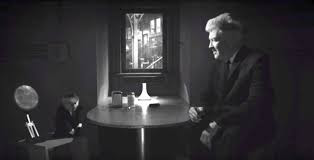
 

"...detective Lynch faces a talking monkey..."
What Did Jack Do?

Whether this one has any intent beyond disorienting the audience and indulging its author is speculative but the process is richly enjoyable.


Curiously funded as an art project, what we would think of it without Lynch’s participation is irrelevant. No one else would have considered it. His set construction credit is a match for Sissy Spacek’s on Phantom of the Paradise.


The copy on Netflix is suitably grungy.


The Italian Film Festival currently offers films by Gabriele Salvatores, Pif, Eduardo Leo, Silvio Soldini, Gianni Amelio & Giuseppe Tornatore - pretty well the top Italian cinema heavyweight contenders. The ones I’ve seen so far haven’t fulfilled that promise and a Pasolini retrospective reminds me I’m sorry I watched his films the first time. Events like that prop up the notion that Italian films start with Bicycle Thieves when it’s the Genina-Blassetti-Camerini era we know the least about.