Sunday, 19 April 2020

Plague Times Diary (14) - David Hare marches through his collection and finds gems from George Cukor, James Whale and William Wyler.

The fourth week of our lockdown begins here today in NZ, so here is some of the the directionless, perpipatetic viewing that chaperoned me through last week. 
Above, Hepburn with Cary Grant (and out of sight) Lew Ayres in the playroom for Cukor's terrific Holiday (1938). The couple here taking a life lesson from Punch and Judy. This and Cukor's first pairing of Kate and Cary in the rhapsodically carefree gender bending comedy, Sylvia Scarlet (1935), are two Cukor favourites.

Holiday is also the first Cukor excursion into the heavy theatrical waters of a Barrie-based screenplay rooted in the US class system with all its Republican prejudice and privilege. Cukor and indeed his screenwriters Sidney Buchman and Donald Ogden Stewart humanize the material in a way Barrie could never have enabled. Cukor and the writers also open up Cary's "Johhnie" into a far more substantial part than the original. The magic thus worked twice for Hepburn and Grant under Cukor and it still - just - flickers in the 1941 Philadelphia Story from yet another insufferable Barrie upper class horse opera, but that movie ultimately to me sinks under the weight of Louis B Mayer's fat arse full of the patented Metro "refeenment" and "good taste".
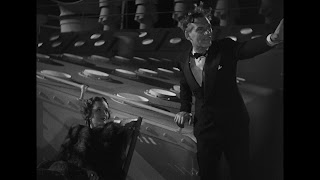
In a vaguely related vein, another adapatation from Broadway that rings with glory on the movie screen, the 1936 movie of the Hammerstein/Kern Show Boat, directed by James Whale for Universal (screens above and and below). I had completely forgotten until spinning this breathtaking new 4K restoration from Warner MPI how astonishing is Whale's direction and mise-en-scène. I have always loved the George Sidney 1951 version, not least for its energy and ceaseless movement. But I had forgotten how much Whale's movie beats Sidney at his own game. Indeed it now looks like Sidney decided to replicate Whale's own opening.

The first twenty minutes are driven to some transcendental level of beauty by the early run of half a dozen key songs for the exposition and first act, and the energy and movement of the Showboat's arrival. With it the quick character sketches of the half dozen plus major players in the show, delivered by Whale in a kind of hyper energized rapid cutting montage that looks more like Kalatazov than Hollywood . What other director could cut with more dynamic power, and effect to give so much intensity to the trademark close-up codas for each of the character montages? Indeed Whale's camera only seems to rest and soar at these moments into its purest form as the actors break into their numbers. The first act ends with an astonishing circular travelling crane shot completely encircling Paul Robeson (below), for his first chorus of "Ole Man River" The movie is, once again and forever staggering.

From one award winner to another, this time the estimable William Wyler's Dodsworth also from 1936 in a spectacular new 4K restoration from Film Foundation and others, released on Kino Lorber Blu. Sinclair Lewis' material gets perhaps its best (and most expensive) treatment in this Sam Goldwyn picture that throws everything the high end studio apparatus could muster into Lewis' blistering critique on the evils of capitalism. 
The film is notable for its often stunning production design, in this case art director Richard Day, a prolific artist whose career is longer than most Hollywood A list directors. The high Deco-Moderne cum Expressionist- Futurist design and sets (see the screen above) seem to fit like a glove with superb high contrast, high white clipped lighting photography by Rudolf Maté. The three leads are fascinating for their individual strengths and weaknesses, a factor Wyler encourages in his direction, especially with Ruth Chatterton. Walter Huston (screen below) as the retired plutocrat is at his rummiest with the narrative playing him off the two female leads, one a luminous Mary Astor (below left) who becomes his lover, and Chatterton’s as the wife, a performance encouraged to be played to the balcony. Chatterton seems happy to allow her own oversized negatives as a performer to become the character's own and I think this works very well. Wyler is often cleverer than we think, and here he's also playing a very smart game to beat the Code
.
Chatterton's performance is so interestingly strident in this I decided to take another look at a favorite precode of hers, Female started by Bill Wellman in 1933, taken over by William Dieterle who was probably too stilted for the pacing, and finished by Michael Curtiz with panache. I have elsewhere found myself sometimes defending Chatterton's performance as the female sex hound in this terrific movie, with people who view her as much a female impersonator as a "woman". But I think that's a large part of the appeal. Certainly her priapic appraisals of every man she eyes over (and up, and down) come straight out of a Tom of Finland cruising manual. So I still recommend the movie for her full bore performance along with, again, astonishing production design for the movie by Jack Okey including exteriors/Second Unit footage shot at Frank Lloyd Wright's Ennis House for the Chatterton pile.
Holiday was released late last year in this superb new full-grained beauty of a 4K by Criterion. As is the recent 4K restoration of Show Boat. Female is still around the shelves on an old Warner DVD, 
I did also watch the three superb Keaton restorations on the MoC/Cohen three disc set which arrived during this period of deprivation but that's for another time.

Saturday, 18 April 2020

Plague Times Diary (13) - Ben Cho finds some films for the times

Harry Farocki
Film diary

The Creators of Shopping Worlds (Harun Farocki)

One of the few places I now visit is the local shopping mall so I thought I’d take a look at this Farocki documentary which examines the planning process behind the consumer behemoth which is my home away from home. Farocki also dives in to the mechanics of organising supermarket shelf space and how operational teams work out how to maximise space and consumer spend. The technology featured in the doc is probably outdated now but it makes for slightly scary viewing that even back then sophisticated eye tracking was keeping note of how our brains respond to commercial signage; God only knows what is used now to work out how to seduce us in to spending more money. 

Contamination (Luigi Cozzi)
A big ship rolls in to a city harbour with infected people onboard and so begins a deadly pandemic. No, I’m not talking about recent news headlines coming out of NSW; just a so-bad-its-hard-to-look-away Italian genre film from Luigi Cozzi starring Ian McCulloch (who was in the Lucio Fulci shocker Zombie). The whole thing plods along with ridiculous plot twists but I have to admit the final alien creature is a brilliantly WTF monstrosity of non-CGI making.
Jean-Marie Straub

France Against Robots (Jean-Marie Straub)  
This was streaming online for free, a 10 minute cine-poem of a lakeside stroll, a Georges Bernanos text and a lament for our current geo-political order. 

Child’s Play [Remake] (Lars Klevberg) 
Now streaming on Amazon Prime, it’s an ok remake but once again why even bother? The Child’s Play series was still going so did the world need this cynical reboot with a way-less creepy Chucky? No. And it’s also a bit of a head scratcher to try and hybridise this sort of 1980s kiddie gang adventure schtick (all the rage it seems) with extremely graphic violence - the two sit uncomfortably side-by-side. 

Basil Dearden


Cage of Gold & Frieda (Basil Dearden)
Two by Basil Dearden and starring David Farrar. I watched Frieda and saw how the wartime community prejudice against Germans was depicted and thought whether the post-COVID19 climate will see an eruption of bigotry against Chinese people? This also reminded me to go on the hunt for more films directed by Mai Zetterling - I’ve only seen Night Games and Loving Couples

Kings Go Forth (Delmer Daves)
Wartime love-triangle melodrama starring Frank Sinatra, Natalie Wood and Tony Curtis. Nothing amazing but I guess in the late fifties a film dealing with miscegenation would have been rarely seen in a film like this? I did have some difficulty in accepting that an ethnically Russian Caucasian actress could pass as half-black but then again this is a world where John Wayne could be Genghis Khan so … ​


Friday, 17 April 2020

Plague Times Diary (12) - Rod Bishop discovers Charles Band's CORONA ZOMBIES (USA, 2020). You can't keep the exploitation sector down for long.

How to make a horror film about Covid-19 in a world of social distancing?
Veteran schlocker Charles Band has solved that problem. Shoot five minutes or so of an LA bimbo called “Barbie” - the humour doesn’t get much better than that - at home watching TV and hoarding toilet rolls. Then cut it together with copious amounts of redubbed footage from Bruno Mattei’s Hell of the Living Dead(1980) and Alex Nicolaou’s Zombies vs Strippers(2012). Mix in a few Trump TV pressers and news grabs of millennials talking about partying on until they get forced into isolation and hey, presto you’ve got the world’s first Covid-19 zombie comedy.
Band’s inventive narrative mash-up is certainly this one-hour film’s best feature. Everything goes downhill pretty fast. 
The plot surrounds a bat soup created by Scambell’s Soup Factory that – you guessed it – turns common-or-garden folk into zombies and they start eating up the rest of the world’s population at an exponential rate. A paramilitary Corona Squad and a TV reporter in “the jungles of Baltimore” are chasing down Franϛois, a toilet paper hijacker who has turned to crime after losing a Matt Dillon lookalike contest.
The paramilitary machine-gun zombies and tell them: “That’ll teach you for not washing your hands”. Other humour is at the level of: “Haven’t you seen any George Romero? You shoot them in the head” or “Your mama is so fat, her belly button gets home 15 minutes before she does” or “you look like Barbara Bush on meth”. The warning to stay away from the Tits and Nickels Strip Club– decimated by the corona zombies – is “Stay at home and help flatten the curve, no matter how desperate you are to see a naked woman”.
68-year-old Charles Band has directed 43 features and has producer credits on over 290 films. If his work has improved with age, I’d hate to see - in Woody Allen’s words - “his earlier funny films”.

Wednesday, 15 April 2020

Plague Times Diary (11) - Films to enjoy again and again

Taking up Adrian Danks thoughts here is a list of fifteen films which will keep you entertained over and over again in these plague times.  Some of them may reduce you to tears. In chronological order:

A Dog’s Life (Charles Chaplin)

7thHeaven (Frank Borzage)

The Crime of M. Lange (Jean Renoir)

Ninotchka (Ernst Lubitsch)

Casablanca (Michael Curtiz)

Shadow of a Doubt (Alfred Hitchcock)

The Reckless Moment (Max Ophuls)

Touch of Evil (Orson Welles)

Plein Soleil (Rene Clement)

The Umbrellas of Cherbourg (Jacques Demy)

Kiss Me Stupid (Billy Wilder)

The Conformist (Bernardo Bertolucci)

The American Friend (Wim Wenders)

Newsfront (Phillip Noyce)

Afterlife (Hirokazu Koreeda)

Tuesday, 14 April 2020

Plague Times Diary (10) - Adrian Danks and David Stratton keep the enthusiasm high

Adrian Danks suggests some plague times viewing:

A 10 or 12 list of movies you have (& would gladly) see again & again. Not quite sure how to make this different from my favorite movies, as that would be a criteria for all of them as well. But my main guide for this are movies I'd probably just keep watching if glimpsed on TV, even with ads in them - & that they create a world for one to live within (even if pretty bleak, like the Melville). So here goes, off the top of my head:
JULES ET JIM (above)
DINER
L'ARM
ÉE DES OMBRES
GOODFELLAS
THE SHOP AROUND THE CORNER
3:10 TO YUMA
I KNOW WHERE I'M GOING
RIO BRAVO
PLAY TIME
VENDREDI SOIR
LATE SPRING
GOOD MORNING, NIGHT

David Stratton writes:

You wanted an update on our viewing.  As you know, we are trawling through the films of 1944.  We started on March 24 with COVER GIRL and since have seen 14 more.  I think the last one I mentioned was THE WAY AHEAD (April 2).  

Since then:-
THE THIN MAN GOES HOME – the last, and probably least, of the Thin Man series and the only one not directed by W.S. Van Dyke.  Pretty slim and also pretty protracted.  But I’m a fan of Myrna Loy (did I ever tell you about encountering her at a party in L.A. in the 70s and she was smoking dope?)

THE MASK OF DIMITRIOS – Eric Ambler intrigue directed by Jean Negulesco.  Pretty silly but it’s one of the films that paired Lorre and Greenstreet and that makes it eminently watchable.

GREENWICH VILLAGE.  After all this ‘noir’ Susie was in the mood for Technicolor.  It’s a terrible film (Walter Lang was a serious hack) and I loathe Carmen Miranda, but there’s a show-stopping sequence with The Four Step Brothers, one of those incredibly talented African-American dance acts that helped make some of the lesser musicals of the 40s endurable.

DOUBLE INDEMNITY.  (Picture above) A pristine Blu-ray makes all that venetian blind lighting look better than ever.  MacMurray was always at his best as a heel (cf THE APARTMENTbut also the underrated PUSHOVER), Stanwyck is genuinely alluring and Edward G. almost steals the picture.

A CANTERBURY TALE.  Susie had never seen this and didn’t know what to make of it at first – but it all comes together most beautifully and the ending is extraordinarily moving.  It compares interestingly with….

THE WHITE CLIFFS OF DOVER. This is a forgotten Clarence Brown epic, slow-paced and set in a palpably phoney England between the wars.  But then, towards the end, there’s that fascinating theme of the importance of Brits and Yanks getting together for the common good, a theme Powell and Pressburger also embraced.  The film has all those Brit ex-pats – C. Aubrey Smith, Dame May Whitty, Arthur Shields (sorry, Irish ex-pats too), Miles Mander, Gladys Cooper, Peter Lawford, Roddy McDowall.  Plus it has an uncredited appearance from Elizabeth Taylor in a tiny part, but given four or five lingering close-ups as if she was being auditioned for NATIONAL VELVET, which is coming up on our movie schedule shortly.

The other news is that we have branched out into another year, this one selected by Susie.  She chose 1993, and we started with PHILADELPHIA, the perfect film for a pandemic – and what a seriously fine movie it is.  Jonathan Demme, we miss you!

That has been followed by IN THE NAME OF THE FATHER, which was pretty intense, and A PERFECT WORLD, an underrated Clint Eastwood film in which most of the running time is given to Kevin Costner as the escaped convict who has taken a small boy hostage.  It’s an odd film in many ways but a compelling one.  Good to see Laura Dern too.
From now on we alternate our chosen years; Susie’s turn next so we expect to unearth something exciting from 1993.

I can’t believe anyone but me (and possibly you) is interested in this…

Best.

Editor’s Note: Contributions welcome. Send them to filmalert101@gmail.com

Monday, 13 April 2020

Adam Bowen's Talkie Talk - Movies on TV and Vale Honor Blackman

AFTER EASTER 


FREE-TO-AIR TELLY SELECTIONS

Tuesday 14th

Opening Night, Melbourne Film Festival, 1981
SBS World Movies 1140am: Chariots of Fire (1981) - a box office mega-hit featuring hundreds of pink knees pounding along a British beach, to the accompaniment of Vangelis’s soaring synth score. A highly romantic movie about two very different men running for Britain at the 1924 Paris Olympics.

SBS World Movies 930pm: The Long Good Friday (1980) – grisly crime melodrama, starring Bob Hoskins as a very nasty gang boss, whose empire is under threat.

Wednesday 15th

SBS World Movies 730pm: Monty Python & the Holy Grail (1975) – likeable silliness abounds as King Arthur and his knights seek the Holy Grail via a series of neatly linked comedy sketches, set in very gritty-looking Middle Ages. Hilarious.

Thursday 16th

SBS World Movies 120am: The Long Good Friday (1980) – see above.

SBS World Movies 7.30PM: The Life of Brian (1979) – The Monty Python team’s funny spoof set in biblical times. Brian (Graham Chapman) is mistaken for the Messiah and is crucified.

Friday 17th

SBS World Movies 930pm: Slumdog Millionaire (2008) – fast-moving, feelgood romance about a young man accused of cheating on the Indian version of the TV quiz show “Who Wants to Be. A Millionaire”.

Saturday 18th

9Gem 3pm: The Ladykillers (1955) – Highly recommendedEaling Comedy, in which the spectre of violent crime throws its shadow over Mrs Wiberforce, an innocent old lady (Katy Johnson), who lives in a tumble-down house above a train line. A motley bunch of train robbers (including Alec Guinness and Peter Sellers) masquerade as a chamber music quintet, and rehearse in Mrs Wiberforce’s upstairs room. Brilliantly directed by Alexander Mackendrick, and shot in suitably murky Technicolor by Otto Heller.

SBS World Movies 730pm: The King’s Speech (2010) King George VI (Colin Firth), of Britain, is hampered by the most frightful stutter, but is helped by a speech therapist (Geoffrey Rush). A delightful bro-mance, which climaxes when the King makes a vital broadcast. The royal family, in a state of anxiety, hang on the King’s every syllable, as do listeners all over Britain and the Empire - glued to their radios. This suspenseful montage is accompanied by the allegretto from Beethoven’s Symphony No 7 - an emotional pulse, throbbing under the speech with a hypnotic, stately beauty.

SBS World Movies 730pm: The Damned United (2009) – if you like soccer, you’ll probably love this biopic of Briam Clough (Michael Sheen), focusing on his brief gig as the coach of Leeds United.

Sunday 19th

SBS World Movies 1.40am: Slumdog Millionaire (2008) – see above 


VALE - Honor Blackman

Honor Blackman has died, aged 94. She was best known as a “Bond Girl” in Goldfinger (1964) and as the tough, glamorous, highly athletic Cathy Gale, in the first series of TV’s “The Avengers”. Born in the East End of London, the glamorous Ms Blackman appeared in many movies as an English Rose type; she was required to be decorative rather than assertive – despite working as a dispatch rider during WW2. She starred with Richard Burton in Green Grow the Rushes (1951), but it wasn’t until she clad herself in leather and knocked screen villains (and 007) for six, did she become a household name. Despite that fame, Blackman was more a jobbing actor than a star, content to work in many very ordinary productions.  Her last film appearance was Cockneys versus Zombies (2012).

Adam Bowen Productions 

Sunday, 12 April 2020

John Baxter ponders the pleasures of Opera which leads him to to a YouTube viewing of I DREAM TOO MUCH (John Cromwell, USA, 1935) starring Lily Pons


Editor's Note: John Baxter is an expat Australian who has spent a lifetime writing about, joking about and making films. He has had a couple of dozen books published - novels, travel guides, literary companions and biographies of film-makers among them. Most recently he has self-published two volumes of memoirs, "The Paris Mens Salon" about a literary life in his adopted home and most recently "Filmstruck: A Life in the Movies". The latter volume is reviewed on the Film Alert 101 blog and for those who are subsequently curious to read it there is an email link to purchase one or both books via Sydney's Cinema Reborn. You can find the review and the email link if you CLICK HERE

**********************************************************************************


At school, music wasn’t my best subject. In fact, the chorus master, after hearing a few of my failed attempts at B flat, exiled me to the group in the back row who mouthed the words, but in silence.
         Fortunately this didn’t impair my appreciation of music, augmented in adulthood by having as a companion a soprano sufficiently gifted to sing in the London Symphony Orchestra Chorus and the choir at Benjamin Britten’s Aldeburgh Festival. She introduced me to that most improbable of all musical forms, opera.
         The week we arrived in London, still a bit unsteady after thirty days at sea, the cheapest way in those days to escape from Australia, she took me to the Royal Festival Hall, in the Purcell Room in which Janet Baker was singing. No sign directed us. Instead, a bar of music in brass, embedded in the marble, indicated the entrance. I sensed that perceptible click as her mind switched to musical mode.
           “When I Am Laid in Earth,” she said. “Dido’s lament from Dido and Aeneas.
           “By Purcell?”
          “Yes.” Of course, dummy
           “What about people who can’t read music?”
           She shrugged. Well, whatabout them?
           This indifference is common among lovers of opera. Either you’re born with the gene that attunes you to its delights, or you stand in the back row and mouth the words. Against all odds,  I had the gene, although it never sat comfortably with its neighbour in my artistic DNA, the love of movies. Cinema can never quite convince itself that opera isn’t a bit...well,  silly.I mean...sung dialogue, and those costumes? Easier to make fun of it than try to understand.
         And of course some of the send-ups are sublime. The baritone in A Night at the Opera, banging away gamely at Il Trovatore as the backdrops behind him change from castle to tram terminal. Bugs Bunny in a blonde wig as Brunhilda in What’s Opera, Doc?,  draped over a libidinous-eyed horse. Not to mention Mae West as Delilah in Goin’ to Town, miming to Saint-Seans while toying absently with the phallic braid of Samson’s wig. 
         What troubles cinéastes about opera is often the element of performance  - not on the part of the artists but of the audience. Cinema is austere. You take your seat in the dark, watch in silence and leave without applause. Maybe you have an ice cream. Contrast opera, where one dresses up, applauds, gives standing ovations, demands encores – never mind watching from a box at Covent Garden, or attending Glyndebourne, where patrons dress formally and dine on the lawn between performances on champagne and foie gras. A friend who could only afford standing room for a performance of Die Walkure in Vienna was slumping towards the end of the second hour. A passing usher gave him a nudge. “Bitte, stand up straight, mein herr,”he said severely, “This is the Staatsoper.”  Catch that happening in a cinema, even the Curzon, Mayfair.
The closest cinema comes to accommodating opera is the filmed adaptation. Luchino Visconti never filmed any of his stage productions and Nino Rota failed to lure Fellini into the opera house. But we have Joseph Losey’s Don Giovanni, made on location in the lagoons around Venice, Frederic Mitterand’s lush Madame Butterfly, and Francesco Rosi’s smoky, sweaty Carmen.
All these are creditable facsimiles of opera, but no closer to the real thing than a Shakespeare play on film. Films that take an oblique look or address the form are rare. Tom Hanks in Philadelphia, of course, his spirit briefly lifted out of a tormented body by the sheer delight of Callas, Dorothy Comingore struggling with Bernard Herrmann’s pastiche Salammbo in Citizen Kane, and Mike Leigh’s Topsy Turvy, which makes us feel we have lived through the experience of Gilbert and Sullivan writing The Mikado. But after those, not much.
         John Cromwell’s 1935 I Dream Too Much is not in the same league as these. But stumbling recently on a TV transmission in the small hours and refreshing my memory by re-viewing it on YouTube, I was surprised at the degree to which its star, the soprano Lily Pons, revived some of the awe one feels at the sheer improbability of opera, and particularly of bel canto
         The tiny Pons, a mere five feet tall and thin with it, is more or less forgotten today, but she was a household name between the wars, easily as famous as Joan Sutherland for her expertise in the same rarefied heights of the coloratura repertoire. I Dream Too Much, popularly called I Scream Too Much because of Pons’s penchant for skittering around above high C, was the most worthwhile of her three RKO films.  She’s in her best voice as a country girl who just wants to settle down to married life with Henry Fonda, whereas he’s set on writing the world’s greatest opera and having her star in it.
         Pons sings a few inconsequential Jerome Kern/Dorothy Fields songs but what makes the film memorable is a five-minute staged performance in costume of the Bell Song from Delibes’ Lakmé, a coloratura showpiece. Cromwell was already astute enough to keep directorial touches to a minimum and to let Pons demonstrate how startlingly big a voice could emerge from her schoolgirl’s body. Her naiveté as she shows us is charming. There’s none of the star’s condescension. Instead, she seems to be saying “Look what I can do! Isn’t it fabulous?” Well, yes, as a matter of fact, it is. Even in the back row, you can tell that.
         Pons, incidentally, was not just a pretty voice. Her name has come up a couple of times in quite different connections. In 1949, an English text of Jean Cocteau’s Le Sang d’un Poète was published. Pons did the translation. And in the late twenties, a quack surgeon named Serge Voronoff claimed he could rejuvenate the human body by transplanting tissue from monkeys. Apes being thin on the ground, even in the 19tharrondissement, he started a farm to raise them on the Riviera near Menton. Among his regular visitors was Pons. Maybe there was more behind that incredible voice than we realise.