Saturday, 23 May 2020

Streaming (free) the near-complete works of major indie film-maker Mark Rappaport - The Munich Film Museum steps up.

Mark Rappaport
Editor's note: An email from a friend in today's inbox advises that the Munich Film Museum will be streaming, free, a very comprehensive selection of the films of Mark Rappaport. The friend informs me that the announcement is notable for including the five indie features Rappaport made in New York in the 1970s.  These have been impossible to see for 20-30 years.

Rappaport's email to his friends follows:


Dear Friends,


Starting Monday, May 25, the FILMMUSEUM MÜNCHEN will begin a 7 week 14 program MARK RAPPAPORT STREAMING RETROSPECTIVE that you can watch in your own home, wherever you are. Every program is three or four days. All day long! No charge! 

The website can be found if you click here

Feel free to pass this information on to anyone!!!! 


And here’s the complete list—


Monday 25 – Thursday 28 May
Rock Hudson’s Home Movies (1992, 63 Minutes)
Blue Streak (1971, 18 minutes)

Friday 29 May – Monday 1 June
The Scenic Route (1978, 76 minutes)
Exterior Night (1993, 36 minutes)

Monday 1 – Thursday 4 June
Our Stars(2015, 27 minutes)
Becoming Anita Ekberg (2014, 18 minutes)
Max & James & Danielle… (2015, 17 minutes)

Friday 5 – Monday 8 June
From the Journals of Jean Seberg (1995, 97 minutes)
The Empty Screen (2017, 11 minutes)

Monday 8 – Thursday 11 June
Casual Relations (1973, 80 minutes)
The Vanity Tables of Douglas Sirk (2014, 11 minutes)

Friday 12 – Monday 15 June
The Silver Screen/Color Me Lavendar (1997, 100 minutes)
Mur 19 (1966, 23 minutes)

Monday 15 – Thursday 18 June
Mozart In Love (1975, 100 minutes)
The Circle Closes (2015, 20 minutes)

Friday 19 – Monday 22 June

The Double Life of Paul Henreid (2017, 33 minutes)
I Dalio - Or the Rules of the Game (2014, 33 minutes)
John Garfield (2003, 9 minutes)

Monday 22 – Thursday 25 June

Local Colour (1977, 116 minutes)
Postcards (1990, 27 minutes)

Friday 26 – Monday 29 June

America's Grandpa (2018, 31 minutes)
The Boy Who Cried (2016, 17 minutes)
Debra Paget, For Example (2016, 34 minutes)

Monday 29 June – Thursday 2 July

Imposters (1979, 110 minutes)
Mark Rappaport - The TV Spinoff (1980, 29 minutes)

Friday 3 – Monday 6 July

Conrad Veidt (2019, 61 minutes)
Anna/Nana/Nana/Anna (2019, 31 minutes)

Monday 6 – Thursday 9 July

Chain Letters (1985, 96 minutes)
Private Screenings (2017, 14 minutes)

Friday 10 – Monday 13 July

Sergei/Sir Gay (2016, 36 minutes)
L'Annee Derniere a Dachau (2020, 30 minutes)
Tati vs Bresson (2016, 20 minutes)


Friday, 22 May 2020

Remembering Mario Bava - John Baxter delves into the horror master's LA MASCHERA DEL DEMONIO ( aka BLACK SUNDAY et al, Italy, 1960)

         
 In the sixties, Australia was no place for anyone interested in horror movies. Anything scarier than the most anodyne fantasy was savagely censored, if not banned entirely. King Kong, Frankenstein, Dracula, even more recent films such as The Creature from the Black Lagoon existed in copies whose shortened running time and frequent blips on the sound track hinted at what we were missing.

         Of the few interesting films that did slip by relatively unscathed, many were European, and therefore, reasoned the censors, unlikely to impinge on the unpolluted minds of Australian youth. They often surfaced at such grind houses as Sydney’s Capitol. Situated in the middle of Chinatown, the Capitol, since refurbished as a venue for live shows, still clung to shreds of its twenties glory, including a sky blue ceiling with actual clouds, which had at one time moved, though were now rusted up. 
         Most Saturdays, I caught the new programme there, but only after visiting the  restaurant opposite and purchasing some spring rolls and slices ofspiced roast pork. Locating a seat where the springs hadn’t worked their way through the balding plush, I’d settle down for whatever double bill the management had chosen that week. “Chosen” is probably being generous. The jumble of dubbed and mutilated Franco-Italian co-productions could include a political docu-drama like The Bandit’s Revenge, alias Francesco Rosi’s Salvatore Giuliano, or Valerio Zurlini’s The Girl With the Suitcase, featuring a young actress whose identity I took the trouble to note as the final credits rolled. Thereafter, I would always associate Claudia Cardinale with the taste ofchar siu. 

Occasionally the Capitol screened something that had begun as a horror film but was now little more than a succession of spooky decors in which various bad actors recoiled from frightful sights we were forbidden to see. Among the credits of these films, certain names recurred. One was Mario Bava. Once I reached Europe, I made a point of hunting down one film in particular which I knew only from stills in such magazines as Midi-Minuit Fantastique.Variously called La Maschera del Demonio, Mask of the Demon, Black Sunday, The Mask of Satan and Revenge of the Vampire, it did not disappoint. 

It begins in 17thcentury Moldavia, with a young sorceress of haunting beauty railing defiantly at the usual mob of torch-carrying moralists. As she curses them all, a metal mask studded inside with spikes is placed over her face and a brute with a huge mallet slams it home. Ouch.

Mario Bava (right)
Few of Bava’s subsequent films open so auspiciously, but, equally, none was less than interesting. He began as a cinematographer, as his father had been. I learned this from Barbara Steele, who played the witch in La Maschera del Demonio.It helped explain the visual intelligence evident in his work.

Barbara Steele, La Maschera del Demonio
(I met Steele at the home of director Curtis Harrington, himself a practitioner of the creepy craft: eg. How Awful About Allan, What’s the Matter with Helen?, Who Slew Auntie Roo?  At the same dinner, the actor Paul Sand told Steele “I was staying in Rome a few years ago. My friend told me you lived in the apartment building next door and sometimes sunbathed on the roof. We went out with some binoculars and there you were – wrapped up in something large and brown, as I remember.”
With faultless timing, she replied huskily “A man, I hope, dahling.”)

I finally got to meet Bava in the early seventies. Unexpectedly for the director of The Torture Chamber of Baron Blood, Planet of the Vampires, An Axe for the Honeymoon and The Whip and the Flesh (a film its star, Christopher Lee, was reluctant to discuss) he lived like a banker in a penumbrous 18thcentury Roman apartment hung with tapestries. Ticking from his collection of antique watches provided a solemn obbligato to our chat. 

Once he decided I was not another fanatic eager to kiss the hem of his garment, he was a fount of insider lore on film technique, particularly about ways of stretching budgets. A morocco case, inherited from his father, contained a piece of rippled glass with which, he explained, he created the effect of a dissolve without expensive opticals. A 20cm cardboard cut-out of a galley was the Argo from Ulysses. It showed how images he snipped from a magazine could stand in for the arches of a Gothic chapel in La Maschera del Demonio.

Listening to him discourse on his craft, it was hard to square this portly gentleman with the horrors of his films. He didn’t seem the type.

 Oh, but he was, he insisted. “When I sleep here alone, if my family is away, I put pieces of crumpled newspaper on the floor around my bed -  to hear if anyone comes close.”  He glanced round uneasily.

“I am,” he confessed, “a frightened man.”  

Black Sunday, Brit Blu-ray cover

Wednesday, 20 May 2020

Plague Times Diary (33) - David Hare renews his interest in long neglected B Movies DAUGHTER OF SHANGHAI (Robert Florey,USA, 1937), SUSPENSE (Frank Tuttle, USA, 1946), THE GANGSTER (Gordon Wiles, USA, 1947)

NZ moved over to Level 2 COVID security just under a week ago which leaves us all a little more relaxed.
What always sends me pawing through the shelves for discs, old and new are prompts from others. Facebook Movie Wardrobe guru supreme, David Noh had been posting about a season of Asian-Americans in Hollywood on US TCM a week back. One of the new to me titles he fingered was a 1937 Paramount B pic (at 62 minutes), Daughter of Shanghai. An early picture directed by the great French surrealist expat, Robert Florey. I managed to claw out a copy from the backchannels, likely taken from the same US TCM screening.
Apart from being the only 30s Paramount “B” feature I can remember seeing, it’s also a revelation in how much B pictures could get away with over and above the code controlled “A” picture industry. The two leads are Asian-Americans, notably the great Anna May Wong, still luminously beautiful, and Philip Ahn, an actor I’ve loved forever who appeared in hundreds of pictures from the 30s up to his death in 1978. 
Anna May Wong, Philip Ahn, Cecil Cunningham,
Daughter of Shanghai
My two favorite Ahn movies are the bad guy part in John H. Auer’s nihilistic 1955 Hawaiian Noir,Hell’s Half Acre  and as the noble son of a Mandarin matriarch who dies defending his family honor, itself embodied by yellow-face Pauline Frederick playing Madame Chung in Thank You Mr Moto (1937, same year as the Florey but for Fox’s B unit under the great Norman Foster). 

Daughter of Shanghai is remarkable for the total absence of yellow-face performers, and the casting of all but one of the leads with Asian-Americans. At this point of his career Ahn was also quite as beautiful as Anna May, if not given to launching into hoochy-cooch numbers that Anna May does midway in the picture when she enterprisingly takes up a gig as “dance girl” at some South American niteclub hellhole, here run by a very young Charles Bickford. The head “girl” is a bit from the great Evelyn Brent (late of Sternberg and Chaplin) who plays what is virtually the only decent white person in the entire film. In fact, the white race is comprehensively damned in the film which sports a remarkable if not uniquely sanguine representation of the bullshit non-white people in America are still putting up with. Even the apparently sole “friendly” white is played here by the cinema’s greatest butch lesbian, Cecil Cunningham, in her “maternal” mode as Anna May’s only honky confidante. Alas, Cecil turns, as she must. 
Florey was one of those directors out of left field in Hollywood who brought so much style and intelligence to even worthless projects. Daughter of Shanghai  is very far from worthless, and it engages a mixture of Paramount A and B crews to deliver style and relatively code free presentations of Asian-American characters. One should remember that yellow-face with white actors was essentially a creation of the various movie Codes which banned any mixing of races in romantic scenes. Such would have been miscegenation, and worse. 
Above two images. "..an amazing hallucinatory production design out of
Weimar and late Surrealism by Paul Sylos", Suspense.
From 1937 B-Plus Paramount to 1946 and one of the last Monogram pictures released under that moniker in 1946. Suspense, is directed by Frank Tuttle, on loan from Paramount. Godard’s homage to Monogram pictures in A Bout de Souffle is not some campy reference to low budget trashiness, but rather to the compellingly inventive and energetic way poverty row studios and film making could keep turning up masterpieces. By the time The King Bros were running the show at Monogram Suspense was their first full blast “A” budget picture, coming in at a staggering $900 grand, after the average Monogram budget was literally 10% of that figure. Not long after the release of Suspense Monogram changed its name to “Allied Artists” which it remained until the end of its era in 1956 or thereabouts. 
Barry Sullivan, Suspense
The movie sports an extremely effective Barry Sullivan in the lead as the Noir Sap who’s undone by a dame, with an amazing support cast including Albert Dekker, Eugene Palette and Bonita Granville. The crew resembles a first tier Paramount outfit with DP Karl Struss, an amazing hallucinatory production design out of Weimar and late Surrealism by Paul Sylos, comparably imaginative wardrobe from Kalloch, which almost lifts Belita’s performance and persona, on and off the ice rink, into the realm of the credible. It’s the best thing she did, but she’s got an entire studio apparatus behind her. At 101 minutes this would be the longest film Monogram would ever make. It’s worth every minute. Warner released an excellent DVD of it ten plus years ago, still in print.
Belita, Suspense
Lightning doesn’t strike twice however. After reveling in Suspense I dug out another disc unwatched for years, The Gangster, directed by occasional hack Gordon Wiles in 1947 which was designed to re-unite Sullivan and Belita under Monogram-reborn-as-Allied Artists in another prestige “A” picture. 

"...designed to re-unite Sullivan and Belita", The Gangster
The one unquestionably amazing aspect of this otherwise disastrously misconceived movie is the supporting cast: Akim Tamiroff, Harry Morgan, John Ireland, Charles McGraw and buried in there as a non-speaking “check out” girl, Shelley Winters. In powerhouse company like this constellation of character and method actors, Belita can barely breathe, which is probably just as well. Her wardrobe here is from the less flamboyant Norma Koch who had previously done Sirk’s Scandal in Paris and Lewin’s superb The Private Affairs of Bel Ami. But it’s not Belita who sinks the project, it’s something far more impossible to overcome, the ever turgid and overwrought Philip Yordan, whose lamentable uncredited screenplay pours concrete over every impulse to movement or action and freezes scene after scene into static psychodramas of the most staggering banality. There are a few good things to enjoy here, almost all of them Barry Sullivan, again, playing a variation of Lancaster’s 40s shat upon, ever suffering dumb loser. Even more interesting is Harry Morgan who builds a fascinating minor part into a complex and contradictory Noir loner. The Gangster is still in print on an older but very good Warner DVD. 
So a week lurking back in the world of the B picture, and another chance to dig out titles from the shelves that I haven’t seen for thousands of years. There’s perhaps something karmic about wallowing in the world of Noir, too in a period of time when life seems circumscribed by threat and pandemic.

Tuesday, 19 May 2020

The International Film Guide and World Cinema 1963-2011 - Bruce Hodsdon pays tribute to one of the longest running publications devoted to the current cinema -

Bruce Hodsdon has reviewed the five decades of the International Film Guide's (IFG) documentation of world cinema written as a contribution to the documentation the AFI-RMIT research collection (see a link below).

*****************************


“Art cinema can be defined by its impurity; a difficulty of categorisation that is as productive to film culture as it is frustrating to taxonomy.” (Global Art Cinema p.6)

I saw my first foreign language film, Umberto D, age 13, in 1953 in the local suburban cinema (“the pictures”) where for a decade I had viewed exclusively English language, mainly Hollywood, product. In addition to this classic of Italian neo-realist cinema, also screened at the local pictures about this time I recall, were La Symphonie Pastoraleand La Ronde. Sustaining the opportunity to imagine cinema as a domain outside Hollywood, within a decade international art films were screening in four dedicated art house cinemas in Sydney's CBD and also from time to time with increasing frequency, on other city and suburban screens. By the late sixties film festivals had begun their transformation from film society initiated events in university grounds to international event status. The appearance of a publication announcing the priority of  “international film” and the association of art - often a code for foreign (European) cinema - challenged the industry-promoted connotations of “continental film.”


IFG spanned the spread of a world film culture parallel with the exponential growth of international film festivals. The brainchild of its founding editor Peter Cowie, the publication in 1964 of the first issuea mark of the emerging concept of an art cinema as something of a hybrid alternative to Hollywood at various points intersecting with popular genres, national cinemas, engagé and avant-garde filmmaking. The Guide,in its editor's words in 2008, aspired to be “a definitive annual survey of contemporary global cinema” as it unfolded year by year.

The AFI Research Collection at RMIT in Melbourne's CBD is a principal research collection and information archive on film and television open to the public. The Library on which it is based has a long and productive history. Its origin was as the personal collection of George Lugg who was information officer and editor of  Federation News for the Federation of Victorian Film Societies  from 1956-73. The Federation acquired George Lugg's extensive collection of books and magazines on film in 1973 which had been a primary source of information for the Melbourne Film Festival to which George was an advisor for many years*. It subsequently formed a central part of the AFI Research Library for which the RMIT assumed responsibility for staffing and growing in 2002. As a frequent user it was suggested I might have a contribution to make to the “Gems of the Collection” section in the preface to the online catalogue. Also being in personal possession of a full set, I settled on the Library's complete holdings of the International Film Guide – 48 annual volumes 1964-2012.

For an account of all that is known of the genesis and history of George Lugg's collection and his career as a CSIRO research chemist, see John Turner's monumental  The History of Australian Film Societies, A.C.O.F.S 2018.

Click here to go the link to find Bruce's scholarly survey  of the IFG AFI Research

Monday, 18 May 2020

Vale Michel Piccoli - one of the great actors of his, indeed several, generations.

Michael Piccoli, Jean-Luc Goard
Piccoli was born in 1925 and made 233 appearances in films and on television. A legendary figure of the French Cinema he appeared in films by dozens of directors major and minor. Among the majors were Jean Renoir, Luis Bunuel, Paul Vecchiali, Jacques Rozier, Jean-Pierre Melville, Rene Clement, Jean-Luc Godard, Costa-Gavras, Alain Resnais, Agnes Varda, Henri-Georges Clouzot, Jacques Demy, Alfred Hitchcock, Marco Ferreri, Claude Sautet, Claude Chabrol, Bertand Tavernier, Marco Bellocchio, Louis Malle, Ettore Scola, Claude Lelouch,Jerzy Skolimowski, Yousef Chahine, Leos Carax, Jacques Rivette, Manoel De Oliveira, Raul Ruiz, Theo Angelopoulos and Nanni Moretti. He also directed five films. 
There is a very fine obituary for him in today’s Guardian if you click here 
Brigitte Bardot, Michel Piccoli, Le Mepris

Sunday, 17 May 2020

Not on any screens - Scott Murray ponders the fate of A RAINY DAY IN NEW YORK (Woody Allen, USA, 2019) and AN OFFICER AND A SPY (Roman Polanski, France, 2019)


ALLEN & POLAŃSKI vs THE THOUGHT POLICE
The Thought Police must have felt they were on a roll when they successfully started suppressing the release of the 2019 films of Woody Allen (A Rainy Day in New York) and Roman Polański (J’Accuse, aka An Officer and A Spy). 

Woody Allen
In September 2019, Woody Allen (born Allan Stewart Konigsberg) faced refreshed allegations of sexual abuse from a daughter of his former partner, Mia Farrow. Farrow had adopted the girl (at two weeks of age), who was first named Eliza, then Malone and finally Dylan. Allen has not been charged with any crime and has been exonerated (or found to have no case to answer) by all the authorities that have investigated Dylan’s repeated and sometimes variant claims. 

Dylan has also denounced actress Scarlett Johansson for appearing in three Allen films, and for declaring, “I believe him, and I would work for him any time.” In a Hollywood where cancelling one’s fellow workers has become a regular occurrence, Johansson’s supporting Allen is both brave and career-dangerousIn concert with Dylan’s renewed claims came several mea culpas from cast members of A Rainy Day in New York, Allen’s wittiest and most whimsical romantic comedy since Midnight in Paris, ravishingly photographed by Vittorio Storaro and beautifully played by a young and highly talented cast (plus, of course, a hilarious Liev Schreiber).

Timothée Chalamet, for one, blamed contractual reasons for not speaking out earlier about his decision to work with Allen, ending with “I want to be worthy of standing shoulder to shoulder with the brave artists who are fighting for all the people to be treated with the respect and dignity they deserve.” But not fighting “for all the people” if their name is Woody Allen, of course. Chalamet will be lucky to make another film as good as Rainy Day, where he is so much more natural and skilled than in, say, Call Me By Your Name.

Elle Fanning, Timothée Chalamet, A Rainy Day in New York
However, the revelation of Rainy Day is not Chalamet but Elle Fanning (doing as good a Diane Keaton as Keaton did herself) and also Selena Gomez (extraordinary). Unlike Chalamet, Fanning did not recant on working with Allen, despite highly leading questions from reporters. But she clearly felt uncomfortable in the #MeToo searchlight and admitted to unspecified “regrets” while expressing the hope she hadn’t hurt anyone. In contrast, Gomez stood firm, even when criticised on Instagram by her mother, Mandy Teefey, for showing independence of mind and working with Allen. Gomez is 27 years old and yet her mother believes she has the right to lecture her daughter – publicly! – on how to behave? 
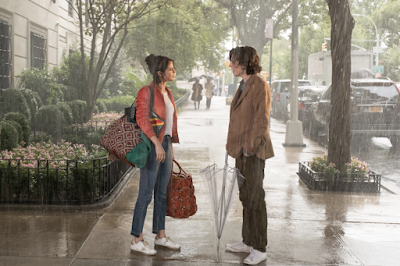
Selena Gomez, Timothée Chalamet, A Rainy Day in New York
For the record, Teefey isn’t too keen on Gomez’s choice of boyfriends, either. So, a huge tick for the defiantly independent Gomez, a considered tick for Fanning and nothing for Chalamet, whose mea culpa reminded me of Soviet citizens being dragged before a Soviet show-trial, where they know they have to denounce themselves and promise ideological purity for eternity if they have any hope of escaping a bullet in the morning.  Chalamet gave his Rainy Day salary to various organisations including RAINN, while Gomez made a $1 million donation (far more than her Rainy Day pay-cheque) to Time’s Up. 

According to Allen’s 2020 autobiography, Apropos of Nothing (more later), Chalamet told Allen’s sister and Rainy Day producer Letty Aronson that he gave his salary away in the hope of winning an Oscar. Instead, he won the Yoga Award’s Worst Foreign Actor Award for Little Women and Beautiful Boy.

Roman Polański
After having lived through an attempt by the Polish government to seize and deport him to the United States for having illegally fled Los Angeles after serving 42 days in prison for having sex with an underage girl, Roman Polański (born Raymond Thierry Liebling) found the release of his 60 million euro J’Accuse/An Officer and a Spy interrupted by a new allegation of sexual harassment 44 years after the claimed incident. 
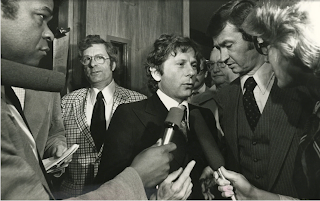
In a world where we are all told daily that every charge alleged by a victim must be believed, Polański and his film faced permanent cancellation.After all, Polański had previously pleaded guilty to having sex in March 1977 with the 13-year-old Samantha Gailey (now Geimer).  He was not found guilty of pædophilia (the victim was not pre-pubescent) or rape (no force was alleged) or statutory rape (a term not in use at the time in LA). But the world’s press continues to label Polański a “rapist” and “pædophile” to this day.  Polański also served the prison term set by the judge in the plea-bargain deal (which is how 97% of American criminal convictions are achieved). Gailey’s attorney actually played a key role in getting the plea-bargain done and having five charges against Polański dropped.

By far the best account of the crime, trial and aftermath is The Girl: A Life in the Shadow of Roman Polanski, written in 2013 by Geimer. It is an extraordinary book and I remain haunted by it to this day. Geimer is heroic, intelligent and beyond fair, and I would put it on every school curriculum.

Allen & Amazon
Allen’s Rainy Day in New York was dropped before its release by Amazon Studios after pressure was brought to bear. Allen sued and the case was settled out of court. European distributors took a different view to Amazon, putting the film into cinemas and watching the film gross $30m in the limited number of markets it has so far ventured into. It is the world’s highest-grossing film during the Covid-19 crisis, while the UK has done an abrupt U-turn and announced the film will be released theatrically in June. Maybe Australia will one day follow suit (but don’t hold your breath). Meanwhile, excellent-quality DVDs are available in all manner of territories.  Allen has also completed a new film, Rifkin’s Festival, in Spain.

But the setbacks continue. His autobiography, Apropos of Nothing, was pulped in America just days before its planned release by the Hachette Book Group after a highly publicised protest by Ronan Farrow (whose publisher is also Hachette). Ronan claims that Allen is his father, despite his mother Mia Farrow having twice stated publicly that Ronan’s father is actually Frank Sinatra, a claim Mia has only recanted once (so far as I can find). If Woody Allen can one day film this story, it might well be his masterpiece, loaded with Ancient Greek references.

Despite Hachette’s volte farce, Apropos was quickly taken up by a new publisher and is now available in print in the UK and will be later released in the US.  My UK copy (Arcade Publishing) is in the mail and Amazon.com keeps apologising for the delay in sending me the Hachette copy I so long-ago ordered, a litany of apologies that could last as long as Amazon does, for Hachette will clearly never get around to printing my copy.

Allen remains undaunted, though clearly drained by the relentless campaign to cancel him and his life’s work. I doubt charges will ever be laid against him, but innocence in law means nothing in a world where every accusation from an alleged victim has to be believed or you risk becoming as non-person.

Robert Harris
Polański & Harris
One of the most fascinating writer-director relationships of modern times is that between novelist Robert Harris and director Roman Polański. It began with Polański’s adaptation of Harris’ The Ghost, which was retitled The Ghost Writer because in the US, in part, the term “ghost”, as readers of Philip Roth’s The Human Stain and viewers of Robert Benton’s film version well know, can be used derogatively to describe African Americans. Despite being made in Germany and not the UK (Polański would have been arrested and extradited to America), The Ghost Writer is a stylish and well-crafted thriller – as well as a poisoned billet-doux from former speechwriter Harris to his one-time bosses, Tony and Cherie Blair.

Polański then planned to film Harris’ The Fear Index, but for a variety of reasons it didn’t get made. That is a pity as it is a gripping analysis of how fear grips the planet and the various ways some people profit from that fear.  So, next up was Harris’ novel, The Officer and A Spy, a dazzling re-telling of the real-life Dreyfus Affair, where a Jewish officer, Alfred Dreyfus, was cashiered out of the French army in 1896 for an act of espionage he never committed. The Army knew who the real culprit was but decided it was better to maintain the reputation of France by insisting on the fiction that Dreyfus was guilty.

Dreyfus cashiered, An Officer and a Spy

Polański’s film version (scripted by Harris) is a remarkable achievement, the work of a brilliant filmmaker at the peak of his craft. There are sequences (the opening, a scuffle in the street, the chilling way Dreyfus declines to thank his saviour) that I would argue no other director alive could equal.
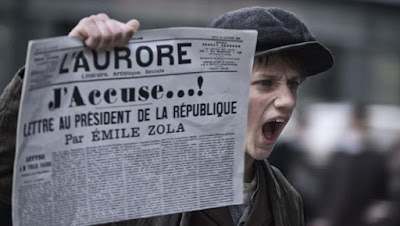
An Officer and a Spy
Needless to say, socially progressive reporters tried to damn the film even before it was released with claims that it was an attempt by the Jewish Polański to allege he was treated as appallingly by the American justice system as the Jewish Dreyfus was by the French Army. This fiction continued with reviews after the film premiered in May 2019 at the Venice Film Festival (where it won the Grand Jury Prize). 

I can discern not a single moment that supports such a reading. After all, Dreyfus was innocent, while Polanski pleaded guilty. Polański had also served his time as set by the judge, Laurence J. Rittenband, and agreed to by his lawyers and the victim’s: namely, 90 days, including psychiatric evaluation and probation. 

However, it is claimed in several printed accounts that the judge was later warned by a friend that he would never get re-elected unless he extended Polański’s jail term and so he began considering abandoning the plea bargain and extending the prison sentence to 50 years. When Polański (who had been released on probation) was informed of the judge’s likely change of heart, he fled the US, so far not to return. 

Many (including me) felt Polański ought to have served more than 42 days in prison, but I hope few would approve of the way the judge was said to be behaving. Switching from an agreed sentence of 90 days to 50 years is some switch, indeed. 

Humans love to re-interpret and re-judge issues of the past by applying the moralities of the moment, as if we have reached an unparalleled pinnacle of clarity and insight. But nothing is more certain than how, in a few years’ time, the values of today will be denounced as totally wrongheaded as the values that have come before. It is the human way. It is also the human way to make light of serious matters. 

The director Billy Wilder liked to joke about Polański’s physical stature. When asked what he thought of Polański making Macbeth, Wilder replied, “I wouldn’t touch it with a five-foot pole.” At the time, I recall no one thinking Wilder’s gag was anything worse than acerbic. Today, he would be silenced. Ditto Wilder’s opinion on Polanski’s seduction of the 13-year-old Gailey, Wilder claiming Polanski was merely looking for someone of his own height.

There is no point in going on about how values were so different back then (the casual acceptance of adults having sex with teenagers, how so many Australian homes had a copy of David Hamilton’s Dreams of Young Girls on their coffee tables, bought in some cases by women – as they explained to me – who felt Hamilton was the first photographer to accurately capture how they felt about their own sexuality when teenagers). 

Polański has been a fugitive from the American justice system for almost half a century, but how many of his accusers would have stayed to face a judge who was threatening to overturn a plea-bargain deal and lock you up for 50 years? If Polanski had stayed, he could still be in jail today. Murderers get less.

However, that does not change what Polański did or the need to question whether his actions should be taken into account when assessing his career. Should he, for example, have been given Cannes’ Palme d’Or for The Pianist or an Oscar for directing it? Equally, to open out the debate, should the painter Caravaggio be acclaimed as a supreme master when he was an unrepentant criminal who fled Rome to escape punishment for killing a man? 

Should Kurt Vonnegut’s Slaughterhouse Five still be considered a literary masterpiece given he falsely claimed the death total in the Allied bombing of Dresden to be 500,000 when it was (as almost all historians agree) between 22,700 and 24,000? London lost 32,000 in the German blitz, a figure rarely mentioned today, but Dresden and Vonnegut’s fake account are.

I can find no one on record criticising Vonnegut for libelling the Allies and Bomber Command other than for me in the Fairfax press, or find anyone who seriously rules out Caravaggio from consideration as a genius because of his myriad crimes. However, there remains an uncountable and resolute many who want to forever damn Allen (who has been charged with no crime) and Polański (who served his time and apologised to his victim – too slowly, perhaps, but Geimer accepted his apology).

Despite the late-2019 allegation against Polański, the French film industry gave J’Accuse its annual César Award for Best Director, despite the outrage everyone knew would follow It is odd that the West so often portrays the French as morally spineless (especially in war movies). Here, they have showed more spine than anybody else (though I exclude the Hachette Book Group from that endorsement).

Polański was born in Paris and has been a French citizen his entire life, and that may have some bearing on what happened at the Césars. France is a nation that stands up for its citizens in ways no other nation does. They will negotiate with anyone, and use any means at their disposal, to bring home a citizen from overseas trouble, and also do everything possible not to extradite its citizens to foreign shores (especially those with death sentences, like the US). 

I applaud the courage of those who voted for J’Accuse. I haven’t seen a 2019 film from France remotely as well made and no one has suggested one to me (though Adrian Martin might).

For those living in countries where no distributor will take up the mantle of releasing The Officer and A Spy, and who can’t speak French (thereby ruling out the French Blu-ray), why not try the Russian Blu-ray, in the original French with English subtitles (which sadly go berserk with every é and switch to Italian for one line)? There is also an English-subtitled Czech Blu-ray I have not yet sighted.

Summary
In 2019, Allen and Polański managed to produce major films and thwart those who seek to control those they want to make films and those allowed to see them. It is similar to when the satellite states of the Union of Soviet Socialist Republics gave up the fight for free speech and directors robotically churned out state-sanctioned propaganda. 

The few directors who were brave and knew how to work the system were the ones Australian film festivals championed as world heroes. These are the same Australian festivals that now refuse to show films by Allen and Polański.

But every attempt throughout history to control how people think has ultimately failed and it will fail again – especially when directors like Allen and Polański refuse to kowtow to whatever self-appointed Thought Police are around trying to rule people’s minds and lives. 


Editor’s Note: J’Accuse/An Officer and a Spy has previously been written about by Rod Bishop on the Film Alert 101 blog. You can find that post if you click here

Saturday, 16 May 2020

Plague Times Diary (32) - Peter Hourigan puts his files in order and rediscovers an evening with ALFRED HITCHCOCK

This weird time of being locked-in is a time for going through cupboards and shelves untouched for ages, as well as for some extra viewing. This week I came across a notebook with notes from some of the lectures I was lucky enough to attend when I was in London many years ago. One of the most memorable was with Alfred Hitchcock, on October 3, 1969. He was back in England to mark his 70th birthday that year. 

A small 18 minute excerpt from this lecture is still on-line on YouTube if you click this link

But he had a lot more to say. Hitchcock often gave an audience what they wanted – not just in his movies, but sometimes in interviews.  But he was also open and many of his answers were not what you’d have thought. So, let me share some of my notes from that memorable day.  These are not verbatim records, but I was trying to capture the spirit of what he said. I haven’t repeated any of the comments in the clip – enjoy that on-line.

Before the interview (with Bryan Forbes, picture above) began, a clip from Psycho was shown. Hitchcock drolly commented, ‘The bathroom.  They’ve cleaned it up now.’   
**********************************************               
Unexpectedly, Alfred Hitchcock entered at the back of the National Film Theatre auditorium in London and made his way slowly down to the small stage under the screen.  Guests for the NFT lecture series, usually entered by a side door that let them straight onto the stage.  He made his way slowly down the wide stairs, very slowly. Applause accompanied him for the entire progress. I wondered if the great man had sized up the theatre in advance and schemed that this Grand Entrance would prolong the enthusiastic greeting.
       Colour should be reduced and desaturated down.  What you give the camera so it will record. Give it set decoration that will defy the efforts of Technicolor.
       Doesn’t believe in method actors. When he filmed with Montgomery Clift, he would turn up on set with a scene completely rewritten
           Now he has complete freedom – it itself is a handicap.  One enters into the field of financial ethics, a restraint.  Cart Grant should never have been in Suspicion– with a star as a murder suspect, then you have to compromise. The Front Office at one stage had a cut of 55 minutes – all references to Cary Grant as a murderer had been deleted.  Hence no film.
          Why remake The Man Who Knew Too Much?  He was short of a subject at that time and most suitable to the American public. The first version was more spontaneous, less logic, less reason. 
            Marnie  - The harbour scene – agrees it was bad.
           Bernard Hermann, a musician who always has his own way.  Plays it when it’s been orchestrated. 
         What makes you laugh? Bonnie Scotland – Laurel and Hardy. Laurel takes snuff and sneezes into the snuffbox.  The longest take before anything happened.
         Shadow of a Doubt. Gives him the most perennial satisfaction – suspense and melodrama combined with character. And Rear Window– the most cinematic film I ever made.  Montage and cutting creates drama.
          Torn Curtain – totally miscast.  Should have been a singing scientist.
           Under Capricorn – for the benefit of Ingrid Bergman. Bad for Hitchcock because it was a costume picture.   No-one in a costume picture ever goes to the toilet.
         Has cinema seen its best days? On stars, yes.  But this is being taken over by casting without compromise. 
          It’s powerful to know audiences in Tokyo, New York, London and West Berlin are re-acting in the same way – the greatest satisfaction a director can have. 
'the most perennial satisfaction', Shadow of a Doubt