Thursday, 7 May 2020

Plague Times Diary (28) - On Blu-ray a Brit box set of films by Roger Corman evoke memories of Alan Finney - with contributions from David Stratton and Barrie Pattison

Alan Finney (not 1964)
I feel fairly certain that discovering Roger Corman was something that happened in the wake of the blowfly enthusiasm of Alan Finney back in the heady MUFS days of 1963-5. 

In 1964 Alan got the job of the film critic on Farrago, the University of Melbourne student newspaper. His enthusiasm knew no bounds. He did not write about Godard and Resnais and all the other directors whose work popped up occasionally at the Australia or The Curzon or The Savoy. He wrote about Howard Hawks, Alfred Hitchcock, Jerry Lewis, Roger Corman, Jerry Lewis and more….and Jerry Lewis. It was the start of a beautiful friendship. Alan also wrote about Hank Lennon and his impossible to see masterpiece The Clock Under the Stairs. That led us all a merry dance. 

And when he wasn’t writing under his own name he would write letters to the editor under other people’s, Celia Bennett was one, arguing the toss about the views expressed by the paper’s film critic. 
 
Back in the day there was a pent-up catalogue of Corman movies that had never been seen. His producers and distributors American International Pictures (AIP) didn’t have any sort of deal with any of the local distribution companies to take their prodigious output of mostly fodder for mindless audiences in the American south so AIP releases were few and far between. Our audience never quite got so down and dirty in its tastes or else was never allowed to by the people who ran the Drive-ins, who were mostly the same people who owned the theatre chains. So the Drive-ins played the same stuff as everyone else, just later at about the same time that films came to the Brunswick Alhambra or the West Brunswick Western or the East Brunswick Liberty before they disappeared forever.

Then the dam burst. Sid Blake, the bloke who bought in the stuff that filled the art house screens if not the art houses themselves, did a deal to handle AIP product and suddenly the Corman output was all over screens in Melbourne’s underground movie houses, most notably the former newsreel theatrettes The Century in Swanston Street and The Albany in Collins Street. I wouldn’t want to try and recall the order in which they tumbled out but memory says sometime back in 1963 and on into 1964 there were so many Corman films on show, so many that Alan Finney alone in Farrago paid attention to, it was expensive to keep up. Alan Finney chronicled it all though I don’t think MUFS delved into those backblocks for its programs. 

Roger Corman, Vincent Price
But, it was complicated. Apparently there had been efforts to bring in some Corman titles, the ‘prestige’ productions based on the work of Edgar Allan Poe. That series began in 1960 with The House of Usher and ended four years and eight films later with The Tomb of Ligeia.  The rumour goes that the first few were banned by the Australian censor who had long taken a dislike to so-called ‘horror’. The breakthrough came with the occasionally comedic Tales of Terror, made in 1962 and finally released here in 1964. That was followed by The Raven made in 1963. 

In the meantime however non-Poe Corman pictures were all over Melbourne or at least all over the Albany and the Century.  Back in 1963 and 1964, in no particular order you could have seen Machine Gun Kelly  (1958), The Intruder (1962), The Young Racers (1963),The Little Shop of Horrors (1960), X: The Man with the X-Ray Eyes (1963) and maybe more. Memory fails me. 

(But there was one man, in Sydney, who kept note of all this Corman activity. David Stratton kept impeccable records and this is what he saw way back when in Sydney. Remember that often there was only a single print of these films imported so the release would have been staggered around the state capitals. In Sydney it went like this:
THE LITTLE SHOP OF HORRORS/THE LAST WOMAN ON EARTH – Double Bill – seen Capitol 13.9.63
THE RAVEN – seen Victory 31.10.63
THE YOUNG RACERS – seen Roma 22.2.64
X: THE MAN WITH X-RAY EYES – seen (supporting THE TESTAMENT OF DR. CORDELIER!) - Capitol 8.8.64
THE TERROR – seen Capitol 21.8.65
THE MASQUE OF THE RED DEATH – seen Capitol 13.2.65
THE SECRET INVASION – seen Palace 19.4.66

That’s eight Corman movies in 3 years. Gotta hand it to Strat. He is the nonpareil in this little field of completist endeavour.  David also advises that he saw the early Poe/Cormans in England before landing on these shores so can't comment on any censor activism.

But most of the Poe films remained elusive until the VHS revolution in the early 80s when, in pretty drab, pan and scan copies, they were issued to a likely indifferent audience. Their day had passed. Maybe someone latched onto them for the likes of The Video Age but I have no memory of any attention being paid.

But…they are back. Thanks to Arrow in the UK there has been a superb new box set of the Corman/Poe pictures released. The transfers are exceptional. There has also been a release of The Masque of the Red Death (1964) on the local Shock Video label as part of its el cheapo Cult Cinema badge. This latter is the one where Corman had started to take himself seriously and really went for the arthouse crowd. I think someone called it sub-Bergman, clearly wondering whether Roger was trying to channel The Magician  or The Seventh Seal.  The Masque of the Red Death had as its photographer the young Nicholas Roeg, replacing veteran Floyd Crosby, not that Crosby’s work in the other films indicated he was a slouch. Roeg just brought that slight additional brilliance to the colour in a movie where constantly changing colour schemes were part of its attraction. For the last of the series, The Tomb of Ligeia, Arthur Grant was brought in.

The Pit and The Pendulum (1971)
In seven of the eight of the films Vincent Price was the key actor. (Ray Milland took the lead in The Premature Burial). There were occasional dips to other names (John Kerr was in The Pit and the Pendulum, 1961Basil Rathbone and a brilliant Peter Lorre  were in Tales of Terror 1962, Lon Chaney was in The Haunted Palace) but mostly the supporting actors were unknowns and thus presumably cheap. Still, the adorable Debra Paget, after Hedy Lamarr the most beautiful brunette in the cinema, did have roles in Tales of Terror  and The Haunted Palace and the delectable Barbara Steele had a key role in The Pit and the Pendulum.

So…the Arrow set brings back both some fond memories and the chance to see a couple of the films that slipped through my net all those years ago, The Haunted Palace  especially, which, as the extras on the disc tell started as an attempt to get away from Poe and instead adapt H P Lovecraft. AIP however had other ideas and the film came out as another Poe adaptation. The Arrow box set confirms that Alan Finney was right from the very start. Corman was a director to chase down though I can’t say that I have ever managed to get anywhere near completion. …and throughout his career, the Australian censor laid some heavy crap on him. Word was that The Wild Angels (1966), The Trip  (1967) and Gas-s-s-s (1971) were all banned at some stage though they are now all on DVD and no doubt streaming in both front and back channels somewhere. 

Thanks Alan (and Strat)….and I’m still trying to see The Clock Under the Stairs…
Hank Lennon
Final note: Sydney's supercinephile Barrie Pattison has sent in the following additional thought.

Your comments made me recall the 1962 British Film Institute Xmas party where one of the studio publicists I knew brought along Roger Corman. As the evening wore on, it became obvious that I was the only one in the room who'd seen his output. We got along but I later found he did that with anyone who had followed his career. I even put the hard word on him for a spot on the next movie to which he responded with sympathy.

A couple of weeks later he press showed THE YOUNG RACERS in Paris where I managed to show up. I was more enterprising in those days. He acknowledged me but his attention was focused on Alain Resnais who had decided to explain MARIENBAD to him.

I miss all that.

Plague Times Diary (27) - Peter Hourigan watches series TV, movies and a Met Opera adaptation of Hitchcock's MARNIE

Normal People

               It’s interesting how a week will take on a dominant characteristic of its own. This week for me, it was “Series”.  More about some of the movies I watched later, but first I must share my enjoyment with several series I devoured this week. I’m not really a binge-watcher of series, preferring to ration myself to no more than an episode a day of something I’m following. But this week, Normal People landed on Stan, and I finished it all (12 x 30 min episodes) in four days. 
               This is about Connell and Marianne.  We meet them first in their final school year in Sligo, and then share their University Days at Trinity College, Dublin. I’m trying to be as neutral in describing it, because everyone deserves to go into this with no spoilers or expectations. But I was absolutely captivated. Often, I’d be aware I was just smiling aloud (if you can) at and with these two people, so confident in parts of their lives, so fumbling and unsure in others. And one episode had me so teary I had to go for a long socially-isolated walk outside to come back to normal. 
                  Its quality comes from an intense understanding of its two main characters – and all of those around them. We can sense their strengths and insecurities, their fumblings and their confident strides. And the two actors are outstanding, embodying completely all their complexities. The script is beautifully understated and insightful. 
                 I’d read the book about a year back and can remember quite enjoying it. But I soon moved on something else, and really remembered almost nothing about it.  This might be one series I will watch again just so I can spend time again with these two terrific people.
                 
After Life (s2)
After Life came back to Netflix for a second series. I loved Series 1 very much with its mix of understated humour, warmth and pathos. Ricky Gervais is a journalist on a small newspaper in a rural English town, still sunk in grief after his wife’s death from cancer.  Series 2 is still enjoyable, but it now feels a bit forced, and some characters seem to belong to nudge-nudge English sea-side panto humour and they jar. 
                 Series apart, I had some good film viewing, too. A Sun was on Netflix, a Taiwanese film from director Chung Mong-Hong released last year. It has a violent opening – and then becomes more introspective, as the repercussions of this event play out, not only on victim and perpetrators, but also on those around them, such as their family and friends.  Its slow-burning exploration of grief, thwarted expectations and pain has been compared to two other master Taiwanese directors, Hou Hsiao-hsien and Edward Yang – and it deserves those comparisons.
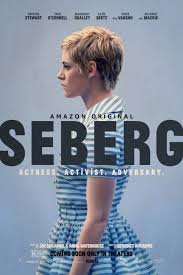
                Seberg (Benedict Andrews) has already played cinemas here and didn’t excite much interest. This story about Jean Seberg focuses on a few years when her best known films were already behind her, but she was getting the attention of the FBI because of her support for political movements such as the Black Panthers. I was glad to see it, and it is probably not as bad as some of the reviews. But it is also a film that could have been so much better and insightful. 
                 Last week I excited to rediscover Bo Widerberg on Rarefilm, and so explored another of his films on this channel, Man on the Roof, from 1976. But it’s not a patch on Raven's EndIt is an entertaining cop thriller, but almost anonymous. With its central grizzled, middle-age homicide detective it could almost be any Scandi-noir tv series – or several of any Brit. series too. The climactic final section is well-staged, without 
                    Then there was a film that came to me via someone who got a copy under the counter from a source that said it came in the back door after falling off a truck somewhere. The viewing copy did have more than a fair  share of rolling streamers and watermarks. But it was still great to have a chance to get a preview of Christian Petzold’s latest film Undine. This premiered at this year’s Berlin Festival, and who knows when or where it will surface again in the lockdown world.
               The few reviews have generally expressed disappointment.  It doesn’t inhabit that world of politics or history that we recognise from his earlier films. Rather, it helps to remember the myth of the Undine, mysterious beings in the water, most likely female, resembling mermaids, they can only gain a human soul and mortality by marrying a human. And if that human betrays her, pity help him! 
 
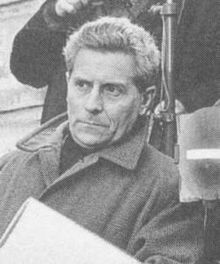
Christian Petzold
               The interest in this mythic world possibly bleeding into our ‘human’ world has some links with the way his recent film Transit had one specific time period seeming to bleed into a different time period.  Undine in some ways is a love-story (or stories), and again about an intersection of different times, or more likely different worlds – the mythic and the human.  Petzold doesn’t really give you many clues to help you decipher this world, and I am sure this has caused much of the frustration of many reviewers.  Give it a go, and there are pleasures, but I did miss the political and social elements of the rest of his work. However, I shall certainly look forward to an un-watermarked (in this context, an ironic term for the film) and big-screen viewing post-Covid 19.
               As a post-script, and actually doing some afternoon viewing, I watched one of the Met Operas, one of the many performances being streamed free around the world at the moment. This was Marnie. I had seen this a few years back when it was doing the Met Opera Screening circuit shortly after its premiere in New York. It’s a fascinating work – and what a thrill to be able to see it again, to be reminded of how successful it is in translating to the opera world, the novel that Hitchcock translated to the cinema. You keep remembering Hitchcock’s images – but you’re more than satisfied with these alternate ways of expressing those moments.
Marnie,  Met Opera production

Wednesday, 6 May 2020

Plague Times Diary (26) - Ben Cho heads down mostly little-trod paths to find Miike, Guerin, Woo, Del Toro and Jia.

First Love (Miike Takashi, Japan, 2015)
I don’t know anyone that has been able to keep up with catching all of Miike’s films over the past ten years; it’s not that difficult to see English-subbed Blade of the Immortal, Yakuza Apocalypse or Shield of Strawbut who is watching Mole Song: Hong Kong Capriccio or The Lion Standing in the Wind with English subs? So I can’t give an accurate assessment of where First Lovefits in the overall scheme of 2010s Miike but it’s rollicking fun and its pulpy Yakuza premise is far more engaging than Yakuza Apocalypse. You’ve got the fallen boxer, shady cop, double-crossing drug dealer, Chinese mafia, prostitute on the run … how it all comes bloodily together on the streets is frequently violent but nothing approaching Ichi The Killer levels of gore. At some point in the film’s climax the cartoonish violence literally transforms into cartoon … a smart budgetary strategy, an aesthetic decision, or both? 

Guest (Jose Luis Guerin, Spain, 2010) 
Considering our passports are about as useful as a porcupine in a condom factory, the chance to see foreign lands is restricted to watching movies or television. I put on Guest mainly for this reason and for over two hours I visited Italy, Peru, Macau, Cuba and elsewhere, connecting not with the usual tourist hotspots and picturesque landscapes but those countries’ downtrodden people and their stories of struggle. You can’t help but walk away from the film thinking that the world of film festivals is so unimportant in the large scheme of life; interviews with Jonas Mekas and Chantal Akerman are nowhere near the level of fascination or intrigue as a tour of a ramshackle Cuban community where HIV-infected gays sing the praises of the Cuban healthcare system. Whether intended or not, what you’re left with is a lingering sense that the privileged world of film festivals and arthouse cinema (which, let’s be frank, has often championed the downtrodden and the destitute) is a bubble of champagne and Marxist posturing that can afford to bicker on the questions of fiction versus reality when others are suffering the hopeless realities of grinding economic marginalisation. 

Manhunt (John Woo, China, 2017)
How bad is Manhunt? Surely it must rank amongst the very worst of John Woo’s films, going head-to-head with Paycheckfor the worst-of-the-worst badge. It was a slight red flag when the opening credits listed over five people responsible for the screenplay (based on a Nishimura Juko novel, already adapted for the screen in the mid-seventies). The Woo-isms are presented here in such a ridiculous manner (a fight amongst doves for example) that it is clear this is all meant to be a bit of an over-the-top corny thriller. But even if we’re meant to be in on the joke and having a good time, the mediocre artistry of the fight scenes, the gunplay and the plotting is nowhere near bad enough to be “so bad it’s good” or nowhere near good enough to distract from the clunky dialogue deliveries of Asian actors speaking English. I guess it’s fun to a certain extent but when it comes to exciting action sequences of recent memory do Manhunt’scompare with something like The Raid or The Yellow Sea? Even that old Woo film Hard Target? Now that was junky fun with so-so performances but its action sequences were a cut above anything presented in this pan-Asian “thriller”. 

Mimic (Guillermo del Toro, USA, 1997)
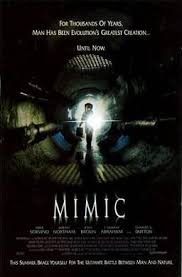
“Evolution has a way of keeping things alive … the world’s a much bigger lab,” says one scientist to another in del Toro’s terrific horror thriller about a bunch of mutated bugs wreaking havoc in the shadows of New York city. Opening on a mysterious virus transmitted by cockroaches which is killing the city’s young people, a gifted entomologist has the smart idea to use a genetically engineered insect to wipe out the disease-ridden cockies killing all the youth. What could go wrong, right? Fast forward a few years and the virus is no longer a threat but there’s something in the subways and sewers lurking around the city preying on unsuspecting humans. The effects may have dated a little bit when we finally see the mutant bug in all its glory, but for a great deal of the build up it’s all menacing shadows and spooky tunnels that supplies the dread. If someone suggests we create some super mutant animal to absorb all the Covid-19 in the air or something like this, show them this film. 


Visit (Jia Zhang-ke, Greece, 2020)
Jia Zhang-ke (l)
Thessaloniki Film Festival asked a variety of filmmakers (including Albert Serra, Denis Coté and Radu Jude) to make a short film at home inspired by Georges Perec’s Species of Spaces. Jia’s contribution, apparently shot on a cellphone, shows what the business of film production meetings look and sound like in the age of Covid: masks, temperature checks, distancing, soap and sanitiser. 


Tuesday, 5 May 2020

On Foxtel - Tom Ryan reviews the HBO series THE PLOT AGAINST AMERICA (Sc: David Simon & Ed Burns, USA, 2020)

“Nazis! I hate those guys.” 
Indiana Jones (Harrison Ford), spying the enemy 
in Indiana Jones and the Last Crusade(1989)

The Plot Against America (2020, HBO via Fox Showcase in Australia) is set in a fictional past: the US during a two-year period between 1940 and 1942 when famed aviator Charles Lindbergh was elected to the presidency ahead of Franklin D. Roosevelt. But, at the same time, it deliberately insinuates itself into an ongoing debate about the dangers facing the US under the sinister rule of its current President and the dangerous forces it appears to have unleashed. They scarcely need elaboration here. Just open your newspaper on any day you happen to read this.

Created by David Simon and Ed Burns (pictured left), it’s the fourth collaboration for the pair after The Corner (2000), The Wire (2002- 2008) and Generation Kill (2008), all made for HBO. They met when Burns – not to be confused with the good-looking, scratchy-voiced actor-writer-director of the same name (The Brothers McMullen, Sidewalks of New York) – was working as a Baltimore detective and Simon’s beat was as a police reporter for The Baltimore Sun. 


Based on Philip Roth’s semi-autobiographical 2004 novel of the same name (1)The Plot Against America clearly belongs to that very loose grouping of fictions which offer alternative histories to the ones we might all be familiar with. Alt-histories, if you will. What-ifs. It’s a genre of sorts, one that could, if we’re going to be strict about it, include everything from Michael Curtiz’s period saga, The Private Lives of Elizabeth and Essex(1938), to Quentin Tarantino’s Inglorious Basterds (2009) and Once Upon a Time… in Hollywood (2019). 


Sometimes, it simply changes or rearranges real-world history and goes its own way. Sometimes, it takes things a bit further, introducing a science-fiction aspect, one in which the rules that govern our day-to-day realities are broken. As in The Final Countdown (1980), in which an aircraft carrier in the film’s present tense is transported back through time to shortly before the Japanese attack on Pearl Harbor. Or in 11.22.63 (2016), an eight-part TV series based on the 2011 Stephen King novel in which a Maine English teacher travels through a portal into the past and ends up in 1958, with Elvis still rockin’ up a storm and JFK yet to make his way into the White House. Can he change history and help Kennedy to escape assassination? Should he?

Or in the TV series, The Man in the High Castle (2015 – 2019), which is set after the Allies lose World War 2 and the US is occupied by Germany on the East Coast and Japan on the West, with the Mountain States as a neutral buffer zone. What would everyday life be like in this America? What would the architecture look like? What would we think of those Americans who accepted the terms of the invaders’ rules? Who would make up the Resistance? Its four engrossing seasons are currently available for streaming through Amazon. The first was based on Philip K. Dick’s 1962 novel, the rest of the series builds further on its premise. 

Inasmuch as it proposes an alternative World War 2 scenario and examines the mark that it leaves on the US, The Plot Against America is probably closest in spirit toThe Man in the High Castle. Its starting-point is a simple tweak of historical fact: with Hitler’s armies on the march in Europe, FDR loses the 1940 election to national hero Lindbergh (Ben Cole (right), plus Lindbergh himself in some documentary footage), whose isolationist agenda opposes US entry into the war. How, it asks, would such an event affect the state of the nation? (Pearl Harbor, December 7, 1941, doesn’t happen.)

The ramifications are felt throughout the country, the series focussing on their impact on the extended Levin family based in inner suburban Newark, New Jersey. 

Written by Burns and Simon, with Reena Rexrode collaborating on episode four, it’s directed by Minkie Spiro (the first three episodes) and veteran Thomas Schlamme (the last three). And they’ve made a significant change to the way the story is told: whereas the novel is narrated by young Philip and pivots on his child’s-eye view of the complexities of the world into which he’s been born, the series widens the perspective to include events beyond his direct experience. 


While there are recurring shots of the wide-eyed little boy (played by Azhy Robertson, above, who also starred in Marriage Story and featured in a couple of episodes of The Americans), it looks beyond his increasing bewilderment at the turbulence of the times and measures its impact on his parents, Herman and Bess (Morgan Spector and Zoe Kazan), his brother, Sandy (Caleb Malis), his aunt, Evelyn (Winona Ryder), and his cousin, Alvin (Irish actor Anthony Boyle). At least one member of the extended Levin family is present in every scene, and it’s through the spectrum of their contrasting and often conflicting reactions to unfolding events that the series shapes a debate about how best one should respond to the threats being posed to their existence.

The WW2 battlefront might be thousands of miles away, but its tremors reverberate throughout the Levin household. Most notably in the way that, in the newly elected President’s refusal to speak out against the Nazi outrage in Europe, he is empowering the anti-Semitism and the racism that has been simmering beneath the country’s surface since the beginning of its European colonisation. 

In one of his many tirades against the forces of darkness that have been waiting for their moment, Herman says that they’ve been “like dry leaves waiting on a spark”. And, by implicitly giving them the all-clear, Lindbergh has set them ablaze. As Herman’s brother (David Krumholtz) puts it, “These assholes, they’ve always been here. Now they have permission to crawl out from under their rocks."

Morgan Spector (Herman Levin)
Herman is a proudly Jewish second-generation American everyman and a respected agent for the Metropolitan Life insurance company. For him, the plot against America is one that  that has been simmering within, that has remained hidden but is about to explode into his everyday world. And he’s seen it coming. 

At first, he’s reluctant to think that Lindbergh – whom he describes sarcastically to Bess as “the big man with the little plane” – could possibly translate his popularity as a national hero into success at the electoral polls. But at the same time he’s also been fearful about what lies ahead. And when his dream of America turns into a nightmare – “They said it can’t happen here. It is happening here” – he looks to another populist figure, Jewish radio demagogue and tabloid newspaper columnist Walter Winchell (Billy Carter), for hope. The outspoken Herman is a man of principle who believes that words matter. And he’s committed to the notion that, if he decides to take a stand, his family should line up behind him. Bess has seen the writing on the wall and proposes that they pack up and leave for Canada, which has joined the fight against Hitler in Europe and where the family will be safe. Hers is a voice of good reason and her concern is an equally principled one: their survival. But Herman argues that the enemy won’t be defeated if they, and others like them, run away.

Winona Ryder (Evelyn)
Bess’s sister, Evelyn, is a regular visitor to the Levin’s home and very much a part of their life, but her chief worry is that she’s going to be left on the shelf. So when she catches the eye of the socially prominent widower Rabbi Lionel Bengelsdorf (John Turturro), a supporter of Lindbergh’s isolationist stance, the starstruck young woman is overwhelmed by his social stature and blinded by his pompous oratory. Beautifully played by Turturro with a Southern twang, Bengelsdorf is probably best described as a well-meaning dupe. She falls for him just as he falls for the glitter bestowed on him by the White House. Both are blinded by the light (a recurring motif in the series).

Philip is a good kid, naïve but loyal, ready to do the decent thing by the troubled boy next door (Jacob Laval) even though his immediate instinct is to flee his fawning attentions. His dawning realisation about how his childhood is being torn away from him mirrors the way in which reality hits home for the rest of his family.

Azhy Robertson, Caleb Malis

His older brother, Sandy (pictured above with him), brings order to his world through his art, and his meticulously crafted pencil sketches speak of a nascent talent in the process of being born. He secretly hero-worships Lindbergh, rushing to the window whenever he hears a plane flying overhead. In his own way, he embodies the gullibility of a populous at large, too easily taken in by a duplicitous agenda that’s been packaged inside a benign demeanour. He naively embraces the opportunity offered to him, thanks to Evelyn’s influence, by the “Just Folks” program. Designed by the new administration’s Office of American Absorption to help assimilate Jewish youth into the American mainstream, its cover is its claim that, through the program, “city youths are being introduced to the values of the heartland”.


Herman’s orphaned nephew, Alvin (above with Sandy), is the family rebel without a cause, the restless young man whose heart is in the right place but who, to his uncle’s chagrin, seems to be forever getting mixed up with the wrong people and getting himself into trouble. Everybody else in the family loves having him around, but Herman doesn’t trust him. Even when Alvin finds a cause and heads off to Canada to help fight the Nazis.

There’s nothing simple about the way in which the Levin family tackles the issues confronting them. They’d be ordinary people in an extraordinary situation were it not for the way in which that situation reflects what’s happening today in the US. Dinner table gatherings lie at the heart of their unity – there’s one in every episode – and the disruptions to their domestic harmony and the divisions that separate them run parallel to the disturbances and the social breakdown happening all around.

They’re all struggling to make sense of their place in the scheme of things, their personal histories and the relationships they form along the way affecting how they deal with the life-changing choices facing them. What emerges from their struggle inThe Plot Against America is a powerful family portrait framed by the blaze that Lindbergh’s election has set alight. 

There is both a knowing embrace and a savage irony in the series’ use of Frank Sinatra singing the famously patriotic ballad, “The House I Live In (What Is America To Me?)”, on the soundtrack in the closing sequence of the final episode. On the one hand, it presents the images of ballot papers being burned by shadowy figures as a response to the song title’s question: “That’s America to me”. A dream going up in flames. On the other, the song lends a potent emotional weight to the possibility of renewal as, just before the closing credits roll, hands are joined and life goes on as the Levins gather around the radio, hoping for good news… And Sinatra’s song gets the final word, an uplifting final line about what it is that makes America great: a lot of things “…But especially the people/That’s America to me.”


*****
                                                         
Asked, shortly before his death, about the applicability of his original 2004 what-if scenario to the circumstances of contemporary America, Roth was circumspect, but left no doubt about his view of the current president. “I found much that was alarming about being a citizen during the tenures of Richard Nixon and George W. Bush,” he wrote. “But, whatever I may have seen as their limitations of character and intellect, neither was anything like as humanly impoverished as Trump is: ignorant of government, of history, of science, of philosophy, of art, incapable of expressing or recognizing subtlety or nuance, destitute of all decency, and wielding a vocabulary of seventy-seven words that is better called Jerkish than English.” (2)

Citing Shakespeare’s Julius Caesar as a key reference for him – when a leader overplays his hand, what is the appropriate response? – Simon is a little more forthcoming about the direct pertinence of Roth’s novel to the modern day. Asked by Vulture’s Kathryn Van Arendonk about how he sees his adaptation of The Plot Against America in relation to “the contemporary moment”, he replied, “The dial turns a very bright orange.” (3)

Philip Roth

But he also points to its wider implications and to his team’s rationale for shunning Roth’s order-is-restored ending. “Looking at our own fundamental problems with our electoral process right now, the lack of faith any of us can have that the popular will is going to be conveyed through the American voting structure, we said, ‘We’re coming on an election year. We need to comment. We need to speak very bluntly to what this election means.’ So we ended without feeling the need to say, ‘…and then America was restored.’ The only reason to spend the money to film [this show] is that this generation is facing a fundamental threat to the norms of our republic and self-governance.” Elsewhere, he puts it more concisely: “It’s a piece of work about how fragile democracy is. The fight is never over. But if you stop fighting, you lose it.” (4)


1.    Philip Roth, The Plot Against America, Houghton Mifflin, 2004. 
The family’s surname is Roth in the novel. Roth’s parents in real life were named Herman and Bess  and his brother was Sanford (who was known as “Sandy”). Herman was a district manager for the Metropolitan Life Insurance Company. The TV adaptation changes the family surname to Levin, with David Simon at the same time incorporating his own autobiographical elements. “I didn’t have to research the tone,” he told Vulture’s Kathryn VanArendonk (April 20, 2020). “Not only does Philip Roth lay it out beautifully in his work, but I could draw on a reservoir of memory of my parents and grandparents.”
 2.  Judith Thurman, “Philip Roth E-Mails On Trump”, The New Yorker, January 30, 2017
 3.  Kathryn VanArendonk, “David Simon on the End of The Plot Against America (and Democracy)”, Vulture, April 20, 2020
4.   “The Plot Against America: David Simon and cast with Peter Sagal” (at the 92Y in New York, March 2020) Watch it on YouTube if you click here


 The trailer for The Plot Against America can be found if you click through on 
YouTube 


On iTunes and VOD - Rod Bishop welcomes a film by a Melbournian and VCA film school graduate THE ASSISTANT (Kitty Green, USA, 2019)

The clear influence here is Chantal Akerman and Jeanne Dielman, 23 quai du Commerce, 1080 Bruxelles.
But you also feel the minimalism of Ozu and the restraint of Robert Bresson. #MeToo concerns are exemplified through the eyes of a film production office shitkicker in New York, whose responsibilities include being first to arrive and last to leave; washing everyone’s dishes; distributing schedules; fielding telephone calls from The Boss’s distraught wife; fetching lunch for her co-workers; picking up dropped jewelry in The Boss’s office and cleaning his casting couch. She arranges flights to LA and meetings with women in hotels.
She watches young women signing contracts and waiting for behind-closed-door meetings with The Boss. She takes one to an expensive hotel and then arranges assignations between her and the Boss in the hotel room. 
She must deal with this clearly unqualified aspirant as she sets up on an adjoining desk - another “assistant”, but given nothing to do.
The power wrought over the office by the unseen producer and his sexual exploitation is thick and heavy, poisonous and morbific.
Written and directed by Melbournian and VCA film school graduate Kitty Green, now resident in the USA, the film uses sparse dialogue and apparently everyday events to slowly unravel a virtually invisible and entrenched reality. And her co-workers know the score. They know how to phrase apologetic emails to The Boss when things go awry; and everyone is in fear of losing their jobs, knowingly ignoring what’s in front of their eyes.
Julia Garner, so riveting as Ruth Langmore through all three seasons of Ozark, gives a compelling performance as the assistant. Her face, as each new exploitative detail emerges, reflects our simultaneous comprehension as viewers - the mundanity of the workplace is methodically revealed: masculine, toxic and hidden to any passing casual observer. 
In a covid world, devoid of new releases, The Assistant shines and heralds in a new locally trained talent making her way in the USA.

Monday, 4 May 2020

On DVD and Blu-ray - David Hare gives a rundown on his Buster Keaton collection

These three screens chart the madness of a film collector, going back not quite twenty years, to 2005 when I was able to pick up these gorgeously packaged and designed cardboard book style Keaton DVDs issued by then rights holder MK2 (above). 

I picked these four up in one hit at the now long gone Bastille fnac store in Paris, sadly missing several more from the same edition, in similarly beautifully designed covers. These are literally the only DVDs I have retained with their original packaging, as the whole product was and is so beautiful. For the remaining 3000 or so DVD titles on the shelves in the house of Hare the covers of all my DVDs were discarded years ago and the discs are stored for space saving in double sided archive quality PVC sleeves.

The second screen (above) shows most (not all) of the 2012 Kino first reissues of the Keaton features in Blu-ray. 
The third screen shows all so far of the new Cohen/Ritrovato 4K restorations of the Keaton features now gradually coming out on MoC Blu-ray (and Cohen in the USA). There are three more to come before the set is completed: Three Ages, Go West and College. These superbly restored titles have had début screening at Bologna each year starting back in 2015. They are always screened at one of the twilight Piazza Maggiore outdoor cinema events with a live orchestra usually conducted by Timothy Brock. The experience of watching these masterpieces, even from the sidelines of Bologna’s magnificent collonades was and is for me one of the greatest audience viewings of my film going life.
We will all miss this year’s Keaton in the Piazza, thanks to lockdowns and plague, which I hope means we get a double dollop of Buster next year.

Friday, 1 May 2020

Plague Times Diary (25) - John Baxter ponders rogues in the movies - Vincente Minnelli's THE PIRATE (USA, 1948) and Georges Franju's JUDEX (France, 1964)

Gene Kelly, The Pirate
ROGUES’ GALLERY
         I once took a painting into Sotheby’s in London to have it authenticated. Despite the signature, it seemed too much to hope it really was by Raoul Dufy. The head of Modern Painting, Julian Barran, confirmed my doubts. 
         “It’s quite good, though,” he said. “Might almost be an Elmyr.”
         Well, having a painting by ace forger Elmyr de Hory, featured in Orson Welles’ F for Fake, was almost as good as having the real thing. Almost.
         Barran pointed out that the signature used a colour of paint not present in the picture itself. Someone added it later. And De Hory was known never to sign his work, leaving that to the unscrupulous dealers who bought it.
         “Yes, Elmyr was a rogue,” Barran concluded, “but not a villain.” 
         The distinction came to mind this week when two seasons on French TV, one devoted to Vincente Minnelli, the other to Georges Franju, intersected in one of those dream double bills - Minnelli’s 1948 The Pirate and Franju’s 1964 Judex.
        
Vincente Minnelli
 Both are favourites of mine, partly because each flopped on its first release, and was, for a long time, difficult to see. Like Yolanda and the Thief, The Pirate was one of the musicals MGM preferred to keep in the cupboard. Cole Porter (betraying his ignorance of film processing techniques) wrote ruefully of “my downbeat score for The Pirate, a $5 million motion picture that failed to get back even the cost of the emulsion to develop the negative. My agent told me ‘No one wants you, Cole. They think your tunes are old-fashioned.’” 
The Pirate came complete with a back-story of disaster; performers like Lena Horne excluded on racial grounds (though Kelly smuggled in the Nicholas Brothers): Garland behaving even worse than usual, requiring the daily presence on the set of a psychiatrist: Louis B. Mayer, who thought the story “too highbrow”, demanding Kelly tone down the violence in the Mack the Blackballet (Remove references to killing babies? How bourgeois.) and excise entirely the number Voodoo as too erotic.    
Happily, there’s lots left, including Niña,one of Kelly’s most inventive appearances ever, with an extraordinary exhibition of acrobatics in and around the balconies and walkways of a set obviously calibrated to the centimetre to fit his choreography. That over, the music
shifts, after a lyric opening, into a rhumba during which Kelly prances around a bandstand supported on vertical poles. His jerky, almost grotesque movements, with bent elbows and knees, grimaces and hand gestures, and including some flamenco stamping, all with a brassy Conrad Salinger orchestration, are as unlike other Kelly numbers as the song itself. How much the studio disliked everything about it can be inferred from Kelly’s sound-track recordingIt speeds up the tempo, and its Cuban beat, not to mention the orchestration, is submerged in a sludge of conflicting tempi.   
         As for Judex, in Australia it came out just after we were bewitched by Jules et Jim and Vivre Sa Vie. The general reaction in informed circles, not only in Australia, was “What’s this shit?” You really needed to know the pre-World War I serials of Louis Feuillade of which it was a pastiche. That excluded almost everyone, myself included, Then, too, it was filmed in a misty monochrone, nothing like the crisp blacks and whites of Raoul Coutard and Henri Decae. Who knew that Franju, au fond a cinema historian – he co-founded the Cinématheque Française with Henri Langlois – was evoking the orthochromatic film on which those early films were shot? 

Georges Franju
         It was only after seeing Judex juxtaposed with The Pirate that I realised the two films had something else in common that might have put people off. Neither has a hero. Or, rather, the hero is, using Barran’s distinction, a rogue. Kelly’s Serafin is an itinerant actor and seducer, not above using hypnosis to have his way. In pursuit of Garland’s sheltered Caribbean virgin, he impersonates the notorious pirate Macoco, aka Mack the Black. Imagine his surprise – and her’s - when the local dignitary she’s about to marry, portly Walter Slezak, is revealed as the real Macoco, having left the sea decades ago and gone very much to seed. 
         Judex is built around an outlaw as well, the avenger Judex, who leads his troupe of masked, caped and gloved helpers around pre-World War I France in a vendetta against Favreau, a crooked banker, in the course of which they must also foil the efforts of a criminal gang to kidnap the banker’s daughter. 
Jack Nicholson advised Michael Keaton, nervous about playing Batman, “Let the costume do the work.” Franju cleaves to the same counsel. Judex, in the person of stage magician Channing Pollock, arrives in tails at a costume ball in Favreau’s chateau where everyone has the mask of a bird. His is that of a falcon (below), Favreau’s, naturally, a vulture. After wowing the crowd by producing dove after white dove from his person, he pauses only to hand Favreau a flute of drugged Dom Perignon and disappears into the night. Joaquin Phoenix isn’t in the race.
        
 As in Batman, where the true star, judged by flamboyance and prominence in the story, is The Joker, the most effective menace in Judexisn’t embezzler Favreau or even Judex but the leader of the kidnap gang, Diana Monti, the role that, for Feuillade. was played by Jeanne Roques, alias Musidora. 
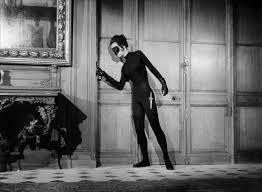
One can only guess at the effect of Musidora’s black body stocking and domino mask on adolescents of a century ago, but as Monti in Judex, Francine Bergé is no slouch. She is so much more fun than Edith Scob as the frail heiress, forever fainting and having to be rescued - on one occasion from a river on which she serenely floats, Ophelia-like, watched incredulously by some kids fishing. 

Francine Berge, Judex
Franju gives Bergé all the best stuff. He sets off her black leotard with a silver stiletto strapped to her slim thigh (left), or dresses her as a nun, then has her, still in her coif, light up a Caporal or check her maquillage in a mirror before neutralizing Scob – again - with a hypodermic in the neck. She doesn’t kill anyone – well, only one - any more than Serafin goes through with his threats of slaughter. That’s for villains. Rogues are better behaved. But presumably the cinema audience needed someone to love and admire, and so turned its collective back on these ingenious rascals. For myself, I incline towards the reprehensible. As Ogden Nash memorably observed “Home is heaven, and orgies are vile/But you need an orgy once in a while.”

         YouTube has some clips from The Pirate, including a portion of Niña, though with a witless preamble about Kelly “inventing pole dancing.”  Kelly’s soundtrack performance can also be heard, in all its horror, as well as the audio of Voodoo.  Judex is better served by the full version, without, however, English titles. Not to mention the Feuillade originals.